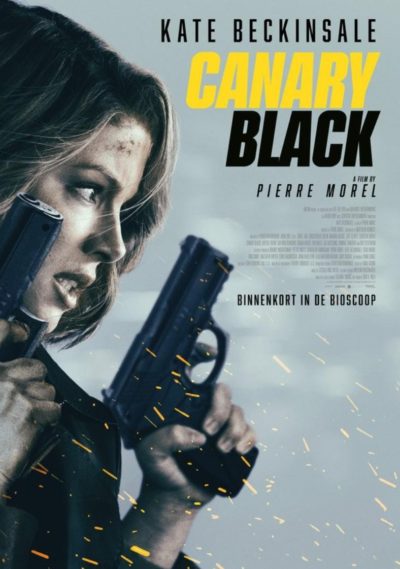
Both director Morel and star Beckinsale should be familiar names around here. The former directed Peppermint, the latter for the Underworld franchise. Indeed, I was a little surprised this wasn’t directed by Mr. Kate Beckinsale, Len Wiseman. But I guess he was too busy getting booted off Ballerina. Morel, who also directed Taken, is a perfectly adequate stand-in. This is more or less what I expected. A forgettable yet adequately amusing spy caper, with Beckinsale kicking moderate ass in pursuit of… [/checks notes] a computer virus which could potentially wipe out the whole Internet in selected countries. As I write this, two weeks before the US presidential election, nuking the Internet seems like a pretty good idea to me.
She plays Canary Black no, actually, Avery Graves, a globetrotting spy whose husband David (Friend) has no idea of her day job. If that sounds a tad familiar, I refer you to Role Play, which had a similar concept. Then, David gets kidnapped and used as leverage against Avery. She is ordered to liberate the “Canary Black” file of blackmail data, and hand it to David’s abductors, or he will pay the price. Needless to say, her boss Jarvis Hedlund (Stevenson, in one of his last roles) isn’t happy about his best agent going rogue. However, in one of a series of twists – some expected, some not – the file ends up containing the virus discussed above, and Avery must stop it from being released by the bad guys.
This all just about skates by, mostly on the strength of Beckinsale’s charisma. She keeps things watchable, and helps paper over a number of elements that would otherwise have you going, “Hang on a minute…” For instance, when Avery is breaking into a server farm, she flies in on a drone, which for some reason, is lit up like Times Square. The facility also lets you slap in a USB drive without authorization. My entry-level work PC won’t let me do that, and I don’t believe I have access to world-shattering computer viruses, the last time I checked. Naturally, it all ends with Avery rushing towards a computer as the upload progress bar crawls… ever… so… slowly towards a hundred percent.
Morel handles the action with a professional eye, and considering she’s now in her fifties, Beckinsale isn’t bad. Though watching this the night after The Shadow Strays, the fights here seem like the participants are playing patty-cake in comparison. There’s a nice car chase through the streets of [/checks notes] Zagreb, but most of this is simply reasonably-made and thoroughly generic, and the lack of a memorable villain poses a problem. I couldn’t even tell you the main villain’s name, and his motivation appears to be purely mercenary, which is bad form for a bad guy. While I wasn’t bored, this is destined to be forgotten within a few weeks, and vanish into the black hole which is beyond the front page of Amazon Prime.
Dir: Pierre Morel Star: Kate Beckinsale, Ray Stevenson, Rupert Friend, Jaz Hutchins
I’m rarely going to find animated action as impressive as “live action”. Something done by an actual human will always seem more real than anything CGI or traditional hand-drawn animation can achieve. That’s true even if the former is arguably as fake, between stunt doubles, green screen and no small amount of CGI itself. Maybe it’s just me. While I have given multiple animated films our Seal of Approval previously, including Mulan, Aeon Flux and Battle Angel, these have been won on the basis of other elements beyond action. A live-action film can get there purely on those merits, despite clear deficiencies elsewhere e.g. In the Line of Duty IV. I don’t think animation can do that.
Hence, I suspect that I would look more kindly on this were it another live adaptation. It wouldn’t have to do much to be an improvement over the Alicia Vikander version, though to be honest, the Angelina Jolie versions were only adequate and borderline bad respectively. Maybe the makers would be better taking a Resident Evil approach, and not worrying about being faithful to the video-games. I did play the original – it remains one of only a few I ever completed – but care not about accuracy. Films and games are different, and need to be. Plot and character matter more on screen, not playability. Here, those elements are alright: they feel functional rather than organically inspired. For instance, it feels less a story than a series of levels.
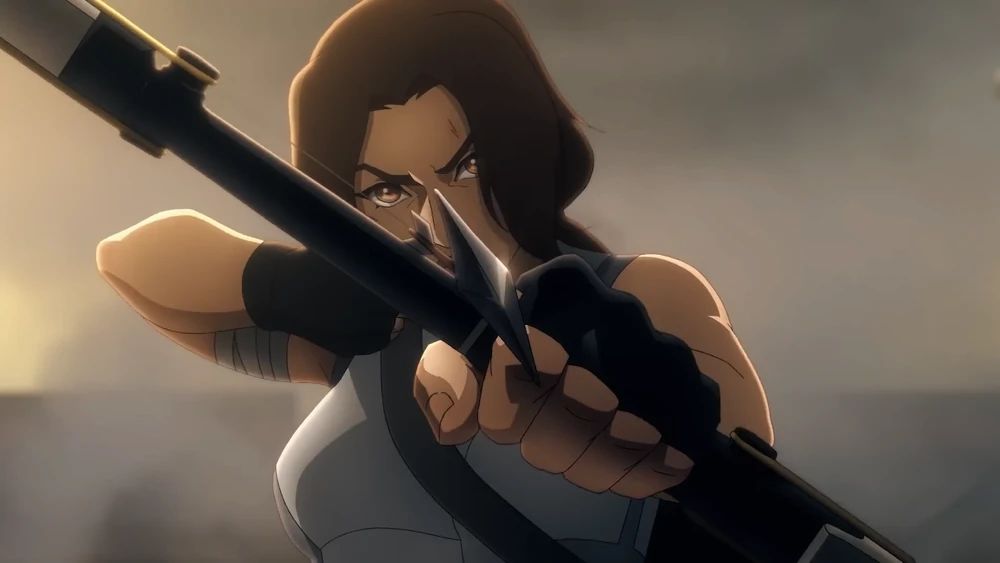
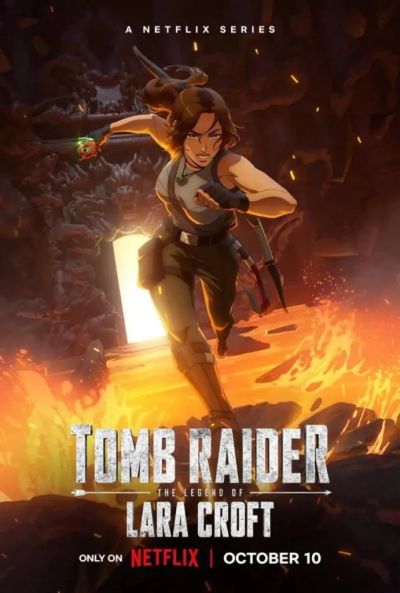
We begin with a prologue which sees Lara (Atwell) in Chile retrieving a box, alongside her mentor, Conrad Roth. Three years later, Roth is dead and Lara blames herself for that. She’s about to sell off all the family’s treasures, when the Chilean box is stolen by Charles Devereaux (Armitage). Turns out the stone it contains is the first in a series of four, which when combined will destroy the precarious balance under which the world operates. Along with sidekicks Jonah (Baylon) and Zip (Maldonado), Lara criss-crosses the globe, from China to Turkey to France, and back to China, trying to stop Devereaux from completing the set and unleashing the power they contain.
From subsequent reading, I suspect you probably need to have played the specific games on which this is based (I believe it’s the “Survivor timeline”), to understand the significant of the apparent trauma through which the character has gone. None of this is depicted in the film, so I had no clue why I should be bothered by the off-screen death of Conrad, someone I’d only known for about five minutes. Also, Lara seems a bit gay here. Quite why a video-game character should be given specific sexuality escapes me. Shame they didn’t have the courage of their apparent convictions, to do more than hint heavily. To quote Yoda, “Do. Or do not.” Give us hot cartoon babes making out, or don’t bother bringing it up.
Of course, an old white guy is the villain, in comparison to the young, ethnically diverse group in Lara’s camp, and there are a couple of other jabs along those lines. But in general, it’s light enough with the messaging. The eight episodes probably total just under three hours, by the time you trim off the credits, so not all that much more than The Cradle of Life‘s 117-minute running time. You could probably get through it in a single sitting: it’s not difficult viewing. The animation is mid-tier, but does the job, and I liked the performance of Atwell (well-known here for her depiction of Agent Carter), who comes over as a serious, almost solemn, heroine – yet one with whom it’s still easy to empathize. Her supporting cast though, feel superfluous and don’t make much impression.
Within the limitation of animated action discussed above, what you get here isn’t bad. There are some good set pieces, and a couple of occasions where I almost forgot I wasn’t watching actual people, and held my breath. Key word there though, is “almost”. There’s an overall air of competence surrounding the production, and no obvious elements at which I can point a critical finger. Yet there is also not much to cause me to recommend this actively to anyone, who isn’t already a fan of the games. A second series hasn’t been confirmed: there are reports it received a two-season order out of the box, although it doesn’t appear to have received the critical acclaim given to Arcane. But if Lara does return, she probably falls into the “If I’ve nothing else to do” category.
[Jim]
Looking at some of the harsh reviews for the show, I get the impression a lot of it comes from, “I wanted the show to be this but it was that.” It’s a bit unfair because as a show, the series is good, standard adventure animation. Those who expected the show to be somewhat like Arcane: League of Legends, for example, were setting expectations very high. It’s true, that there are “two Laras”. The original by Eidos was invented in 1996, and the “modernized version” came out with the new games of Crystal Dynamics in 2013, and influenced the 2018 reboot movie, with Alicia Vikander. The original Lara could be described as a rich but goodhearted sociopath: watch the Angelina Jolie version, she really got it. Lara was a female Indiana Jones, living in a Bruce Wayne-like mansion, while the modern version seemed inspired by the Lisbeth Salander character from the Millennium Trilogy.
She instead became a guilt-stricken trauma survivor: I remember a trailer for one of the modern games, where she was talking with a psychiatrist and her whole body shook while remembering her previous experiences. The relentless adventurer who just enjoyed the journey seems to be out; the pain-stricken and emotive heroine is in. Still, she does all the action you would expect from her. This Lara just comes with emotional baggage; she has to learn to value her friends and understand that people are more important than the things she hunts. In a way it’s like modern and old James Bond. Once upon a time, he was a superhero we all loved and adored. Today, he has been cut down in size to make the character “more human”. For Lara, it makes her more relatable, for sure – but arguably less interesting. I’m not sure it’s the best way to present the character.
Filmed versions of Lara always seem to have her suffering from the loss of her father. This is the third such, after the Jolie and Vikander live-action versions. It should be noted this was not originally part of her imagined biography, which has changed several times over the years. Originally, she fell out with her family, when she decided to make adventure her lifestyle, earning her living as a travel writer, instead of marrying the Earl her parents had chosen for her. Her big defining moment was surviving alone for two weeks in the Himalayas after a plane accident. It was only after the Jolie films and the reboot games, it became that she had lost both parents.
Here, Hayley Atwell gives our favourite tomb raider a very good voice, and you wonder why film makers seem so resistant to casting a British actress as real-life Lara, with the previous actresses being American and Swedish. After all, Lady Lara Croft is as quintessential British as Sherlock Holmes, James Bond or Emma Peel. [Jim: be careful what you wish for, Dieter. You now have to deal with Sophie Turner as Lara in Amazon Prime’s adaptation!] In Charles Devereaux, this show offers Lara a villain who gives her the old, “You and me are actually very much alike” speech, as heard from Belloq in Raiders of the Lost Ark and Scaramanga in The Man with the Golden Gun, to emphasize the darker side of a hero. Nothing new here on this front.
A lot of effort goes into giving Lara a circle of friends, something less a factor in the games. But as every Bond has his Felix Leiter, every Indiana his Sallah, it’s only fair Lara also get her sidekicks! Interestingly, Lara’s arc is as an emotional vulnerable character, who finds her way back to humanity, in contrast to the villain who seems to lose his more and more. But the “coolness” of the original character, as seen in the early games and movies, has perhaps been lost in favour of her becoming a team player. It’s indicated that what prevents Lara from falling to her more negative instincts, is that she has friends who care for her, and help cope with her pain and grief. Devereaux is essentially alone, with no reason for him to overcome his anger, pain and wish for revenge. Richard Armitage gives a believable performance there. Yet she is still constantly trying to save her enemy. I suspect that “old Lara” would just have killed him when he attacked her, of that I’m quite sure.
There are a lot of small nods to previous games and films if you pay attention, beyond Lara doing parkour, reflecting her running and jumping around in the games. Things like a mention of the Trinity group, which appears in the Alicia Vikander movie, or her hallucinations of demons with a striking resemblance to the stone gargoyles that came alive in the first Jolie adventure. However, the show delivers only standard adventure, neither great nor bad; like so many things, it’s in the middle, just average. If you can cope with that, the show should entertain – no less, no more, with animation which similarly is fairly standard but satisfying enough. It provides the action and adventure I would expect from this genre. The one real flaw I see, is that it lacks the kind of humour, fun and levity I’d also deem essential elements of the Tomb Raider franchise. Lighten up a bit next time, Lara.
[Dieter]
Showrunner: Tasha Huo Star (voice): Hayley Atwell, Earl Baylon, Richard Armitage, Allen Maldonado
This is one of those films where the same person wrote, directed and starred in it, and once again, the results illustrate the problems with such an endeavour. Almost any project will benefit from an external perspective which can offer constructive criticism, but when this is removed, the flaws typically end up multiplied. That said, this isn’t terrible. I think Riches the screenwriter comes out best, with a story which bypasses the usual cliches of urban storylines e.g. gangster rising out of the gutter, and does offer some genuine surprises. Director Riches also gets some points for restraint on the soundtrack front; it’s not comprised entirely of her mates rapping badly.
It’s as an actress that Riches is weakest. The story has her playing Tiana, a woman whose entirely life has been dogged by poor relationships with men, from a distant father through bad boyfriends, to a controlling and eventually abusive husband, who kicks her and young daughter Erica (Session) out on the street. The only thing keeping Tiana sane is the classes she gives at the local martial arts school, owned by Mr. Lewis (Hoo), and she decided to use these skills to make bad men pay for their behaviour. This comes close to home, because she suspects that her sister, Rochelle (Amor), is also in an abusive relationship. These suspicions prove well-founded, though in one of those genuine surprises, not quite as Tiana believes.
The problem is that Tiana is never even slightly convincing as a bad-ass. Her idea of martial-arts training is, I kid you not, jumping jacks, and most of the fights we see are poorly-staged and/or brief, I suspect out of necessity. It’s the kind of film which needs to go a lot harder than the lead actress is capable of. “Concerned mother” is within her acting range; “angel of vengeance” is not. I did appreciate how the script does not attempt to go #AllMen on us, with a couple of sympathetic male characters. Mr. Lewis is probably the most well-developed, though he does fall right into the wheel-house of the “wise Oriental spouting philosophical insights” trope instead. But he does deliver some unexpected truths.
The structure is either clunky or interesting, and I’m not sure which. It begins with her abducting one of her targets, then leaps back decades to tell Tiana’s story from the very beginning. I’m not certain anything useful is gained by this, and by the time it circles back, we’ve largely forgotten why we are supposed to care. The final act is the best in most departments, including Riches apparently doing one actual stunt which genuinely surprised me, and proceedings that capture a down-to-earth tone, missing in dumb plot threads like Mr. Lewis giving the dojo to Tiana. To be brutally honest, I’d not blame the viewer if they’d bailed by that point, having decided Riches needs to focus her talents on one area.
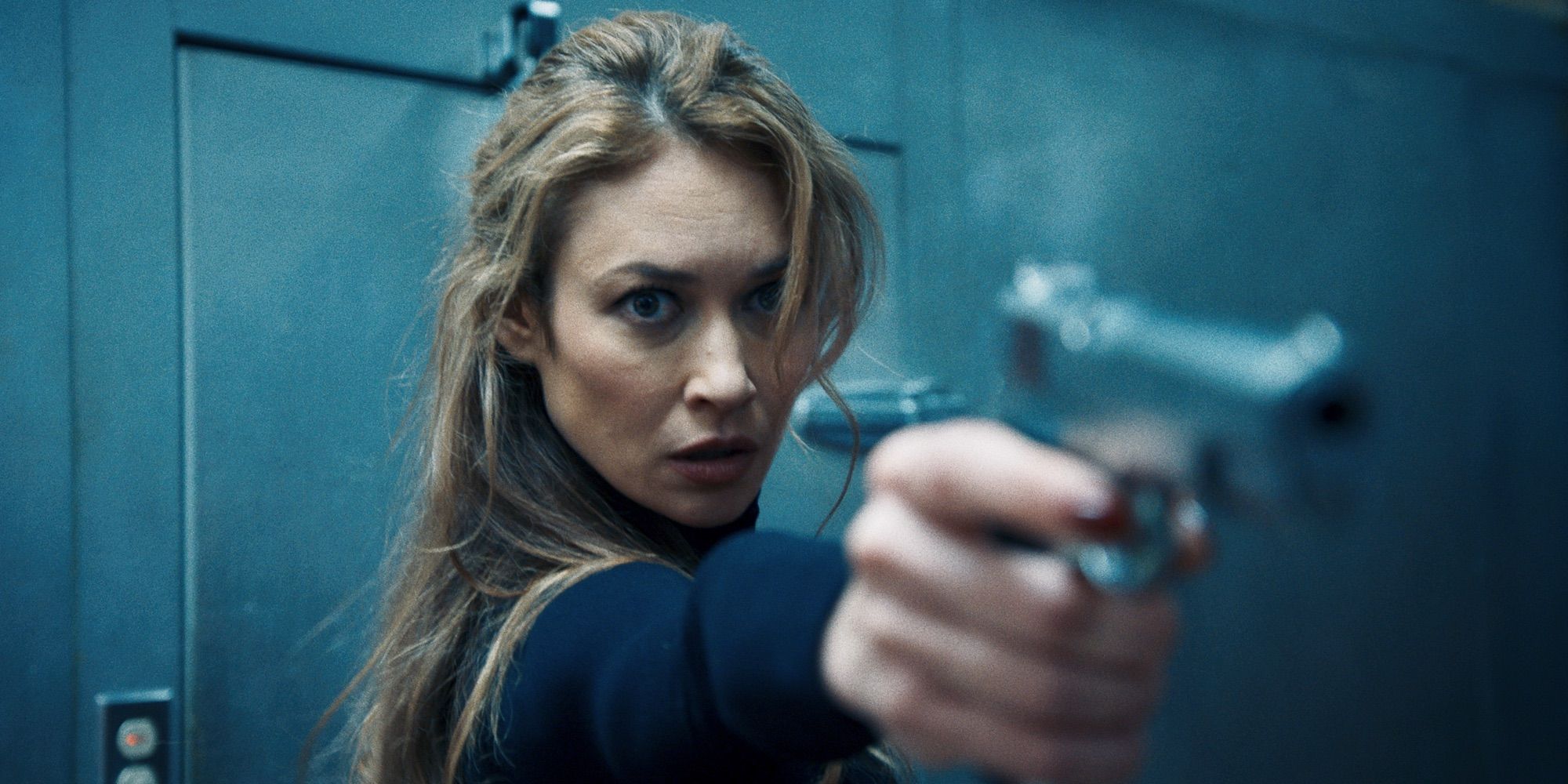
Reading other reviews, this seems like an exercise in managing expectations. It is, very much, a tongue-in-cheek entry in the action genre. If you’re expecting something serious or even marginally realistic, I can certainly see how you’d be disappointed. But as a dry satire, I found it worked more often not. It takes place on Opening Night at the Etoile Rouge restaurant, where Ana (Kurylenko) is beavering away as head chef in the kitchen, while husband Ray (Johnson) glad hands things in the front of house. Except, both have a secret. Ray’s is that he ran up over a million dollars in gambling debts to Dom (WWE star Page). His creditor now intends to burn down the restaurant and make Ray collect the insurance.
Ana is not willing to stand by and watch her life’s work go up in smoke, which is where her secret comes in. For she is a former KGB agent, and is more than capable of taking out the low-level goons Dom initially sends in. That forces the gangster to up his game, and hire some bigger guns (literally, even if the mercs demand a catered lunch should the job takes more than four hours). However, Ana has resources she can call on as well, in the shape of former fellow spy Mimi (Doubleday). Though Mimi may not be entirely pleased to get the call from Ana, given the way they previously parted company. Their unfinished business also needs to be resolved.
Initially, it’s hard to tell this is parody, but it plays not dissimilar to Cat Run. I had my suspicions from the facile way Ray accepts his wife was a Soviet asset. But the comedic aspects really kick in with the arrival of Mimi, her sniper husband and their daughters who feel like teenage versions of the twins from The Shining. They’re as intent on working through their relationship issues – mostly through bickering – as much as helping Ana. The rest of the supporting cast are along the same lines. Larger than life caricatures, yet ones that are amusing to encounter, such as Gary the masseuse, who would rather be anywhere else than storming a restaurant occupied by a pissed-off chef.
Kurylenko still carries herself very well, both looking the part and cracking heads with some style. It’s mostly firearm action until the end, when there’s an extended brawl that offers a decent payoff. Not all of the humour works: Mimi and her husband are a distinctly mixed bag. The structure is also kinda sloppy. Initially, Dom is set up to be the big bad; by the end, he has become almost an afterthought. Yet it’s still a breezy bit of fun. I could have sworn I’d written about this before: however, I’m damned if I can find my review. I’d definitely heard of it, and can’t figure out why it slipped through the net. Although it may have taken two years, I’m glad to have finally caught up with it.
Dir: Zach Golden Star: Olga Kurylenko, Don Johnson, Dallas Page, Kaitlin Doubleday
Naomi (Ghenea) is sailing a schooner single-handed in the Caribbean, returning it from Antigua to Grenada so it’ll be ready for a charter customer to take out. Her boyfriend, Jackson (Westwick) has already gone ahead to prepare things there. But a squall diverts Naomi off course, and she then stumbles across boat wreckage to which Maria (Gómez) and Jose (Coppet) are desperately clinging. They tell her there’s still a survivor trapped on the sea bottom, and Naomi dives down to rescue Tomas from his watery tomb. However, on returning to the surface with him, she gets a nasty surprise and finds her work is not over. For the survivors were also transporting 200 kg of cocaine.
Naomi is now key to salvaging it, whether she wants to be or not. Complicating matters is the presence of a large, predatory shark prowling the area, which makes simply going up and down from the sea bottom a perilous endeavour. Especially after one such encounter, where we get the immortal line, “The shark bit into the bags and now the shark is probably high on cocaine.” Sadly, hopes that this was going to become a sequel to Cocaine Bear never materialized [there is a film out there called Cocaine Shark, but it’s so bad, even a hardened connoisseur of badfilm like I, couldn’t get through the trailer] . Instead, there’s just an awful lot of sub-aqua shenanigans, and there’s really only so much SCUBA-ing I can take.
I will say, it all looks lovely. Malta actually stood in for the Caribbean, and if you’re looking for a picturesque tourist destination, combining beautiful scenery with clear water, it seems a good bet. However, as a thriller, it’s distinctly lacking in thrills, whether it’s a shark whose diet seems exclusively to consist of the bad people, through a cast for whom English is not their native tongue in many cases, to a heroine whose lips appear recently to have encountered a swarm of wasps [I note Ghenea’s credit in Zoolaander 2 as “Hot Shepherdess”]. The pacing is also off, especially early, when irrelevancies like Naomi and Jackson renting an apartment show up, serving no apparent purpose except delaying her arrival on the scene.
Gómez, whom you might remember from SexyKiller, is likely the best element the film has to offer, switching from cowering victim to manipulative sociopath. For instance, Maria conceals her nautical skills because if Naomi realizes she’s surplus to requirements after bringing up the coke, she might not be willing to do so. That kind of smarts is something the film needs to have more, ideally replacing the apparently endless amounts of moist mischief. I did like how the shark attacks don’t hold back on the blood, something you don’t see often. However, the creature rarely feels more than a toothy plot-device, thrown into scenes whenever the film-makers run out of other ways to generate tension. And that is far too often, to be honest.
Dir: Marcus Adams Star: Mãdãlina Ghenea, Ed Westwick, Macarena Gómez, Stany Coppet
It’s probably symptomatic of… something, that the film’s title is never explained. With the main character working in a casino, I presume it’s a reference to the Martingale betting system, where you basically double your bet after every loss. It guarantees a profit – unless you hit such a long losing streak you run out of money entirely. Its relevance here is uncertain, and I doubt most viewers would know what a martingale is either. But then, the film is very good at not explaining stuff. Another example would be, what the scam is supposed to be with Andi (Sullivan) collecting left-behind cash-out casino slips and handing them to a collaborator, Whit (Melikhov). These are for trivial amounts, so why bother?
When not bilking her employer out of pocket change, Andi’s main obsession is investigating the death of her daughter, a year previously. She had overdosed in a drug house, but the police were unable to press charges on anyone. Andi is not put off, and is intent on finding the boy whom she blames for her child’s death, and making him suffer in a similar way. Her investigation proceeds with the increasingly reluctant help of local private eye Levi (Adkins), and brings her up against the powerful and evil Harland (Shockley). Turns out, it was his son Robby who was with Andi’s daughter. Neither parent is prepared to back down and give up on their offspring, so eventually, something will have to give.
The tagline on the release poster was changed to “Revenge is a deadly gamble,” which does at least tie in with the title. But the original one of “Revenge is a real mess,” might be more accurate, with Andi stumbling into increasing trouble, and refusing to accept the very sensible advice, just to let it go. While her persistence is the heroine’s most admirable quality, the film itself is also a real mess in some aspects, with plotting which is often as obtuse as its title. While Harland does project a certain menace as the villain, I found it hard to take anyone seriously as a bad guy, when he looks like James May out of Top Gear.
Nowhere is the vagueness more apparent than at the end. There’s a knock at the door and… That’s it. We never learn who it is. The makers were clearly going for ambiguity, but if you hated how The Sopranos ended, this might well have you lobbing pets, living-room furniture or small children through your television set. If the script leaves plenty to be desired, at least the performances are decent, and a bit like in Adrenaline, you do get a sense of turning over a societal rock, and seeing the less than pleasant results beneath. As a heroine’s journey, it’s a trip into the underworld, though I would be hard pushed to tell you how Andi was changed by her experience. I certainly know I was not.
Dir: Jeremy Berg Star: Kelly Sullivan, William Shockley, Jason Adkins, Konstantin Melikhov
You know you’re in for a shaky experience when the film can’t even spell its own title right. That proves a fairly accurate assessment of the overall experience: while not without its merits, these are outweighed by the negatives in the final analysis. The heroine is Victoria Travers (Payne), an FBI agent on holiday with her family in Romania, when she spots a fugitive from justice, John Slater (Mandylor). She attempts to extract him over the border, to where he can be extradited, but while that takes place, her husband is killed, and her daughter snatched by an organ harvesting ring, run by Ivan Raj (Saini). Suddenly, Slater with his local knowledge, is the only hope of Victoria rescuing her child.
It’s all very basic and quite linear. The plot feels almost like it might have been lifted from a video-game, as the odd couple roam Bucharest, working their way up the criminal organization. with the occasional side quest such as rescuing another kidnapped child, freeing hookers, etc.There’s an NPC, in the form of hacker Tony (Hauck), who provides helpful information whenever Victoria and John appear to be at a dead end. The low-budget nature does work for the film, in that there’s an overall scuzzy feel to proceedings which is appropriate, and the location enhances this. It feels like the kind of place where organ harvesting would take place, though I suspect any such organization would, in reality, be more ruthless – and considerably more competent, to be frank.
Mandylor helps elevate proceedings, as he usually does: nice that his brother, Costas, also appears in this, playing Victoria’s long-suffering boss. Shame the Mandylors don’t get any scenes together. Payne is just about adequate as the relentless mother, and much less convincing as an FBI agent. However, she’s still better than certain members of the supporting cast. Some don’t even appear to have English as a second language, but there are others who can’t lean on that excuse. The action is intermittent, albeit not badly-staged in general. We could have done with more, perhaps in lieu of the interminable scenes of our heroine and hero driving around town, talking to people on the telephone or, occasionally for variety, driving around town while talking to people on the telephone.
I wobbled back and forth for much of this between 2 and 2½ stars. While low-budget, often obviously, it keeps moving forward, and there’s something to be said for simplicity, rather than burdening the viewer with unnecessary subplots. It’s never boring, over its seventy-five minute duration. But the ending is particularly weak, falling well short of providing Constance with an opportunity to face off against a final boss, something the movie undeniably needs. This passed the time adequately, yet I cannot say I was ever engaged, and there’s not enough to make me look into other work by Cerchi, whose talents appear limited to making sure the image is mostly in focus.
Dir: Massimiliano Cerchi Star: Constance Payne, Louis Mandylor, Adam Saini, Alexander Hauck
If a little light on the action front, this probably makes up for it in heart. On surface, the Brackett family are largely like any other. Sure, mom Emma (Cuoco) spends a lot of time out of town on business. But she loves husband Dave (Oyelowo) and her two kids, even if she’s a little unfocused, forgetting their anniversary. The problem is, as we know from the start, that Emma is a hitwoman, who used to work for an organization called Sovereign, before turning freelance. They’re still after her. And that’s where the problems start, as on a make-up anniversary date at a hotel, she’s spotted by Bob Kellerman (Nighy), another freelancer, interested in collecting the reward on Emma’s head.
While she is able to fend him off, the fracas blows her cover and she has to hightail it to Berlin. Given she told her husband she was going to Idaho, this understandably leaves a very confused Dave in her wake, trying to come to terms with the woman he loved, not being the woman he loved. The cops believe he was involved in the hotel incident, with special agent Gwen Carver (Nielsen) intent on using him to get to Emma. He heads off to Berlin in his spouse’s wake, only for them both to get captured by Sovereign, who make Emma an offer she can’t refuse. To save her kids, and come back into the company fold, she has to kill Dave herself.
In general, this appears to be more interested in the dramatic than the explosive. I’m fine with that though, since the performances are all up to the mark. We knew Oyelowo mostly from his time playing a spy on MI:5 (a.k.a. Spooks), so it was somewhat ironic to see him as a naive but doting husband, unwittingly married to an assassin. Cuoco is best known for her time on sit-com The Big Bang Theory, and I was a little concerned about her ability to play a professional killer. However, she’s fine, and Nielsen makes a good antagonist for her. But it’s probably Nighy who delivers the best performance, in a small role that’s just off-kilter enough to be memorable, while always seeming one step ahead.
The fight scenes here are typically brief: do not expect any Atomic Blonde style brawls. It feels they’re trying to depict Emma as a tersely efficient executioner, and given the actress’s lack of combat experience, this approach is probably for the best. This seems slightly like a low-key version of The Long Kiss Goodnight, though the family life here is deliberate, rather than the product of amnesia. It relies a lot on the relationship between Dave and Emma, and that’s good enough to counter the limited quantity of action. This was especially true at the end, where I expected a better battle between Emma and Gwen. Truth be told though, I didn’t mind too much, even if this is perhaps mostly role-playing as an action film.
Dir: Thomas Vincent Star: Kaley Cuoco, David Oyelowo, Connie Nielsen, Bill Nighy
To be one hundred percent clear, the best thing about this is the rather arresting poster. A far better film than what we have here, would struggle to live up to it. Instead, we have a classic example of vanity cinema, where one man decides to write, direct and play a major part in his own movie. The over-ambition here is palpable, to an often accidentally amusing degree. Perhaps most obviously, a pair of “car chases” – and I use the quotes deliberately – which unfold at a stately 15-20 mph, involving a muscle car on which the production clearly could not afford a single scratch on the paint. They’d have been better off not bothering.
The story concerns an unnamed young woman, referred to in the credits only as The Driver (Carmichael). She picks up a vagabond, similarly called just The Hitchhiker (Knudson), as she is on her way to… Well, that’s left largely vague until late, though not as much as why she picks him up in the first place. The reason provided at the time, doesn’t make much sense in the light of subsequent events. Also operating in the area is a serial killer called the Highway Hunter, who is being sought by all the resources law enforcement can bring to bear. Which in this film would be a grand total of two (2) officers: Sheriff John Teagan (Fast, the director deciding to give the character he plays an actual name) and his deputy Corey Vernon (Hudson).
It isn’t particularly a whodunit, in the sense that the identity of the Highway Hunter is no great secret. It feels a little like Fast is trying to capture the spirit of The Hitcher. There’s an innocent, who is trapped by association on the road with a complete psycho, the police blaming them for a string of brutal murders. However, not a single element is anywhere in the same league, most obviously the gulf separating this from Rutger Hauer. Carmichael is rarely close to convincing, while Knudson looks like the makers ordered Keanu Reeves on Temu. Not helping matters: the faux film effects like scratches applied to the print. Fortunately, Fast seems to forget about this pointless affectation after the first few minutes of prologue.
There are times when it feels this might be intended as a bone-dry spoof, rolling out idiocy with a deadpan face. Witness the way The Driver manages to strangle someone when a) they are lying on top of her back, and b) her hands are handcuffed behind her. I suggest you get a partner and role-play that out, if you need convincing of its implausibility. Things escalate from there, by which I mean they become both dumber and less interesting. I was genuinely surprised to learn Fast has a previous feature, because almost every aspect of this screams “No experience”. Let’s hope he learns from this. Ideally, learns not to bother making any further films.
Dir: Warren Fast Star: Caitlin Carmichael, Ryan Knudson, Warren Fast, Trenton Hudson
Well, this is a spectacular mess. Except, the word “spectacular” implies something of interest, and that’s far from anything this delivers in its boring trudge towards a predictable ending. It demonstrates the perils when you, as a film-maker, decide to take your story and fragment the timeline. This only works if the script is able to maintain coherence around the jumps back and forth. This painfully fails on that count, beginning in the middle, but then bouncing back and forth to the point you know little and care less about any of the participants, or what happens to them. How bad is it? It gets the rare honour of me starting on the review, when there’s still half an hour to go.
Loosely, it’s the story of Star (Scout-Compton), who decides to go full vigilante after her best friend, an addict called Karma (Francesca), had enough of life and killed herself. Fortunately for the plot, Karma left a letter behind which explained, in tedious detail, the reasons why she committed suicide. This would largely be the result of abuse at the hands of her boyfriend, BJ (Miller) and various members of his scummy family. Meanwhile, there’s also a connection to a vicious murder that took place forty years ago, and a police investigation, including a homicide detective sporting the most implausible Swedish accent this side of The Muppet Show. What there is not, however, is any reason to give a damn about any of it.
The makers even manage to waste the talents of a triple-bill of horror icons, in Michael Berryman, Kane Hodder and Bill Moseley, all of whom are capable of carrying films on their own. Here, they just kinda… exist, wheeled on screen and then shuffled off again without making any significant impact. Instead, it’s mostly Star yelling at BJ and their relatives, as they are abducted with remarkable ease, and tied up in a shed somewhere. This proves sufficient to reduce them to snivelling wrecks, apologizing for whatever they did. The notion that Karma might – as her name ironically suggests – be in any way responsible for the unpleasant consequences of her own actions, is never breached to significant degree.
I was certainly left asking myself questions. Unfortunately, the questions were along the lines of, “What happened to Taylor Scout-Compton’s once promising career?” or “How many incriminating photos does the writer/director have, in order to get this financed?” Because what you have here is an ugly, uninteresting mess, which fails on the level of basic coherence, and has almost nothing to offer the viewer. It’s startling to see an 86% audience score for this on Rotten Tomatoes; looking at the far more credibly harsh reviews on Letterboxd, I’m certainly leaning shill. Not even going to bother reaching my usual 500 words here. This simply doesn’t deserve it.



 Both director Morel and star Beckinsale should be familiar names around here. The former directed Peppermint, the latter for the Underworld franchise. Indeed, I was a little surprised this wasn’t directed by Mr. Kate Beckinsale, Len Wiseman. But I guess he was too busy getting booted off Ballerina. Morel, who also directed Taken, is a perfectly adequate stand-in. This is more or less what I expected. A forgettable yet adequately amusing spy caper, with Beckinsale kicking moderate ass in pursuit of… [/checks notes] a computer virus which could potentially wipe out the whole Internet in selected countries. As I write this, two weeks before the US presidential election, nuking the Internet seems like a pretty good idea to me.
 ★★★
★★★ We begin with a prologue which sees Lara (Atwell) in Chile retrieving a box, alongside her mentor, Conrad Roth. Three years later, Roth is dead and Lara blames herself for that. She’s about to sell off all the family’s treasures, when the Chilean box is stolen by Charles Devereaux (Armitage). Turns out the stone it contains is the first in a series of four, which when combined will destroy the precarious balance under which the world operates. Along with sidekicks Jonah (Baylon) and Zip (Maldonado), Lara criss-crosses the globe, from China to Turkey to France, and back to China, trying to stop Devereaux from completing the set and unleashing the power they contain.
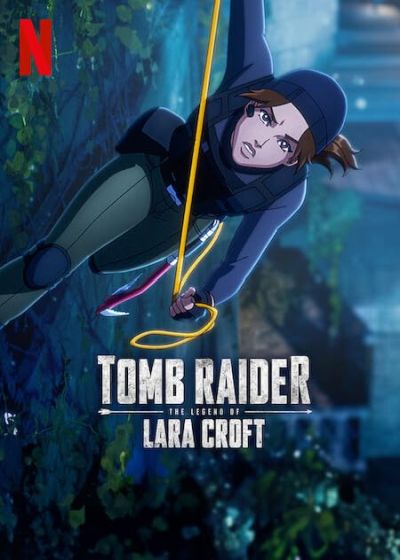 Filmed versions of Lara always seem to have her suffering from the loss of her father. This is the third such, after the Jolie and Vikander live-action versions. It should be noted this was not originally part of her imagined biography, which has changed several times over the years. Originally, she fell out with her family, when she decided to make adventure her lifestyle, earning her living as a travel writer, instead of marrying the Earl her parents had chosen for her. Her big defining moment was surviving alone for two weeks in the Himalayas after a plane accident. It was only after the Jolie films and the reboot games, it became that she had lost both parents.
 This is one of those films where the same person wrote, directed and starred in it, and once again, the results illustrate the problems with such an endeavour. Almost any project will benefit from an external perspective which can offer constructive criticism, but when this is removed, the flaws typically end up multiplied. That said, this isn’t terrible. I think Riches the screenwriter comes out best, with a story which bypasses the usual cliches of urban storylines e.g. gangster rising out of the gutter, and does offer some genuine surprises. Director Riches also gets some points for restraint on the soundtrack front; it’s not comprised entirely of her mates rapping badly.
  ★★★½
★★★½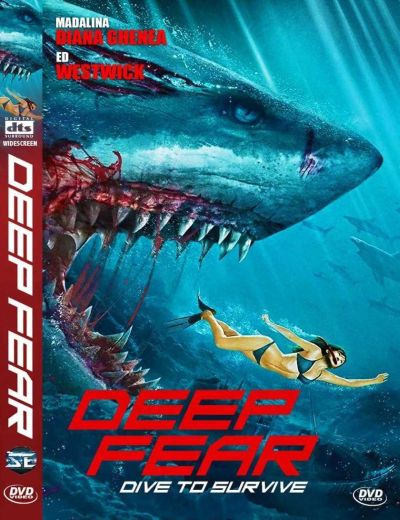 Naomi (Ghenea) is sailing a schooner single-handed in the Caribbean, returning it from Antigua to Grenada so it’ll be ready for a charter customer to take out. Her boyfriend, Jackson (Westwick) has already gone ahead to prepare things there. But a squall diverts Naomi off course, and she then stumbles across boat wreckage to which Maria (Gómez) and Jose (Coppet) are desperately clinging. They tell her there’s still a survivor trapped on the sea bottom, and Naomi dives down to rescue Tomas from his watery tomb. However, on returning to the surface with him, she gets a nasty surprise and finds her work is not over. For the survivors were also transporting 200 kg of cocaine.
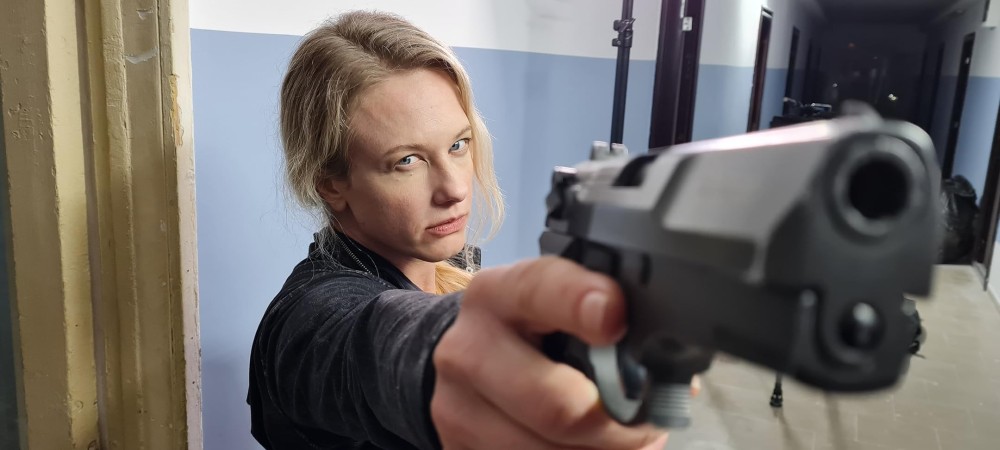
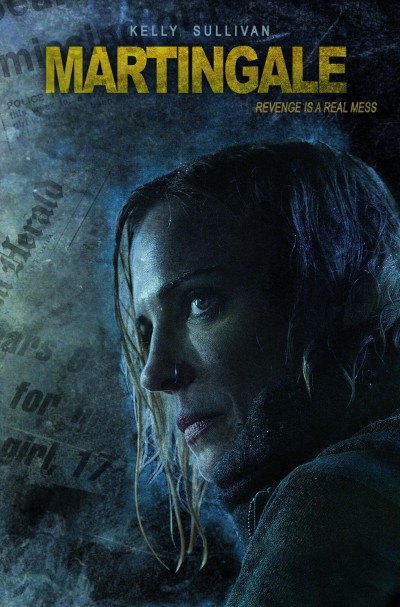 It’s probably symptomatic of… something, that the film’s title is never explained. With the main character working in a casino, I presume it’s a reference to the Martingale betting system, where you basically double your bet after every loss. It guarantees a profit – unless you hit such a long losing streak you run out of money entirely. Its relevance here is uncertain, and I doubt most viewers would know what a martingale is either. But then, the film is very good at not explaining stuff. Another example would be, what the scam is supposed to be with Andi (Sullivan) collecting left-behind cash-out casino slips and handing them to a collaborator, Whit (Melikhov). These are for trivial amounts, so why bother?
 ★★
★★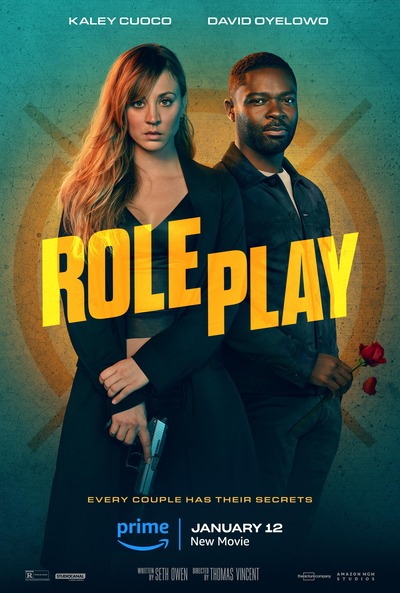 If a little light on the action front, this probably makes up for it in heart. On surface, the Brackett family are largely like any other. Sure, mom Emma (Cuoco) spends a lot of time out of town on business. But she loves husband Dave (Oyelowo) and her two kids, even if she’s a little unfocused, forgetting their anniversary. The problem is, as we know from the start, that Emma is a hitwoman, who used to work for an organization called Sovereign, before turning freelance. They’re still after her. And that’s where the problems start, as on a make-up anniversary date at a hotel, she’s spotted by Bob Kellerman (Nighy), another freelancer, interested in collecting the reward on Emma’s head.
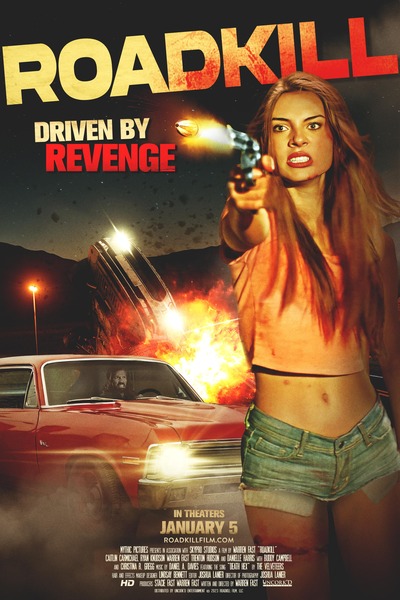 To be one hundred percent clear, the best thing about this is the rather arresting poster. A far better film than what we have here, would struggle to live up to it. Instead, we have a classic example of vanity cinema, where one man decides to write, direct and play a major part in his own movie. The over-ambition here is palpable, to an often accidentally amusing degree. Perhaps most obviously, a pair of “car chases” – and I use the quotes deliberately – which unfold at a stately 15-20 mph, involving a muscle car on which the production clearly could not afford a single scratch on the paint. They’d have been better off not bothering.
 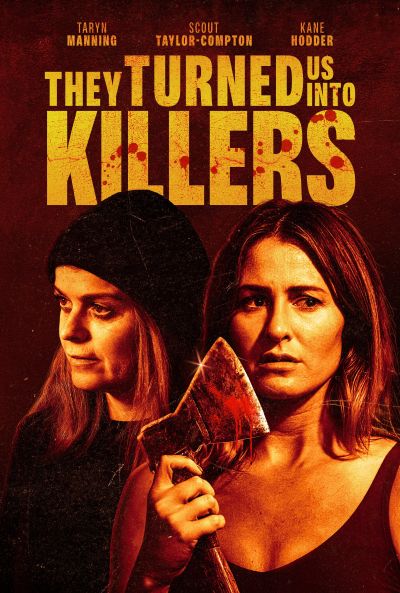 Well, this is a spectacular mess. Except, the word “spectacular” implies something of interest, and that’s far from anything this delivers in its boring trudge towards a predictable ending. It demonstrates the perils when you, as a film-maker, decide to take your story and fragment the timeline. This only works if the script is able to maintain coherence around the jumps back and forth. This painfully fails on that count, beginning in the middle, but then bouncing back and forth to the point you know little and care less about any of the participants, or what happens to them. How bad is it? It gets the rare honour of me starting on the review, when there’s still half an hour to go.