




★★★★
“State of flux”

 Difficult though it may be to credit, especially for younger readers, there was a time when watching MTV could actually be interesting occasionally, back in the days when the station had its own animation division. The best-known product to seep out was Beavis and Butthead, but more interesting was Aeon Flux, perhaps the most dense and impenetrable animated series to reach a wide audience – even if the general reaction was “Eh?”
It debuted as part of Liquid Television, and right from the start, makes an impression with its lack of dialogue, weird design and astonishingly high body-count. The first series of mini-eps depicted the mission of an apparent secret agent, Aeon Flux, who comes within moments of solving the case of a mysterious epidemic, only to meet an untimely death. Undaunted, the second series had a variety of cases, whose only real linking theme was the repeated untimely death of Aeon.
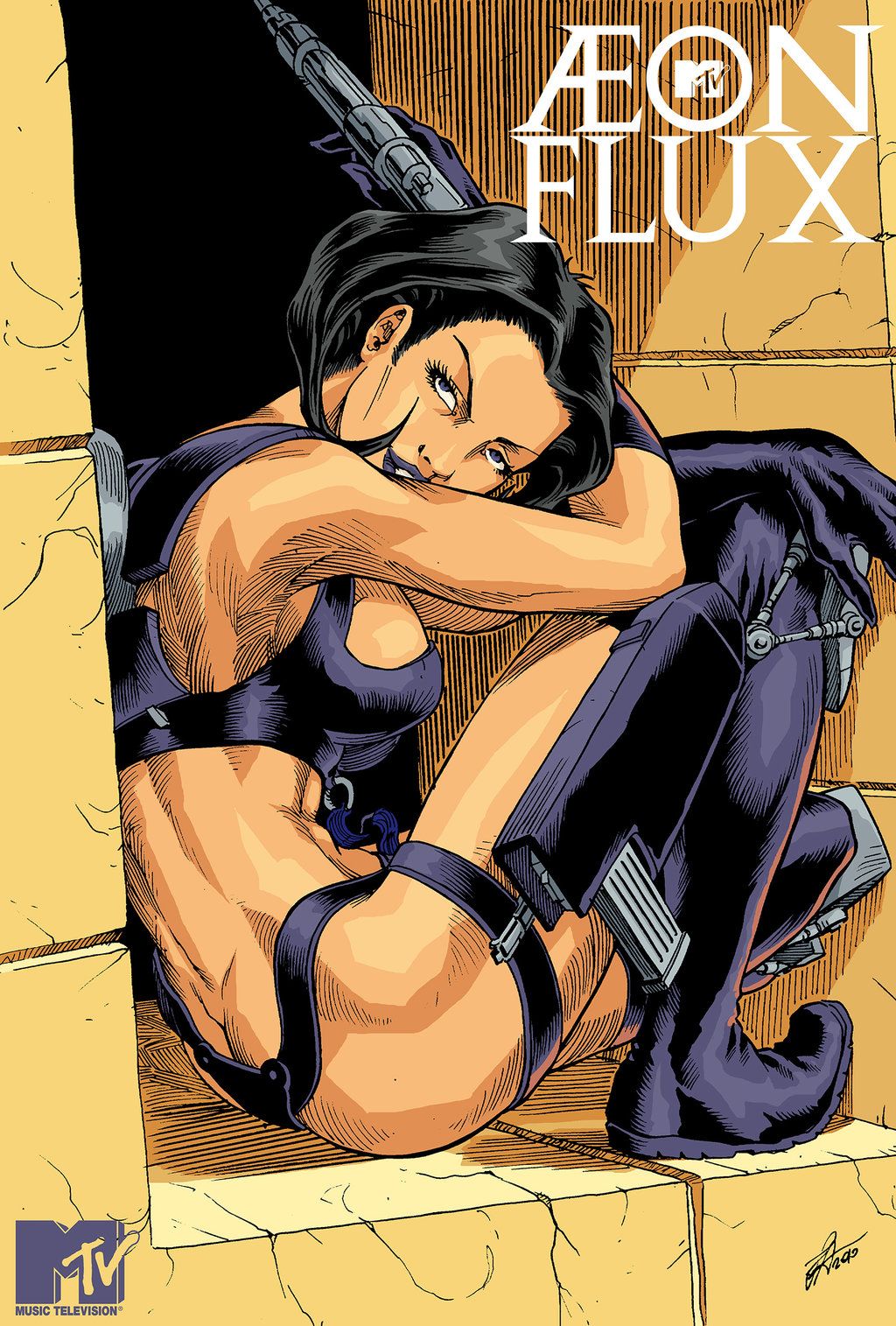 Then MTV commissioned some 25-minute episodes, and things inevitably started to mutate. The characters started to speak (gasp!), but anyone who thought this meant it would become easy to understand was in for a shock – if anything, it added an extra new dimension of complexity. More of the setting was exposed: two countries, Monica and Bregna, of opposite character and once united, but now in perpetual tension. Extra characters were added, most notably Trevor Goodchild, the Breen leader, whose relationship with Aeon (a Monican “agent”?) is perhaps the central focus of the series.
“What I was trying to go for was a kind of ambivalence.” So said creator Peter Chung, and as ambivalence goes, there’s little doubt he succeeded – rarely has a show hidden its light quite as effectively. Very little is laid out for easy consumption, and each episode repays, and indeed demands, repeat viewings. Every action and line of dialogue sometimes seems to have multiple meanings.
If it has a weakness, it is perhaps too obscurist, and you wonder whether the show is quite as deep as it wants you to think. In addition, there are parts which, however stylish, just don’t seem to make sense. But Aeon is a fabulous character, who in the words of Chung, “is not someone who reacts to things. She makes things happen…she’s a force for change as opposed to the status quo”, and the combination of intelligence and malevolent brute force is immensely appealing. Chung again: “I think it’s undeniable that there’s a certain glamour or a certain seductive power of violence on film. Her whole design and the way she looks, the way she moves is engineered purely to evoke that attraction.”
A feature version of Aeon Flux has occasionally been hinted at (Liz Hurley would seem a leading candidate for any live-action version!), but at the moment seems somewhat unlikely, especially with MTV having now folded their Animation Division. Chung has moved on too, first to work on Phantom 2040, whose characters are clearly cut from the same cloth, in their spidery style, and then off to the Far East, for an animated series based on the life of, I kid you not, Alexander the Great. Whether anything created in his future will be as memorable, intense and downright impenetrable as Aeon Flux is surely in doubt.
Creator: Peter Chung
Star: (voice) Denise Poirier, John Rafter Lee


 While one might question Pam’s acting talents, she is backed by a sterling cast of character actors: Steve Railsback, Xander Berkeley, Clint Howard, Udo Kier and Temuera Morrison. Each one hits the mark in their role, delivering lines with the correct level of enthusiasm. Kier, as usual, steals the show (his presence definitely helped soothe Chris’s eye-rolling), though Berkeley’s sleazy cop is perhaps the biggest surprise, especially if you’re only familiar with him as Jack Bauer’s boss in the first two seasons of 24.
 I admit, you could argue the entire story is irrelevant, and this is nothing more than an indefensible cocktail of eroticized violence. But those who live in such a moral vacuum as to require Hollywood to fill in the gaps, have got much bigger problems than Pamela Anderson’s breasts. If you can get past the first five minutes (which even I will say seem a lot longer), there’s no denying the effort expended here – albeit mostly on sex and violence, aimed at the lizard section of the viewer’s brain.
 This sprang virtually fully-formed from the twisted mind of McCracken back in 1992, as a student film: even then, he intended it as a series, with most the characters, both heroines and villains, already present. The main change was to the title, the Cartoon Network balking at presenting a show called The Whoop-Ass Girls, and so the “can of whoop-ass” which was originally part of their make-up, was replaced by Chemical X.
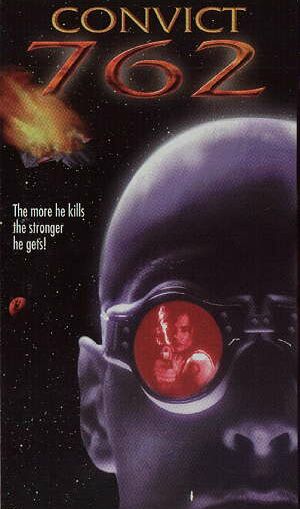 A good idea – even if one borrowed about equally from Pitch Black and Aliens – gets sucked into the void and drained of all life, thanks to some of the most turgid direction imaginable. A ship with an all-female crew has to land on a prison planet for fuel, but finds only two people left. Which is the mass murderer? Can they find out before they get picked off, one by one…?
 After thirty minutes, I was toying with the idea of giving this the first ever 0 star rating. On that basis, eventually creeping up to two counts as something of a miraculous recovery. The heroine is an alien, transporting her child across the English countryside, while being pursued by white-masked hunters. There is almost no dialogue, which is so obviously a penny-pinching device it hurts – the video stock and woeful “martial arts” don’t help.
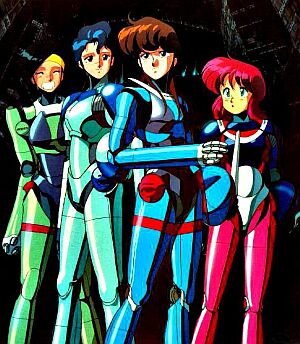 Worthy of note as one of the first pieces of anime made available to an English-speaking audience, (not long after its original 1985 Japanese release), BGC is set in 2032, when Tokyo has been rebuilt, post-earthquake. The Genom corporation are fiddling with Boomers, biomechanical robots of immense strength but with a nasty tendency to run amok. Standing guard are a mysterious team, the Knight Sabers, with their own technological strengths, who alternate between merc work and more altruistic concerns.
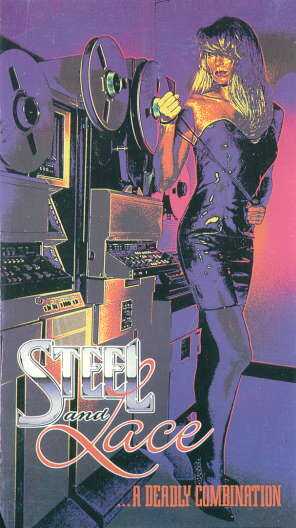 Inside ten minutes, we’ve had heroine Gaily Morton (Wren) raped and her attackers acquitted in court, not to mention her subsequent leap off a roof-top to her death – this isn’t a film which hangs around, boys and girls. Luckily, her brother is a NASA boffin (Davison – you might recognise him as the Senator from X-Men), who builds a robot in her image, in order to wreak gory revenge on the perpetrators five years later. Cleaning up behind are a cop (Naughton) and his ex-girlfriend, a courtroom artist (Haiduk) who joins the dots.
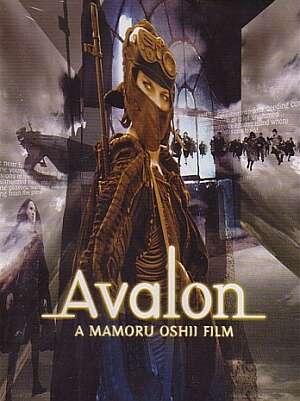 While this is live-action, Oshii is best known for his anime work, such as Ghost in the Shell. That also had an action heroine, great visual style and lost its way in philosophical navel-gazing. There, it was the nature of self – here, it’s the nature of reality. Set in Poland, which may be a first for a Japanese film, the heroine, Ash (Foremniak), is addicted to an illegal computer game called Avalon. When she hears about the existence of a special level in it, she’ll stop at nothing to find the entrance. But, for her, the line between life and pastime is becoming more and more blurred…
 Wuhrer plays Sasha, a space pilot coerced into attempting to stop a rocket, hijacked by evil emerald dealer Conrad Nash (Rossi) and his creepily incestuous sister Carla (Rubin), from ploughing into LA. The proper pilot (O’Keefe) provides assistance, with much running around corridors and plunging into a glycerine tank. Yes, glycerine: a feeble excuse to give our heroine the wettest T-shirt of all time. Between this and the “ass panning” (as Chris described Simandl’s fondness for shooting at waist level), it seems disturbingly fetishistic, though a large chunk is due to footage spliced in from another movie – see

 Our qualms were largely because, unlike Run Lola Run or Groundhog Day, which made no attempt to explain what was happening, here there’s just enough logic to be unsatisfying. The “rules” are clearly important – for example, do time-travellers keep their memories? – yet are inadequately laid out. We spent the last 15 minutes with furrowed brows, trying to see if it made sense. It may, or may not, but either way was an unwelcome diversion in an otherwise pleasant surprise.