★★½
Lady Snowblood
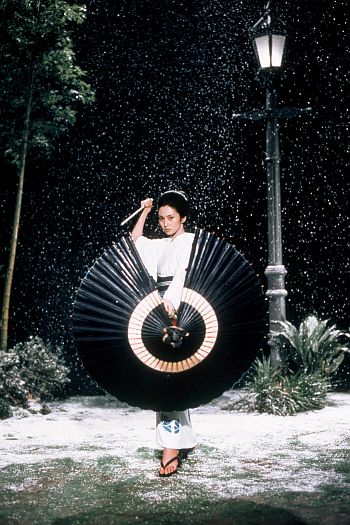 I’ll be honest: I was disappointed. I’d been looking forward to seeing this for a long while, but when we finally cranked it up on Monday, found it pretty dull. Truth be told, Chris was giving it loud Z’s by the end of the film, and I spent a few minutes closing my eyes and just listening to the dialogue. Which, since it was in Japanese, isn’t a good sign either. This was a surprise. A lot of people, whose views I generally respect, really like it, such as mandiapple.com, who called it “nothing short of a masterpiece.” Reading that, I had to check they were reviewing the same film. Because, personally, while its influence on Kill Bill is undeniable, that is a far more effective piece of work.
The plot in both is needlessly-convoluted, but it has much more of a negative impact here. Here is the story, in chronological order. In late 19th-century Japan, a mother sees her husband and young son slaughtered by a group of four con-artists; she is kidnapped and raped over a period of several days before being abandoned. She vows revenge, but is arrested after killing only one of the four, and sent to prison for life. There, she has a baby daughter, Yuki, spawned for the sole purpose of continuing the revenge. After the mother dies in jail, Yuki is released with another prisoner, and begins her training under a tough Buddhist priest (Nishimura). When she reaches her twentieth birthday, she leaves, to start her mission.
The problems here are multiple, not least that Yuki is just too cold. She might as well be an automaton, as she progresses on her vengeance, showing no emotion or feeling, and it’s hard to feel empathy for her. Yes, she is supposed to be a cold-hearted killing machine, but the performance here is devoid of all humanity. There’s nothing personal here either. Yuki is not the victim; the events in question occurred before she was even conceived, giving her no direct stake in proceedings – she is simply a tool, wielded from beyond the grave by a mother she never really knew. Contrast Kill Bill, where the Bride sees her husband-to-be slaughtered at the altar. As motivation, it’s far superior and resonates much more with the audience.
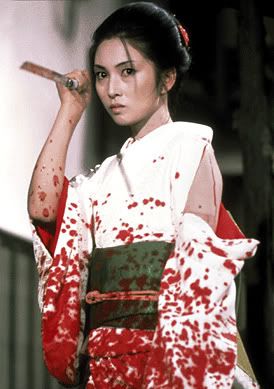 Then there’s the action, which is second-rate at best. It may have seemed cutting-edge when the film was released in 1973. Approaching forty years later… Not so much. There’s little sense that anyone – good or bad – has true sword skills, and the battles are largely brief and perfunctory. Admittedly, the arterial spray is enthusiastic – clearly the high blood-pressure epidemic affecting Japan is not a new phenomena – and looks very pretty on the snow backdrop which is frequently used. However, that can only go some way to overcoming the flaws in the characterization: one suspects the original manga, by Kazuo Koike (who also did Lone Wolf and Cub), perhaps had more room to be better developed in this area. And while we’re at it, what’s with the anachronistic jazz soundtrack, dating from a good half-century after this is set? Any sense of period atmosphere is completely destroyed, every time it cranks up.
What works is mostly the visual style, and it’s soundly put together from a technical aspect. Kaji, who plays the adult Yuki, is also solid enough, though was probably better – even if she said less! – in the Female Convict Scorpion series [I must get round to reviewing the excellent Jailhouse 41 here some time, though it won’t be till after we move house in October, and the DVD re-surfaces…]. I also liked the chaste purity here: Yuki doesn’t have any real relationships at all – she lives purely for revenge. However, I feel much the same way about this, that I did about the original Night of the Living Dead. While it certainly deserves to be respected for its influential place in the history of the genre, it feels as if the elements seen here have been revisited with greater success, by those who followed in its foot-steps.
Dir: Toshiya Fujita
Star: Meiko Kaji, Ko Nishimura, Toshio Kurosawa, Masaaki Daimon
★★
Lady Snowblood 2: Love Song of Vengeance
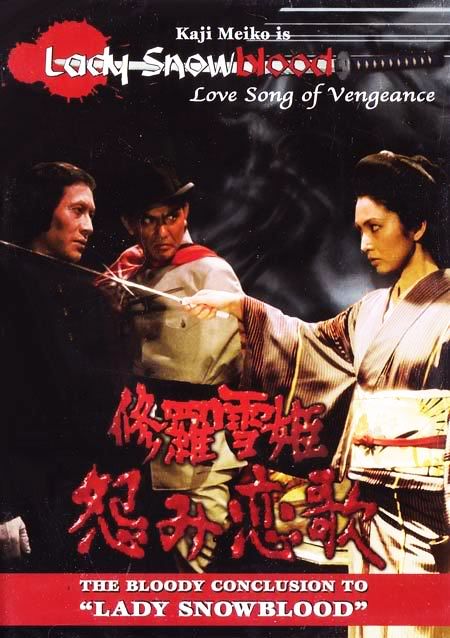 I was hoping that the second film would show me why this series has such a solid reputation, but was even more disappointed by the sequel than the original. There’s a striking opening, where Yuki basically walks out of an ambush, hardly bothering even to pay attention to the men circling her – except to slaughter them. Unfortunately, it’s pretty much downhill from there, with proceedings getting badly bogged down in even more of the political shenanigans that we saw in part one. Yuki is arrested and sentenced to death for her 37(!) murders, but is rescued by the chief of the secret police, Kikui Seishiro (Kishida), who sends her on a mission against nihilist Ransui Tokunaga (Itami), perceived as a threat to the order of things.
That’s because Tokanaga and his wife are in possession of a document that could seriously embarrass the government, by proving their involvement in the deaths of Tokunaga’s partners. When Yuki discovers this, she switches sides, though Tokunaga is arrested, tortured and, when he fails to give up the document’s location, injected with bubonic plague [interestingly, this is a decade before the biological weapons work of Unit 731 during WW2 became public knowledge in Japan] and dumped in the slums as a warning to others. Yuki teams up with Tokunaga’s estranged brother, and sets out to take revenge on the government forces responsible for his death.
This is set just after the Russo-Japanese war of 1905, and I’ve a feeling is meant in some way to parallel the political situation of the 1970’s. However, all such sentiment is entirely wasted on Western viewers watching it almost forty years after it was made. If you’re looking at this as an action movie, it plays out in a manner best described as turgid, with very sporadic action, to such an extent that it hardly qualifies as such at all – if it weren’t for the original, I doubt I’d be covering it here. Even the arterial gushiness seems to be less unenthusiastic and sprayful than previously.
On the other hand, Kaji’s portrayal is more emotionally-disengaged this time, and it’s even harder to develop sympathy for a character engaged in some kind of obscure political activism, rather than personal revenge. It’s what perhaps makes this one’s closest cousin V For Vendetta, with samurai swords. And, in case you were wondering, that is not meant to be much of an endorsement. I’d say you are far better off watching the futuristic remake, The Princess Blade or even the better entries in the Crimson Bat series than either of these films, and given my high hopes coming into these, based on their reputation, that’s extremely disappointing.
Dir: Toshiya Fujita
Star: Meiko Kaji, Juzo Itami, Kazuko Yoshiyuki, Shin Kishida



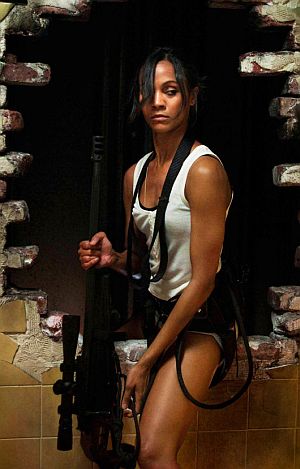 There are moments where this seems to have the potential to break out beyond its story, but once you get past the strong central core, the script has very little to offer. Cataleya (Saldana) narrowly escapes death when her parents are killed on the orders of their gangster employer, Don Luis. She flees from Colombia to Chicago and is raised by a family friend, but never forgets where she came from, and has revenge on her mind. Grown-up, she becomes a hit-woman, but has a side-project of payback. She has an occasional boyfriend (Vartan) who knows little about her, and a dogged FBI agent (James), intent on tracking down the mysterious, elusive killer. Y’know: all the usual baggage that goes along with being an assassin.
 After she gets word, back in their native Russia, that her sister has been killed in Toronto, Karma (Bechard) vows revenge on those responsible. This pulls her in to a seedy, dangerous world of sex trafficking, with women being lured from Eastern Europe to the West, with the promise of legitimate jobs, only to forced on arrival into working as strippers or worse, by the criminal elements who organize and run the business, with a fist of iron. As Karma stabs, shoots and bludgeons her way up the chain of command, those at the top grow increasingly restless. Initially, they think a rival gang is responsible, but the evidence eventually convinces them Karma is, indeed, a bitch,
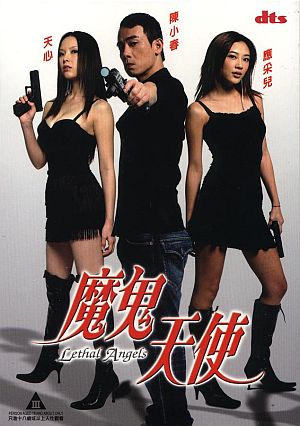 Winnie (Lee) has a grudge: against gang boss Bowen (Yuan) in particular, but also against just about any man who abuses women. She puts together a team of four underlings, such as Yoyo (Sum), whose family was killed by thugs, and uses them to take out anyone whose lustful desires overwhelm their common sense. Now, it’s time for the big one: Bowen. Winnie sends Yoyo in as an undercover nanny, to scope things out and obtain evidence of Bowen’s illegal dealings. However, once in, she finds out that Bowen is now largely reformed, and Yoyo also objects to Winnie’s plan to wipe out all of Bowen’s family, including his six-year old daughter. Meanwhile, she’s also being investigated by Jet (On), a cop who knew and almost dated her at college, and is on the case of the mysterious deaths of mob bosses at the hands of beautiful ladies.
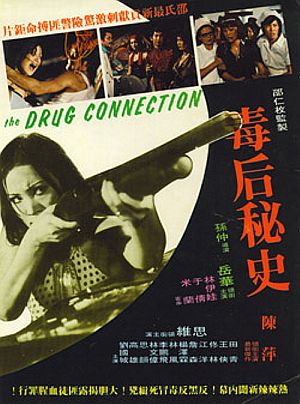 Not to be confused, in any way with SexyKiller, this 1976 Shaw Brothers film is more of an unofficial remake of Coffy. Wanfei (Ping), a nurse by day, decides to go vigilante by night, after her sister falls victim to druglords and ends up brain-damaged and drooling. With most of the police force in the pockets of the dealers, Wanfei opts to go undercover as a drug-addict of loose morals, so she can make her way up the chain of command, to deliver justice on behalf of her sister to the sinister Boss (Hsia). This finds her an ally in Weipin (Hua), a childhood friend and honest cop whose hands are tied by pesky bureaucratic niceties, like “needing a search warrant”; she’s also encouraged by her pundit boyfriend (Wei), who has long taken a strong anti-drug stance.
 So opens this rare example of British grindhouse. We don’t generally
 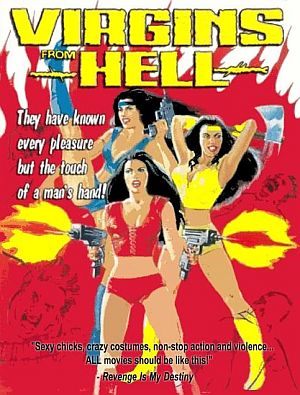 Let’s be clear: most of the entertainment to be found in this, is strictly of the “so bad it’s fun” variety. For instance, we perpetually found ourselves in Evil Overlord mode, i.e. “If ever I become an evil overlord, I will ensure my compound is not dotted with large, explosive barrels, clearly marked DANGER.” The lameness of this is often amusing, such as the complete aversion to nudity, an obvious product of its origins – the heroines even take baths with their clothes on. Other elements are just bizarre, if educational: it appears, if you get shot, you can jam a live snake into the wound and it will come out holding the bullet in its teeth.
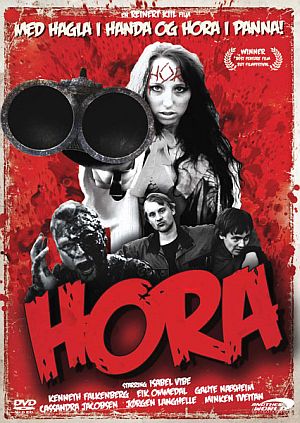 Crime-writer Rikke (Vibe) heads out to her former home in the country for a quiet few days catching up on her work. There she bumps into a guy whom she hasn’t seen since she was eight, but who still seems to have the hots for her. She declines his advances, telling him of her husband back in the city, but he persists in his efforts, along with his policeman friend, and the backward clerk in a local convenience-store. A dead animal is left on her doorstep, and that’s only a precursor to a long, brutal assault on Rikke that leaves her battered and bruised, almost beyond recognition. However, barely have the rapists left, before she is already planning her revenge on each one of them, and it will be every bit as unpleasant.
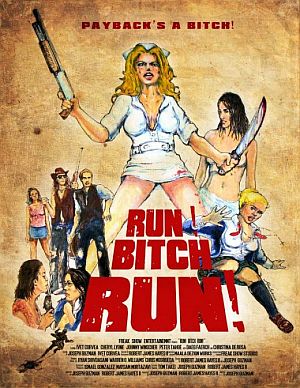 I can certainly appreciate where the makers are trying to go with this one. Two Catholic schoolgirls, selling Bible door-to-door to raise funds for their educational establishment. Unfortunately, they knock on the wrong door: this is actually a whorehouse, run by the psychotic Lobo (Tahoe), who has just killed one of his hookers. The two are kidnapped: one is killed, while the other (Lyone) is left for dead, naked, in the nearby woods. She is taken to hospital, but has only a single thought in her head: revenge. Stealing a nurse’s uniform, she checks out, intent on taking our her wrath on Lobo and his no-less depraved sidekicks.
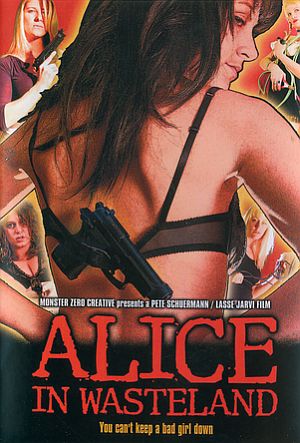 Ok, that brief is a little harsh, but it is true to say by the end, I had opted to double-task, and was watching this while I stood over the sink in the kitchen. It wasn’t as good as I expected: I was hoping for something along the lines of Faster, Pussycat, and instead got a turgid, over-extended crime drama. While it has all the right aspirations, the yawning chasm between that and its execution would require several days’ trip by mule to cross. Alice Wynn (Sondrup) is part of an armored-truck robbery, only to find herself double-crossed and left for dead by corrupt cop Jill Robbe (Beisner). Alice vows to recover the loot and take revenge on Robbe, and won’t let anyone – examples include her late mother’s boyfriend, psychotic pimp Ramrod or his Swedish assassin – stand in her way.