



Literary rating: ★★½
Kick-butt quotient: ☆☆☆
With this read of the fourth (in the Lincoln Square Books numbering) installment of the author’s Kim Oh series, I’ve now read all of the volumes that are currently available in paper format. All of the previous ones have earned high ratings from me, despite some flaws that can mostly be summarized as continuity or editing issues; it’s fair to say that this is one of my favorite action-adventure series, and I’m definitely a fan of the heroine. This particular book, however, proved to be the weakest of the series so far, and really only mustered two and a half stars in my estimation. The main drawbacks here only become really evident on reflection after the read, or at the very end, so all through the read itself I did enjoy the experience.
Korean-American (though, as we learned in the previous book, she and her brother are only half Korean in their ancestry) protagonist and first-person narrator Kim, as series fans will already know, is the guardian and caretaker of her wheelchair-bound younger sibling Donnie. Not able to pay for their food and rent as a bookkeeper (she’s good at it, but not very credentialed) the series opener showed how, by a believable story arc, she opted for a career change as a hired gun. She’s occasionally a paid assassin (though, as she says, only of “the kind of creeps on which there was a general consensus that if they stopped breathing, it’d pretty much be an improvement to the world;” she does have ethical “standards” for herself, and Jeter doesn’t directly depict that side of her work), but mostly as a bodyguard or “security” for employers whose business interests may attract violent hostiles. They tend to be shady types (whom she doesn’t much like or respect), and job security isn’t very dependable.
When our story opens, some two months have passed since the previous book. Kim’s now about 20, and Donnie around 14 (the ages aren’t explicitly stated, but inferred from time progressions from book to book). Since her former boss didn’t survive the previous adventure (and had fired her anyway), she’s been between jobs since then, and her savings are dwindling. Now, however, an opportunity knocks. A wealthy but sleazy tycoon wants to hire her to accompany his college-student daughter to fictional Meridien (supposedly the smallest country in South America) for spring break. This won’t (so he says) be a very taxing job; Lynndie Heathman doesn’t so much need a bodyguard as a kind of glorified nanny to keep her out of serious trouble. So, Kim’s soon flying to Meridien –with Donnie in tow, albeit against her druthers.
 She’s reluctant to bring him anywhere near the sybaritic conditions that await them; but although he’s able to look after himself for awhile if he needs to (and has, at times), as he pointed out, Child Protective Services knows she’s landed this job and won’t look kindly on him being left to his own devices for this long. (And she doesn’t plan on letting him participate in any drunken orgies!) Knowing the kind of intense searches today’s airplane travelers are subjected to, she’s opted not to bring along a gun. But, hey, it’s not as if any danger is likely to present itself on this gig, right? (I was reminded of the Robert Burns poem about “best laid plans….”) On the flight, Donnie strikes up an acquaintance with Mavis, a full-scholarship anthropology student who’s headed for Meridien on her department’s nickel, not to party but to do research, and who’s (like him) more than a little tech-savvy.
We’ll see more of her (long story!). Jeter doesn’t explicitly establish her age, either (and that’s going to be an important detail, in my estimation!) We only know that she’s not old enough to drink, “Even for here;” if the drinking age there is 18, I’d guess she’s 17. (Kim noted that she seemed younger than the rest of the college crowd, and refers to her once as underage.) Some teens enroll in college early (and dual enrollment programs for high school juniors and seniors exist at a number of colleges); but this should have been explained, and I can’t think that she could be any younger than 17.
We’re not surprised when this expedition goes south (in more ways than the geographically obvious one!) early on. This tale is an excursion into the darker recesses of what human nature is capable of, though there’s light in the darkness. With a time span of just a few days, the plotting is taut and the pace mostly quick (it slows a bit in the middle, only because it has to). As always, Jeter handles action scenes well, and the setting is evoked effectively. Kim’s her usual self, and for series fans her wry, snarky narrative voice (with a chip on the shoulder as far as wealthy, entitled snobs are concerned, but given her circumstances, it’s hard to blame her) comes across much like her sitting down with you as an old friend she trusts completely, kicking back over a cup of tea and recounting her experience.
And along the way, there are the revealing moments that show her inner dissatisfaction with aspects of her present life, and her yearning for more normality and human connection; she’s a three-dimensional person who comes across as just as human as you or I, and that’s no mean literary achievement. A couple of plot elements show significant authorial research (smoothly integrated); and Donnie and Mavis’ video technology know-how will come in handy. There’s no explicit sex; and while there’s some h- and d- words and religious profanity, which I didn’t like, there’s no obscenity and the language is in the bounds of realism with a degree of tasteful restraint. You can expect some violent deaths, and you’ll encounter one grisly image in particular that even had Kim “a little nauseated;” but the grisliness isn’t any worse than it has to be.
What pulled my rating for this installment down wasn’t the kind of continuity and editorial issues some earlier ones had; those weren’t present here. But there were more serious basic logical issues. In the first place, the main villains here acted in a way that was (from their standpoint) highly unnecessary and unwise, against their own interests, and that’s just papered over in the apparent hope that we won’t notice. But that creates a logical hole you could drive a fleet of trucks through. Secondly, Kim’s plan at the end completely depends on somebody else acting in a certain way in two respects, one of which was likely enough but not guaranteed, and the other of which was IMO actually quite unlikely. Things fell into place here because she had the author pulling strings on her behalf, but in real life that factor wouldn’t be present.
Kim also came across as uncharacteristically naive in accepting the supposed lack of danger in this job so uncritically; and later she made one error of judgment that immediately set off even my warning bells. (Her late mentor Cole would have chewed her out royally!) Finally, Jeter introduces one or two intriguing mystery elements in the first chapter –and soon drops them completely down the memory hole. :-( Another major negative (for me) appeared only in the final paragraphs. For that reason, it might be spoilerish to discuss it here, though it isn’t a spoiler for anything to do with the main plot. But despite these negatives, I’d still recommend the book to most fans of the series.
Author: K. W. Jeter
Publisher: Lincoln Square Books; available through Amazon, both for Kindle and as a printed book.
A version of this review previously appeared on Goodreads.
 The most obvious difference between the previous installments and this one is that we’re no longer in our familiar upstate New York setting. Landing on her feet at the conclusion of her previous adventure, our rough-edged heroine had wangled herself a job as chief of security for her deceased boss’ erstwhile newly minted partner, Mr. Karsh (whose business practices unfortunately aren’t any more ethical or strictly legal than the late Mr. Falcon’s, though he also aspires to a veneer of legitimacy). In the interim between the two books, his far-flung business enterprises have taken him to L.A. for an extended stay, so he’s re-located Kim and Donnie (I’d say she’s now at least 18, if not 19, and Donnie’s 12-13) there along with him. When our story opens, Kim’s making better money than before; she and Donnie can afford a better apartment, and Karsh’s gotten him into a private school that caters to special-needs kids. She’s thinking that their situation is looking up; but with her luck, it can go south very quickly. And then things get really hairy, when she finds herself, in a Karsh-owned equipment truck, in the middle of a late afternoon traffic jam on an elevated L.A. freeway, in which Donnie’s school bus is also stuck –and shooting and explosions start to happen.
 This is not to be confused with the rather higher profile i.e. it’s available on Netflix, Japanese film with the same title, made the same year, and covering a not dissimilar theme. Both are about a woman who is prepared to commit murder, in order to save their best friend from an abusive relationship. However, after the killing in question, the films take divergent paths. The Japflix version becomes a road-trip movie, with the killer and her friend going on the run. This, however, focuses heavily on the killer, whose already fragile mental state falls apart completely, after she discovers that things weren’t quite as she had been led to believe. It’s not her first time at the homicide rodeo either.
 This is a sequel to Traucki’s 2010 film, The Reef, whose synopsis reads: “A sailing trip becomes a disaster for a group of friends when the boat sinks and a white shark hunts the helpless passengers.” I haven’t seen it, yet based on that, I’m not sure I need to. Replace “sailing” with “kayaking”, and you’re more or less here. Perhaps lob in a bit borrowed from
  There are spells where I find myself going through a stream of mediocre movies, wondering when I’ll see something genuinely good. Then, I stumble into the likes of this, which leaves me yearning for the heady delights of mediocrity. It was in trouble right from the start, with five minutes of opening voice-over that did nothing but leave me confused. Then again, if your story requires five minutes of opening voice-over in the first place, you should probably rethink your storytelling techniques. The same could be said for a post-apocalyptic scenario in which food is in short supply, yet black pleather cat-suits are apparently easily available, in a range of sizes to fit all needs.
 This gritty and action-packed series was originally marketed in seven volumes. The new edition condenses that to four, by combining the first six into three and designating each component in the pair as either Part 1 or Part 2, the original title of each Part 1 serving as the new book title for both. So this book counts as two series installments. That’s a felicitous arrangement, because installments 1-2 (now paired as Real Dangerous Girl) and 3-4 here both fit together nicely as two self-contained two-part story arcs, each featuring protagonist/narrator Kim but centering on a different challenge each time, that starts in Part 1 and finds its resolution in Part 2. But the books should be read in order; here, references are made to persons and events from the prior installments, and in order to fully understand who Kim and her wheelchair-bound kid brother Donnie are, their situation, and the development of her character, you really need to have read the preceding part of the canon. Warning: this review will contain “spoilers” for the previous book(s).
 At Cole’s funeral, a meeting with Curt, an old acquaintance of his that he’d recommended her to, led to a three-month gig in “security” for one Mr. Falcone, another mobster like her former employer, who now prefers to be called Mr. Falcon since he’s looking to shed his Mafia image; also like the late Mr. McIntyre, he’s moving to position himself as more plausibly “legitimate.” (So “security” work for him involves dealing with his double-crossing employees, and attacks by thugs working for his equally shady rivals.) Near the beginning of this book, she’s invited to join his personal bodyguard team, where a sudden vacancy has opened up. But the way it opened up isn’t encouraging…. Since there are a couple of more books in the series, we know that our girl’s going to make it home at the end of the day. But she doesn’t have any such assurance, and the chances of this job ending with a tag on her toe look pretty real. She needs the money, though, since failing to provide for Donnie isn’t an option she’ll accept; and she’s about to face another unexpected existential threat to her little family unit, from a totally different quarter.
 Joan is always a figure who has the potential to be co-opted into other times and locations. Recently, we reviewed
 I did not originally expect to be reviewing this here. I watched it because of the technical elements, which I’ll get to in a bit. However, by the end, it does qualify – though you certainly wouldn’t think so from how things begin. It gets underway with Lili (Puig) waiting for a date arranged over the Internet with Eduardo (Alcantara). He shows up late, very apologetic after having been mugged, and having had his phone taken, but is utterly charming, and the chemistry with Lili is immediate. They end up back at his place for dinner. But as he’s cooking on the kitchen, the tone of the evening changes, when she hears his supposedly stolen phone going off in his jacket…
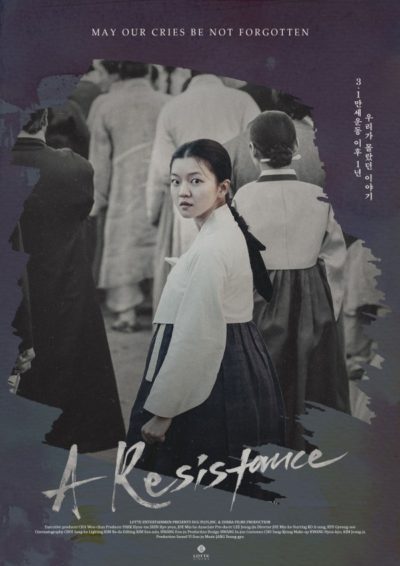 This takes place in 1919-20, when Korea was under occupation by the Japanese [there seems to be quite a lot of this about; I’ve seen a bunch of Chinese movies set when that country was occupied by Japan as well]. Even demonstrating against the Japanese, or in favour of Korean independence, was sternly forbidden, with those taking part likely to be arrested and thrown in prison for months. If they were lucky, that is: an opening caption tells us 7,500 were killed in the protests or died in jail subsequently. Even for those merely arrested, this was not a “nice” prison, to put it mildly, with horrendously over-crowded conditions (24 to a cell!), freezing temperatures and meagre rations.
 This is set around fifty years after “the Provocation”, a series of unsolved mass abductions which led to Capernica becoming a strictly-controlled hierarchical society of Uppers, Lowers and the Military. Orphan Jaclyn Holloway is a Lower, living in near poverty in the seaside town known as Settlement 56. The only way out for a Lower is to pass the stringent test which allows entry into the Military. On graduating from the local school,