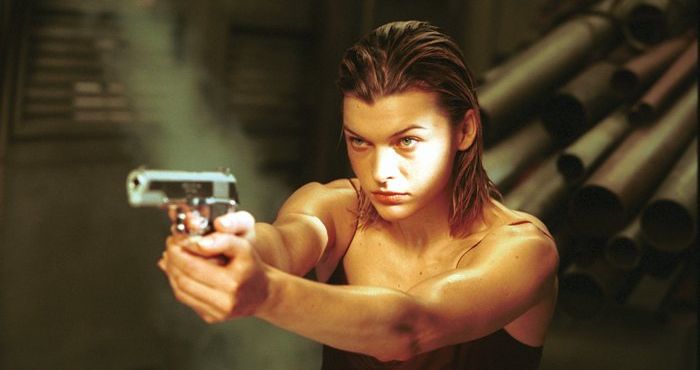
★★★½
“Alice in Underland”
Interestingly, in the past year, all three of the computer-game to movie adaptations have had heroines: Lara Croft, Aki (Final Fantasy), and now, Resident Evil‘s Alice, who wakes up one day with a splitting headache and no memory. I’ve had mornings like that too. However, I never found myself kidnapped by a SWAT team and dragged into the Hive, an underground complex populated by the walking dead (human and canine), a peeved computer, and a mutated computer graphic monster called the Licker. My stepson somewhat gleefully informed me that, in the game, the last-named’s method of attack is to wrap its tongue round your head and pull it off. The movie doesn’t go so far – it just kinda nibbles on its victims. I felt somewhat disappointed at this display of taste and restraint, not least because it ran contrary to much of the rest of the movie. This is not a subtle movie, relying heavily on things leaping in from outside the frame, while the soundtrack goes “Boo!”.
Of course, that doesn’t make it a bad movie. Nor do the obvious plot-holes. Here are a few examples:
- Why would an assault team choose to take a pair of amnesiac security guards on the mission with them?
- Zombie humans shamble along at classic Romero speed. Zombie dogs can run like greyhounds.
- Security lasers in a corridor zip along with a variety of heights/patters, before finally switching to an inescapable grid-pattern. Why didn’t they do that to start with?
These are forgivable – the first is necessary to the plot, and Anderson (a veteran of game/movies, having done Mortal Kombat) uses the other flaws to stage satisfyingly cool sequences, with the security lasers perhaps the highpoint of the film. It’s a shame this represents about the extent of the Hive’s defenses; I’d have liked to have seen more ingenuity of this sort. The rest of the story revolves around the T-virus, being developed by the corporation that runs the Hive – when the virus is stolen and released, the Hive goes into lock-down, with the central computer (the Red Queen, personified by a little girl hologram with a nice line in not-so-idle threats) killing all the personnel inside. Bad move, for the T-virus reanimates them, turning them into hungry cannibals, which adds an extra frisson to the assault team’s mission.
 This is to…er, well, I think it was to disarm the computer, but I’m not certain about that. Mind you, I’m not certain about quite a lot in this movie. The characterisation is so woeful, I managed to combine two opposing characters into one for the entire film. And it still made sense – indeed, even after Chris enlightened me, I felt my version was better. My version would also have discarded the clock countdown, or used it as the basis for an exciting race against time through the tunnels. What’s the point of a countdown, if you don’t see it in the last ten minutes? There’s also maddeningly shallow nods to Lewis Carroll: the heroine is called Alice, who goes down a “rabbit hole”, while the computer is the Red Queen with a fondness for lopping off peoples’ heads. You should either do this stuff to the hilt, or not at all.
On the plus side, we do have Milla Jovovich as Alice, and Michelle Rodriguez as the Vasquezesque Rain, who are about the only easily identifiable characters. The former drives the plot along as her memory slowly returns at convenient intervals, along with her ability to kick butt. Most notable is the kung-fu vs. zombie Dobermann battle seen in the trailer, though she does the same neck-snap with the thighs thing that Famke Janssen did in Goldeneye. It’s a further step on for Jovovich, who showed action potential in The Fifth Element, yet there isn’t enough here to truly satisfy. Rodriguez, too, is underused, marching through her third straight film (Girlfight, Fast and the Furious) with the same expression. I thought I saw her smile once, near the start, but it was probably a digital effect added in post-production.
 So, not as good as it could have been, with even the most undemanding viewer able to imagine improvements. Yet, as an action/SF/horror film goes, it’s not bad at all, with very little slack or let-up. The virus is released in the first two minutes, and it’s pretty much non-stop from there on, with plenty going on. Jovovich looks the part, and the final shot has me anticipating the sequel, in a kind of Evil Dead 2 way, with her character getting totally medieval on the zombies’ asses. We can but hope.
Dir: Paul W.S. Anderson
Star: Milla Jovovich, Michelle Rodriguez, Eric Mabius, James Purefoy




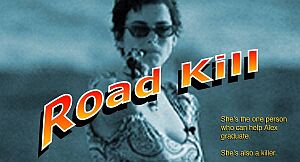 Advertised with the fetching slogan, “Guns don’t kill people – she does”, this is a film about a film, specifically the graduation documentary being made by Alex (Palladino), who has the good fortune to live opposite hitwoman, Blue (Rubin). She just happens to be going on her final job, and agrees to let him and sound-man Lars (Jayne) come along. On the way, however, things come out of the closet about Blue’s background, and Alex finds himself crossing the line between documentarian and instigator.
 Rubin, given the chance, does a good job, though it’s only in the final confrontational scene that we get to see what she is really capable of doing. Until then, the job of assassin seems little more interesting than that of a travelling salesman – she drives cross-country, pop-pop, and drives home again. It’s all rather too prosaic, making it hard to see why Alex (or, indeed, the viewer), would want to get so involved. It certainly isn’t the glamour or the excitement.
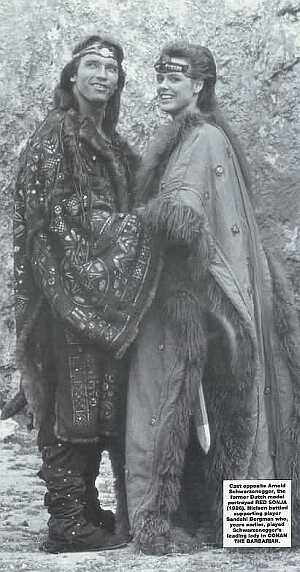 No, really. The milliner on this production deserves an Oscar, simply for providing the most amazing range of headgear I’ve ever seen. Everyone seems to have a different selection of pointy things to choose from; this civilization may have limited technology, but it’s clearly not short of hat-shops.

 The term “action heroine” moves into a whole new dimension with this movie: no gun-battles, no fight-scenes, no explosions, but it still maintains a breathless pace for almost the entire 81 minutes. Lola (Potente) needs to find DM100,000 in 20 minutes, after her boyfriend Manni (Bleibtreu) loses a bag of money he was supposes to deliver to a highly dubious character. All this is set up in about five minutes, and then Lola is off, sprinting to try and get the cash.
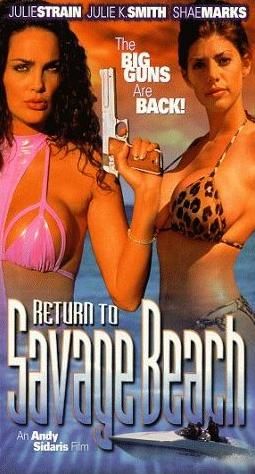 This was Sidaris’s last film, and after the disappointment of Warrior, it’s nice to see him return to a more straightforward approach, with little of the post-modernity attempted there. It is largely a sequel to Savage Beach, with a raid on the LETHAL offices puzzling Willow (Strain) and her agents, because the only thing accessed was the files on that case, which have long been closed. However, it turns out the villain there, Rodrigo (Obregon) did not die in a fiery, explosive-tipped crossbow bolt explosion as thought, and now sports a nifty mask, apparently lifted from a production of Phantom of the Opera. He sends his blonde minion in her submarine(!), along with his ninjas(!!), back to the island to claim a priceless Golden Buddha buried there, and it’s up to Cobra (Smith), Tiger (Marks) and their himbo colleagues, to stop him.
 The above quote, from one essay in this collection of pieces on “violent women in the movies”, perhaps sums up its main problem. I cheerfully admit that my writing is skewed heavily towards the former point of view, but even so, too many of the authors here seem concerned with squeezing meanings out of films that were never intended to be there. This over-analytical approach results in the book swinging between thought-provoking and infuriating on almost every page.