


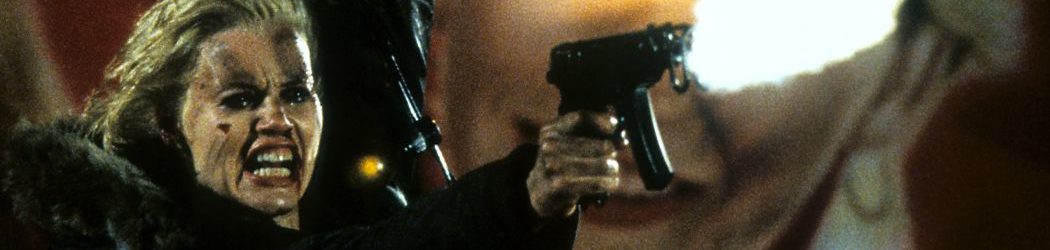

★★½
“The more things change…”
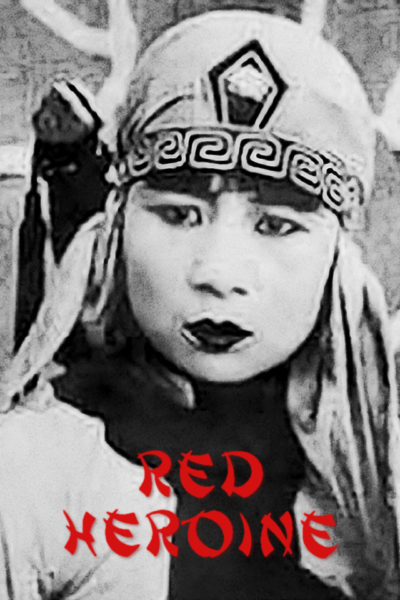 Tied somewhat to our March feature on the earliest action heroines in cinema, is this Chinese film, It’s not just the oldest surviving action heroine film from that country, it’s the oldest martial-arts film of any kind. This silent feature dates from all the way back in 1929 – I had to keep reminding myself that the “red” in the title was not a Communism reference, this being from well before such things. It’s most likely an attempt to cash in on The Burning of the Red Lotus Temple, a now-lost film series whose highly successful release had begun the previous year.
Heroine, like Temple, was a serial, in this case consisting of 13 feature-length episodes. This was #6, and I’m not sure quite how it fitted into things – it stands on its own perfectly well. The heroine is Yun Ko (Van – for all character names and credits, I’m using the names given in the intertitles), whose village is threatened by the approach of an invading army, under General Chiny Che Mang (San). While trying to flee, her blind grandmother is killed and Yun Ko captured.
She’s just on the edge of being forced to become one of the General’s scantily-clad harem – an aspect which seems very racy for the twenties! – when she is rescued by a Daoist monk, the White Monkey (Juh). He had met Yun Ko’s cousin (Wen), who informed Monkey of her plight. After being taken to her grandmother’s grave, she vows that those responsible will pay, and becomes a pupil of the monk. Three years later, with the invaders now in full control, the General is still up to his lascivious tricks, arresting a girl’s father on trumped-up charges, to get her to accept his sordid demands. It’s time for White Monkey and Yun Ko finally to strike.
In some ways, it’s most impressive how little has changed in the almost 90 years since this was released. The most standard of all martial-arts movie plots – “You killed my (insert family member), and you must pay” – is clearly in play, as is the student who must learn from a master in order to take that revenge. I also note that crappy subtitling was there, right at the birth of the genre. On the other hand, I’m quite impressed a print with any English-language content survived at all, even if it’s at the level of this exchange between Yun Ko and White Monkey:
“Are you not care to revenge?”
“As I am so weak, how could I to revenge?”
“Don’t kill yourself. I’ll teach you my military skill.”
The first third of this is very solid, with Van making for a good heroine. She has the extraordinarily expressive eyes essential to a silent star, putting across the horror of what has befallen her, and the “worse than death” fate yet to come. However, once she teams up with her kung-fu guru, they both vanish from the film until the very end: clearly the concept of the “training montage” had still to be invented. What replaces them – the General’s conniving against a completely different target – is far less interesting, little more than silent soap-opera, draining the film of almost all its energy.
Our revengeful duo finally return, sailing briefly through the air in an early and extremely primitive version of flying fantasy or wuxia. Equally primitive are the fight scenes, which certainly remind the modern viewer we’re still four or more decades before Bruce Lee showed up. This is still a somewhat interesting watch, for anyone with an interest in martial arts films. However, it’s really only of note for being the first of its kind, and this aspect is purely a result of circumstance, rather than its own inherent merits.
Dir: Wen Yeh Ming
Star: Van Shih Bong, San Kwan Wu, Juh Yih Fong, Wen Yih Ming
a.k.a. Hongxia
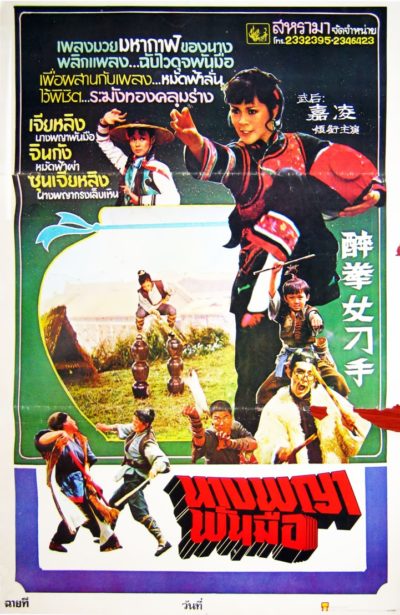 In this late era Judy Lee film, she stars as the confusingly-named Brother Blind, a name which scores only 50% for accuracy. She is indeed, largely unable to see, the result of a confrontation with the motley group of bandits who killed her father (Sit). Though even here, there is some confusion as to whether there are 13 of them, as an alternate title suggest, or 14 as the English dub mentions on several occasions. They’re certainly a random bunch, some of who are missing limbs or fingers, as well as two “giants” who aren’t very tall, and a “poison dwarf” who wields a blow-gun, responsible for Brother Blind losing her sight.
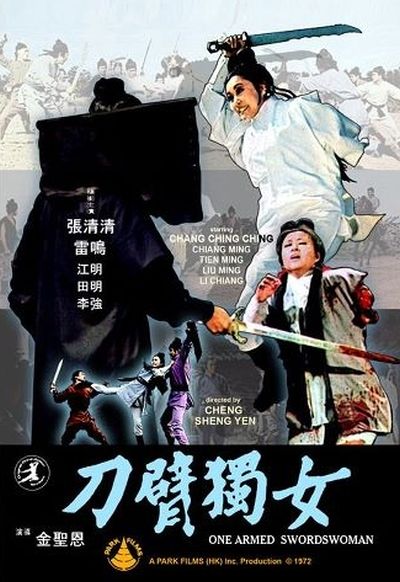 Official disclaimer. I watched two seventies Taiwanese kung-fu flicks the past weekend, this one and Revengeful Swordswoman, and I’m having serious difficulty keeping them separated. You are therefore warned that some plot elements discussed here, may actually have seeped over from Revengeful, or vice-versa…
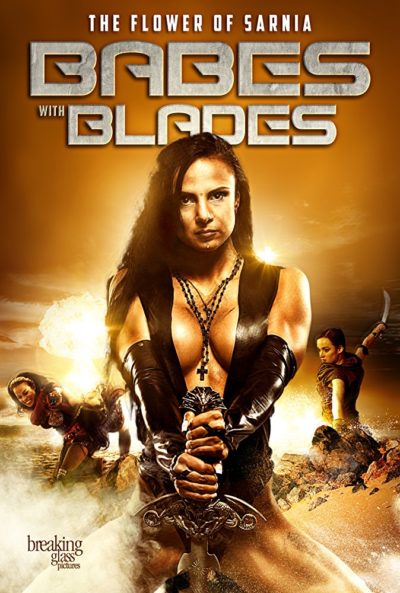 I’m unsure who the woman is on the DVD sleeve. I can only presume it’s Lady Not-Appearing-In-This-Film. For what we have instead seems to be a real labour of love for British stunt-woman Cecily Fay. Though calling her a mere stunt-woman would be selling her short: she also wrote, directed, starred in, edited and scored this feature, plus did the fight choreography and sound re-recording, while sewing every sequin on the costumes herself. Okay, the last might be a bit of a stretch, but since she is also credited as the costume designer… perhaps not. Hell, even Robert Rodriguez doesn’t have such a large collection of hats, and this overwhelming multi-tasking might help explain why it took close to five years between the start of filming and its eventual release. The main problem is that Fay’s talents, while considerable, are not equally spread.
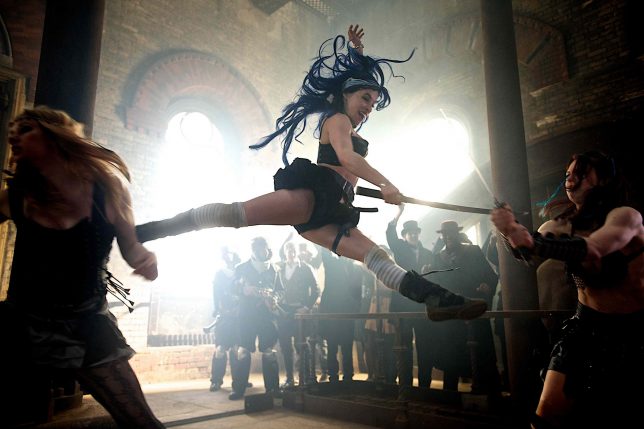 More positively, we have Fay’s acting and directorial talents. The former isn’t much of a surprise, as I enjoyed her performance in
 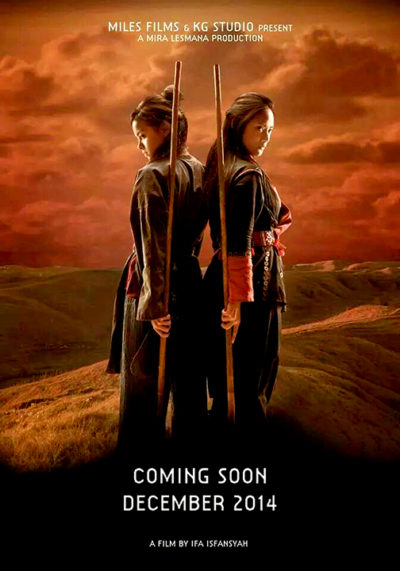 Veteran martial arts guru Cempaka has been training her four students, the children of other gurus she defeated, for years. It’s time to pass on the ultimate move, and the titular artifact which goes with it. She selects Dara (Celia) as her heir, but before Cempaka can bestow the necessary knowledge, she is attacked by Biru (Rahadian) and Gerhana (Basro), two of the students passed over for Dara. In the ensuing fight, Cempaka is killed and the cane stolen by Biru. The injured Dara is found and nursed back to health by the mysterious Elang (Saputra), a man with a murky past and no shortage of his own skills. Biru and Gerhana frame Dara for the death of their mistress, and use the cane’s power to take over the local area. Can Dara track down the last living practitioner of the Golden Cane style, and learn the skills necessary to defeat her fellow students?
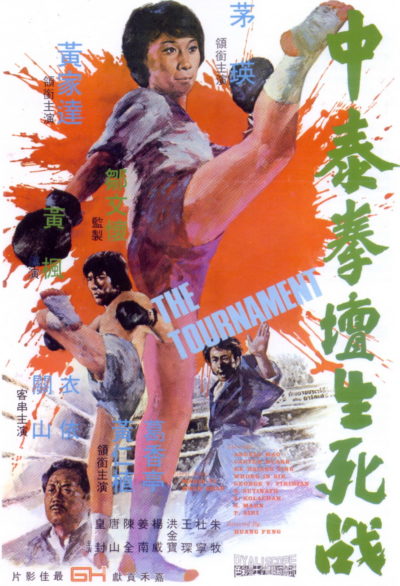 There’s a lot of chit-chat about face, honour and respect here. It begins when the master of a kung-fu school, Lau, has his daughter kidnapped by local hoodlums, after he won’t cough up protection money. Perhaps surprisingly, rather than using his skills to kick their arses, he sends two students to Thailand, including his son, Hong (Wong) in an effort to win the necessary funds. Hong loses, the other student is killed, and Lau is drummed out of the local Kung-Fu Association for having disgraced the name of Chinese martial arts by losing to foreigners. He’s so devastated, he hangs himself, leaving it up to his daughter, Siu Fung (Mao) to restore the family name, learn how to mesh Chinese kung-fu with Thai boxing, and rescue her sister. Quite the “to-do” list, I’d say.
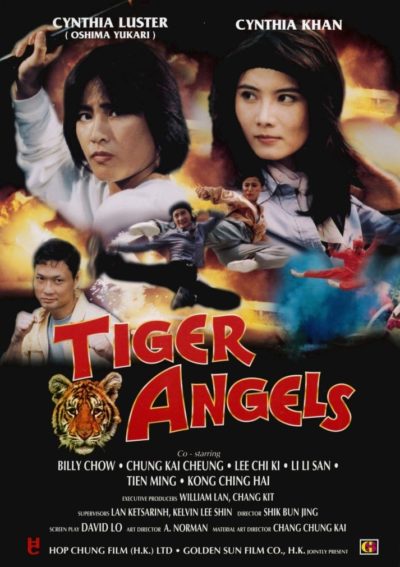 It is pretty close to an article of faith that no movie starring Yukari Oshima and Cynthia Khan can ever be entirely worthless. This film, however, shakes that belief to its very foundation. Not least because despite the cover and credits, found just about everywhere (including here), it barely stars them – indeed, Khan doesn’t even show up for the finale, with absolutely no explanation provided. This is included here, mostly as a warning, and because I’m a stickler for completeness with regard to their filmographies. Though in this case, I suspect, I’m less a stickler and more the sucker.
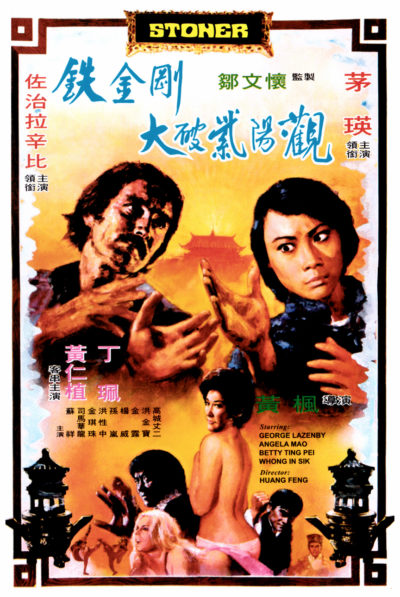 This production had a long, convoluted and quite interesting path to the screen. While Lazenby was always on board, the original plan was for him to be a Western bad guy, going up against Bruce Lee and Sonny Chiba. But Lee’s death – oddly, he was supposed to have had dinner with Lazenby that night – resulted in Chiba quitting, and Warner Bros then also backed out of their worldwide distribution deal. It was reworked as a much smaller film, at less than one-tenth the original budget (although at around $850,000, was still very expensive for the time, location and genre), with Lazenby now teaming up with Angela Mao.
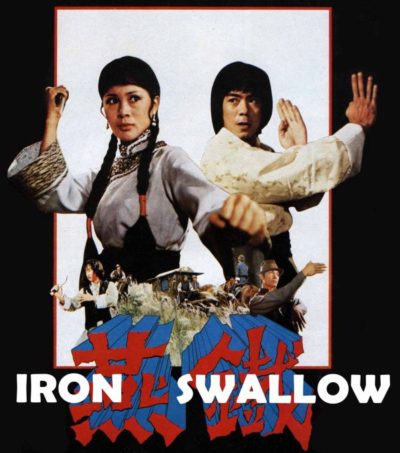 Generally, if someone is roaming the country, carrying out brutal attacks on apparently innocent citizens, blinding and disfiguring them, they’d be the villain of the piece, right? Not so here. For despite such distinctly non-heroic actions, Iron Swallow (Lee) is the heroine, disabling the men she holds responsible for killing her father years earlier. Needless to say, they’re not exactly impressed with the situation. To make matters worse, someone is flat-out killing her targets, intent on covering up something or other, and is trying to make it look like Swallow is responsible, by leaving her trademark darts behind at the scene. There are also two friends (Tao and Chung) rattling around, the son and pupil respectively of the region’s leading martial arts master Chu Hsiao Tien (Yuen), who get involved in the murky situation because Chu is one of Swallow’s targets and has hired a particularly loathsome assassin to bury the case.