I’ve never played League of Legends, but the good news is, you don’t need to, in order to enjoy Arcane. While that may provide some extra depth, it works perfectly well on its own. There is a degree of over-familiarity with the high-level scenario, which is Generic Fantasy Plot #3. Per Wikipedia’s premise, “Amidst the escalating unrest between the advanced, utopian city of Piltover and the squalid, repressed undercity of Zaun…” Yeah, it’s class war time again, cut from the same basic stamp as Mortal Engines, Alita: Battle Angel and The Hunger Games. To this series’s credit, it does show more nuance than some, with good and bad on both sides of the divide. Perhaps a bit too much though, as there were points where it felt like new characters were being thrown at the viewer, even late into the nine-episode series, when the time might have been better spent developing existing ones.
The central pair are sisters Vi (Steinfeld) and Powder (Purnell), orphaned after a failed rebellion. They’re brought up by the leader of the rebellion, and subsequently get entangled in the web of crime, politics, magic and science which powers both sides of the divide. There’s a lot going on here: simply summarizing it would fill the rest of the article. But there are a couple of key points. Powder becomes estranged from her sister, changes her name to Jinx, and goes to work for crime lord Silco (Spisak). Scientist Jayce Talis (Alejandro) creates a technology called Hextech: this (Generic Fantasy Plot #7…) allows for the control of magical energy, which can used for good or evil. It also does… well, whatever the plot needs, from curing illness to blowing things up. Intrigue ensues. A great deal of intrigue.
I did appreciate the script’s complexity, which stands in contrast to most video-game adaptations. I think the greater length (9 x 40-ish minutes) than a movie, gives the writers time to explore things in more depth, and I can’t complain at all about the overall world-building, either in story or artwork. Its French origins perhaps explain the look, which sometimes resembles a bande dessinee. Indeed, the show does almost all the big things right, from animation that’s top-notch, through good voice-acting, and some very well-constructed fight scenes. Vi does not mess around, and proves more than capable of going toe-to-toe with the biggest and baddest both Piltover and Zaun have to offer. Animated combat often lacks the impact of live-action – it’s an almost inevitable result of the medium – but that is not the case here. Blows pack a real punch, if you see what I mean.
However, there were a number of elements which did hamper the show, and for me, left it short of Seal of Approval level. I mentioned above the reliance on over-familiar tropes. This extends to dialogue which sometimes topples over into clichés, e.g. Vi telling Powder, “What makes you different makes you strong.” Pardon me if I roll my eyes and quote Chuck Pahluniak in response, “You’re not a beautiful and unique snowflake. You’re the same decaying organic matter as everything else.” I also didn’t like the use of indie rock and rap music, finding it too distracting and not a good fit for the environment. I like Imagine Dragons as much as the next person, but… This felt too much like a soundtrack CD in search of a film. Contrast the fight at the end of episode 7 (I think?), accompanied instead by orchestral music, which is perhaps the best in the entire show.
Still, there are absolutely no shortage of strong female characters, even past the sisters. For example, Caitlyn Kiramman, the daughter of a noble family who taken on the difficult job of policing the streets, or Mel Medarda and her mother. While the society portrayed in the show has its issues, gender (and race) don’t appear to be among them, rarely even cropping up. I’ve tended to skip a lot of the Netflix animated shows, for one reason or another, but this definitely was not a waste of time. The way it finishes though… I can’t discuss it in depth for spoiler reasons. But if they hadn’t already announced a second series is coming, I would be severely peeved. I hate that kind of ending in books, and it works no better in a TV show. Do better next time, please.
Dir: Pascal Charrue, Arnaud Delord Star (voice): Hailee Steinfeld, Ella Purnell, Kevin Alejandro, Jason Spisak
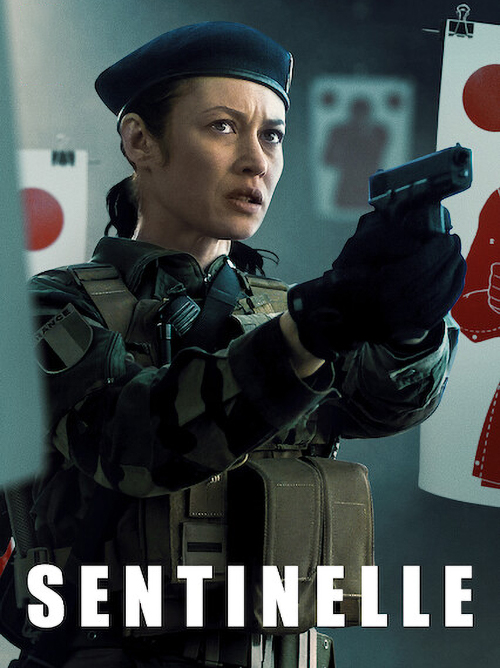
Klara (Kurylenko) is a French soldier who returns home after a tour of duty in the Middle East. But the homeland security mission to which she’s assigned – basically, patrolling sea-fronts and shopping malls – hardly seems like a credible use of her talents. However, she’s also suffering from PTSD, and it’s easy to see why the authorities decided she was better off kept away from the front lines. Then Klara’s sister, Tania (Lima), is found on the beach in a coma after having been raped. The evidence points to Yvan, the son of prominent Russian businessman, Leonod Kadnikov (Nabokoff). But the cops can do nothing, as the Kadnikov’s have diplomatic passports. Klara, needless to say, operates under no such restrictions and vows that if the justice system won’t make the perpetrator pay, then she will.
On the one hand, this is a straightforward revenge flick, though it’s revenge by proxy, with Klara not directly the victim. However, what I liked is that, while she obviously has the skill-set to pull off her mission, she’s far from invincible, even if the Kadnikov’s need to fire their security advisor. Indeed, there are points at which Karla’s straight-line approach to the problem, causes more problems than it solves. For instance, contrast the nightclub fight in John Wick with the one here. John breezed through the scenario virtually unscathed, dispatching victims with ease, in a plethora of headshots. Klara spends what seems like an eternity brawling against two opponents, and never even gets out of the bathroom. That said, the violence here packs a genuine wallop, with some startling moments which left me feeling certain someone was going home with a concussion that day. It’s definitely quality over quantity.
Former Bond girl Kurylenko has graced these pages before, in The Courier and The Assassin Next Door, but this is probably her best effort yet. She is in almost every scene, and does a solid job of holding the audience’s attention, with a sympathetic portrayal of a damaged, yet still extremely dangerous, heroine. She also demonstrates her flair for language, switching effortlessly between French, Russian and Arabic. In real life, she speaks English and Spanish too, as well as bits of others. In 2013 on Twitter, she said, “I want to speak ALL the languages.” [She also knows how to say “I love squirrels” in many of them…]
Coming in at a brisk 80 minutes, it does still take a little while to reach the meat of its topic, The assault at the core of the film (which, incidentally, we don’t see – and nor do we need to) takes place not far short of half-way in, though the pace never feels as if it’s dragging. I also have some questions about the ending, which out of nowhere seems to suggest a Nikita-like program of black ops assassins, created by the government out of captured murderers. Though to be honest, I’d not mind seeing such a sequel, and definitely would not want to be the one on whom Klara was unleashed.
Dir: Julien Leclercq Star: Olga Kurylenko, Marilyn Lima, Michel Nabokoff, Carole Weyers
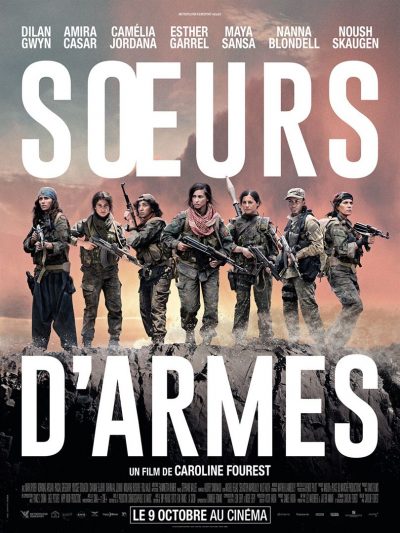
This suffers from being almost exactly the same story as the previous feature we reviewed about women Kurdish fighters going up against ISIS, Les Filles Du Soleil. Both focus on a woman who is kidnapped by ISIS after they sweep through her town, and gets sold into slavery by her captors. She escapes, and joins of the all-female units who are battling the jihadist occupation. Bur there is a family member – in Filles, the heroine’s son; here, her younger brother – who is still with ISIS and has become a child soldier for them. Even if you haven’t seen the earlier film, you’ll not be surprised to hear this plays a key role in the film’s climax. The similarities are so startling, I kept expecting to hear this was a remake. It just appears to be a carbon-copy.
There are some differences, the most notable feature being the multinational nature of the women’s group here. As well as local Yezidi Zara (Gwyn), there are two young Frenchwomen, Kenza (Garrel) and Yaël (Jordana), an American sniper (Nanna Blondell, who was in Black Widow), etc. The ISIS are similar: the chief “bad guy” is English, with a strong Northern accent – though I’ve been unable to take English jihadists seriously, ever since watching Four Lions. It’s no easy task for the women’s commander (Casar) to mesh all these different upbringings, experiences and personalities into a cohesive unit.
And extending the similarity to Filles, the film has the same main weakness, and ends up spreading itself too thinly across the multiple stories it wants to tell. None of them manage to acquire the necessary depth, and most of which are more or less obvious. Not helping, the film has an unfortunate tendency to sink into drippy feminism. The montage sequence of the women training, accompanied by a pseudo-empowering “I am woman, hear me roar”-type song, marked a particular low point. More successful in general is the technically impressive action. The film’s best sequence depicts a battle between the women and a platoon of ISIS troops who are chasing a group of fleeing refugees, which includes Zara. It’s beautifully shot and well-staged, with a genuine sense of tension.
Yet, there are other, almost embarrassingly naive moments, such as the women entering a town their side has just bombed, and standing in the middle of the street for a chat, without checking the area has been cleared. I’m not a soldier, but even I know that’s… not wise. Such gaffes aside, it’s mainly the hackneyed and trite storyline that stops this from achieving any real degree of success. There is certainly a fascinating story to be told in the Kurdish women’s battalions and their part in the war against ISIS. But that’s now two efforts which appear to have barely scratched the surface, or gone beyond the obvious. Particularly here, they seem more interested in political, religious and gender-based point-scoring than telling a good story.
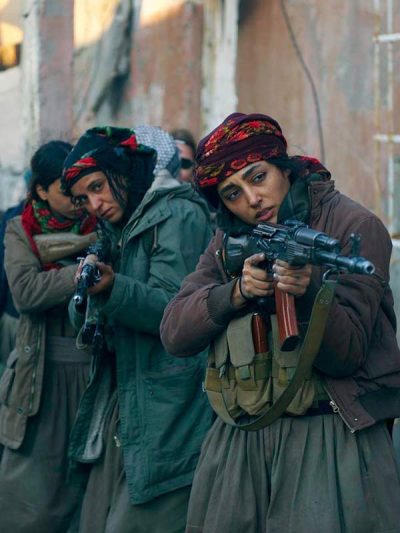
There’a a good film in here. Actually, there may be as many as three good films in here. But the way in which they are melded together, manages to rob a good chunk of the power and impact from all of them. We begin by following Mathilde H (Bercot), a war journalist clearly modelled on Marie Colvin, down to the eye-patch and traumatic experience in Homs, Syria – Mathilde lost her eye there, Marie was killed. She has just started the process of embedding herself in Kurdistan, covering the locals’ attempt to regain territory taken from them by ISIS. The second story is that of Bahar (Farahani), leader of a Kurdish women’s battalion, who was forced to flee her hometown, losing her son in the process. She has heard rumours he is being radicalized and trained as a child soldier in occupied territory, and will risk anything to liberate him.
But wait! There’s more. For Bahar was also captured by ISIS herself, and held as a sex-slave, until she managed to escape and make her way back across the front-line. Her subsequent recruitment into the military, gives her the chance to take revenge on her captors – both for herself and for the thousands of other women who weren’t so lucky as to regain their freedom. On their own, any of these stories would be fine. The problem is that Husson does a real dog’s dinner of assembling them into a single narrative, and the result weakens all of them. There’s a convoluted structure of flashbacks and side angles, to the point that Mathilde ends up serving little narrative purpose herself. It’s a pity, as in Farahani, the director has found a marvellous actress, worthy of playing the heroine. In particular, she has amazing eyes that are both luminous and expressive. She reminds me a bit of the famous “Afghan Girl” photograph.
Of the three stories, probably unsurprisingly, it’s the most action-oriented one which I liked best. Bahar and her fellow soldiers make their way into enemy territory through a tunnel. It’s mined, yet they have a captured ISIS soldier to guide them past the booby-traps… or will he? It’s almost painfully tense, and a stark reminder that in this kind of war, you can never truly relax, with potential death lurking around every corner. It also helps that Bahar carries herself in a way that seems legitimate and battle-hardened (a bit of a shame the film isn’t apparently interested in the details of how she went from being a wife and mother, to commanding troops on the front-line). But just when this is getting a full head of steam, we suddenly switch to an extended flashback of her time in captivity. This would have worked much better as a chronological narrative. Instead, it’s a fatal blunder from which the film sadly never recovers. Rather than surging towards a climax, it peters out in sadly predictable melodrama.
Dir: Eva Husson Star: Golshifteh Farahani, Emmanuelle Bercot, Zubeyde Bulut, Maia Shamoevi
a.k.a. Girls of the Sun
Lurking behind one of the most cringeworthy titles I’ve ever seen, and a trailer that’s not much better, is a very pleasant surprise. Well, at least if you’re a fan of the “splatstick” genre, mixing over-the-top gore and comedy: Peter Jackson’s Brain Dead is the pinnacle of that genre. I certainly am, and consequently found this a real hoot. Girls volleyball team, the Falcons, are on their way home after their latest victory, when they end up diverted into a small town, populated entirely by inbred rednecks (or the Gallic version thereof). After an encounter in the hotel, they find themselves getting a night-time visit, and are soon being hunted down by the village’s residents. However, the biggest psycho may not be among the locals…
Afonso does a great job in depicting the heroines with broad strokes. You quickly establish the egotistical star player Morgane (Azem), up and coming star Jeanne (Daviot), nerdy M.A. (Balchere), etc. They’re all overseen by their distinctly non-athletic coach (Solaro), who treats them as if they were one big, dysfunctional family. Yet these internal tensions often threaten their literal survival. It was clear to me (if not many reviewers!) that Afonso is parodying the slasher genre: he takes it to such extremes, with the girls bickering over boyfriends even as their pursuers are mere feet away. That’s where this differs from the other “women’s sports team in wilderness peril” movie – yes, it’s a genre… well, there are two –Blood Games, which took itself seriously. He does an equally nice job with the villains. For example, rather than having hunting dogs, there’s one local who pretends to be a dog, playing the sound of hounds baying over a bullhorn.
It’s just one of the many times where this film subverts the audience’s expectations, not least in having heroines with their own set of flaws. Also included there is the country-and-western singer who hitches a ride on the team’s camper van, interrupting proceedings to offer sardonic commentary on proceedings. “The players on this team were all kind of hot”, he sings at the start, going on, “Another thing they have in common, is that they die before the end.” [Is he telling the truth? I won’t say…] Inevitably, of course, there’s a rather dumb scene where the girls use volleyballs to attack their enemies, and the climax doesn’t actually stick in the mind as well as many of the scenes which preceded it. The attack chihuahua, or the headless corpse that Just. Won’t. Die.
If you took this seriously, it would potentially be thoroughly offensive – though it’s entirely equal-opportunity in its approach there. Men, women, gay or straight: no-one here gets out alive. Just, for the love of all that is holy, skip the dubbed version on Netflix, and watch it subtitled. I caught a few seconds before lunging for the remote control, and my ears may still be bleeding.
Dir: Olivier Afonso Star: Tiphaine Daviot, Manon Azem, Louise Blachère, Victor Artus Solaro
Before getting to the film, we probably have to address the elephant in the room: the rape accusations against Luc Besson. Though police investigations have finished, with the allegations unproven, they definitely have damaged Besson’s reputation. While in Europe, the basic rule remains “Innocent until proven guilty”, in Hollywood a mere accusation in a newspaper headline or online can potentially destroy a man’s career these days. And while some people are guilty of the crimes of which they were accused, I personally strongly doubt that the small, overweight, apparently introverted Frenchman is a serial rapist.
Honestly, if I go by what I heard about countless actors and directors working in Hollywood today, I probably wouldn’t be able to watch any movie. The logical thing for me is to separate a creator and what you know about them (or perhaps, think you know) from their work. Beethoven is said to have been a terrible, unsympathetic misogynist but his music is great. Klaus Kinski was one of the most controversial actors of the 20th century, with a reputation for unpleasantness at best; yet there is no doubt of his acting genius that shines through almost any movie he made in his life.
Right now though, a whiff of suspicion, and you are already dead to Hollywood. Besson might be slightly safer, as he is not part of the business there, and lives in Europe. But I wonder if the allegations may have led to some kind of semi-sabotage by his distributor in the US. For hardly any cinemagoer seemed to have known about his new movie, Anna. Even though I was told the film got some TV spots on cable channels and a trailer in cinemas, it seemed marketing was seriously toned down, and the movie rushed out of cinemas shortly after release.
[Note from Jim. I can confirm this. We were on holiday in Scotland when it came out. By the time we returned to Arizona and got over the jet-lag, it was basically gone. Anna opened in 2,114 screens. Three weeks later, it was on… 92. I still haven’t seen it, which is why I was glad Dieter stepped in with a review]
There seems almost to be some kind of unspoken agreement just to bury this movie quietly. Heck, even here in Germany the film wasn’t advertised apart, from the online trailer. I definitely didn’t see a trailer for it at the cinema, or big posters for it anywhere. If I had not consciously looked out for this movie, due to being a fan of Luc Bessons work over the last 36 years, I probably wouldn’t even have known about it.
But to put things in a more objective perspective: over his entire career Besson has had only two real successes in the US: One was Leon (1994), which made Jean Reno a big star and started the career of Nathalie Portman; the other was Lucy (2014), the break-through film for Scarlett Johannson, now the highest-paid actress in Hollywood. Heck, even now-loved cult movie The Fifth Element (1997) (originally supposed to be a two-parter!) was considered a flop in America at the time of release. What has always been Besson’s bread and butter is the rest of the world. Though in the beginning he had some detractors in his own country for a style which was seen as “Americanized” and “not really French enough”.
Nevertheless, it seems kind of strange when looking at the box-office numbers of Besson’s movies in the last few years. Lucy was an international success, that in the US alone made $126 million, while Anna closed with takings of under $8 million. It’s easy to create conspiracy theories looking at these numbers. But in between came Valerian and the City of the 1000 Planets (2017). Despite being the most expensive European movie ever, with a budget of about $178 million, took a disappointing $41 million in the US (though made its costs back in the rest of the world). And yes, some of his movies never were commercial successes – regardless of their quality – such as Adele Blanc-Sec (2010), The Lady (2011) or the sequels to his Arthur and the Invisibles animated movie.
Why do I mention all of the above? I guess, because I think that Anna may be a turning point in Besson’s career – perhaps more than you may think. Valerian seemed to have cost his French Eurocorp studio money, despite pre-sales and – according to Besson – only a small financial investment by Eurocorp itself. It seems that about two-thirds of the company are now in the hands of foreign investors, and they don’t want Besson to continue in the chairman’s seat of his own company. With Valerian under-performing, and Anna a theatrical flop despite a modest budget (reportedly around $35 million), we could be looking at the last big movie of Luc Besson.
Sure, he has always shown that he can make effective and very good movies with small budgets such as his debut movie, The Last Battle (1983) or Angel-A (2005). Indeed, maybe the quality of his movies increases, as his budget decreases. But the big question is if the 60-year old director really wants to start again from the ground up, especially given his age. He’s not the youthful punk he started as. In Europe (or at least France) he is what Spielberg might have been in mid-90s Hollywood. But then Spielberg grew up and matured; can Besson do that? Does he even want to? I also think you can compare him with contemporary James Cameron, a famous director who now mostly has others direct his productions. Certainly, I don’t think Besson has to prove anything to anyone, anymore.
With all that said, how is Anna? Answer: surprisingly good. I went into this movie not expecting much at all (going from the quasi non-existent marketing). Yes, it’s true, it’s not one of the “greats” of Besson, and he also doesn’t re-invent the genre wheel with this. If you have seen his classic Nikita (1990) which has been exploited by Hollywood ad infinitum, and her spiritual successors Atomic Blonde (2017) and Red Sparrow (2018), you know the story. And knowing these kind of movies, you’ll be familiar with a story arc, you can figure out from the very beginning.
But then, I don’t hear anyone complaining about the 1000th Marvel movie following the same paths of its superhero predecessors. In the end, the question is how the cook combines the ingredients to bake his cake. And this cake tastes good – but definitely not great. While the DNA of Nikita is everywhere, it never reaches the fine and poetic quality of that movie. It feels like a modernized remake, with Besson obviously having seen Sparrow and Blonde too, and saying to himself: “I can do better!”
And I think, subjectively, he mainly succeeds. Red Sparrow was a very heavy, slow-burning spy movie without what I would really call action scenes. Atomic Blonde had impressive action choreography, which Besson definitely tried to top here – up to the individual viewer, whether or not he succeeded. But Blonde also had, at least for me, a strange, difficult to figure-out ending, and characters which were all cool, to the point of emotionless. My feeling is that Besson took the best elements of all these movies – the intrigue of Sparrow; the action of Blonde – and combined it with his own style.
What I always notice when watching one of his movies, is that Besson can be an incredibly visual director if he wants. He knows how to do great mise-en-scéne, how to give his movies a lot of kinetic energy. The scenes are not too long, but also not so short you can’t invest yourself into them emotionally. He inserts moments of genuinely funny humor and sometimes almost kitschy emotional scenes, that are a component of his own unique style – and, unfortunately, usually not to be found in American action movies. And when he gets playful, the editing and the music of his “house composer”, Eric Serra (Nikita, Leon, The Fifth Element, and many others), join each other in a perfect marriage that’s just incredible fun to watch.
Do I sound too enthusiastic? I don’t think so. Besson is an excellent director. This doesn’t exclude him from creating flawed movies or average scripts; yet even his failures are – at least for me – still more satisfying and interesting than an average “successful” conveyor-belt Hollywood movie. He is an almost classic storyteller, telling his very own stories, depending on what he focuses his current interest on in the moment. One quality I think I haven’t seen mentioned anywhere, is his ability to lead actors. All of the performances here, including Evans, Murphy and Mirren are very good. But the one that really impressed me is supermodel-turned-actress Sasha Luss, who previously played a smaller role as an alien in Valerian.
She’s not perfect: Luss playing a poor Moscow-wife selling “matroshkas” on the market, can’t disguise what a beauty she is. Compare that to Anne Parillaud’s ugly punk-girl-duckling in Nikita who only turns into a beautiful swan later in the movie. Still, Luss comes across as very charismatic, believable as a model (not a stretch!) and seductress, as well as a murderous killer for the KGB. Honestly, I was really impressed: for me, she gives a better performance than the enigmatic but also somewhat bland Jennifer Lawrence in Red Sparrow.
But then a talent of Besson is being able to insert some “emotionality” into his characters. This adds just enough to make them appear more believable than many similar characters in Hollywood movies. Here, he even manages to make Helen Mirren’s role, playing a cold-hearted merciless KGB trainer and mentor of Anna, comparable to Lotte Lenya in From Russia with Love and Charlotte Rampling in Red Sparrow, into an oddly likable character.
What seemed a problem for some cinema-goers was the non-linear storytelling of the movie. The film jumps a couple of years ahead, a few months back, another year forward and so on, allowing it to surprise the audience with some unexpected revelations. I personally had no problems with that – but some people don’t like to use their brains at all when watching a movie. Their loss. :) Where I’d say Besson fails is in what I call the “model photo shooting scenes”. Here, he overdoes it so much, to the point you wonder if he intended to make a satire about haute couture. These scenes come across as exaggerated and almost cringe-worthy. Fortunately, they don’t occupy too much of the film’s running-time.
The basic story is of a trained secret agent who works for one side, becomes a double agent, then is essentially only working to get back their personal liberty, and isn’t a new one. This plot goes back at least as far as Triple Cross (1966), a WWII-spy movie from Bond director Terence Young, with Christopher Plummer, Romy Schneider, Gert Fröbe and many others. The comparisons to Nikita really write themselves. There are many similarities to the movie that, 29 years ago, more or less signified Besson’s breakthrough out of arthouse cineaste circles. Despite this, they are different, probably due to a different contemporary zeitgeist, which made the movie an interesting viewing experience for me.
Gone is the girl who never had a choice, as Anna originally applied to work for the KGB by herself – though ends in a situation where she can’t quit. This makes for a different dynamic to Parillaud in Nikita, although I also don’t really buy the emotional and psychological interest in being a killer for the state here. Nikita was a desperate girl, slowly breaking apart through having to follow the orders of her handler while wanting a normal life with her boyfriend. Anna comes across as a hard professional: she is not just Nikita but also “Victor, nettoyeur” in one person, andcomes off as remarkably cold-blooded.
In one scene, a not unsympathetic, shy Russian who is an illegal arms trader confesses his love for her; she kills him in the moment she has the relevant information. Then there is that scene in a restaurant, which makes the similar scene in Nikita look like a Disney movie in comparison. Anna leaves a room full of bloody corpses behind her; the word “overkill” sprang immediately into my mind! A normal “relationship” with her girlfriend seems possible; but Anna hardly seems to care for her, since said friend is mainly a cover. At the same time she has passionate sex with Evans and Murphy, and calls them her family. But is this just another deception? You never know if she cares for anyone at all, or if she is just manipulating everyone around her emotionally and sexually, for use later in her intricate plan.
That may be the weakest point in Anna’s character. She is just bigger than life, out-fighting, out-manipulating, out-smarting and out-sexing anyone. Somehow, Nikita seemed much more grounded in reality, and more believable because of that human character. Anna is purely professional, always ahead of the game, even when you think: “Well, now she is done!” You wonder why she needs all these complicated components of her plan, when she seems quite capable off killing off half an army of KGB-employees [And you definitely don’t want to play chess with her!]
Other aspects: It’s nice to have actual Russians speaking real Russian in a movie. I had a hard time when watching Red Sparrow with all these Hollywood actors speaking English with Russian accents. It just sounded fake. The solution here is much better: You have Russian actors speaking Russian, maybe the main actors say a thing or two in Russian, then you change to the “normal” language. I didn’t feel that it broke the illusion, since it was well enough established that the characters were Russian. Kudos also to Alexander Petrov, who plays Anna’s original Russian criminal “boy-friend”, Piotr, an especially unsympathetic human being. It’s an important and effective role, letting the film establish a feeling of reality before it shifts into the more fantastic spy genre we know and love. John le Carré it ain’t!
Some production credits stood out for me. Shanna Besson, one of Luc’s daughters did the stills photography for the movie, and his wife Virginie Besson-Silla seems to have been involved in some capacity. Responsible for the car stunts is David Julienne, who has worked for some Besson productions already in the past. I suspect he is related to Remy Julienne, the famous driver responsible for all the great car chases in the Bond movies of the 80s and also some Jean-Paul Belmondo films. [There was a major issue between Remy and Europacorp, after a stunt went wrong during the filming of Taxi 2] As mentioned, the music of Eric Serra, is as remarkable as ever, and I had a big smile on my face when in one specific scene he directly referenced a melody from his own Nikita soundtrack. I notice and appreciate little things like that.
Visually the film is – as can be expected from a Besson movie – stunning and top-notch. There are some beautiful shots of cities and once again Besson reminds us why people love Paris so much. Unlike so many modern secret agent and action movies, Anna leaves you with a real sense Besson and crew jetted around half the world to capture as many beautiful images as possible for this movie. The end titles included thank-yous to the cities of Moscow, Belgrade, Guadalupe, Milan and – of course – the studios of Paris.
Unfortunately, Anna is a commercial flop right now. Sure, the film is less than subtle, and Nikita stays unchallenged as a genre icon. We might have seen this kind of story a bit too often recently – and probably will again next year when Marvel’s Black Widow comes out. But among the modern entries in the genre, it is easily one of the best. Besson doesn’t quite reach the quality of his formative years as a director, and I doubt he ever will. But as typical genre fare, even if exaggerated in the depiction of its female main character, this is solid entertainment, and should be enjoyed as such.
I just hope this isn’t Besson’s last movie, since he is still better than most of those trying to walk in his footsteps. We’ll see!
Dir: Luc Besson Star: Sasha Luss, Luke Evans, Cillian Murphy, Helen Mirren
★★★★½
“Women always have to put up a fucking fight.”
This French rape-revenge movie is the most blood-drenched GWG film I’ve seen since Kill Bill, Volume 1, and is not for the faint of heart. However, the good news is, it’s not the rape part of the equation which is hard to watch: this is depicted with admirable restraint, occurring mostly off-camera. The director has stressed that the story isn’t about the rape, and I’m delighted with that: it has always struck me as the least interesting element. It’s a plot device, to kick-off what matters. Focusing on it, as some films have done, seems to me like focusing on turning the ignition key, instead of driving the car. This, instead, offers a road-trip to remember.
The victim is Jen (Lutz), a young girl having a weekend in the Moroccan desert with her rich, married boyfriend, Richard (Janssens). He’s also there to do a spot of hunting with his pals, Stan and Dimitri (Colombe and Bouchède). They four have a night drinking and dancing, but the next morning, when Richard heads off to make travel arrangements, Stan rapes Jen. On Richard’s return, he tries to smooth things over. Jen is having none of it, and storms off. Knowing that any legal complaint would destroy his marriage, Richard fakes calling for transport out, then pushes Jen off a cliff. Her landing is… not a soft one. Convinced the problem is solved, the men leave disposing of the body until later. Except, Jen isn’t dead, and when the trio go back, she’s not there. Helped by some impressively strong peyote – in this case, the drugs clearly do work – she patches herself up, and turns the hunters into the hunted.
First, let me address the improbably-resilient elephant in the room. Yes, her survival and pursuit is implausible, with a couple of large holes. Literally: one of the film’s two highly cringe-inducing pieces of self-surgery shows Jen patching up a hole in her stomach. Yet there must, of necessity, be an even larger one in her back. What happened to that? To be honest, they didn’t need this aspect at all: simply surviving the fall would have been hardcore enough. She also goes barefoot through the entire film, without a whimper. In the Arizona summer, I can’t take the garbage out barefoot without leaving singed skin on the drive. One shot of her pulling the shoes off her first victim would have fixed that.
It’s a shame, albeit a minor one, because virtually everything else is perfect. The transition of Jen, from the stuff of Richard’s fantasies, to that of his nightmares – he’s the one who delivers the tagline above – is impeccably handled. Even her good looks transform. At the beginning, it’s a shallow and utterly conventional prettiness – which she has exploited into a weekend getaway to a luxury location. By the end, she has paid a terrible price for this. Yet even as she’s missing minor body parts, disfigured, drenched in blood (both hers and others) and covered in desert grime… she’s glowing. Her inner beauty shines through, increasingly illuminating the bad-ass bitch she has become over the course of proceedings.
For a film lauded for its supposed up-ending of the male gaze, this feels a bit odd, since it could be read as the sexual assault triggering Jen’s blossoming: rape as psychological therapy. She should thank her attackers! [The image of a rising phoenix branded into her skin, due to her impromptu first-aid, is not exactly subtle in its imagery. Then again, the entire film is not exactly subtle, and proudly defiant as such] If that reading is on shaky ground, it’s also amusing to note Revenge utterly fails the dreaded Bechdel Test, despite being brutally empowering, to a degree rarely seen. More evidence – as if it were really needed – of how shitty the Bechdel Test is at evaluating films.
The good thing is that the feature’s entertainment value in no way relies on any kind of Identity Politics 1.0.1. to work. It functions perfectly well as a stripped-down pursuit, which neither asks for, no offers, any kind of quarter on behalf of the participants – for their genders or any other reason. There’s a steady, relentless escalation to proceedings from the moment Jen takes flight, to a final confrontation which redefines “paint the walls blood-red”. That’s a jaw-dropping pursuit round the house where things began, and includes proof that cling film, like duct tape, has a thousand and one uses.
The director says the only previous example of the rape-revenge genre she watched was Wes Craven’s Last House on theLeft. Though if true, the proximity of names for the heroine here and in the genre’s most infamous entry, I Spit On Your Grave, is a striking coincidence. That aside, it’s interesting to note that the only other female-directed entry, Baise-moi, was also from France. And in tone, this has almost as much in common with À l’interieur (Inside), which was just as blood-drenched, and similarly gave absolutely no fucks. Much credit to Fargeat for this “take no prisoners” attitude, and delivering a thoroughly uncompromising piece of cinema; kudos for all of her cast as well, in particular Lutz, who go all-in to no less a degree.
I’ve been watching extreme films for thirty years or so, and let’s be honest, you get a bit desensitized to it all. We went to see this one at a local art cinema, and from their reactions, it was clear that most of the audience were, let’s say, not as “experienced” in the ways of savage cinema as Chris and I. Their responses merely added to the fun: I’d kinda forgotten how audience reaction can enhance a film (their goddamn rustling of snacks… not so much, but let’s move rapidly on). At the end, after all was said and done, one of the other attendees blurted out loud, “Best ten bucks I’ve ever spent.” I’m not inclined to disagree. Despite its flaws – which I acknowledge and embrace – if 2018 offers a film which packs a bigger punch, I can’t wait to see it.
Dir: Coralie Fargeat Star: Matilda Lutz, Kevin Janssens, Vincent Colombe, Guillaume Bouchède
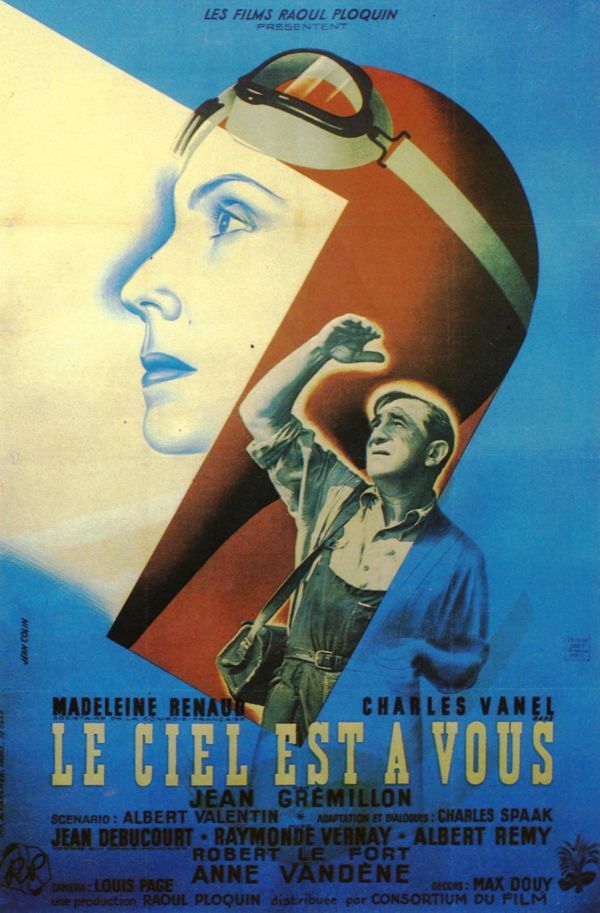
Made during World War II under the Vichy regime which controlled the South of France, it’s tempting to read the story as a metaphor for France’s struggle to be free. It begins with the Gauthier family having to relocate their family garage business, to make way for an airfield (strictly recreational, mind). This, along with a visit by famed aviatrix Lucienne Ivry (Vandène), rekindles a love of flight Pierre (Vanel) has had since his days as a mechanic in World War I. At first, his wife Thérèse (Renaud) is dubious, but after she experiences the joy of soaring through the air, her passion soon exceeds his. She flies, he mechanics, and they prepare a bid, out of their garage, to set a record for long-distance flying by a woman – even as Ivry prepares a much higher profile and better funded attempt on the same mark.
Oddly, it’s a film which reminded me most of two anime. Firstly, the work of Hayao Miyazaki, which has consistently demonstrated a love of flight – most obviously, Porco Rosso. Yet here, it’s odd that a film so much about aviation, is literally grounded. The only shots of planes in motion are taken from the earth, and Thérèse’s record-breaking flight is entirely off-screen. In this, it feels more like The Wings of Honneamise. This was a movie about an alternate-world race into space – yet it was a great deal more concerned about the human aspects than the actual end result. Similarly, this is as much about the love Thérèse and Pierre have for each other. It does come with a note of caution about how shared obsessions can cause tunnel-vision; they even sell their daughter’s beloved piano to fund their project.
Given the era, it’s remarkably forward-thinking. Lucienne and Thérèse are portrayed as easily the most competent aviators, with the men pottering around in their flying machines by comparison. Yet Thérèse is also the glue that holds the Gauthier family together; when she moves to the big city to take on management of a car dealership, their home life suffers considerably. I’d have liked to have seen a better case made for what the appeal of flying is; you’re left to deduce it second-hand, from the reactions of those who have experienced it. Regardless, the appealing central characters here help ensure the viewer is slowly drawn in to proceedings, through a low-key process of familiarity. There’s something particularly genuine about their relationship, and how they’re prepared to sacrifice so much for each other’s dreams. If you’re not holding your breath as Thérèse’s attempt unfolds into disconcerting silence, and even Pierre’s steadfast confidence begins to waver, you’ve clearly not noticed the ominous and foreboding processions of orphans through the town’s streets…
Dir: Jean Grémillon Star: Madeleine Renaud, Charles Vanel, Raymonde Vernay, Anne Vandène
a.k.a. Le ciel est à vous (The Sky is Yours)
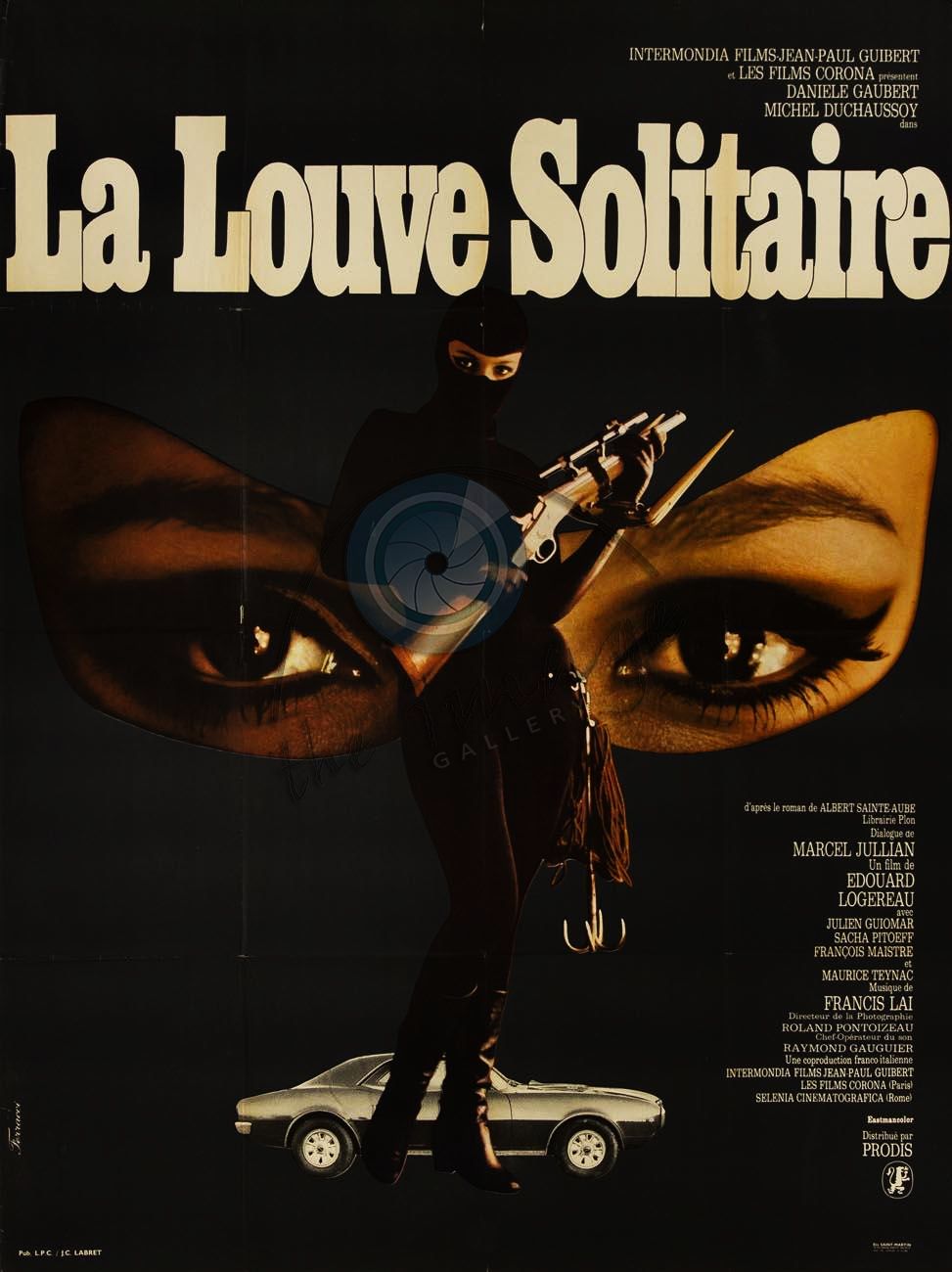
Inspired by the first in a series of books by Albert Sainte-Aube, it’s easy to see why this proved a successful concept. Beautiful circus performer Françoise (Gaubert, who managed to marry both a dictator’s son and a triple Olympic gold medalist, in Radhamés Trujillo and Jean-Claude Killy respectively) takes her talents to the criminal field, where her tightrope and trapeze skills help in her secret life as a cat-burglar. However, this is derailed when she falls for a sting by government operative Durieux (Guiomar), and the price of her freedom is her assistance with a task set by him.
Diplomat Saratoga (Pitoëff) is using his status as a cover for drug-running, and in order to break the operation open, Durieux needs Françoise to break into Saratoga’s office and liberate a 20 kg package of drugs from the safe. To this end, she’s given the help of Bruno (Duchaussoy), a gifted lip-reader who’ll be able to figure out when the deal is going down, and the two of them begin a stake-out from a nearby apartment. But our heroine’s sticky fingers don’t stop at the drugs, and when she also liberates a large sum of cash from the safe, and heads for Switzerland, with the cop, the criminal and Bruno, all keen to track her down, each for their own reasons.
Unfortunately, this is one of those films that, despite a brilliant title (not the original one, which translates as much more prosaically, as The Lone Wolf). doesn’t live up to its promise. There is an awful lot of sitting around and chatting, filmed in a flat and uninteresting manner, and none of the supporting cast provide any kind of depth or interest. That’s a shame, as the action is generally well-handled, not least the heist at the movie’s core, which takes place during a thunderous rainstorm, making every move all the more treacherous. I do have to wonder, however, quite where they are hanging the trapeze from which the heroine swings, or why she bothers – the tightrope-walking depicted on multiple occasions previously, would seem a much more sensible and reliable method of getting from High Point A to High Point B!
Regardless, after a wonderful 10 minutes, it’s back to sitting around and chatting, and that’s largely where the movie remains until the end. More than one review has remarked on the film’s possible status as an inspiration for Luc Besson’s Nikita. While I can see that possibility, in its tale of a woman coerced into working for the government, who yearns to escape, this would be a case where the student’s efforts significantly surpassed those of his master.
Dir: Edouard Logereau Star: Danièle Gaubert, Michel Duchaussoy, Julien Guiomar, Sacha Pitoëff
a.k.a. La Louve Solitaire
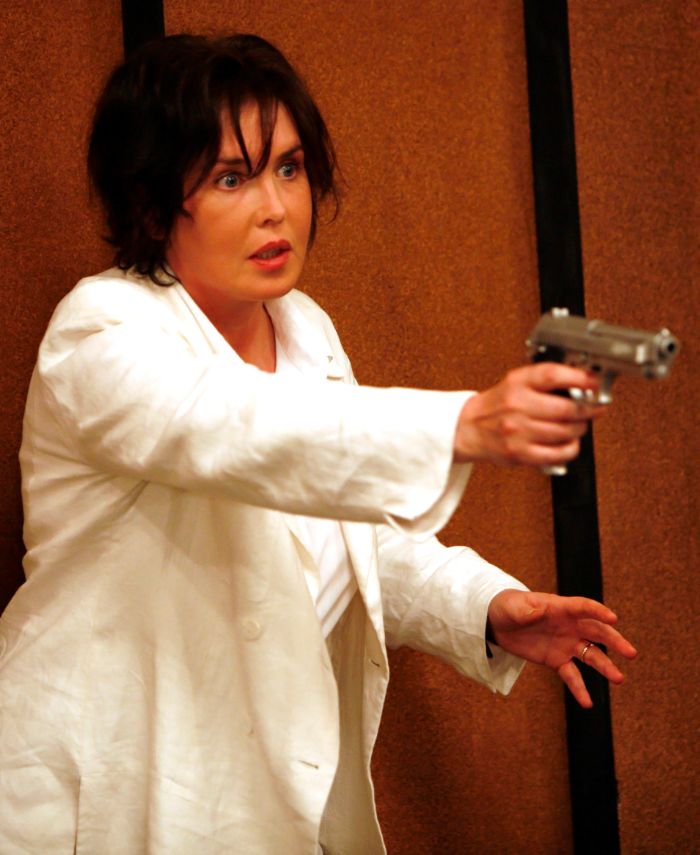
Guaranteed to put anyone off education as a career, this stars Gallic sex-kitten from the 80’s, Isabelle Adjani, now all middle-aged and playing French literature teacher Sonia Bergerac. whose career has devolved into hell – hence the line atop this review. She’s teaching a teenage class who, virtually without exception, clearly don’t want to be there, when she finds a gun in one of their bags. A struggle erupts, and when the dust settles, Sonia has the gun, a student is lying on the floor with a bullet-wound, and a siege situation has begun. On the outside, police negotiator Labouret (Podalydès) is having a bad day himself, trying to avoid a blood-bath, while his political masters try to spin news of the unexpected hostage crisis. But inside the theater, Sonia finds that it’s not just political power that grows from the barrel of a gun: she hasn’t ever had pupils pay such impeccable attention to her lessons before…
Made in 2009, this has, if anything become even more topical in the light of the refugee crisis which has become a hot-button issue in Europe of late. For this pulls few punches in its criticism of those who adopt politically-correct policies, simply to avoid trouble with minorities. The title refers to one of Sonia’s unusual demands, a day that women can wear skirts without the risk of harassment by political or religious conservatives, and writer-director Lilienfeld is also scathing in his criticism of immigrants who don’t integrate into their new homeland (a later reveal indicates it’s the latter aspect which is most important), as well as, it appears, yelling at local kids to get off his damn lawn. It is almost certainly the case that aspects of this will make more sense to a local audience; viewers outside France have to work backwards from what’s presented, to read Lilienfeld’s view of French society, rather than the other way around. However, he is also careful not to paint the pupils with a single brush: some are every bit as aggrieved with the status quo of appeasement as Sonia – and, arguably, with greater justification.
It’s not a film without its problems. The exterior scenes don’t have anything like the same impact, and the end feels almost like the director ran out of things to say, and opted for the simplest way to tie up all the loose ends, regardless of how abrupt it might seem. But it’s still genuinely thought-provoking – not something we find often in our genre here – and even if you don’t necessarily agree with everything Lilienfeld has to say, he deserves respect for saying it in a reasonable way. Adjani, who largely came out of retirement to make this, does a great job: the scenario sounds kinda silly, yet largely through her portrayal of a woman at the absolute end of her rope, it becomes plausible enough to work. Hard to imagine anything like this coming out of Hollywood, that’s for sure.
Dir: Jean-Paul Lilienfeld Star: Isabelle Adjani, Denis Podalydès, Yann Ebonge, Sonia Amori
a.k.a. La Journée de la jupe




 I’ve never played League of Legends, but the good news is, you don’t need to, in order to enjoy Arcane. While that may provide some extra depth, it works perfectly well on its own. There is a degree of over-familiarity with the high-level scenario, which is Generic Fantasy Plot #3. Per Wikipedia’s premise, “Amidst the escalating unrest between the advanced, utopian city of Piltover and the squalid, repressed undercity of Zaun…” Yeah, it’s class war time again, cut from the same basic stamp as Mortal Engines, Alita: Battle Angel and The Hunger Games. To this series’s credit, it does show more nuance than some, with good and bad on both sides of the divide. Perhaps a bit too much though, as there were points where it felt like new characters were being thrown at the viewer, even late into the nine-episode series, when the time might have been better spent developing existing ones.

 This suffers from being almost exactly the same story as the previous feature we reviewed about women Kurdish fighters going up against ISIS,
  There’a a good film in here. Actually, there may be as many as three good films in here. But the way in which they are melded together, manages to rob a good chunk of the power and impact from all of them. We begin by following Mathilde H (Bercot), a war journalist clearly modelled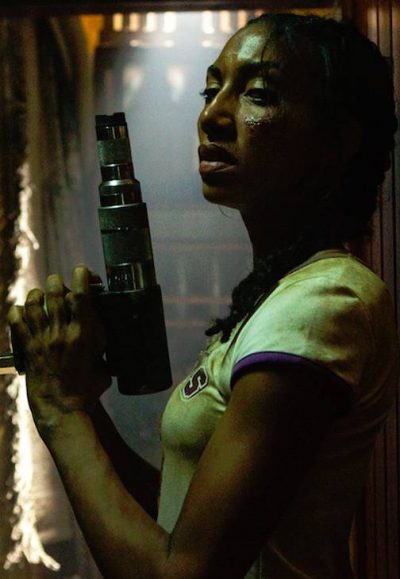
 Before getting to the film, we probably have to address the elephant in the room: the rape accusations against Luc Besson. Though police investigations have finished, with the allegations unproven, they definitely have damaged Besson’s reputation. While in Europe, the basic rule remains “Innocent until proven guilty”, in Hollywood a mere accusation in a newspaper headline or online can potentially destroy a man’s career these days. And while some people are guilty of the crimes of which they were accused, I personally strongly doubt that the small, overweight, apparently introverted Frenchman is a serial rapist.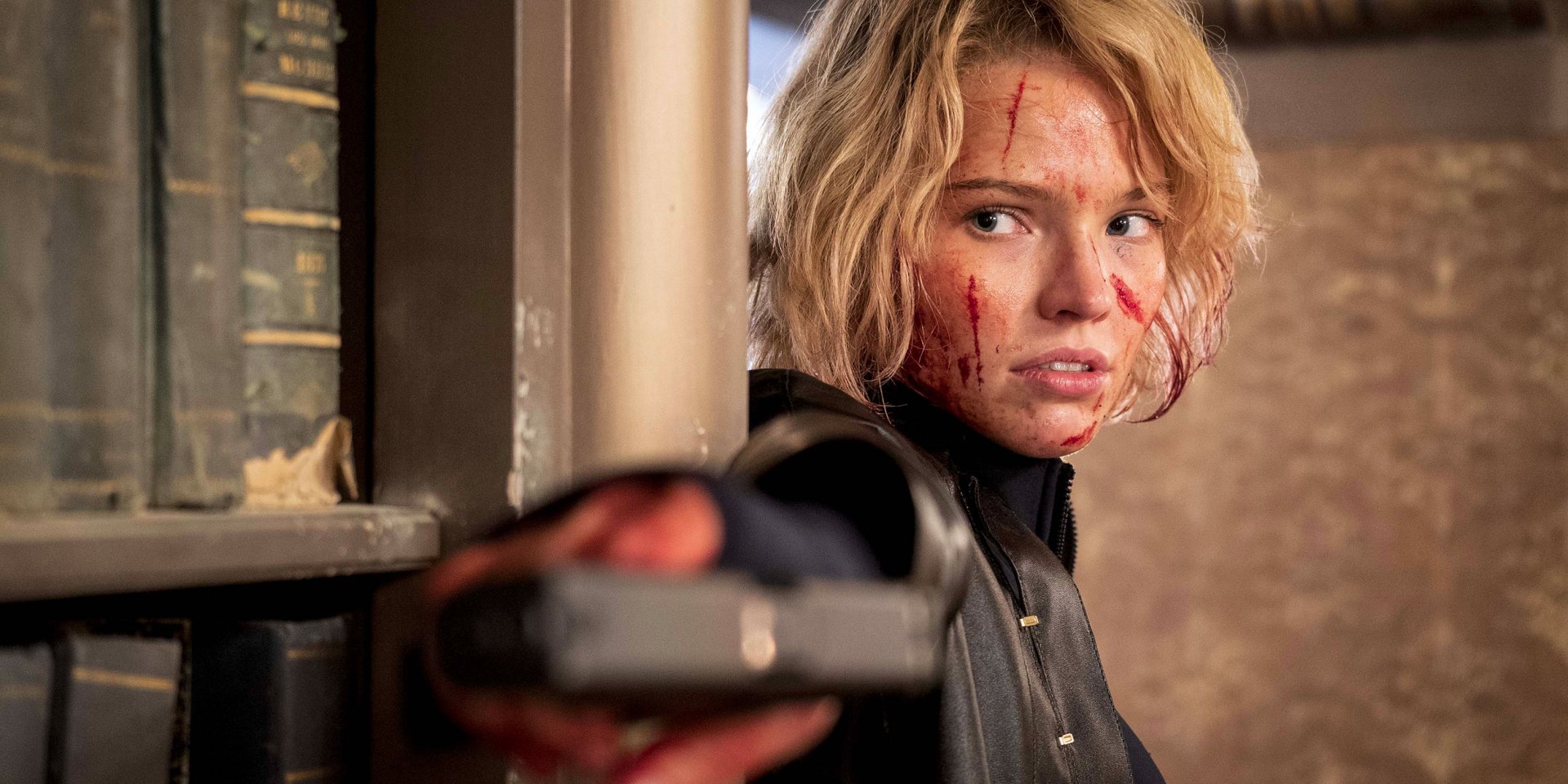
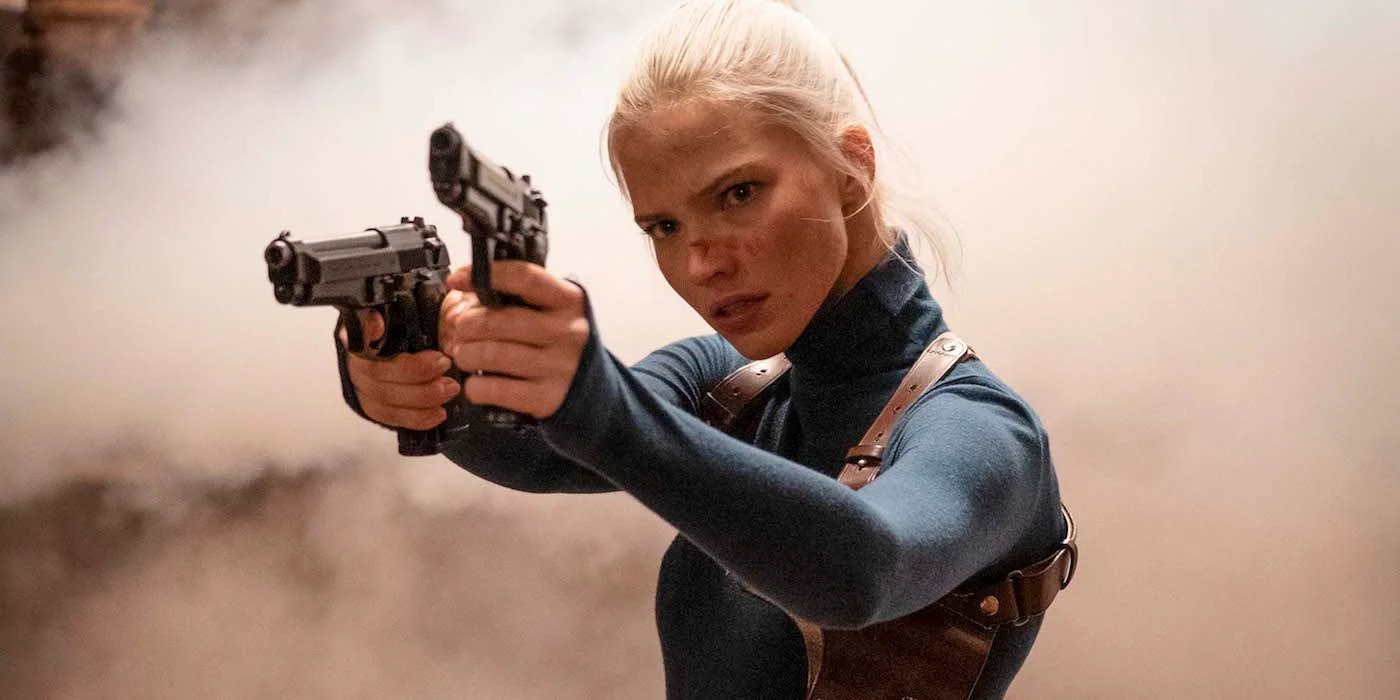 Do I sound too enthusiastic? I don’t think so. Besson is an excellent director. This doesn’t exclude him from creating flawed movies or average scripts; yet even his failures are – at least for me – still more satisfying and interesting than an average “successful” conveyor-belt Hollywood movie. He is an almost classic storyteller, telling his very own stories, depending on what he focuses his current interest on in the moment. One quality I think I haven’t seen mentioned anywhere, is his ability to lead actors. All of the performances here, including Evans, Murphy and Mirren are very good. But the one that really impressed me is supermodel-turned-actress Sasha Luss, who previously played a smaller role as an alien in Valerian.
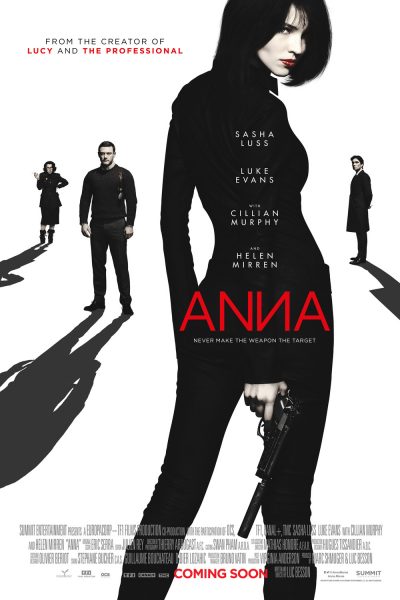 In one scene, a not unsympathetic, shy Russian who is an illegal arms trader confesses his love for her; she kills him in the moment she has the relevant information. Then there is that scene in a restaurant, which makes the similar scene in Nikita look like a Disney movie in comparison. Anna leaves a room full of bloody corpses behind her; the word “overkill” sprang immediately into my mind! A normal “relationship” with her girlfriend seems possible; but Anna hardly seems to care for her, since said friend is mainly a cover. At the same time she has passionate sex with Evans and Murphy, and calls them her family. But is this just another deception? You never know if she cares for anyone at all, or if she is just manipulating everyone around her emotionally and sexually, for use later in her intricate plan.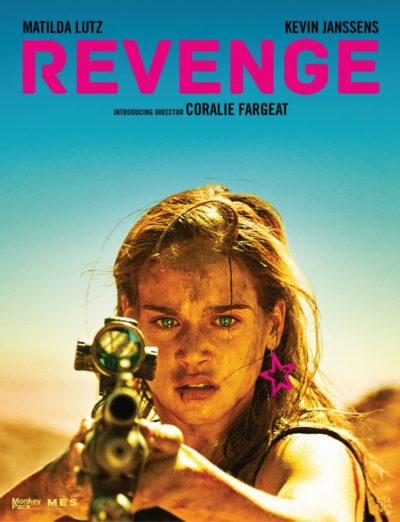
 For a film lauded for its supposed up-ending of the male gaze, this feels a bit odd, since it could be read as the sexual assault triggering Jen’s blossoming: rape as psychological therapy. She should thank her attackers! [The image of a rising phoenix branded into her skin, due to her impromptu first-aid, is not exactly subtle in its imagery. Then again, the entire film is not exactly subtle, and proudly defiant as such] If that reading is on shaky ground, it’s also amusing to note Revenge utterly fails the dreaded Bechdel Test, despite being brutally empowering, to a degree rarely seen. More evidence – as if it were really needed – of how shitty the Bechdel Test is at evaluating films.