




★★★★
“Want another piece of Chocolate?”

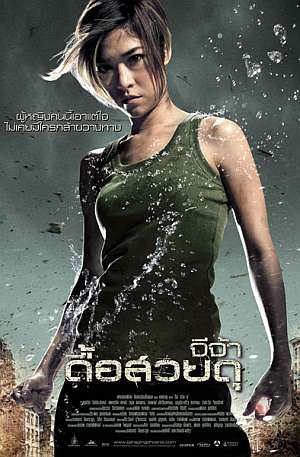 If you’ve seen Chocolate – starring the same lead actress, though confusingly billed under a different name here – you’ll know what to expect, and the film delivers much of the same. Which would be stunning, brutal fight scenes combined with moments of mind-numbing tedium. The plan for Yanin’s career seems to be to contrive methods by which she can avoid acting: last time it was autism; here, it’s a drunken style of kung-fu which helps mitigate a voice that might charitably be compared to broken nails on glass. She plays former rock-star(!) Deu, who is on the edge of being kidnapped, when she’s rescued by Sanim (Tang). He and his fellow masters of alcohol-fu have all lost ladies in their life to the kidnappers – who, it turns out, are doing this because… No. You wouldn’t believe me even if I told you – and are trying to locate their lair. Deu joins the team, and agrees to act as bait, to see if the kidnappers will go after her again.
After a brisk and entertaining start, this drags badly in the middle. At 111 minutes, it is simply too long, and needs to lose at least a quarter of an hour. However, as with Chocolate, the action makes up for any such deficiencies, with the final reel featuring an escalating trio of fights, any of which would be entirely credible climaxes for any other movie. This culminates in a battle against female body-building champion Roongtawan Jindasing, the leader of the kidnappers, which is the most savage, knockdown, heroine vs. villainess brawl I’ve seen in… Ever? I can’t think of anything to match it immediately. Jindasing’s raw power pitted against Yanin’s devastating flexibility makes for a fabulous contest, and this is preceded by some great “pairs martial-arts” [when you see it, you’ll understand], when Deu and Sanim try to take out the villainess.
A fractional complaint is that the spotlight, action-wise, is not solely on Yanin, especially in the first two-thirds of the film. While the co-stars are by no means incompetent, it’s a step down from Chocolate, where the focus was squarely on her, and going into the last turn, this one getting a seal of approval seemed unlikely. However, the movie found an entirely new gear – one apparently just not available to other film-makers – and surged over the finish line. Just as Chocolate was the best action-heroine film of 2008, it looks like Raging Phoenix will be right up there in the 2009 contest.
Dir: Rashane Limtrakul
Star: Jeeja Yanin, Kazu Patrick Tang, Nui Sandang, Sompong Lertwimonkasem
 ★★★★
★★★★ The second series of TLC’s “mommy cops” reality series struck close to home, centered as it was on Phoenix. It didn’t come as much surprise as our local sheriff, Joe Arpaio, is infamous locally as a media whore, who wastes no opportunity for self-promotion, and is a sharply-divisive figure locally, adored and loathed by about equal parts of the population. We wondered how long it would take before Joe slimed his way onto the screen: six minutes into the first episode, we had our answer. Fortunately, this was more of a blip, and our fears of an Arpaio-centered show proved largely unfounded [see the execrable Smile… You’re Under Arrest for how bad this could have been].
 As notable as what is shown, is what was
 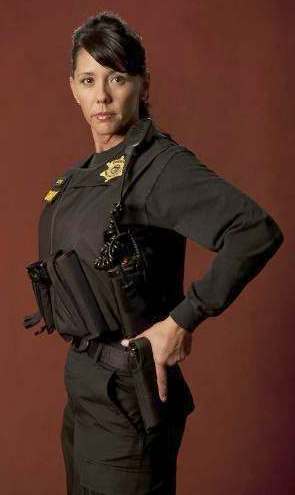 Finally, there’s Detective Deborah Moyer (right), who is completely marvellous, and the main reason to watch the show. A 19-year veteran, we’d be entirely happy if the show was 100% about her. While the other women occasionally seem very scripted when they are talking to the camera, that isn’t the case with Moyer: there’s a definite sense that what you see is what you get with her. While her policing style may not be “by the book” – in one episode, she basically arrests a teenage girl for failing to hug her father – her reactions are entirely natural and certainly had us nodding in approval more often than not. She just comes across as being very normal: when she encounters a young perpetrator, she tends to think about her own kids of the same age.
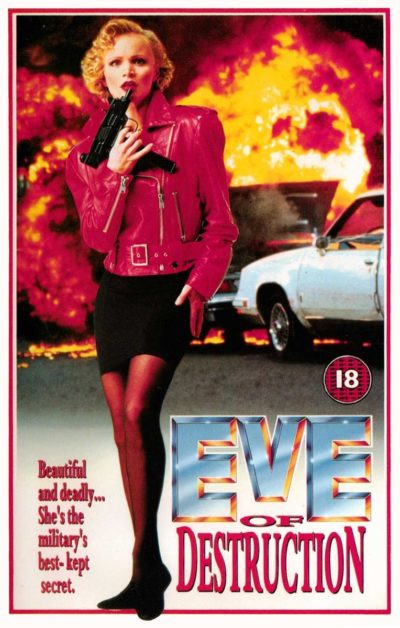 While undeniably a product of its time – which would be 1991 – this has stood the test of time very well, and remains a solid piece of action SF. Eve Simmons (Soutendijk) is a researcher working for the US government on creating life-like robots for surveillance missions, and her creation, Eve VIII, not only looks like her, but has her memories and psychology too. When on a test run in San Francisco, Eve VIII is caught up in a bank robbery and a bullet sends her off the grid, and on her own mission. Jim McQuade (Hines), something like a proto-Jack Bauer, is brought in to track down the lost little robot, who has all of her creator’s complexes, but none of the social restraints, leading to a fondness for automatic weapons, which she uses with abandon as she works out her psychiatric issues [cheaper than counselling, and a good deal more fun]. Oh, and Eve VIII also has a nasty little surprise package tucked away inside. It’s up to McQuade and Simmons to stop the killing machine before things
  But as a straightforward B-movie, it works nicely, with Hines having a nicely sardonic wit: “A spinach lasagne, in a light tomato and basil sauce,” is the reply, when Simmons asks dubiously what is McQuade’s “specialty” as a government agent. I’m still trying to work out if the film is feminist or chauvinist: you could read it either way, with the ‘liberated’ (if robotic) woman a free spirit, though the ending firmly puts Even back in her place, to say the least. She also emasculates one man, somewhat familiar territory for Soutendijk, who previously wielded a scissors to leg-crossing effect in The Fourth Man. Gibbins, meanwhile, died in the 1993 Hollywood fires, while trying to rescue a cat. Guess there’s never an unstoppable robot around when you really need one.
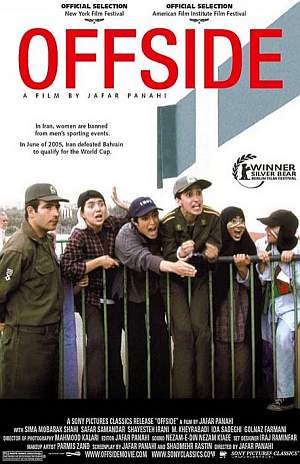 Being an action heroine is a rebellious, possibly revolutionary, act against society: what counts, depends entirely on how your society views women. Going to a soccer game, for example, would not qualify you in the Western world – but as in Ancient Greece, sporting events in Iran are strictly male-only, and a woman who attends one and gets caught, will find herself handed over to the Vice Squad. It redefines requirements somewhat, to say the least. The film tells the story of a number of women, who dress as men to sneak into a crucial 2005 World Cup qualifier between Iran and Bahrain, only to find their disguises imperfect. They’re held in an area, just out of sight of the game, by a group of soldiers, who really have better things to do themselves.
 Particularly outstanding is Irani’s tomboy, who becomes the de facto leader of the group, and continually hassles the guards. The film has a surprising amount of straight-faced humour, such as her riposte when asked if she’s a boy or a girl: “Which do you prefer?” Or one girl’s response when told they can’t go in because the men will be cursing: “We promise not to listen.” Similarly, when another needs to use the bathroom, this poses problems, since naturally there are no women’s facilities. The solution involves the impromptu conversion of a poster into a mask, though this hardly resolves things. Obviously, it’s not a traditional genre piece, and it’s this
 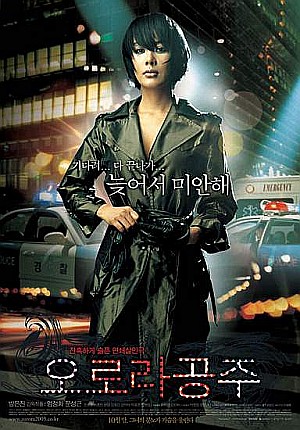 After inflicting Forbidden Warrior on Chris, my stock with her had slumped like Morgan Stanley. Fortunately, this Korean serial-killer flick provided a good measure of redemption. It stars in a department store, where Sun-Jung (Uhm) sees a mother abusing her young daughter, before leaving her and going into a stall. Sun-Jung shepherds the girl outside, breaks into the stall and stabs the mother repeatedly. The case is investigated by Detective Oh (Mun), who spots his ex-wife in the store security video. When bodies keep turning up, though killed in different ways, the police link the cases due to the cartoon stickers found on each scene. Oh gradually comes to suspect his wife is taking revenge on those holds she responsible – directly, or otherwise – for the death of their child, killed in a brutal kidnapping previously. Is that really the case, and if so, does he have the moral fortitude to turn in a woman he still loves as a murderer?
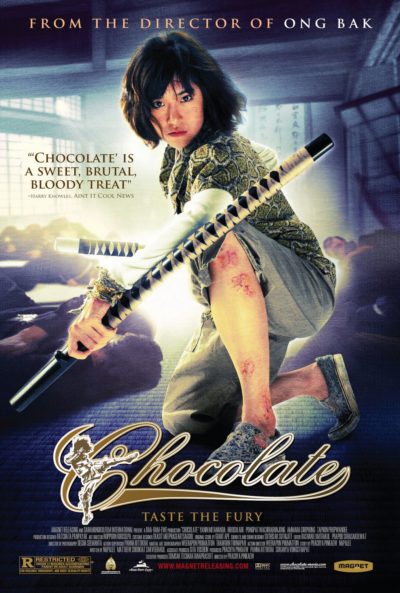 Zen (Vismistananda) is the autistic daughter of a Japanese gangster and a Thai woman (Siripong), who betrayed her local partner, a rival boss (Wachirabunjong), to be with her lover. When her mother gets cancer, it’s up to Zen and a chubby friend (Phobwandee) to collect on debts owed. Fortunately, Zen has a sponge-like ability to learn martial arts, be it from Tony Jaa movies on TV, or the school next door, and proves herself adept at “encouraging,” shall we say, repayments from those who are reluctant to pony up. The bad news is, this attracts the attention of her mother’s former employer, who has not forgotten the past and is unwilling to let matters lie. Which, inevitably, leads to a showdown where Zen takes on an apparently infinite line of henchmen – it’s somewhat reminiscent of Kill Bill, Volume 1, in the same way an earlier ice-house battle reminded me of The Big Boss, However, the final fight, on a series of balconies, is bone-shatteringly unique.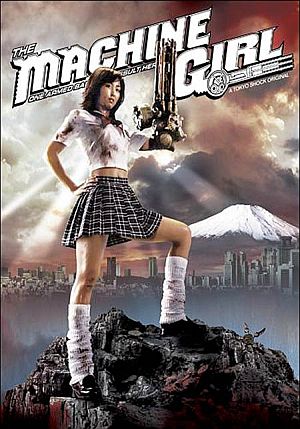
 If you enjoyed Planet Terror, you’ll likely get a kick out of this, which also combines elements of The Evil Dead, Kill Bill and Tetsuo the Iron Man into what has got to be the bloodiest movie of 2008. The life of Ami (Yashiro) is turned upside down when her brother and his friend are killed by school bullies under the control of a local gangster’s son (Nishihara). Ami sets out for revenge on all those responsible for the killings. But the Yakuza don’t take kindly to this and Ami finds herself with a count of functioning limbs that ends at three. Does that stop her? Of course not. Teaming up with the late friend’s mother Miki (Asami), whose husband happens to be an ace mechanic, Ami gets fitted with a machine-gun and the pair of vengeful vixens head off for a return match.
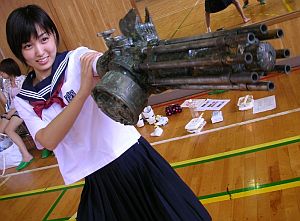 Yashiro’s background is in…well, what could politely be described as ‘bikini videos’, not action movies, but her performance here is respectable enough. Probably more impressive are Asami, and Honoka, who plays the wife of the Yakuza boss. They both, too, come from the adult industry, possessing an impressive feral intensity which reminded me of Brigitte Lahaie in Fascination, and is entirely in keeping with the grindhouse feel of the entire enterprise. You could argue that the trailer contains everything you need to see, in a more concentrated form, and I wouldn’t argue with that, or if you said this was no more than a porn variant, where nothing matters except the money shots of body fluids getting sprayed everywhere. Still, we had a blast, and the film fully lives up to the sleeve description, delivering the “One-Armed Ballistic Assault Heroine” it promises, in spades.
 Let’s start off by giving us a heroine who is dying, thanks to an inoperable brain tumour. Way to bring me down, Juncture: what do you think this is? DamesWithDiseases.com? The Hallmark channel is tha…oh, hang on. She’s following a child-porn purchaser back to his house, and guns him down? Hmmm. This is clearly not your everyday Illness of the Week flick. For Anna Carter (Blackport) has decided to go out with a bang: several of them, in fact. Realising she only has a short time to live, she decides to extend her day-job as the co-ordinator for a charitable foundation, and correct the failings of a justice system: neglectful mothers, drunk drivers, selfish CEOs, they’re all likely to meet impeccably-dressed vengeance.
 Still, there’s a great deal to admire here, with every penny being squeezed out of the budget. Particular kudos to cinematographer Richard Lerner and composer Neal Acree, whose efforts enhance proceedings significantly – the results look to be the product of a significantly-higher budget, than the rumoured million dollars. It leaves you questioning what you would do in the same situation: follow Queen Latifah off on a Last Holiday, or head for the dark side, as Anna does here, with a mission for what you perceive as the ‘greater good’? Certainly more thought-provoking than usual, it’s intended as the first part on a trilogy, though stands fairly well on its own, I would be very interested to see how things proceed from here, as Anna heads towards closure, both personal and medical.
 This is probably a borderline Girls With Guns flick, but Angelina Jolie is the nearest thing we have to a legitimated action-heroine superstar: Lara Croft, Mr. and Mrs. Smith and now this, where her character, the uber-assassin Fox, is certainly the most interesting in the film. Office drone Wesley (McAvoy) discovers his true heritage is in The Fraternity, a group of killers who surgically remove bad elements from society, as their names come up encoded in a cloth woven by a mystical loom. However, one of their number has gone rogue, and Cross (Kretschmann) is now taking out his former colleagues, one by one. Recruiting, training and using Wesley, is the only hope they have to stop the renegade.
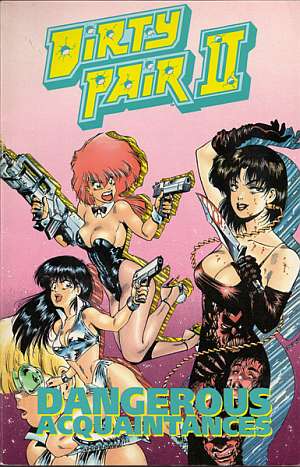 It’s been at least a decade since I read this – probably more – but it is still a thoroughly-enjoyable read, and a major improvement in just about every way (plotting, art, pacing, imagination and characterization) over the first stab. Of particular note is the solid way in which the two separate threads of the story are woven together. While on holiday, Kei and Yuri bump into Shasti, a former colleague of theirs in the WWWA. She was actually an android, who went rogue after a criminal’s personality was implanted into her, part of a (failed) experiment to see if it would help with his capture to have her think like him. She’s now apparently leading a group of “freedom fighters” who are planning to hijack a luxurious space-liner, crammed with VIPs and new technology. Has Shasti gone all political? Or, if not, what is she up to?