 ★★★½
★★★½
The Girl with the Dragon Tattoo
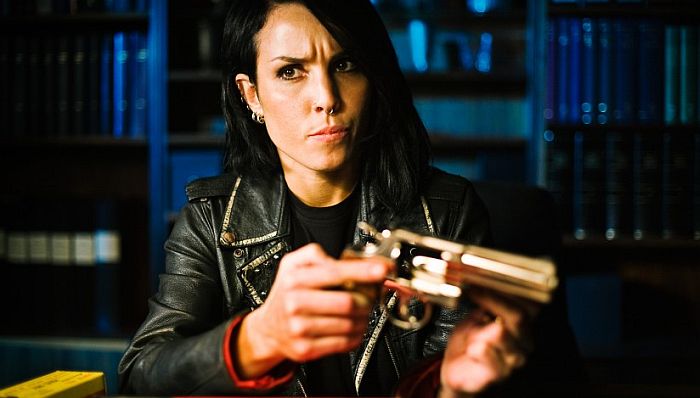
I think we know the exact moment we fell in love with the character of Lisbeth Salander, the central character both in Stieg Larsson’s Millennium trilogy, and the Swedish films based on the books. It would be the scene in the first film where she goes back to see the man who had been sexually abusing her. Little did he know, on her last visit, she had recorded the whole event. This time, she knocks him out, ties her assailant up, forces him to watch the video and then engages in a spot of amateur tattoo work, leaving him with “I am a sadistic pig and a rapist” etched permanently across his torso. Yeah. You go, girl.
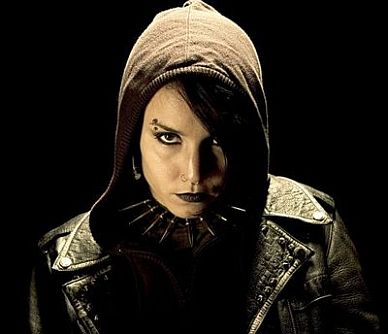 Salander is not your typical action heroine: she’s 5’4″, weighs maybe 90 lbs dripping wet, and anti-social to a degree that may be pathological. But she possesses a mind like a steel-trap, impressive computer hacking skills, a steely resolve and a zero-tolerance policy for anyone who abuses women [the Swedish title of the first book and film translates as “Men Who Hate Women”, and misogyny is something of a theme throughout the trilogy]. This was demonstrated very early: at the age of twelve, and fed up of seeing her father hurt her mother, she doused him in petrol and set him on fire. Like I said: “zero-tolerance”.
We first meet Lisbeth in Dragon Tattoo, using her skills to conduct surveillance on Mikael Blomkvist (Nyqvist), a journalist who has just lost a libel case and is facing prison as a result. As a result of her report, Blomkvist is hired by Henrik Vanger (Sven-Bertil Taube), to investigate the disappearance, forty years previously, of his niece Harriet, who was also Blomkvist’s babysitter. It has been nagging at Vanger ever since, and he feels his time is running out to find the truth. Reviewing the evidence, Blomkvist finds names and numbers in Harriet’s bible, but it’s Lisbeth, helping ‘remotely’, who cracks the code, revealing them to be verses from Leviticus about punishing sinners. The two gradually peel away the years to reveal the truth, a serial-killer whose crimes go back to just after the war – a truth that proves very uncomfortable for some in the Vanger family.
To some extent, Lisbeth is secondary to that plot, but she also has her own concerns to deal with. After the incident involving her father, she spent most of her youth under psychiatric observation. Even after release, she is still effectively ‘on probation’, under the control of various court-appointed guardians. The latest, a lawyer named Bjurman (Andersson) is a truly slimy jerk, who abuses his position to extract sexual favours from Lisbeth. After all, she’s just a little girl – what could she possibly do? See the opening paragraph for specifics there, if you’d forgotten.
Dir: Niels Arden Oplev
Star: Michael Nyqvist, Noomi Rapace, Sven-Bertil Taube, Peter Andersson
★★★★
The Girl Who Played with Fire
 It’s in the second film, Fire, that Lisbeth really comes into her own. After a period traveling the world, she returns to Sweden, and pays a visit to Bjurman, who has been looking into tattoo removal – she warns him off doing that, threatening him with his own gun. However, she leaves the gun behind, and Bjurman then uses it to frame Lisbeth for the murder of two crusading journalists, who were working on a story exposing sex traffickers, and those using the women they provide, for Blomkvist’s magazine. With both the police, and the real perpetrators – the criminal gang who control the traffic – trying to track her down, Lisbeth is forced underground. Fortunately, Blomkvist is able to help, as Lisbeth turns the table and goes after the shadowy “Zala” who leads the crime syndicate.
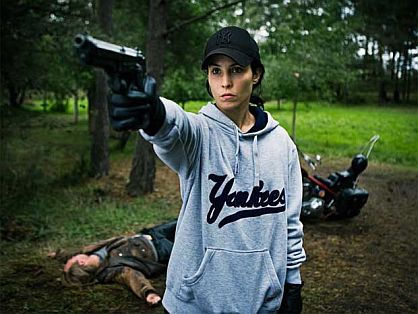 There’s a number of very interesting aspects to the film, such as how Blomkvist and Salander don’t meet until the final scene – I can’t think of many other film where the two central protagonists do that [Heat comes close]. But it’s most memorable for the unstoppable force which Salander has become, utterly fearless, whether it’s taking on a pair of bikers or going into the heart of enemy territory. Even when you think it’s all over for her, she crawls her way back in a way which would make The Bride applaud. It’s curious, yet somehow entirely fitting, to see her as an updated, adult version of another Scandinavian literary and cinematic icon: Pippi Longstocking. Except, to steal a line from Romy and Michelle, she’s like a Pippi who smokes and says “shit” a lot.
Salander’s personality is abrasive, and she clearly has difficulty relating to people or showing them anything even approximating affection: the closest she gets is a bewildered silence. I think the only time we saw her give a genuine smile was in the third film, when she received news that someone she hated had been killed. And yet, people like Blomkvist warm to Lisbeth, initially pitying the circumstances in which she finds herself, yet eventually seeing the human beneath the multiple layers of defensive ice. Fiercely loyal to her (very few, admittedly) friends, and as lethal as a boxful of well-shaken, peeved rattlesnakes to her enemies, the second film proves her to be smart, and as quick with her fists as her brain.
Dir: Daniel Alfredson
Star: Michael Nyqvist, Noomi Rapace, Yasmine Garbi, Paolo Roberto
★★★½
The Girl Who Kicked the Hornets’ Nest
The third film, like the second, has Blomkvist and Salander apart for almost the entire movie; they meet only right at the end, in a way which is as low-key and unobtrusive as an Ikea coffee-table, yet somehow feels entirely appropriate. This time, their separation is because Salanger is in custody for attempted murder, following the events at the end of Fire. The secret group in authority, whose activities are in danger of being exposed, intend to avoid the embarrassment of a trial by getting Salander certified as insane, so she can be locked up as mentally incompetent. This brings her back to confront Dr. Peter Teleborian (Ahlbom), the man in charge of the institute where Lisbeth spent two years. However, Blomkvist asks his lawyer sister, Annika (Hallin), to take up the case. Can they reveal the truth before Lisbeth is committed to Teleborian’s sinister care one more?
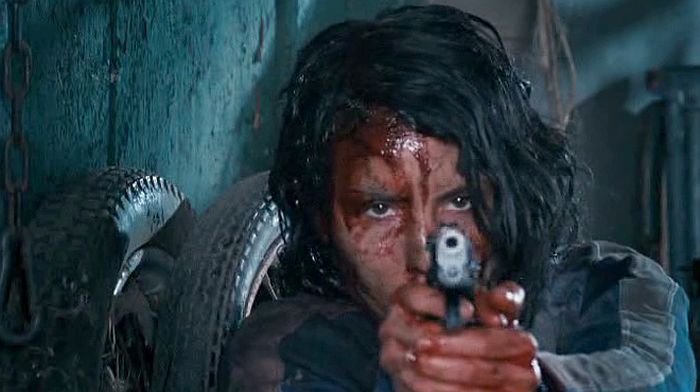
While undeniably a good end to the trilogy, tying up the loose ends and dishing out justice in a solid, satisfying way, it seems a shame to have Lisbeth locked up for 95% of the film. This is much more a purely-investigative thriller than the first two, which were more action-oriented. Here, there’s a fight in a restaurant for Blomkvist, and Salander’s only action is an admittedly impressive battle in a warehouse against an unstoppable force. Much as at the end of the first movie, she doesn’t actually kill the opponent herself, though here, that would be more due to a lack of ammunition for her impromptu weapon. While a nice final act by which to remember Salander, it’s not representative of her more passive role in this entry.
 The trilogy of books have sold more than 50 million copies worldwide, though sadly, Larsson didn’t see their success, as he died in 2004, before they were published. The success of the films, which have grossed a total of more than $210 million worldwide – a phenomenal sum for any non-English language series – has led to the inevitable Hollywood remake. Pause for eye-rolling here… Except, the American Tattoo does have David Fincher at the helm, so I’ll wait until seeing it – while, naturally, reserving the right to administer a good kicking in due course. The first pictures of Rooney Mara as Lisbeth (right), don’t exactly inspire confidence, as she looks more like some kind of coked-up fetish supermodel than anything else. Daniel Craig plays the role of Blomkvist, which would seem to make him a bit more glamourous too.
I guess we’ll see, but Fincher and Mara will certainly have their work cut out. I can’t help thinking of the lukewarm remake of another, highly-lauded Scandinavian movie, Let the Right One In, and the overall history of such things is not cause for optimism. But even in a worst case scenario, we’ll still have the books and Noomi Rapace’s steel-cold portrayal. Wikipedia says that when Larsson was 15 years old, “he witnessed the gang rape of a girl, which led to his lifelong abhorrence of violence and abuse against women. The author never forgave himself for failing to help the girl, whose name was Lisbeth,” even though much of his life was spent fighting oppression, in various forms. But with his creation of a new style of heroine, one appropriate for the 21st century, Larsson has, unwittingly, perhaps achieved redemption.
Dir: Daniel Alfredson
Star: Michael Nyqvist, Noomi Rapace, Annika Hallin, Anders Ahlbom




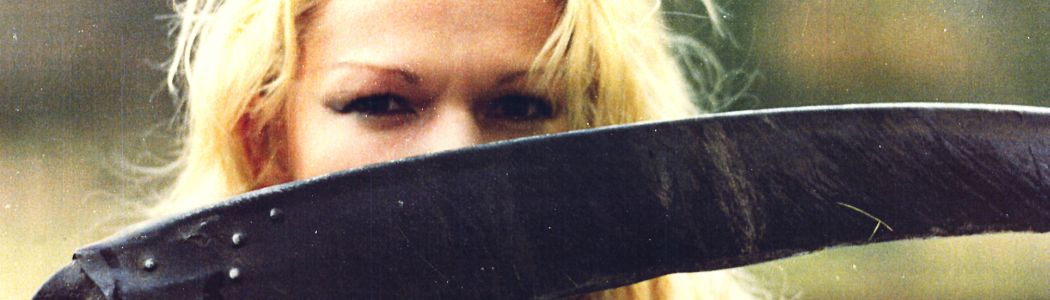 ★★★★
★★★★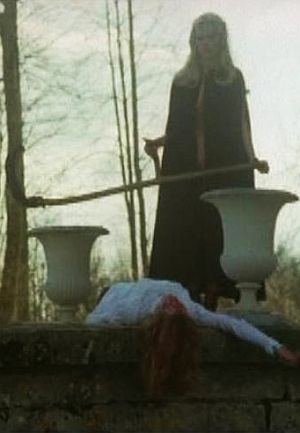 Watching porn stars try to act is often a painful experience, but renowned 70’s XXX starlet Lahaie is perfectly cast here. She plays a feral creature, driven entirely by instinct, and with no qualms about using sex or violence to achieve her aim, of keeping Mark in the house for the night. The sight of her stalking across the bridge which forms the castle’s sole entrance, wielding a blood-stained scythe almost the same size as the actress, is one that will stick with you. The film does betray its cheapness with some fairly crappy effects [you’re going to have someone hacked apart with a scythe, you should do better than some red gunk on the throat], but more than makes up for it with a parade of strong, confident and sensual female characters. Mark is by no means an idiot or a weakling, but from the moment he arrives in the house, it’s clear he’s completely beyond his depth, out-maneouvered at every turn by the women.
 There’s Aya (Otugoro), the stoic sword-wielding one seen on the poster, and Reiko (Hashimoto), the leather-clad one with the infinite-ammo shotgun. Along with fat sidekick Katsuji (Waki), they’re looking for Aya’s sister, Saki – and also Dr. Sugita (Suwa), the mad scientist responsible for the zombie outbreak which has swept the world, setting sister nibbling on brother, daughter on mother, etc. On the way to their goal, they meet other survivors, a zombie version of GoGo Yubari from Kill Bill, and several million gallons of digital blood, including a good chunk sprayed onto the camera lens. Now, I’ve never played the game at all, so can only assume everything makes perfect sense in that universe. Still, as adaptations go, this seems to capture the inherent spirit of mindless slaughter admirably, with Aya’s power-up the most devastating video-game weapon since the Defender smart bomb. I just dated myself horribly, didn’t I?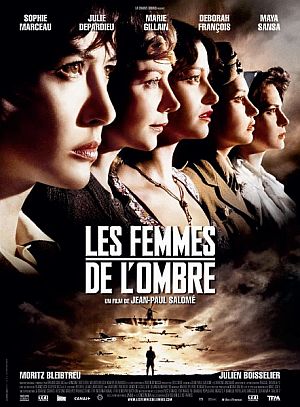
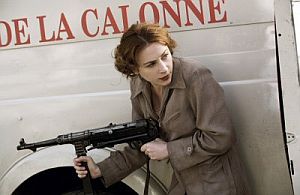 It’s a solid piece of action/drama, which managed to keep both of us awake, despite a session earlier in the evening at the “all you can eat” fish fry; normally, that requires 30,000 Volts to keep us from sliding into post-gluttony unconsciousness. I think Chris enjoyed the movie a little more: I was somewhat on the fence about giving it the seal, finding some of the plotting a little convoluted and occasionally implausible, but her endorsement of this as “great” provided sufficient impetus. Marceau is particularly good, exuding steely resolve to hold the team together, and Bleibtreu makes an excellent foil, coming across as equally smart and committed as Louise. Their conflict is the glue that binds the story together, and makes it one of the best efforts in the wartime heroine genre to date.
 It makes sense that this stems from a drunken agreement between the three co-directors at a film festival, because this is the sort of film you would only make under inebriated terms, and it’s probably true to say that drunk is the best way to watch this. That’s not a bad thing per se, just that its loopy sensibilities and over-the-top antics would seem to go
  ★★★★
★★★★
 Zombie was responsible for the Werewolf Women of the SS faux-trailer in Grindhouse, and brings much the same gleeful approach to proceedings here. Indeed, we first see Suzi-X kidnapping the head of Hitler, which is kept alive in a jar (as in They Saved Hitler’s Brain), and then has to escape by fighting her way through a massive pack of Nazi zombies (that’d be from Shock Waves). Carnage ensues, as it pretty much does, any time Suzi-X is on the screen, which is a lot – she gets far more of the action than El Superbeasto does. Proceedings culminate in a lengthy, slo-mo catfight, entirely necessary to the plot, between her and Von Black, while the soundtrack cheerily informs us that “It’s OK to jerk off to cartoons – the Japanese do it every day – so rub one out for the USA…”
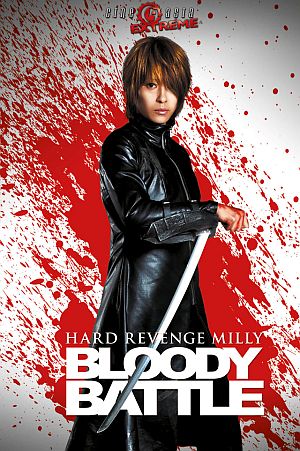 In the near(ish) future, Japan has become a post-apocalyptic wasteland in which only the strong survive. Initially, that does not include Milly (Mizuno), who is tortured by the Jack brothers and their gang: her baby is set on fire, while she has her breasts sliced off and is left for dead. However, she survives, albeit in a partially-mechanical form, and has now devoted her life to revenge on those responsible. Her artificial enhancements include a shotgun leg, a sword up her sleeve and a chest that… Well, that has to be seen to be believed, let’s just leave it at that, shall we? That’s Hard Revenge Milly, the first of the two films on the Western release DVD.
 ★★★★
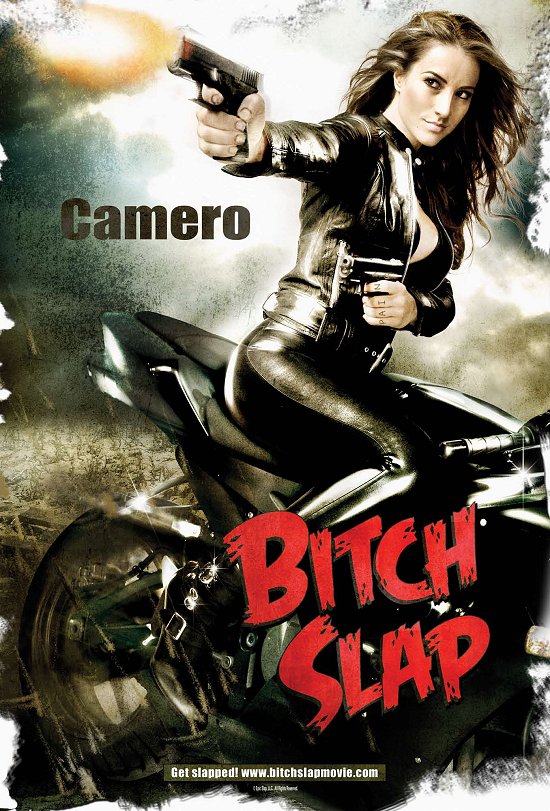
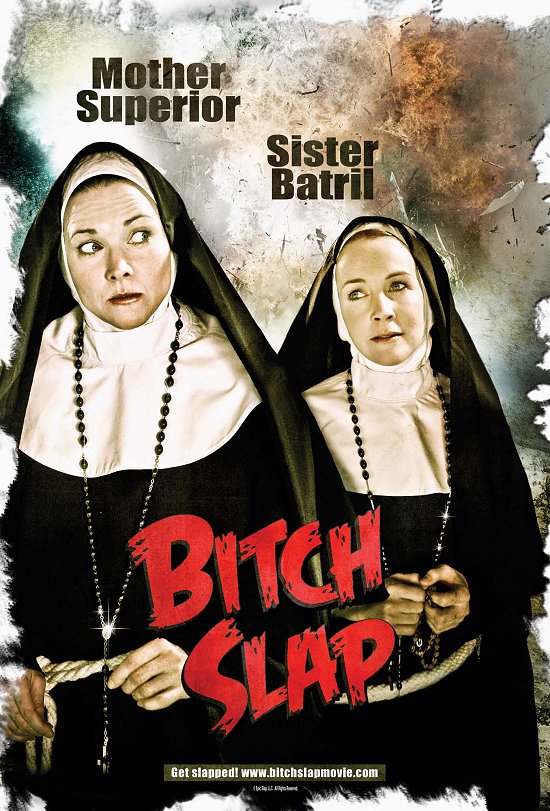
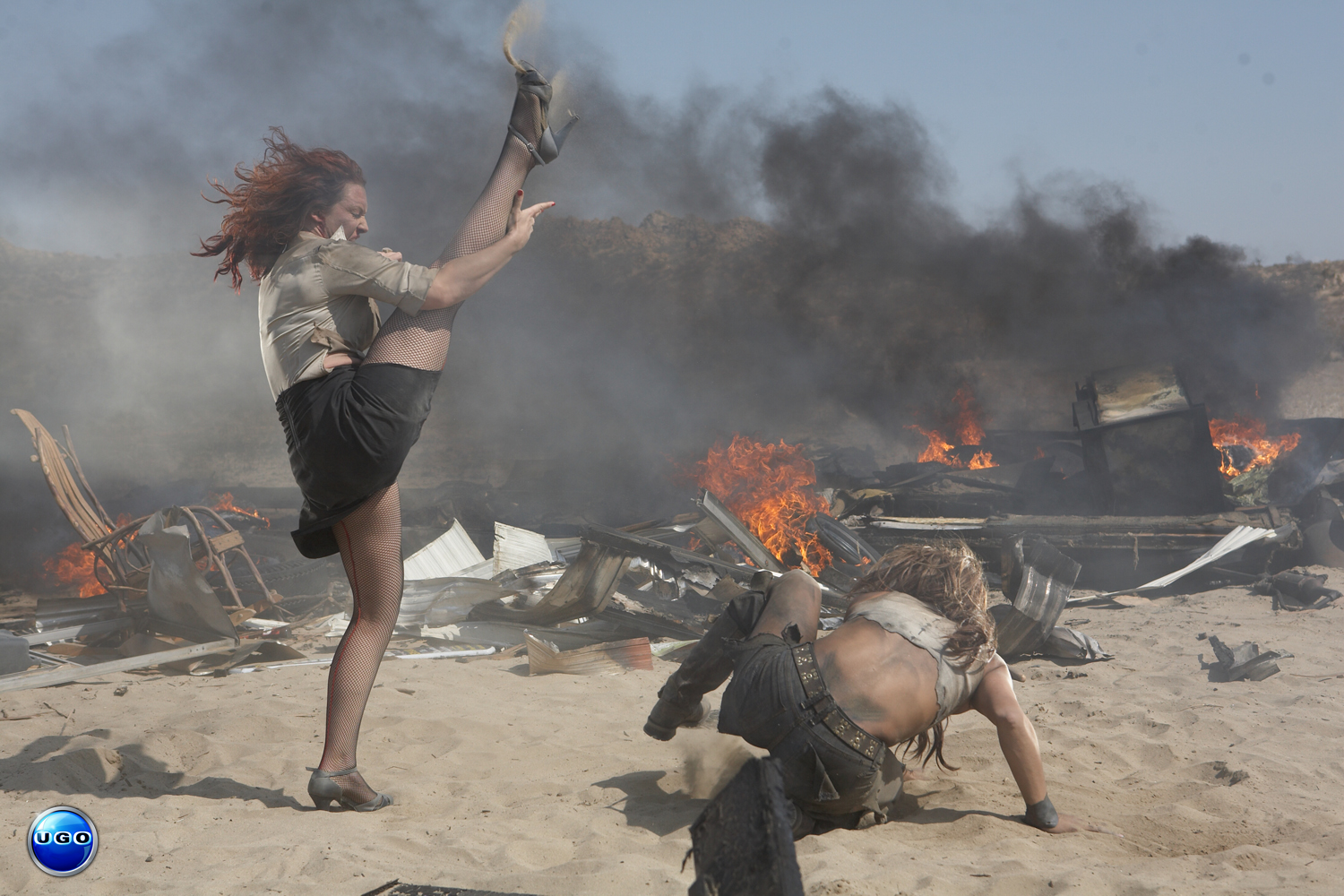
★★★★ Chris has a certain firmness of opinion. When she has made up her mind about something, it’s pretty hard to get her to change it. She will purse her lips, fold her arms and stick to her guns. You could argue whether this strong will is a character quality or a flaw, but it certainly led to her early exit from Bitch Slap. Here’s an approximate timeline of the comments from the seat on the couch next to me:



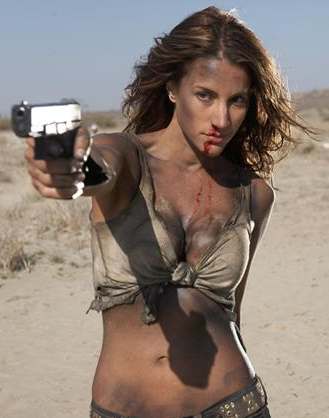 The main weak link is the leads, who don’t have the chops – physical or acting – to pull this off. I to wonder whether it might have been a good deal better if stunt co-ordinator Zoe Bell, Lucy Lawless and Renee O’Connor had been the stars of the film, rather than merely cameos. They have all previously shown the necessary combination of martial ability and screen presence necessary for the parts here. Not that the actresses here are “bad”: however, when you’re spitting out Satana-esque lines like, “Ram this in your clambake, bitch cake!” you’d