

Charlotte Who? – A Gaelic Football Story in America

★★★★
“When Irish eyes are smiling.”

I stumbled across this entirely by accident, Tubi’s autoplay feature putting it on after watching some World Cup highlights. But the start was intriguing enough to keep me watching, and turned out to be a really good documentary, even if the story is a bit clichéd. The original title was the rather more forthright, Who the Fxxk is Charlotte? and that sums up the approach here. Any viewers with an aversion to strong language should not apply. It’s the story of the Charlotte, North Carolina women’s Gaelic football team, and their quest to win the national title. Gaelic football? Yes: an Irish sport, which combines elements of football and rugby. In Ireland, it’s close to a religion with fierce rivalries that go back to the 19th century. 
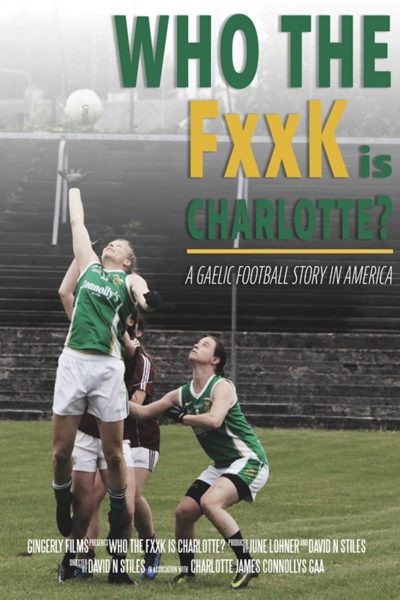
The Charlotte club was formed in 2000, and based on what we see here, is as much a social organization as a sports club. There does appear to be quite a lot of consumption of adult beverages. But there’s no doubt, they take the sport seriously, and recruit from all round the area, both Irish and American players. On North America, teams can bring in experienced players from Ireland, known as “sanctions”, to help grow the sport. But some clubs do that to excess: Charlotte refuse to go that route, putting their team at a potential disadvantage compared to Boston, or their arch-rivals from San Francisco, the Fog City Harps. The film follows Charlotte as they develop their team, and take part in the 2016 and 2017 senior women’s tournament, for the best sides in North America. 

There are absolutely no pretensions here. It’s a very straightforward approach, and that no-nonsense style fits the participants to a T. Unlike some docs, there’s no off-field drama here, be it artificial or genuine. It’s all about the sport, and it’s depicted as a classic underdog story with plucky Charlotte trying to beat their larger, more established and more “sanctiony” opponents. Though in regard to the last, I would have been curious to see actual numbers: how many of their team were Americans, and how does that compare, say, to the Harps? It’s an easy enough sport to pick up for a viewer, though in some of the games, it was occasionally hard to know the exact score. A score bug in the corner would have been useful. 

In some ways, the structure feels like it mirrors that of a classic kung-fu film. The heroine loses the first battle against her nemesis, but this only increases her resolve. She withdraws, trains harder and learns new techniques, in order to prepare for the rematch. That’s what we have here, with the 2016 tournament ending in defeat. The Charlotte coach also retires, his previously pledged three-year term having come to a close. Yet this opens the door for a dual-headed approach, with two managers of different styles. Considering this is a sport about which I knew almost nothing going in, it was all remarkably engrossing. If you’re not cheering by the end, you’ve clearly got no Irish in you.

Dir: David N. Stiles
Star: Aoife Kavanagh, Catríona O’Shaughnessy, Jan Henry, Kevin Tobin

Offside (2019)

★½
“As dull as a 0-0 draw.”

Football is known as “The beautiful game,” but you wouldn’t know it based on this documentary, which seems perversely intended to remove anything like that from its topic. It focuses on Olimpia Szczecin, a women’s soccer team in Poland, as they prepare for the coming season. There’s your first problem. Team sports like this are inherently about conflict: there are winners and losers, but these are not determined on the practice field, and that’s where the film spends the bulk of its time. It’s simply not very interesting, unless you have a thing for watching women amble around a park, kicking balls at each other, jumping over low hurdles or being yelled at by their coach (Baginska).
There’s simply no narrative here which can attract interest. There are any number of threads which could have been used, if the film had bothered to explore or even explain them. For example, you’re never told – I had to Google this – that these players are actually amateurs rather than pros, so there’s the potential issue of striking a balance between their day jobs and their passion. Though we never see much “passion”. The only time the film reaches any genuine enthusiasm is when we see a coaching session for young girls, about the only ones in the entire documentary, who appear to be enjoying themselves. The coach also speaks about the importance of dealing with her players’ personal problems and keeping them off the pitch. Yet we never see this happening in any meaningful way.

A football season is inherently dramatic, fortunes ebbing and flowing over the course of meaningful competitive games. Yet this peters out before the campaign begins, robbing us of that tension. The entire season is instead described in a short series of terse captions. What little footage of actual play we see, is disjointed and impossible to get excited about. For example, they reach the final of an indoor tournament, where we’re told they are wearing white shirts, while their opponents are in blue. Except, the entire film is, for no good reason, shot in black-and-white and consequently, you can’t tell which side is which.

Outside of Baginska yelling at people, there’s no sense of any of the players having personalities or lives off the pitch. Why do they play? What are their goals? [Pun not intended] The film seems supremely disinterested in… Well, anything, to be quite honest. Rather than turning up with a story to tell, or even looking to find one, it feels as if they simply showed up for eight weeks in the off-season, due to an error in scheduling, but shrugged and made their film anyway. The irony is that, certainly in the UK, the women’s game has never been bigger, thanks largely to the English team winning the 2022 European Championships. If you told me this film was made by some American dude, to prove the validity of his belief that soccer is the dullest sport on Earth, I would believe you.

Dir: Miguel Gaudêncio
Star: Natalia Baginska, Roksana Ratajczyk, Kinga Szymanska, Weronika Szymaszek

Fly Like a Girl

★★★
“American girls only need apply…”

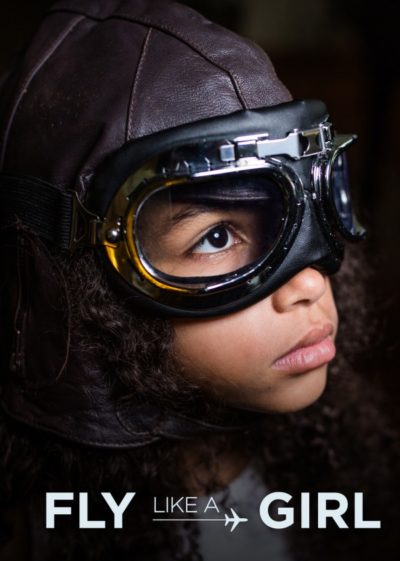
This documentary is about the field of women in aviation, combining archive footage with interviews, covering the range from those who aspire to fly (giving their Lego aircraft lady pilots!) to those who have been into space, fought combat missions in the Middle East or dodged death in aerobatic displays. There’s not any particular structure to proceedings, choosing instead to bounce around between its topics and subjects. This helps keep things fresh, yet at the cost of any narrative beyond, I guess, “Women can do anything men can”? Which, to be fair, deserves saying in the aviation field particularly: how much strength is needed to handle a joystick?
As you’d expect, the interviewees are a bit of a mixed bag. Historically, perhaps the most interesting is Bernice ‘Bee’ Haydu, who was a WASP (Women Airforce Service Pilots) in World War II, and aged almost a hundred at the time she was interviewed; sadly, she died not long after. I think what made her and the others interesting, were being the ones who had actually done something. While wanting to be an astronaut, say, is fine, it can’t compete with Nicole Stott giving an eye-witness account of what it’s actually like to be on the Space Shuttle as it takes off. Or Vernice Armor, the first African American female combat pilot and her tale of flying an attack helicopter, running down to its final missile and being the last hope for a pinned-down squad of troops. That kind of thing could easily become a Major Hollywood Movie.

I think my favourite of all the people interviewed was Patty Wagstaff, a three-time winner of the US National Aerobatic Championships, who seemed remarkably down to earth (pun intended) about her exploits. Seeing her fly upside down, to cut a ribbon with her propeller just a few feet off the ground, was genuinely impressive. On the other hand, Sen. Tammy Duckworth came over as a career politician, with career politician speak that was easy to tune out. Maybe she has stories of her time in the military that are the equal of Armor’s. You wouldn’t really know it from the bland content she contributes to this.

My main complaint, however, was the absolutely American focus. It felt as if no-one outside the United States had ever left the ground. No mention of Sophie Blanchard, the first aeronautess. No mention of British pilot Amy Johnson. No mention even of the Soviet Union’s Night Witches. They’re only the most successful group of female combat fliers in aviation history. But they’re not American, so for the purposes of this film, they don’t exist. The only meaningful reference to anywhere else, is when there’s a passing mention of Bessie Coleman having to go to France to get her pilot’s license. On that basis, it feels like a missed opportunity, only scratching the surface of its topic and wearing a large, nationalistic set of blinkers.

Dir: Katie McEntire Wiatt
Star: Nicole Stott, Tammy Duckworth, Patty Wagstaff, Vernice Armor

The Real Joan of Arc

★★★
“Live to fight another day?”

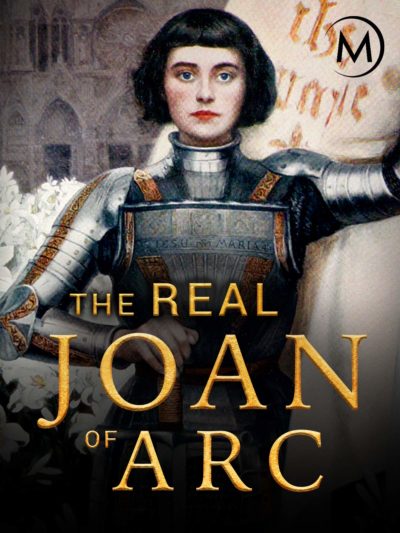
Pun mot intended, but the reality is, we know very little for sure about Joan of Arc. Not even what she looked like in detail, for there are no surviving portraits of her, dating from when she was alive. The facts about her life are equally as uncertain, because everything about Joan was subject to spin, depending on who was talking, when they were saying it, and what agenda they sought to achieve. Because everybody involved had an agenda of one kind or another: either elevating Joan up to the level of literal sainthood (finally achieved in 1920, almost half a millennium after her death), or tearing her down, as a tool of the Devil. Even basic facts – was Joan a shepherd when she was young? – are uncertain, with contradictory testimony. 
It’s really in that light you need to view all this documentary shows. Indeed it largely opens by admitting to the above. This opens the door to questioning the standard narrative, in which Joan is a humble farm-girl, who heard divine voices and was inspired to lead France to fight back against the English invaders. However, I was also left with as much doubt about the alternative suggestions the film provides, because the evidence for them is little if any less sketchy. These theories are certainly interesting – and from a secular viewpoint, elements are perhaps no less plausible than the “voices of God” explanation. On other hand, it feels as if they raise as many questions as they answer. 

The first is the suggestion that Joan was actually of noble birth, perhaps an illegitimate child. This could explain things like her reported ability to ride and wield a lance, and speak “proper” French, rather than the coarse dialect of her village. She was, in effect, created for the specific purpose of becoming a figurehead. It’s an intriguing idea – though given events unfolded over a period of several years after she came to public attention, whoever was responsible clearly had to be playing a remarkably long game. It is, though, small beer beside the theory which occupies the second half: Joan was not burned at the stake, but survived, resurfacing a few years later as Jeanne des Armoises, getting married and living a whole second life.

Yeah, big if true. The evidence for this begins with alleged oddities around her death. Joan’s head being covered on her way to the stake; an unusually high pyre; hundreds of English soldiers keeping the locals at bay. Yet there were a lot of people who were present, and subsequently provided, albeit years later, sworn testimony as to her fate. It would have been a remarkable cover-up, to put it mildly. I’m more convinced by the second element: someone, representing herself as Joan, did resurface a few years later, even getting as far as the royal court and meeting Charles VII of France. However, most accounts agree that de Armoises ended up admitting to the fraud, being unable to tell the King information Joan would have known.

I still enjoyed watching this, and the intellectual exercise it provided. It’s always good to keep an open mind about history, and contemplate alternative scenarios, whether they pan out or not. Though some of the recreations leave a little to be desired, this is a decent, well-assembled piece, with good “talking heads”. It did give me pause for thought, and no documentary which does so can be considered a failure. 

Dir: Martin Meissonnier
Star: Marcel Gay, Francoise Michaud Frejaville, Colette Beaune, Philippe Contanime
a.k.a. Vraie Jeanne, fausse Jeanne 

Perfect

★★★½
“All in, all out!”

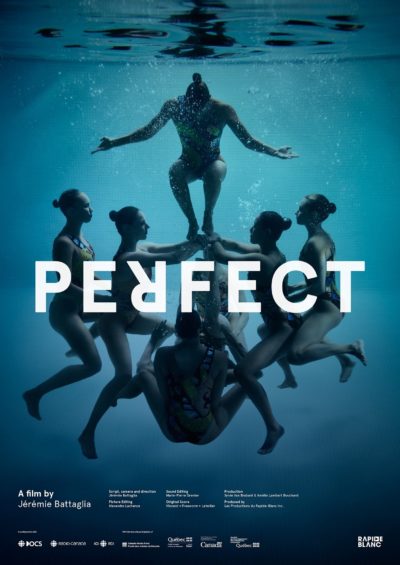
When I reviewed Russian fencing film On the Edge, I said, “I just need to find a synchronized swimming movie.” While this is a documentary, with all the positives and negatives of that genre, this fits the bill until Hollywood produces something more narrative. It follows the efforts of the Canadian team to get into the 2016 Rio Olympics. While normally, they’d be in as Pan-American champions, hosts Brazil got the spot reserved for the Americas. This forces Canada to go through the qualification tournament, battling their nemeses, Spain and Italy. The doc covers the arrival of new Chinese coach Meng Chen, efforts to get the most from her swimmers, and when this initially falls short, a radical re-invention of the team’s routine. 

You may be wondering what one of the most mocked Olympic sports is doing on the site. But beneath the fixed grins, penguin walks and stripper make-up, lies one of the most intense, demanding and gruelling sports, for men or women. To quote one team member, it’s like “running an Olympic-level 400-metre sprint while holding your breath”. She’s not wrong. The most memorable sequence here is when a series of team members list the injuries suffered for their sport. Broken bones. Torn muscles. And concussions. So many concussions, an inevitable result of rapidly-moving limbs in close proximity to skulls. I wrote elsewhere about the sport, now called “artistic swimming”; read that if you want the full case for why it belongs here.

Alternatively, just watch the film, because you’ll likely leave giving the athletes the respect they deserve. It’s the result of throwaway lines like one saying she spends 7-12 hours a day in the pool. Or the relentless pressure of Chen, pushing to unlock their potential. Or team captain Morin succumbing to an eating disorder, this sport being as much about how you look as how you perform. However, I’d have liked to have seen more technical background, rather than another scene of Chen yelling at the team. Even simple things, like explaining they aren’t allowed to touch the bottom of the pool, would have enhanced the footage of them throwing team-mates into the air. Though there are still some staggeringly beautiful shots, using reflections, tilted cameras, etc. it is a shame they couldn’t use the performance music – presumably for rights reasons. 

Interestingly, and perhaps pointedly, the team realizes its greatest results, after Chen adopts a more collaborative approach with them, and brings in external help. They even get an acting coach, to help improve their ability to convey emotions through movement. It’s nice too, to get a bit of insight into the aspiring Olympians, such as Holzner, for whom this has been an ambition since she was eight. We see the scrapbook she made when she was young (to help cope with a concussion!), and it helps foster an understanding of why people are willing to put themselves through this kind of ordeal. It all ends a bit messily: we don’t even see their final routine. But the journey is the thing here, not the destination, and you should be left with a new appreciation for the sport and its participants. 

Dir: Jérémie Battaglia
Star: Claudia Holzner, Marie-Lou Morin, Meng Chen, Karine Thomas

Ring Girls

★★★
“Punches above its weight.”

This dates back from 2005, before Carano was a household name in the world of mixed martial arts, or a somewhat successful actress. At this point, she was only involved in the sport of muay thai, which as it’s name suggests, is a martial art originating in Thailand. She was one of five girls training in Las Vegas under Toddy – a nickname given because the teacher’s real name of Thohsaphol Sitiwatjana was too unpronounceable to Westerners! The goal of both Toddy and his students was a trip to Thailand to take on the best local practitioners of the sport. This “documentary” covers both their training and the visit itself, climaxing with Carano’s battle against the Thai champion.

Quotes are used advisedly around documentary, because of two elements – neither of which help the film. The first is some kind of beef, I’m guessing entirely fabricated, between Toddy and his brother “Master A”, who is a muay thai trainer back in Thailand. Apparently Toddy brought disrespect to the country by teaching their skills to foreign devils or something. [I think this may have been lifted from the life of Bruce Lee?] It’s a bit silly and pointless, but at least it can easily be ignored. Worse are the fake sounds added to the fights, when punches and kicks land. They’re not even well done, and rather than enhancing things, make the contests seem fake.

This is unfortunate, as there’s otherwise a lot to like here. Even though an unknown at the time, you can see why the film focuses on Carano, who is clearly not just the best fighter, even to my amateur eyes, she is also the most charismatic. Sometimes, this works against it: we barely get to learn the results of the other four fights in Thailand. But it mainly helps, like a low-budget movie which lucks into starring a future Oscar winner [hello, Cyborg 2!]. And despite the post-audio’s relentless attempts to derail things, the fights are quite impressive, with the impact of the blows apparent purely from the visual side, such as the reaction of the punchee.

It all makes for a rather inconsistent blend of fact and fiction, and everyone involved would have been better served by deciding in which camp they stood. If fictional, develop a better narrative, with setbacks (at the risk of spoilering, I’m not sure we see any of the girls ever lose a match). Or go strictly factual, and use the time spent on things like Toddy’s family issues, perhaps to give us deeper background on the fighters. Heck, more info on the Thai women would have been welcome, too, comparing and contrasing life in Bangkok to Las Vegas. However, you should not let these criticisms put you off watching this (I stumbled across it on Amazon Prime), as it’s still an interesting insight into the tough world of women (or the world of tough women?) in martial arts.

Dir: Jennifer Ferrara + Thomas Weber
Star: Gina Carano, Master Toddy, Ardra Hernandez, Lisa King

No Man Shall Protect Us

★★★½
“Well-manicured fists of fury.”

In the years leading up to the Great War, the suffragette movement in Great Britain was one of the great social causes. Led by Emmeline Pankhurst, the Women’s Social and Political Union (WPSU) engaged in a campaign of protest and civil disobedience, intended to draw attention to their demand to give women the vote. Their actions were not without reaction by the authorities, however, with the activists frequently being harassed and arrested. To combat this, the WPSU established the “Bodyguard Society”, a group of women trained in self-defense, who could give as good as they got.

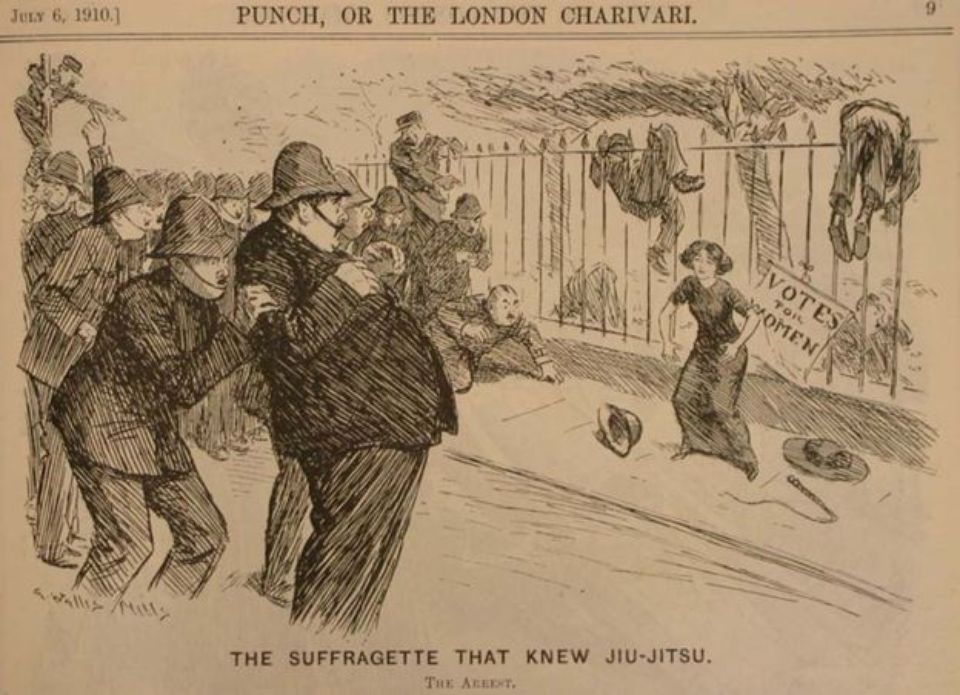
The preferred style was jiu-jitsu – or “Suffrajitsu” as it was nicknamed – which had arrived in Britain in the eighteen nineties, and the woman who taught it to the WPSU volunteers was Edith Garrud, who ran a school with her husband in London. Her role, and the talents of her pupils were clearly well-known by 1910, when the cartoon below appeared in satirical magazine Punch. As the struggle for votes increased in intensity over the coming year, the role of the Bodyguards in protecting the WPSU leaders increased. This reached a head in the infamous “Battle of Glasgow”, when a meeting in the Scottish city descended into violent disorder when local police tried to arrest Pankhurst.

This documentary tells the story of the Bodyguards, a facet of the movement somewhat overlooked in the historical record. It uses the standard documentary approach involving archival footage and a narrator (Bourne), but also contains re-enactments, both of interviews with actresses portraying Pankhurst (Miller), Garrud (Baker), etc. and some of the incidents described. The former generally prove rather more successful than the latter, because the film doesn’t have the budget to stage them credibly. For example, as depicted here, the Battle of Glasgow appears to have involved no more than half a dozen people, rather than 30 Bodyguards taking on 50 policemen (on a stage where the flower garlands were booby-trapped with barbed wire!).

On the other hand, the archival footage is fascinating and well-integrated, while the character interviews do a really good job of capturing the atmosphere of the time, and the passion of the suffragettes. [Though quite where the man playing the Glasgow Chief Constable gets his accent from, I’m less sure. It sounds like it was dredged from the bottom of the the Irish Sea, somewhere between Dublin and Scotland!] At 50 minutes, it’s a brisk watch, and I was left wanting to find out more about the topic, which is always a good indicator a documentary has done its job.

Credit goes to the makers for releasing the finished version online: you can check it out below. If you find your interest too has been piqued, Wolf has a website where you can satisfy that craving, including information on the graphic novel he authored, covering the same subject. While the suffragette movement largely took a back seat once the Great War started – proving women’s capabilities in ways protest marches could never hope to achieve – this shines an admirable light on an aspect which deserves to be better remembered.

Dir: Tony Wolf
Star: Debra Ann Miller, Lynne Baker, Lizzie Bourne, David Skvarla

The Day I Met El Chapo: The Kate Del Castillo Story

★★★½
“Life imitating art, imitating life”

Del Castillo is the undisputed queen of the action telenovela. She made her name as the original “Queen of the South” in one of the most popular entries ever, La Reina Del Sur, and has since followed that up with Ingobernable and Dueños del Paraíso, playing the Mexican First Lady and another ambitious drug dealer. It was while filming the latter, that the stranger than fiction story told in this documentary reached its climax.
As we mentioned at the end of the Reina article, in January 2012, she Tweeted about notorious drug-lord El Chapo. Three and a half years later, after he had been arrested, and subsequently escaped from prison, this led to her and Sean Penn visiting the fugitive, with the plan being to make a film based on his life. Except Penn turned it into an interview for Rolling Stone, the Mexican government got very upset with Del Castillo, and when El Chapo was recaptured, they said it was largely a result of the Del Castillo/Penn visit – with all that implies. The actress was investigated for money laundering, the charges being dropped only a couple of days ago, and is still largely persona non grata in her home country.

The three-part series tells events from her perspective. and even though she was a producer on it, Del Castillo doesn’t necessarily come out clean. From her first Tweet, she seems a little naive. “Let’s traffic love,” she says to a man who supposedly told authorities subsequently, he had killed between two and three thousand people. It feels as if Del Castillo believed the narcocorrida hype: bosses like El Chapo are often seen as folk heroes in Mexico, along the lines of Robin Hood. How much their social works are genuine, and how much practical business sense, is open to question. She does say she understands the cinematic meaning of the word “cut”, and lets go of the characters she plays. Yet I also suspect Kate may have felt that playing a trafficker on TV made her El Chapo’s “equal” somehow.

You can certainly argue that journeying into the heart of the Mexican countryside to meet the most wanted man on the world, who seems to have a crush on you, shows poor judgment. On the other hand, she does come over as courageous. While you can question her ideals, it’s hard to say she’s not entirely committed to them, regardless of the personal cost. Even now, you sense the personal cost has, if anything, probably hardened her resolve. I can’t blame her at all for that: the Mexican government appear to have engaged in a campaign of harassment of Del Castillo, little short of a vendetta. This involves everything up to, and including, fabricating text messages between her and El Chapo, with the intention of damaging her reputation and credibility.

Penn comes off little better. Though we don’t hear directly from the actor – he refused to take part in the documentary – the evidence presented here seems to suggest he used her for his own ends. Most damningly, he got journalist accreditation from Rolling Stone for himself and the film producers who also went with them – but not Del Castillo. And while he may not have directly or wittingly informed the authorities of their plans, it’s quite possible it was through his circle they became aware of the trip. In a subsequent media statement about the film, Penn’s camp didn’t hold back, saying, “This is nothing but a cheap, National Enquirer-esque tale spun by a delusional person whose hunger for fame is both tawdry and transparent.” I think it’s safe to say, if Kate ever gets to make her El Chapo movie, Penn will not be taking part.

While mostly talking heads and old news footage, it does a decent job of weaving the narrative, despite the lack of contemporary input from two-thirds of the people in the photo above. It was still interesting enough to make Chris become one of Del Castillo’s 3.5 million followers on her bilingual Twitter feed. Now, if only I can get her into watching Dueños del Paraíso

Dir: Carlos Armella

Bolivia’s Fighting Cholitas

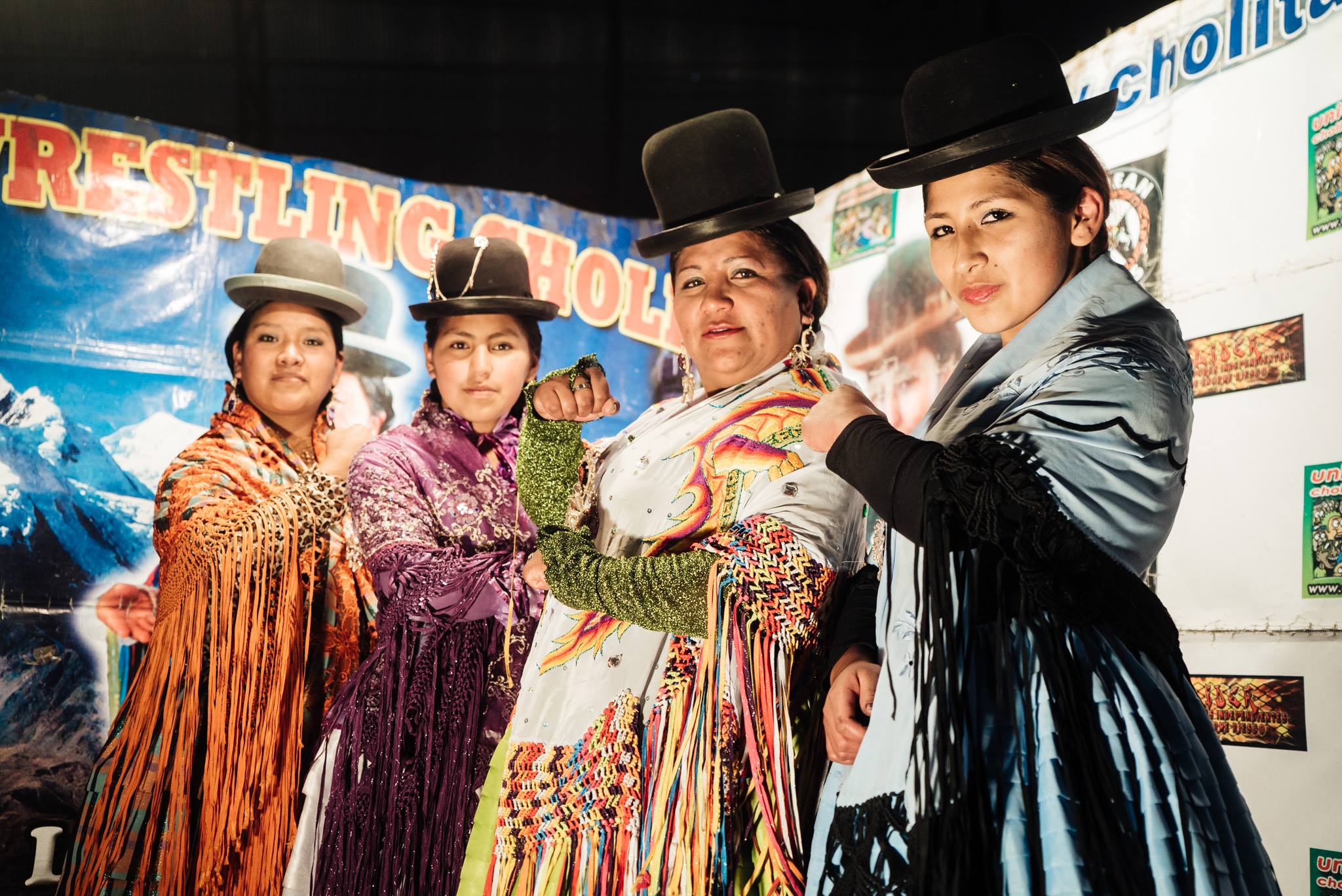
Professional wrestling is perhaps more international than you’d expect. While traditional territories – USA, Japan, Mexico and the UK – still remain the powerhouses, there is hardly a country in the world without its own local pro federation. But even I had not heard of Ecuador’s cholita luchadoras. Cholita is a term used for the native women there, usually found at the bottom of the social pyramid, both in terms of wealth and education. So the term translates as the “fighting cholitas“, who use pro wrestling as a way out of poverty, and to help them at least approach the average wage there, which is around $270 per month.

While initially intended purely for local consumption, it has achieved renown, both local and internationally, and become a tourist attraction. Local company “Andean Secrets” – run by one of the cholitas – runs excursions that pick visitors up at their hotel and take them to one of their shows at the Multifunctional Centre in El Alto. Tourists have to pay five times the cost for locals, but the price does get them ringside seats. In style, it’s closest to Mexican lucha libre, with the good girls (technicos) going up against the rudos, who cheat. abuse the audience and collude with a corrupt referee to try and achieve victory. You can generally tell who’s who from the names they choose. There’s an almost standard format to these: Chela la Maldita, Sonia La Simpática, Juanita La Cariñosa (Affectionate), Rosita La Rompecorazones (Heartbreaker) or Silvina La Poderosa (Powerful).

An exception is the matriarch of the cholitas, known as  Carmen Rosa. She was part of the original group of cholitas and one of the three who made it through the training program. She said, “For me, wrestling is my life; it is in my heart. It makes it hard for me to choose between wrestling and my family. They have asked me to stop fighting and sometimes I think about quitting, but I can’t. My heart beats fast at the mere mention of wrestling, or when I go to see a show, not to mention when I am about to enter the ring. There is nothing I love more than wrestling.” But even after a decade, she’s not fully professional: her day job is running her family’s local snack-bar.

That’s par for the course – as another example, Benita La Intocable (the Untouchable, one of the most high-flying of the cholitas) was training to be a nurse. Because the pay received is still peanuts by Western standards – typically no more than thirty dollars for their night’s work – but it’s an improvement on the very limited opportunities available to cholitas, typically as maid or other menial work. For until recently, the indigenous men and women had suffered a long history of discrimination, denied education, health care and public presence. The election in 2006 of the first Bolivian President from their group, Evo Morales, has helped address things, but there’s a reason the cholitas fight in El Alto, not the more prosperous La Paz.
They first entered the ring around the start of the millennium, the idea of local promoter Juan Mamani. Initially intended purely as a gimmick during a period of audience decline – he also considered using midgets – it took off in an unexpected way, with over fifty women showing up for that first open try-out. But after years under Mamani’s thumb, in which the women took the risks, and the associated damage, while his promotion, Titanes del Ring (Titans of the Ring) took the profits, there was a schism. Carmen and others among his top wrestlers left in 2011, starting up their own independent association, Diosas del Ring (Goddesses of the Ring), to gain the fruits of their own efforts. [Mamani allegedly then hired another woman, to play what I guess was Carmen Rosa v2.0!]

It was initially a struggle, with the women struggling to find even a place to train, and some of the defectors subsequently returning to Mamani – a man whom National Geographic once described as “a tall, angular man whom it would be kind to call unfriendly”. But Carmen and her colleagues persisted, and now they’ll get close to a thousand people attending their weekly events. She has become a celebrity, and not just in El Alto or even Bolivia. Carmen has traveled widely as a result, including trip to America and Peru, as well as being brought to London for 2015’s ‘Greatest Spectacle of Lucha Libre’ festival at York Hall.

The most immediate difference any wrestling fan will notice, is the costumes. While in America, wrestlers typically wear a limited amount of tight-fitting clothing, intended not to interfere with their moves, the cholitas come to fight in the traditional native costumes, consisting of multiple layered skirts (typically five or six), and little bowler hats which perch on top of their long, braided hair. [Bonus fact: the angle of the hat indicates marital status] It seems implausible they would be able to do anything requiring significant movement, but you’d be surprised. Also worth noting: the women need particular endurance, due to the altitude. Bolivia’s capital, La Paz, is the highest in the world, and the nearby low-income suburb of El Alto, home of the cholitas, is more elevated still, at over 13,500 feet above sea-level. Simply breathing is hard work, that far up.
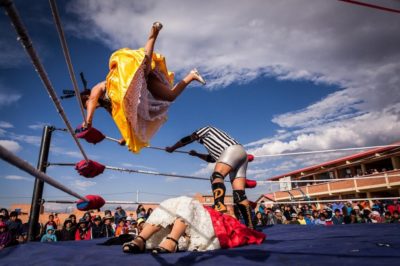
The matches are not limited to women vs. women, with the cholitas taking on their male counterparts, as dictated by the storyline. It’s a one of a kind breed of professional wrestling, and a take which goes beyond the first impression of the unique style. For it is sports entertainment, not just based on athletic talent combined with the struggle of “good against evil,” but a version which offers social and political commentary too. Below, you’ll find a playlist of Youtube videos, including both documentaries and other clips, which give a bit more insight into the world of the fighting cholitas.

“Sometimes my daughters ask why I insist on doing this. It’s dangerous; we have many injuries, and my daughters complain that wrestling does not bring any money into the household. But I need to improve every day. Not for myself, for Veraluz, but for the triumph of Yolanda, an artist who owes herself to her public.”
  — Yolanda La Amorosa

The Eagle Huntress

★★★★
“Where eagles dare.”

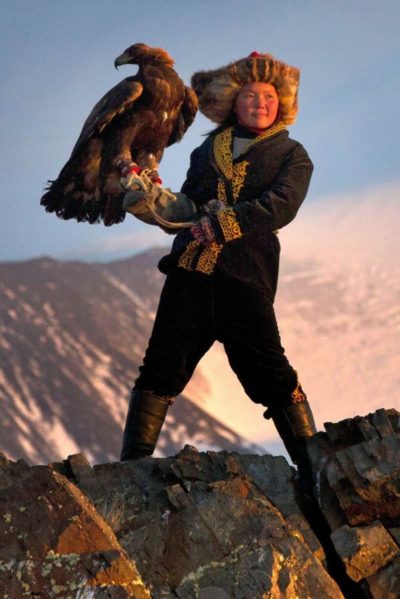
No matter how bad-ass you are, you’ll never attain “13-year-old Mongolian girl, standing astride a mountain, holding the trained golden eagle she raised from a chick, after climbing down a cliff to get it” levels of bad-ass. That’s what we have here, folks, in this documentary about Aisholpan. She’s a Mongolian teenager who wants to become an eagle huntress, a profession traditionally reserved for the male lineage. Her father Rys learned the skills necessary (and, presumably, inherited the really large, very well-padded glove) from his father, and so on.

In the absence of a suitably-aged son, and given Aisholpan’s interest, Rys is happy to show her the ropes. Literally. As in the ones used to prevent her falling off the steep cliff-face she has to descend to pluck her eaglet from its home. For, as we learn, there’s only a brief period between the chicks being able to survive away from their mother, and them leaving the nest, during which they can be taken. We also discover, there’s apparently no word in Mongolian for “child endangerment.” There’s then the training process, as the bird grows up, for instance to get it to come when called. Though “politely asked” would be wiser than “called”. You don’t order around something like the full-sized and scary creature shown on the right.

The first dramatic moment is Aisholpan’s participation in the annual golden eagle festival, which takes place in a nearby (by Mongolian standards – it’s only a day’s ride away) town. She’s not only the youngest participant, she’s the first woman ever to take part. Some of the veterans and elders are interviewed, and are not exactly happy about it. Though their opposition doesn’t appear to go any further than mild levels of harumphing; it’s not as if there’s any active attempt to stop her participation. This could be because the film does seem to over-state Aisholpan’s uniqueness for the sake of cinematic drama. History actually provides much evidence for her female predecessors.

However, there’s still an enormous amount here to appreciate and enjoy, not least a plethora of panoramas, sweeping across the staggeringly beautiful Mongolian plains. You also get a new respect for eagles, creatures whose size is not apparent in the air, and only when you see one perched on the heroine’s arm, it’s razor-sharp beak inches from her eye. Then there’s Aisholpan herself, who clearly gives not one damn for any constraints “tradition” might want to place on her, and goes about her eagle-training business with an infectious smile. Oh, and she’s studying to be a doctor when she grows up. If she went on her rounds with an eagle on her arm, so much the better, I’d say.

Finally, we get to bask in the gloriously stunned silence of the elders, after Aisholpan has demonstrated her skills (and, admittedly, those of her avian familiar) at the tournament. They then point out that, well, anybody – even a girl – can do well enough in the comfortable setting of a field. She could never withstand the harsh conditions faced by real hunters, in the mountains. Guess where Aisholpan’s next stop is? Yep. She takes her bird and heads off into those mountains, through snowdrifts which reach up to the flank of her horse, to hunt foxes for their fur. In terms of teenage empowerment, it sure beats getting a tattoo and hanging out at the mall.

Dir: Otto Bell
Star: Aisholpan Nurgaiv, Rys Nurgaiv, Daisy Ridley (narrator)