
Guerilla Girl

★★½
“Freedom fighter, terrorist or borrower of other people’s cosmetics? You decide…”
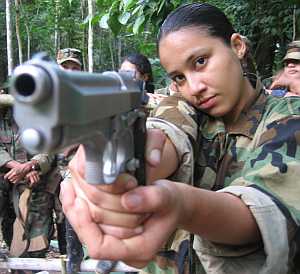
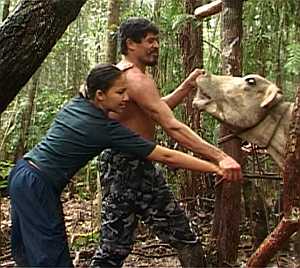
Not to be confused with the (rather tedious, IMHO) bunch of New York feminist artists, this is about Isabel, the well-educated daughter of a middle-class family, who opts to toss it all away and go into the jungles of Colombia to fight the revolution with FARC, the insurgents who have been rebelling against the government for more than 40 years. She undergoes training, both political and military, and has to adapt to an environment radically different from the one she knew before. It’s not always successful, and you wonder how she’s ever going to become a “freedom fighter” when she can’t even take part in the slaughter of a cow. [shown, below right – PETA activists will really want to avoid this one. Trust me.] But she soldiers on – pun not intended – and by the end, seems to be adjusting better to the prospect of spending the rest of her life on the run.

You could certainly criticize the film for an uncritical portrait of FARC – questions raised, such as their involvement with drugs, are quickly dismissed, though most independent observers believe this is a major source of funding for the group. However, once sense the film-makers didn’t want to go down that avenue, and since they were out in the jungle, with a group of heavily-armed insurgents, I can hardly blame them for letting that angle slide. Instead, it lets the film speak for itself, and FARC does sometimes come across as little better than kids playing soldiers: one, particularly memorable part of the training, consists of recruits running around, waving wooden guns about and shouting “BANG!” at imaginary opponents. They also have a startlingly bad ‘national anthem’, which sounds more like the fight song from a third-rate community college.
The film’s main weakness is the lack of any real narrative thrust. Now, obviously, in a documentary, this kind of thing is not always possible, but usually there’s a goal or some sense of purpose. Here, events simply unfold, and the vast majority of them are simply not very exciting; the height of drama is an argument about shampoo with another female recruit. There’s not really much of a character arc for Isabel, and despite some impressive cinematography, I can’t really say I learned much about Colombia, FARC or even the heroine. More insight, less documentary, would have been preferred.

Dir: Frank Piasecki Poulsen
Roller Derby Mania

★★★
“I love the 80’s…if not the clothes.”

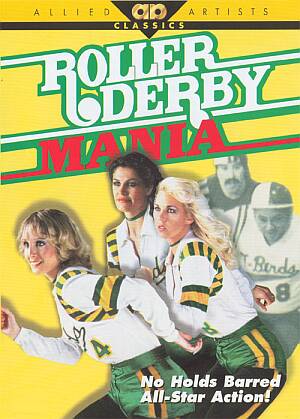
This dates back to 1986, which is a little odd, as the sport was pretty much in one of its down-turns at the time – the excesses of RollerGames were still a couple of years away at that point. This isn’t probably the best place for a novice to start, as there’s no explanation at all about the sport, since it assumes you know what’s going on, how bouts are staged, scored and what the rules are . There’s a little about the history (including a cute song from the 1940’s), but it’s mostly action featuring the Los Angeles T-Birds.

It’s important to realise that this was also the era of mixed leagues – the men and women skated alternate periods – but the cover picture about sums up the significance of the sexes, with the women definitely to the fore. In contrast to the modern version, the staged elements seem more obvious, with some acrobatic stunts very clearly pre-planned – the best hits will still leave you wincing. However, the camerawork often leaves a lot to be desired, though this may be an inevitable result of the sport’s nature.

The managers of the teams are also much more prominent, in a way that also recalls pro wrestling. The likes of Georgia Hase – Miss Georgia Hase, to you – E.G. ‘Pretty Boy’ Miller, Ana Anaya and T-Birds’ manager John Hall are the focus much more than currently seems the style. But if anything sticks in your mind, it’ll be the clothes and hairstyles, which mark this as a child of the 1980’s, in indelible, luridly day-glo marker. While your feelings for this slab o’ nostalgia might thus be heavily coloured by your feeling regarding fluffy hair and sideburns, it’s entertaining enough.

Lipstick & Dynamite

★★★★
“Lives up to its subtitle: The First Ladies of Wrestling”

I first heard about this film last spring, at the Cauliflower Alley Club convention in Las Vegas, a get-together for retired wrestlers and their fans. Two attendees, Banner and Martinez, talked about their part in the film, and we were immediately intrigued; a year later, I’m pleased to say this largely lives up to expectations. It takes you back to a time before pro wrestling was synonymous with the WWE, and the characters here are fabulous. They’re led by Gillem, now in her 80’s, occasionally difficult to understand (they subtitle her comments) but with a life that went from the ring to lion-taming. She’s merely one example, and the results are fascinating.

That’s not to say this is perfect film-making. There’s too little structure – a vague thread about an upcoming reunion is about all – and the film jumps about in history with little apparent purpose. There’s a vaguely misanthropic bent too, in that almost all men are rapists, abusive fathers or cheating husbands; it’d also have been nice to have the women wrestlers better located, culturally, in the era of which they were part. We get some priceless What’s My Line? footage, and we’d love to have seen more of this. Instead, it’s mostly talking-heads, and no matter how interesting, this eventually gets old . Much of the actual footage of bouts comes off the Wrestling Women USA DVD from Something Weird, and there’s also chunks from Pin Down Girl, neither of which are memorable.

But in the end, the subject is an inspired choice, and the film certainly does the topic justice. You’re left with profound respect for ladies who went against the mores of popular society and stepped into the ring, often sacrificing their health – and in one case, their life – for our entertainment. This documentary is a fitting tribute to these marvellous women.

Dir: Ruth Leitman
Star: Gladys Gillem, The Fabulous Moolah, Ida May Martinez, Penny Banner

Female Suicide Bombers

★★★
“A shallow look at a very complex subject.”

Female suicide bombers might perhaps not fit into the generally-perceived definition of “action heroine”, but they have much the same quality of transgressive behaviour – women acting in ways outwith the norm. And, of course, heroism depends on your point of view; one thing this documentary does, is show the cult on the West Bank that surrounds their martyrs. The thin line between “terrorists” and “freedom fighters” is illustrated perfectly by the scene of small children carrying posters of suicide bombers. On the other hand, most of the program skims irritatingly across the surface, not least because host Lisa Ling is a puffcake journalist, uninterested in asking – or perhaps, too scared to ask – the hard questions. Her interview with the mother of Wafa Idris, the first West Bank female martyr, is a masterpiece of shallowness; she doesn’t even bother to follow-up on the answers, let alone challenge the assertions.

Even more annoying is its desire to cram the motivations for all female suicide bombers into the same hypothesis: abused or brainwashed women, who have broken the laws of society, and in particular, religion, so find suicide the only way out. They dig through the histories, looking for evidence to justify their theory: oh, Wafa was infertile and divorced, that must have been it. But this hardly even counts as an explanation: how many women get divorced without committing suicide? It’s actually fairly patronising, the clear implication being that women are incapable of consciously sacrificing their lives for a political or social cause. I think Joan of Arc, Emily Davison (the suffragette who threw herself under the King’s horse at the 1913 Epsom Derby) and Violette Szabo might care to argue with that conclusion.

The film also concentrates the great majority of its efforts on Palestinian bombers; the Tamil Tigers merit only a brief mention, even though they have been using female martyrs for far longer, to a greater extent (almost 40% of their suicide bombers are women) and with greater impact, including the assassination of former Indian Prime Minister Rajiv Ghandi in 1991 – unmentioned by the program, despite it supporting their theory, is the fact that his killer had been raped by Indian soldiers. On the other hand, the Tamil struggle is secular rather than religious, making it hard to apply the same hypothesis of guilt-stricken women opting to go out with a bang. However, I do give the program credit for piqueing my interest in the topic; expect a full article sometime in 2005… [Said article has been delayed indefinitely, as I couldn’t get a good handle on how to approach the topic. I made a lot of notes, then basically gave up. Will maybe dig them out sometime…]

National Geographic Channel documentary, December 2004

Wrestling Queen

★★★
“Great for wrestling fans, non-marks may be less impressed.”

Despite the title, and the fact that Vivian Vachon is the most featured wrestler, the portion of this film which has much to do with women’s wrestling is actually rather small. It’s more a general overview of wrestling and it’s fans, during a strangely innocent era (the early 1970’s), before Vince McMahon dominated, when it still worked to give the illusion of a genuine sport.
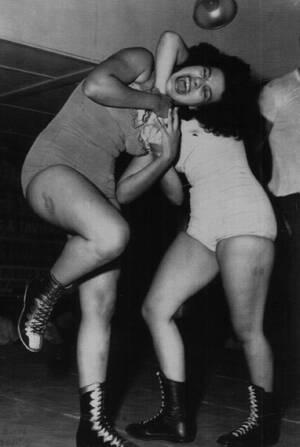
Vivian Vachon was one of thirteen children, and with two brothers already involved in pro wrestling, it was no surprise she followed them in. This film follows her on a tour of the States, but it also diverts into her family history, and has interviews with her relatives, fans, other wrestlers, promoters and, it seems, anyone else who happened to come within range of the cameras. There’s also a fair amount of wrestling action, but this is probably the weakest point of the film; it’s edited, removing any flow, but they also only have a single camera at ringside, often making it hard to see what’s going on.

The interviews, on the other hand, are fab, though I speak as a pro-wrestling enthusiast, and action femme enthusiasts will likely be less impressed. But I find characters like her brother Maurice ‘Mad Dog’ Vachon, endlessly interesting anyway; with a voice like Bluto, he made the leap from Olympic wrestling to the pro ring 40 years before Kurt Angle. Some of the fan insights are also priceless, not least the footage of them getting seriously carried away. As a documentary on wrestling, it’s thus a hit – as a feature on women’s wrestling, it’s less relevant, but anyone who has ever been embarrassed by what all too often passes for women’s wrestling in the WWF, will undoubtedly feel a sense of nostalgia for an era when it was every bit as legitimate as the male version.

Dir: Don Chaffey
Star: Vivan Vachon, Maurice “Mad Dog” Vachon, Andre the Giant

Gladiatrix

★★★½
“Proof that the female action heroine’s appeal is at least a couple of millennia old.”

This intriguing piece of archaeological detective work began with the discovery of an opulent grave in the paupers’ section of a Roman-era cemetery in London. Piecing together the clues, the conclusion was reached that, while it could have been a follower of Isis, this was most likely a gladiator’s grave – which was something of a shock, as the occupant was female…

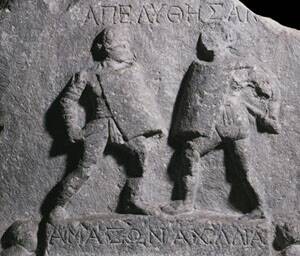
From here, we head into a discussion of how Roman life centred round the amphitheatre and how the gladiatorial games developed. While there wasn’t a great deal of new information here, it was interesting to see a connection made between the rise of the female participant linked to Boadicea’s revolt, which had taken place a decade or two earlier. This would have no doubt opened the Roman mind to the possibilities of broads with swords. Similarly, in Rome, the absorption of the Amazonian legend (originally a Turkish story) could have led to the introduction of the gladiatrix.

Narrated by – who else? – Lucy Lawless, the documentary is hampered by an over-enthusiastic visual style during the battle recreations. At times, these were so hyperactive as to convince me that I was watching clips from the 2001 version of The Arena. While understanding the need to avoid becoming a sequence of talking heads and shots of ruins, the attempts to jazz the inserts up prove more of a distraction than an enhancement. I’d have welcomed more speculation on the life of the gladiatrix too. Still, great to hear a little about the ancestors of Michelle Yeoh and Pam Grier!

Dir: Jeremy Freeston
Discovery Channel documentary, December 2001