

The Sun At Midnight

★★★½
“Nothing here but mosquitoes and bear shit.”
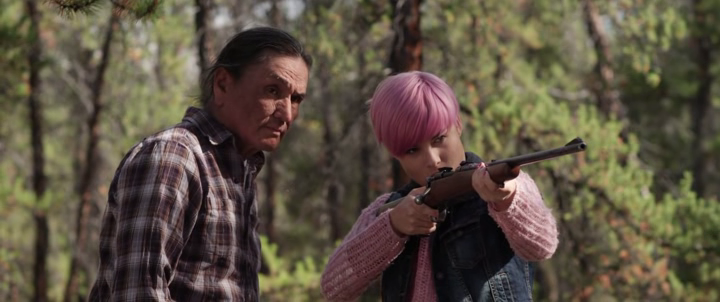
While certainly more relaxed that many of the films we cover here, this makes it in on the strength of its heroine’s character arc. That belongs to Lia (Jacobs), a teenage girl in the Northwest Territories of Canada, who is being raised by her father. When he has to go off for work, she gets sent north of the Arctic Circle to live with her grandmother (Jerome) for the nightless summer. She hates the rural life, and runs away, stealing a boat in the hope of reaching Dawson City, the nearest big town – not realizing it would be four weeks journey. She falls overboard after her boat breaks down, and is lucky to be rescued by Alfred (Howard), a hunter from the local Gwich’in tribe. As they cross the remote wilderness, she begins to appreciate it, bonding with the thoroughly down-to-earth Alfred and learning from him – wolves hate the smell of tobacco, apparently. But when an accident befalls her guide, Lia is going to have to dig into her own resources.

I’m about as much of a city mouse at Lia, whose initial opinion of the countryside is largely summed up by her line at the top. Early on, she just seems like another annoying teenager, whose attitude sits permanently between surly and self-obsessed. Admittedly, it doesn’t help that the locals don’t take to her, and she’s the subject of bullying by them, but until she meets up with Alfred, she’s not very likeable. To her credit, Lia is prepared to learn from someone who has forgotten more about the wilderness than we’ll ever know. As she grows to embrace the untamed landscape (and her hair returns to a more natural shade!), so does the viewer. Alfred clearly doesn’t stand for her city-slicker ways, yet generally disarms them with patience rather than anger, though his dispatch of an injured animal reminds us that nature can sometimes be brutal. They also bond through the shared experience of losing someone close to them – his wife and her mother respectively.

It has to be said, the drama which eventually appears toward the end is rather lacking on the dramatic front. Initially, it appears it will involve Lia in a race against time, to bring help to Alfred. However, that’s never fulfilled and it’s almost as if the director got bored of the idea and decided not to bother, instead looking around for a way to close things out in the least exciting way she could find. Similarly, Lia’s encounter with some less-friendly hunters feels an obligatory incident, unnecessary to proceedings. And, yet… It doesn’t particularly matter, in terms of my enjoyment. This is one of those movies which is considerably more about the journey than the destination, as well as (at the risk of sounding trite) the people you meet along the way. It’s undeniably low-key and understated, yet if you are in the right mood, it hits the spot, particular in its dialogue, which fits those delivering it perfectly.

Dir: Kirsten Carthew
Star: Devery Jacobs, Duane Howard, Sarah Jerome
Wrecker

★★
“Runs out of road.”

This falls victim to the Spielberg Effect. By that, I mean, that any movie directed by Steven Spielberg will inevitably become the yardstick by which future entries of that kind are judged – typically, unfavourably. Killer shark films will be compared to Jaws. Holocaust epics to Schindler’s List. And the genre of movies in which drivers are menaced by unseen truck drivers? Expect comparisons to Duel. And in this case, they are entirely warranted. I guess if you’ve never heard of Duel, this might just pass muster. But you would still be better off watching it, than this lame imitation, which has a nice car (a Mustang) and some lovely scenery (I’m guessing Canadian). That’s all it can offer though.
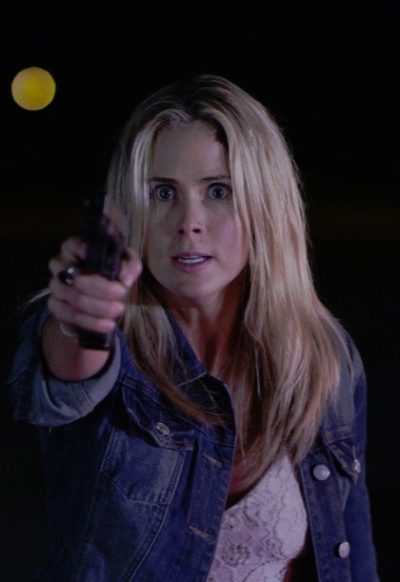
Gal pals Emily (Hutchinson) and Leslie (Whitburn) are on a road-trip, when they go off-route – never a good idea to take a road labelled “Devil’s Pass”, but that may just be me having seen too many horror movies. On the resulting stretch of road, entirely deserted except when conveniently necessary for the plot, they become increasingly concerned about the repeated presence of a tow-truck, pulling a car, which appears to be stalking them. After a number of alarming incidents, they are driven off the road by the truck, and Emily gets knocked unconscious. She awakens, to find Leslie gone. Driving to find help, she is stopped by a police-car, only for the officer to fall victim to the truck. But at least Emily now has a weapon, in the shape of the cop’s gun.

This kind of thing can work. Spielberg’s not the only one to prove it; The Hitcher (the original version) also occupied similar territory, with an almost supernatural figure menacing a driver, for no real reason. That succeeded, however, based on Rutger Hauer’s villainous charisma. There’s nothing like that here, with the villain entirely unseen; the closest we get to any personality are glimpses of Satanic regalia dangling in the truck. That’s not exactly a lot on which to hang your movie.

The main problem, however, is a script which is ludicrous when it isn’t being entirely contrived. The notion that a Mustang – which we are shown can reach over 120 mph – could not simply zoom away from a diesel tow-truck if necessary, is the most obvious, yet perhaps not the most idiotic element. The ways in which the two women, and indeed, their pursuer, behave, are the kind of actions which would only be carried out by characters in a horror movie. Anyone sensible would seek sanctuary in the nearest busy area, and stay there until help arrives. Our couple do visit such a spot, in the shape of a diner, only to leave it after lunch and resume their journey, because… because the film demands they do. If you’re not able to tolerate such things, you’ll have to hope that the Rockies and an American classic sports car provide enough entertainment. For the plot and characters aren’t going to offer much.

Dir: Micheal Bafaro
Star: Anna Hutchison, Drea Whitburn, Jennifer Koenig, Michael Dickson

E.M.P. 333 Days

★★★
“A thoroughly Canadian apocalypse”

Really, for a reported budget of about $6,500 – and those are Canadian dollars, which currently works out to less than five grand in freedom dollars – this is quite impressive. You could argue that trying to create a convincing post-apocalyptic scenario on such a tiny budget is biting off more than you can chew. And there are certainly moments which just don’t work. But in its low-key approach, it’s probably a more accurate reflection than many of the way in which the world might end. Not with a bang, but with a whimper, and a slow grinding to a halt.
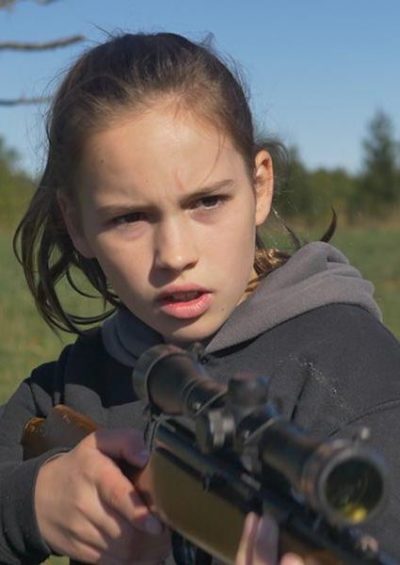
In this case, it’s an electromagnetic pulse weapon, detonated high in the atmosphere (most likely by North Korea, going off early radio broadcasts) and wiping out everything that use electronics. Which, these days, is virtually everything. When it does, young heroine Niamh (Ferreri, the director’s daughter) is staying with her grandmother, because Dad is away on a business trip. Initially, they hole up, trying to wait it out, but eventually resources dwindle and Niamh has to strike out on her own. Fortunately, Dad was a bit of a prepper and so she is better prepared than most girls her age for life in the new, primitive world, as well as encountering other survivors, both good and bad.

Undeniably, you have to allow a lot of leeway for the very limited resources. Even given the rural setting, it’s never clear to where 99% of the population has gone, or why; a throwaway line saying, “A bunch of people left a few nights ago,” is about as close as we get. The collapse of civilization into anarchy and chaos is depicted by a shot of Niamh and her grandmother, peering out the window and looking concerned, while somewhat riotous sound-effects are heard. All told, as the tagline above implies, it’s a very polite end of the world. It’s also a bit unusual, and therefore refreshing, to see a positive portrayal of survivalists. Rather than the usual wild-eyed paranoiacs, they’re depicted here as down-to-earth, and simply prepared for unfortunate events.

The technical aspects are quite impressive, especially on the visual front where it certainly doesn’t look like a microbudget production. However, the film does drag in the middle. From the point at which Niamh meets another young survivor, Will (Davidson), it seems to spin its wheels for the longest time, despite the pair stumbling across a rare car still capable of driving. It takes the injection of an external threat before the plot begins to move forward again, and Ferreri deserves credit for getting its depiction of killing right, as not something which should be done lightly by anyone.

The movie did tie up its loose ends up a little too conveniently, just when it was looking set fair to be nicely ambiguous. Though on the other hand, this offers a somewhat hopeful note on which to finish things. That might not be a bad thing after a generally downbeat experience, and if it remains the complete cinematic opposite of, say, Fury Road, that’s not entirely a bad thing.

Dir: Adriano Ferreri
Star: Rosa Ferreri, Liam Davidson, Derek A. Bell, Martin Saunders

Warigami

★★★½
“Card sharks”

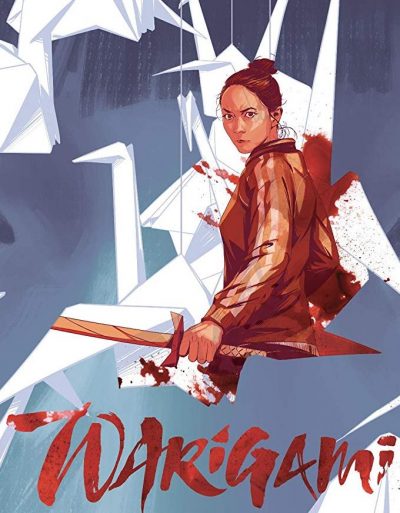
This feature-length entity is the omnibus edition of a series created for Canadian streaming service, CBC Gem. Originally 10 x ten-minute episodes, they’ve been combined into one entity, though the joins are still pretty visible. It is, however, a brisk and generally entertaining work, with a good twist to the usual martial-arts shenanigans.
Wendy Ohata (Piggford) lives with her grandfather, a martial-arts master who is the guardian of a scroll that potentially will confer great power on its owner. Wendy has never been able to tap into her talents, until one day she meets Vincent (Bradbury) and his pal Mark (Julien) – while they are burgling her house. Their choice was not a random one: Vincent felt a strong pull towards the house, and it turns out he and Wendy are long-lost siblings. More significantly, when they are within 50 feet of each other, they both become kami-jin. Those are people who are able to manipulate the density of paper at will, turn it into a lethal weapon in their hands.

Unfortunately, when these talents are used, they attract the attention of the villainous Teramoto clan, who want to use the scroll to return Japan to a more pastoral state, blaming technology for the evils of modern life. Their leading agent is another kami-jin, Sadako (Suzuki). She kidnaps Wendy’s grandfather and holds him hostage, demanding the scroll for his release. Can she, along with her new-found brother and his pal, locate the Teramoto lair, and rescue Gramps?

The show got my attention with an opening scene where Sadako is detained at the airport – it doesn’t end well for the agents trying to hold her – and didn’t let go for much of the way thereafter. This does a good job of balancing between the serious and the silly, no small task given the potentially ludicrous nature of the skill at its heart. About the only moment where it descends into full-on silliness is when Vincent dons a complete outfit of samurai armour made from paper – and even there, you can only admire the effort involved from the costume department. Wendy and Sadako make for a solid yin and yang at the center of things, with both acquitting themselves well on the martial-arts front. Director Lapeyre also deserves credit for not letting their talents be obscured by frenetic editing.

There are a couple of plot moments which have questionable plausibility: both the Teramoto lair and its underground entrance are discovered way too easily. And the ending is rather obviously pointing towards a sequel, though it’s one I’d be interested in seeing, and hopefully the makers are given the chance to deliver it. For, given its origins, this was better than I expected from a web series. That’s especially true for the way the talents of the kami-jin are portrayed, which varies from okay to flat-out impressive, on occasion. I was left with a strong urge to find a pack of playing cards and start working on my wrist strength.

Dir: Jason Lapeyre
Star: Emily Piggford, Kai Bradbury, Miho Suzuki, Akiel Julien.

Daughter of the Wolf

★★
“Bit of a bad dog.”

The cinematic goodwill Carano accumulated as the result of her electric debut in Haywire, is rapidly evaporating. I understand that you can’t expect to work with Steven Soderbergh every time, but the returns have been diminishing with a relentless steadiness since for her. This is certainly the worst one yet, though in her defense, the problem are less to do with her performance. They are more the results of a script which takes several, widely disparate ideas, and doesn’t just fail to connect them into a coherent whole, it also manages to screw them up on an individual level, to the point where most of them become little more than silly garbage.
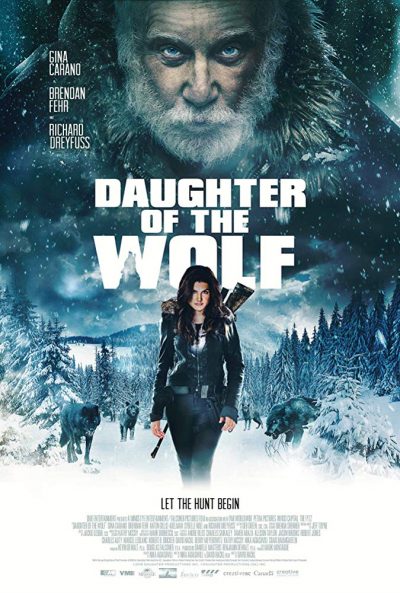
We join a kidnapping already in progress, as Charlie (Gillis-Adelman), the son of Clair Hamilton (Carano), having been abducted by “Father” (Dreyfuss), a cult-like leader who has long held a grudge against Clair’s dad. Quite why he bothered waiting until after the target was dead to take his vengeance, is one of the many things this film fails to explain adequately. At the supposed handover of cash for Charlie, a fire-fight breaks out, which is right in the wheel-house of Clair, a former soldier. Two of the three kidnappers end up dead, the third, Larsen (Fehr), is not such a bad guy, and ends up saving her life after she falls through the ice. Still, she makes him take her to Father, and matters are complicated by the presence of a pack of wolves, who appear to have their own agenda.

About the only thing which saves this are the amazing Canadian landscapes, lushly photographed by Mark Dobrescu. There’s one location in particular, an ice waterfall, which is jaw-droppingly beautiful to an almost implausible degree, forming the backdrop to one of the movie’s less than impressive action sequences. Of course, someone goes over the edge, plummeting to their doom. Oh, wait. My mistake: they subsequently show up again later, with little evidence of damage beyond a somewhat annoyed expression on their face, as if mildly inconvenienced by an out of service elevator. This implausible approach reaches its nadir in Father three-ironing a canine off a precipice with his rifle butt, a moment which genuinely made me laugh out loud. And not with the movie.

Indeed, the wolves are set up as if they’re going to be important, only to vanish from the film, before inexplicably returning for  a tacked-on coda which had me rolling my eyes. While I did like the concept of leaping right into the action, the resulting attempts to fill in the backstory are painfully clunky and add little if anything. It’s definitely a case where less would have been more: simply making it Clair vs. the kidnappers should have been sufficient. We certainly don’t need a distaff cross between two Liam Neeson films, Taken and The Grey. Carano still does have a physical presence that possesses potential. But she really needs to be making better choices.

Dir: David Hackl
Star: Gina Carano, Brendan Fehr, Richard Dreyfuss, Anton Gillis-Adelman

What Keeps You Alive

★★★★
“Predatory lesbian.”

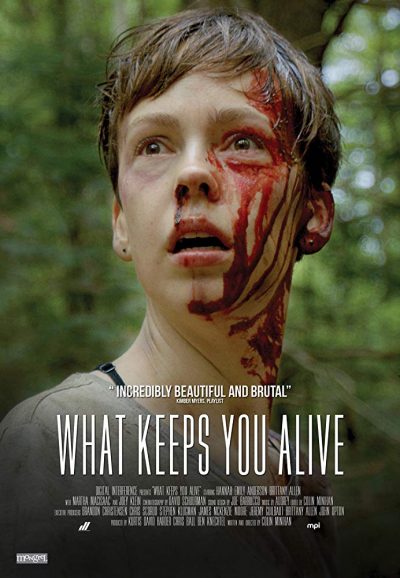
In the modern, politically-correct era, it’s less common to see a film which has a sexual minority as an unabashed villain. Something like Basic Instinct got a lot of flak at the time, and would likely be rejected out of hand by gay-friendly Hollywood these days, as would Silence of the Lambs. So it was kinda refreshing to see a movie which brings us an unashamedly psycho lesbo in the form of Jackie (Anderson). Yet it’s not her sexuality which makes her evil, though she does feel she was “born this way” – or, as Jackie puts it: “It’s nature, not nurture.”

Certainly, the warning signs are there early, when she and her wife Jules (Allen) go for a first anniversary weekend in Jackie’s remote family cabin by a lake. Strike one: we rapidly discover Jackie is a fake name, something she hadn’t told her other half. Strike two: singing a song to Jules with lyrics like “There’s a demon inside / Blood, let it out.” Strike three: telling a story about a childhood hunting trip and a deer, ending in the line, “I just stood over it for the next 20 minutes and I watched the life slowly fade from her eyes.” If you’re not hearing alarm bells ringing loudly, you’ve clearly not seen enough movies. Jules, blinded by love, is about the only one apparently oblivious to the foreshadowing.

To the film’s credit, it doesn’t stretch this out [the trailer, below, is similarly open about the dynamic here], and it’s not too long before Jules is propelled off a cliff to her apparent doom. Except, by the time Jackie meanders down to the foot, ready for a tearful call to the authorities, the body has gone. The fall wasn’t as fatal as intended, and the rest of the film plays like a two-person version of Revenge, with Jules deciding, “I’m not going to let you do it again.” For did we mention Jackie’s first wife? Or the childhood friend who ‘drowned’ in the lake? Because she certainly does…

Almost inevitably for the genre, some suspension of disbelief is needed here. The injuries suffered by Jules in the initial fall are all but forgotten by the end, and there’s other foreshadowing which seems less than subtle, such as the very obvious gun hanging on a wall And was Jules a failed medical student? There’s one line of dialogue hinting towards that, and it would go some way to explaining a number of things. Couldn’t it perhaps have been made clearer?

Yet these are minor issues, which certainly did not impact my sheer enjoyment of this very much. There are two excellent lead performances, in addition to solid work by Minihan, which cranks up the tension impeccably – a rowing race across the lake is a particular highlight. It all makes for a sharp improvement on the director’s previous feature, It Stains the Sands Red – which also starred Allen and put her character in similarly perpetual peril – and is a fine example of a B-movie that punches above its weight.

Dir: Colin Minihan
Star: Hannah Emily Anderson, Brittany Allen, Martha MacIsaac, Joey Klein

Mission NinetyTwo

★★★
“Tree’s company”

The German-Canadian co-production is split into two feature-length parts – “Dragonfly” and “Energy” – but is absolutely a single entity, so that’s how it’ll be covered here. I was braced for something truly dreadful, after reading some particularly scathing reviews, and seeing no less than four directors listed in the credits for part one. In reality, it’s not bad. Not great, admittedly, but the three hours passed without my losing consciousness, which puts it ahead of certain recent genre entries I could mention.
The heroine is Sonia Engelhardt (Dordel), a scientist specializing in trees, who is carrying out research funded by a lumber company. She is on the verge of a major breakthrough when they suddenly yank her funding away. Sonia decides to proceed regardless, and in the forest, stumbles across something which puts her life in danger, along with those of local cops Bill Jones (Breker) and Analena Tempest (Reimer). They’re looking into shady ties between the lumber company, and other groups, not least a biker gang. Helping the good guys out in the subsequent investigation, with cryptic phone calls, are a shadowy, apparently governmental organization called “Libelle” (German for dragonfly, not that this is ever explained or relevant).

Part 1 ends with our trio having to high-tail it to Germany. Part 2 is much more of a solo story. Sonia gets thrown back onto her own resources – which includes, as the poster suggests, dying her originally blonde hair dark. She’s forced to become rather less of a pacifist, going all Katniss Everdeen on the baddies instead, as she eventually finds out what was going on, back in the forests of Canada. To be honest, I’d figured that revelation out quite a bit earlier (there’s a clue in the title). But as a cheerful gallop around rural Canadian and urban German landscapes, it’s not bad, and between Sonia and Analena, as well as villainess Jasmine Chang, there’s a decent quota of action heroines.

Digging into the background a bit, it appears this was originally a web series of 16 episodes, which explains both the rather odd 2-part structure, and probably also the multiple directors. It appears to have been a passion project for Dordel, who actually does hold a PhD in forest science from the University of British Columbia: she’s not just playing a scientist. As such, I can cut it some slack, and forgive the occasional rough edges. However, there are still problems too large to ignore with the script, which doesn’t flow at all, jerking abruptly from one plot point to the next, and with rather too many things happening without credible explanation, e.g. the ‘Libelle’ calls.

It’s a shame, as I like the underlying idea. A bad-ass ecologist, wielding a (very environmentally conscious!) bow and arrow against those who are destroying the planet – preferably involving the giant fireball depicted on the cover? Where do I sign up? Shame there’s a bit too much of a gap between that concept, and the execution which is delivered here.

Dir: Brent Crowell, Neil Every, Kryshan Randel, Guido Tölke
Star: Julia Dordel, Eric Breker, Anita Reimer, Michael Teigen

The Contract

★★½
“We’re from the government. We’re here to help.”

I bumped into this one on a stand of ultra-bargain DVDs, at a truck stop on the way home with Chris from an anniversary trip to Las Vegas. The cover, understandably, piqued my interest: the film didn’t manage to make such an impression, except in intermittent bursts. Hannah (Black) is an assassin, working under the tutelage of her father, Luc (Imbault). He spurns a lucrative contract, smelling a rat: Hannah goes behind his back and takes the job, only for Dad to be proven right, when the hit goes wrong. Luc is killed, leaving Hannah and her oblivious artist boyfriend James (Oliver) on the run from Senator Harmon (Williams). He’s a CIA honcho, who has just announced his plans to run for higher office, and needs to clean up certain elements of his past – now including Hannah and James.
Some of the action here is not bad, particularly a well-staged brawl in Hannah’s apartment while James is out for food (or something). It’s an impressive bit of hand-to-hand combat, which packs a wallop and leaves the apartment in severe need of redecoration. The hotel hit which starts the ball rolling is another highlight. Unfortunately, there are just not enough of these scenes, with the bulk of the movie being Hannah and James running away, or trying to find out what’s going on. This includes a spectacularly bad bit of technological babble. James suddenly reveals hacking skills, we discover that “You can trace the email using the graphic code,” and watch as the text of the message changes into numbers. Wot, mate? Do you even computer? I know this was back in the primitive days of 1999, but still…

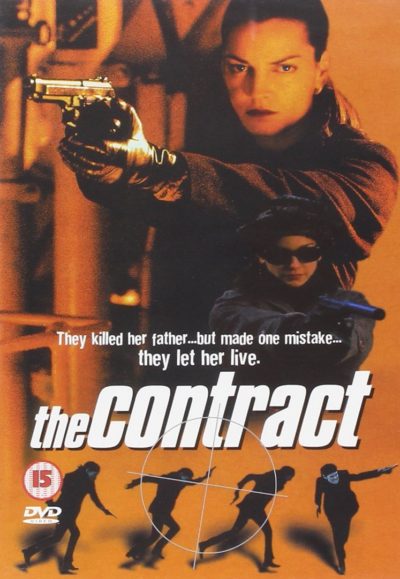
The plotting is, in general, equally underwhelming. It took me a while to realize Luc was supposed to be Hannah’s father – I guess I should just have looked at the British DVD cover (right, and a bit spoilery)… Quite what Harmon is trying to do is also somewhat vague: it seems to be related to a long-ago black operation, which begs the question, why did he wait so long before deciding to tidy up all these loose ends? Williams makes for a half-decent villain and Black is also solid and watchable as Hannah. That isn’t enough, however, as the bland predictability of the storyline, one we’ve seen rather too often before, drags down the positives.

It all builds to the inevitable face-off, after Hannah tracks down the only surviving person who knows the truth about Harmon, who is now working as a school janitor. I guess being a government sponsored assassin doesn’t come with a decent pension plan. The final battle is actually the most disappointing bit of action here, swapping out the close-combat fights showcased earlier, for opponents standing some distance apart and popping off rounds at each other. You’re left with a solid appreciation for why this has been consigned to the discount racks at gas-stations.

Dir: K.C. Bascombe
Star: Johanna Black, Matthew Oliver, Billy Dee Williams, Laurent Imbault

Strange Empire

★★★★
“Strangely appealing.”

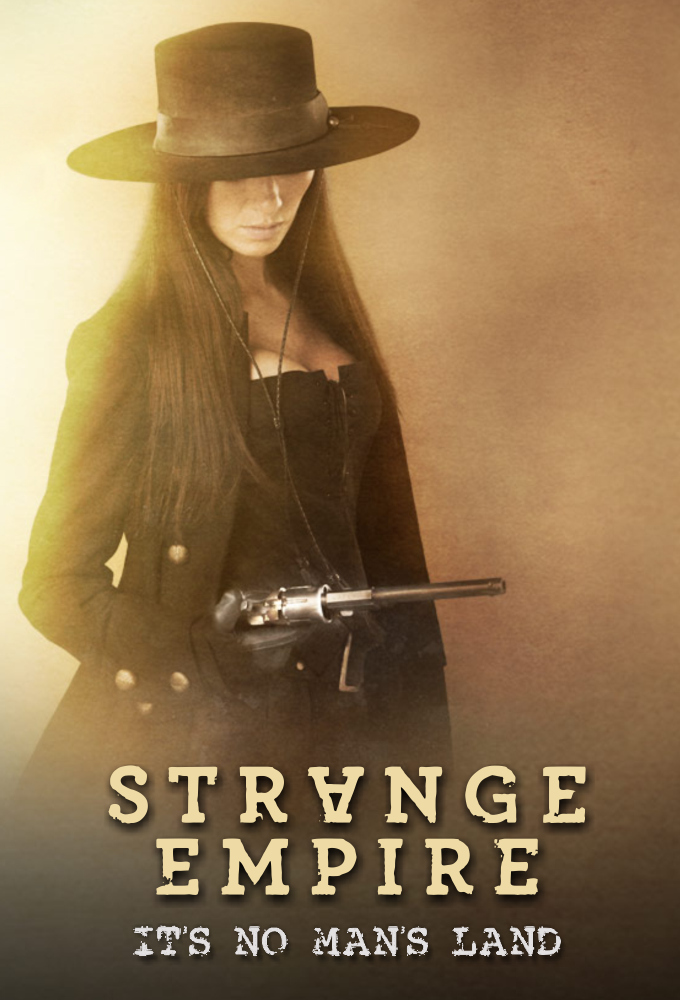
strangemepireThis Canadian TV series ran for 13 episodes, but was not renewed at the end of the first series, leaving the double shock which occurred at the end of the final episode, with no hope of resolution. That’s a shame, since there was a lot to like about its grubby portrayal of 1869 life, just north of the border between Canada and Montana. It begins when a wagon train of settlers, passing near the mining settlement of Janestown, is attacked and almost all the men are killed or driven away, leaving the women to fend for themselves. In particular, there is Kat Loving (Gee), a half-Indian sharpshooter who seeks the truth about her husband’s fate, and Rebecca Blithely (Farman), a female medical researcher, something almost unheard of at the time. But they are up against John Slotter (Poole), who runs Janestown as his own personal fiefdom, and whose wife Isabelle (Jones) is a match for the new arrivals in terms of her wits, and likely surpasses them when it comes to crafting of intrigues.

It’s the characters – the three women, and let’s not forget John, who eventually becomes the glue that binds them together in common cause – which drive this. Kat is certainly the most conventionally “heroic,” becoming the town’s sheriff, a position which brings her into direct conflict with Slotter; yet, she also has a murky past, being a wanted woman for the murder of a surveyor. Rebecca is the most difficult to get a handle on; while possessing a brilliant mind, she has a near-total lack of “people skills”, to the point of near-sociopathy. Finally, Isabelle possesses no scruples and is prepared to do absolutely whatever may be necessary to achieve her goals and escape her low-born upbringing – including seducing her husband’s father, when access to his money becomes necessary. They make a fascinating trio, well-drawn and well-portrayed by the actresses concerned.

The past year has seen a number of new takes on the Western genre, from Bone Tomahawk and The Hateful Eight to The RevenantEmpire does, perhaps, try somewhat too hard to be subversively revisionist, not least in the gratuitously transgender “cowboy”, who seems to have been added to the story for no reason than to appeal to trendy modern sensibilities. It’s much better when not attempting to pander to those, sticking with the Slotters’ efforts to keep their teetering mine business afloat, along with its probably more profitable brothel sideline, by any means necessary. This is balanced with Kat’s refusal to let John act like some kind of medieval baron, and insistence that he face the consequences of his murderous actions, which are becoming increasingly more frequent – if she can’t get justice for the massacre of the male settlers, perhaps there are other crimes that can be pinned on him.

While there are a number of side-threads (the strong role of Chinese businessman Ling is also very interesting), it’s this which drives the plot forward, and I was kept watching in the fervent hope of seeing Slotter get what he deserves. It’s to the show’s credit, with its unwillingness to collapse into a simple “black hat/white hat” mentality, that the outcome remained in doubt until almost the last few minutes of the final episode.

Created by: Laurie Finstad-Knizhnik
Star: Cara Gee, Melissa Farman, Tattiawna Jones, Aaron Poole

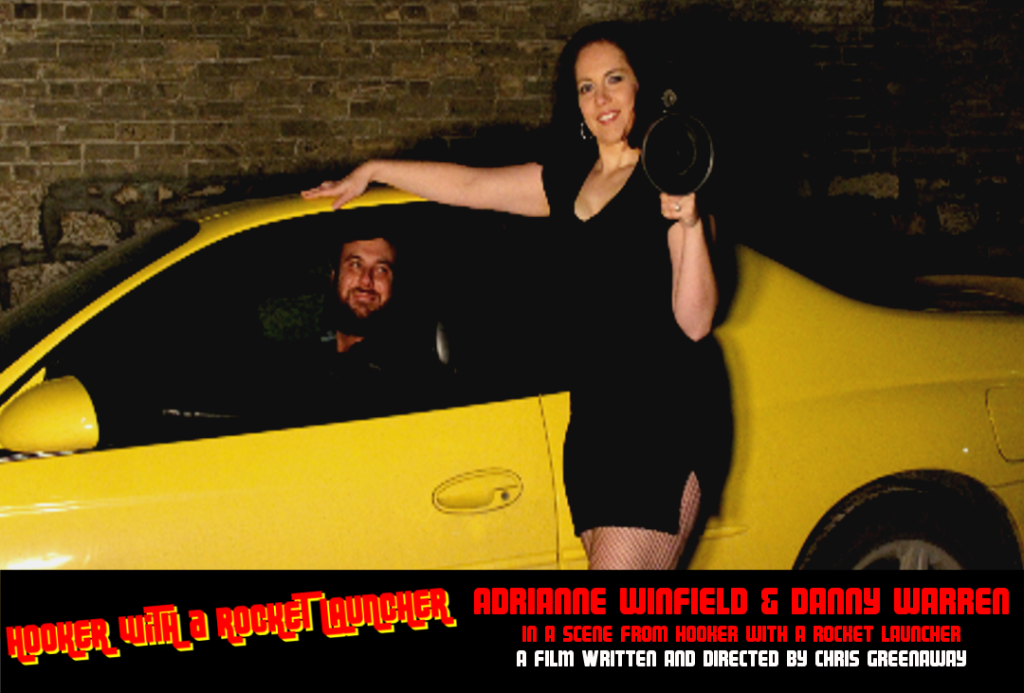
Hooker With a Rocket Launcher

promo6Some titles conceal their meaning behind layers of depth. Needless to say, this is not one of those – but it is, instead, one that demands your attention, and I was not surprised to hear that, according to its Canadian creator, Chris Greenaway,”The title definitely came first.” However, inspiration for this short came from a number of sources. Most obvious among those is Hobo With a Shotgun, the fake trailer originally part of the Grindhouse double-bill, directed by Robert Rodriguez and Quentin Tarantino, before eventually becoming a real (and wonderfully trashy) movie, starring Rutger Hauer.  But Chris says the project additionally “drew inspiration from 80s ‘hooker movies’ such as Angel and Vice Squad. As Misty’s weapon of choice indicates, we were also heavily influenced by the awesome Cannon Films action movies of the 80’s like the Death Wish sequels and Delta Force.” I’ll pause here, for anyone of a certain age to sigh nostalgically.

Lead actress Adrianne Winfield needed no convincing, having worked with Greenaway previously: “Adrianne enquired about the role when I posted a casting call so I didn’t actually have to pitch it to her at all. She really liked the premise.” The actual production was relatively quick, just 2-3 evenings – one of those a reshoot day – with between two and four hours of shooting each night. Perhaps surprisingly (or not, if you have experience of how tolerantly placid our Northern cousins tend to be!), the film-makers didn’t have any problem toting large weaponry round the streets. “We had no issues with the rocket launcher because up close it looks VERY fake,” laughs Greenaway. “We also shot at night when most people were out of the downtown area.”

Chris came relatively late to production. Originally a writer, of everything from comic strips to travel articles, he transitioned into making films after returning home in 2006, after teaching English in Japan. He recalls, “I went through a number of training workshops, and worked as a P/A on a number of sets while making the transition into writing screenplays.” He has been making web series since 2008, with six to his name so far, as well as a host of shorts, and directed his first full-length feature, Witchstalker, in 2013, which was released by Screamtime Films the following year. His IMDb filmography reads like a love-letter to pop culture and bad film, with titles such as Beach Blanket Lucha, Ninjas of the Caribbean and Escape From Ridgemont High.

But what of Misty, whose armaments would make the residents of Sin City‘s Old Town deeply envious? “The reactions have been very positive from the get go. We’ve had several very positive reviews and feedback from my existing fans on Youtube has also been great,” says Greenaway, who would like to see Hooker follow in the footsteps of its Hobo predecessor, and blossom from a trailer into a full-blown movie. “We’re hoping to do a crowdfunding campaign to make it into a feature film. Once I’m done with a few other projects I’m involved in at this time, we can go all in with this!” We certainly hope that’s a project which comes to fruition – some day, we will get to utter the immortal line, “Play Misty for me…” Here’s the film, in its glorious, full 132 seconds.