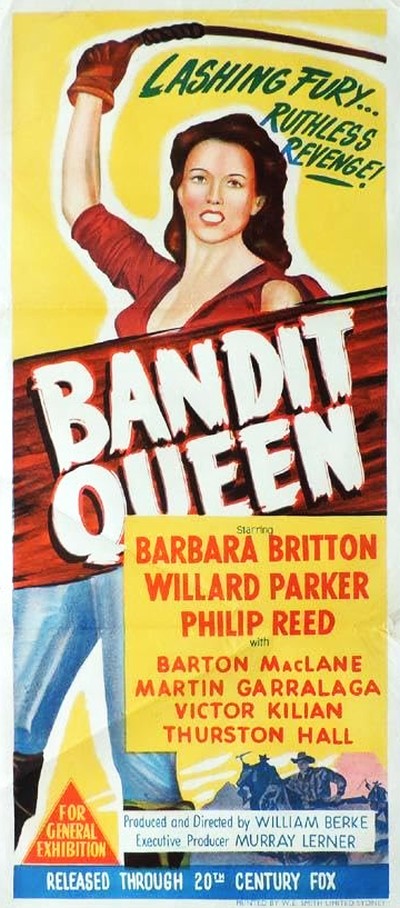
There can’t be many Westerns of the fifties where the Yankees are the bad guys. Yet here we are. In mid-19th century California, to be precise, just after it became part of the US. The new owners enthusiastically threw the existing, Mexican inhabitants off their lands, in the search for gold, using harsh taxation as a weapon against them. And worse, if this is to be believed. For it begins with the callous murder of the Montalvo family, but the legalized thugs responsible don’t realize daughter Zara (Britton) has survived. She takes on two false identities out of necessity: white girl Lola Belmont for Detroit, but also Zara, masked, whip-wieldiing outlaw. As the latter, she seeks justice for her parents, and also “Robin Hoods” the stolen gold back to its rightful owners.
There’s another outlaw, Carlos del Rio, a.k.a. Joaquin Murietta (Reed), also operating along similar lines. But also complicating matters is the local tycoon for whom “Lola” falls, Dan Hinsdale (Parker). Because it turns out his wealth largely stems from being the acceptable face of these legalized thugs. When Murietta is captured, it’s Zara who has to break him out, and the pair them team up, both romantically and in their causes. Their predations have caused enough problems to merit the army getting called in, but there’s also a movement to repeal the tax laws at the heart of the land grabs: which will succeed in their goal first?
It’s obviously a feminine knock-off of Zorro, to the extent in Germany it was released as Zorro’s Daughter. Given the obviously Hispanic leanings, it’s a shame the players involved are so thoroughly and obviously non-Hispanic. The honourable exception is Garralaga as local priest Father Antonio, who for much of the film is the only person to know the truth about both Zara and Joaquin. I wouldn’t expect too much from the heroine here: riding a horse and cracking a whip is about the limit of the on-screen action. Though she is responsible for the (off-screen) deaths of those present when her parents were killed, and does shoot the big villain in the final showdown. If unconvincing as a Mexican, Britton has a righteous intensity about the situation that is effective, and held my interest throughout.
She is certainly more interesting than Parker or Reed, who are blandly handsome in the way leading men of the time typically were. Making a bigger impression in the supporting cast is little person actor Angelo Rossitto, whose career spanned sixty years, including both cult classic Freaks and Mad Max: Beyond Thunderdome. Running barely over an hour long, this is probably a case where less is more: the narrative is generally slight, but good enough. I particularly enjoyed the heroine switching from Lola to Zara, then back again, in order to free Joaquin without causing suspicion. Despite the obviously low budget, this was not a chore to watch, and is as good as some of the other Zorro-related entries we’ve covered here, such as Zorro’s Black Whip.
Dir: William Berke Star: Barbara Britton, Willard Parker, Phillip Reed, Martin Garralaga
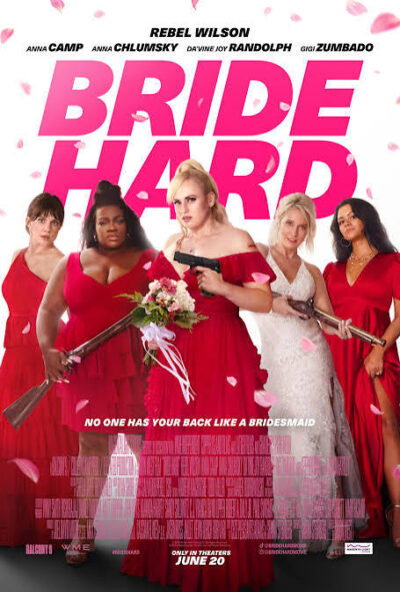
Director West certainly knows his way around an action film. He is probably best known for Con Air, but I’m also a fan of his Chinese disaster porn flick, Skyfire, about a volcano-themed holiday resort (guess how that works out?). So, despite the critical drubbing this received, I was hoping this might still be entertaining. Unfortunately, it is not. It’s a comedy-action movie, that manages to fire blanks from both barrels. There is not a shred of originality to be found here. What isn’t stolen here from Die Hard, is ripped off from Bridesmaids – heroine Wilson plays her role like the makers ordered Melissa McCarthy on Temu. Writer Shaina Steinberg should be ashamed for the lazy sloppiness, painfully apparent here.
Sam (Wilson) is a secret agent, a fact which repeatedly interferes in attempts to reconnect with childhood friend Betsy (Camp), who is just about to get married. For instance, Sam has to abandon the bachelorette party, in order to recover a bio-weapon. On the day of the wedding itself, Sam is fortuitously away from the wedding party when a group of thieves, led by Dorff, attack the event, take everyone hostage and begin cracking the multiple locks on the family safe. But they are not just ordinary thieves, and Sam is the only hope to neutralize them. Sound just slightly familiar? That noise you hear is Steven de Souza preparing his demand for a screenwriting credit.
On the other hand, having seen the end product, I would sue to get my name taken off this heap of nonsense. I kept going back and forth as to which element was less effective: the comedy or the action. In the end, I would have to say the former, because I don’t think I cracked a single smile over the entire hour and three quarters. The characters are of the sort intended to be “larger than life”, but in this case, it means gratingly annoying. Sam wasn’t the worst to be fair. There are others here, whose company I would gnaw my own leg off to escape from, if I ever met them in the real world. Again, I put the blame for these failures, squarely on the shoulders of the script.
The action is not much better, with it being painfully obvious that Wilson needed to be doubled for any scene requiring speed, strength or flexibility. Basically, anything more than standing about – possibly stretching to swinging something like a fire-hose around for a few seconds. Why they couldn’t cast someone semi-plausible in the role escapes me. Spy did a far better job with the similarly plus-sized McCarthy. It all builds to… um, some kind of chase scene involving hovercrafts laden with gold bullion? To be honest, my attention was drifting elsewhere during the action climax, which is a savage indictment of its shortcomings. If the action heroine genre is struggling at the box-office, this kind of garbage is the reason why.
Dir: Simon West Star: Rebel Wilson, Anna Camp, Stephen Dorff, Anna Chlumsky
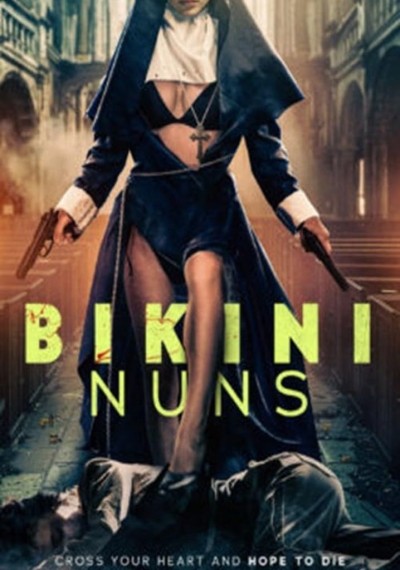
On seeing the title and poster (which looks suspiciously AI-generated, and I know AI-generated warrior nun imagery) for this, I immediately knew two things. Firstly, I had to review it for the site. And secondly, it was going to suck like an Electrolux. And, verily, the prophecies did come to pass. Here is the review, and it is, indeed, pretty terrible. Chris’s sarcasm did flow mightily, and I’m going to have watch a large number of episodes of Anthony Bourdain’s No Reservations with her, to make up for this abomination. Not that there isn’t scope for an interesting story, involving a cadre of warrior nuns, seeking revenge for a long-past atrocity. It’s just that this is not that movie. Indeed, it’s barely a movie at all.
The three Sisters of No Mercy here (have I used that joke before? It feels vaguely familiar) are Mary (Wunna), Sarah (Rakhvalova) and Eva (Legallais-Moha), operating under the guidance of a priest (Kouros), and seeking to find those responsible for the 1992 massacre of an orphanage. Quite why they have waited so long before embarking on this mission is unclear, as is why they insist on questioning people far too young to have been in any way involved. Except possibly as orphans. They gradually work their way up the chain, in scenes which are excruciating only in their lack of pacing to find the man supposedly at the top, Victor Vargas. Only to find – gasp! – there’s one final twist as to who was behind the incident, and its purpose.
There’s about enough material in this for a quarter-hour short. It actually runs ninety-eight glacial minutes. The difference is filled with scenes in which one of the nuns walks into a room in her underwear and puts on her nun attire, with no sense of urgency at all. Seriously, if there’s one of these scenes, there’s at least six of them. They are seen lounging by the pool in bikinis once, so I’m not going to claim the title is entirely inaccurate. But I feel that Nunderwear would have been more appropriate. I will defer to the experts over at Nunsploitation.Net to pick apart the film’s accuracy, for things like nun accessories worn inside out, etc. I wasn’t expecting accuracy, or even anything convincing.
But, if I may be forgiven an appropriately religious appeal: Christ, this is dull. Witness the strip poker scene which had us wondering if we had misunderstood the whole purpose of the game. I mean, why do you need poker chips? Don’t you bet with your clothes? Isn’t that the point? If the makes had actually bought wholesale into the premise, and had fun with it, this could have worked. There is a tension between Old Testament vengeance, and New Testament forgiveness, which could have been fertile ground for exploitatative exploration. Instead, this would have had more energy if performed by a troupe of sloths. Blasphemy has never been so dull.
Dir: Sushank Kini Star: Chrissie Wunna, Clara Legallais-Moha, Christopher Kouros, Anna Rakhvalova
To some extent, Sonia (Arnezeder) is the very antithesis of an action heroine here. For she spends the vast bulk of the ninety minute running-time, sitting in the driver’s seat of her car. Admittedly, this is for good reason, because somebody has wired an anti-tank mine into the car’s circuitry, in a number of diabolical ways. There’s a countdown timer, anti-tamper device and it’s also liable to be triggered if the weight in the car drops below a certain amount. Making matters worse, her two kids are in the back. The reason is because of her work in bomb disposal, part of a charity that disarms mines in the Ukraine, a task which has made her certain enemies.
Fortunately, she’s not alone. Her other half, Fred (Kiwitt), is there for moral support, and – probably more helpfully – colleagues from her agency are also present, in particular Igor (Bukvic) and Camile (Mortensen). Together with Sophie, they have to figure out both a solution to the immediately explosive situation, and find out who’s responsible. There are no shortage of candidates, and no shortage of strong female characters either, even beyond Sophie and Camile. These are involved on both sides of the scenario, as it eventually turns out. Though I must confess, I’m a little uncertain about the motivation of those involved. In particular, why the rather complex approach taken here, was deemed to be the most appropriate method. Sometimes, simpler is better, when it comes to evil plans.
That said, it’s a film which doesn’t hang about. Barely a couple of minutes pass before Sophie and her kids are sealed in, with a literal ticking clock. Though we do know this won’t be the end, because the countdown is for only half an hour, it sets the tone early. Peirani-Vignes then does a solid job of keeping the tension high, for the rest of the way. Every time you think you know where this is heading, the script, by the director and Pablo Barbetti, finds a new wrinkle to go in a different direction. As noted, I… have questions about some aspects. However, these did not stop me from remaining engaged, in particular during the front two-thirds of the film.
It did seem to struggle down the stretch. You know there’s inevitably going to be some heroic sacrifice needed. It wasn’t the character I expected: a bit of a mixed blessing, because I really wanted to see them get some degree of payback and/or redemption. Considering the entire movie takes place in an underground car-park, it feels impressively unrestricted, and the calm behaviour of the players is in sharp contrast to the ever-looming lethality of the situation. You will probably learn more than a little about the art and science of bomb disposal. While I cannot vouch for the authenticity of the information, it has the ring of plausibility. In the context of a thriller such as this, sounding legit is what matters.
Dir: Vanya Peirani-Vignes Star: Nora Arnezeder, Pierre Kiwitt, Radivoje Bukvic, Sara Mortensen
a.k.a. Déflagrations
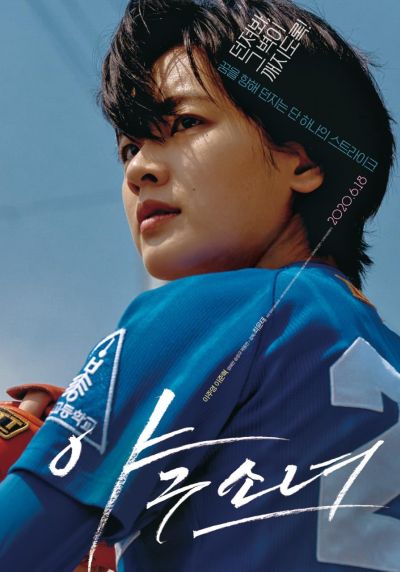
And if the above phrase doesn’t make any sense – it’s basically an underwhelming outcome during a baseball game – then you are probably not the target audience for this sporting drama. After almost a quarter-century living in America (much of it spent running a site about the local team as a sideline!), I’m fairly well-versed in baseball’s intricacies. But in contrast to some of the other Korean movies in this genre, such as Run Off or As One, you really need to know the sport going in to understand this on more than the surface level. Do not expect the film to explain what a knuckleball is, or the importance of spin rates.
The central character is Joo Soo-in (Lee J-y), a high school student who has dreams of becoming a professional baseball player. The main problem there is, she’s a teenage girl, and no woman has ever played professionally in Korea. While she pitches well enough – for a girl – she doesn’t throw with enough velocity to catch the eye of scouts. It doesn’t help that nobody really believes in her dream, with just about everyone trying to dissuade her. Even when she does get an offer from a professional team, it turns out to be to front their women’s outfit. Not least among Soo-in’s critics is her own mother (Yeom), already dealing with a feckless husband, who just wants her daughter to get real and start working in the same factory she does.
There are basically few surprises to be found here at all, with everything unfolding more or less as you would expect. It feels as if the script started off with a single word – “empowering” – and everything was developed from that point outward. For example, you will likely not be shocked to discover that mom is eventually won over to her daughter’s cause. Though I was amused by the scene where she’s told by the pro team the deposit on her daughter’s services is $60,000. Her response is, “I can’t give you that much money right now,” unaware the team is the one paying! Otherwise, it often plays like an All-Star Game of sports cliches, such as the gruff coach, romantic interest, etc.
I will say, the baseball stuff is well done: the actress seems to know her way around a pitching mound, and her mechanics look sound. [I wonder if CGI was used for the baseball, or if she really was throwing at 80+ mph?] It’s interesting that we never actually see Soo-in play in an actual game. Instead, it’s all training sessions and try-outs, as she tries to learn a new pitch, which relies less on velocity. As a fan of the game, I probably got a bit more out of this than most viewers, and was still never more than moderately engaged. When the outcome of any sporting contest is obvious, there’s not a lot of point, and much the same goes for sporting movies like this.
Dir: Choi Yoon-tae Star: Lee Joo-young, Lee Joon-hyuk, Yeom Hye-ran, Song Young-kyu
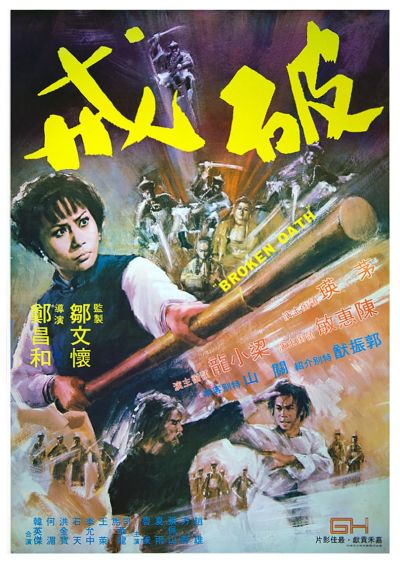
I guess, the old saying “just there for Godzilla” definitely applies to me. This movie is far from perfect, but as long as I see some skilled fighters in fancy costumes battling it out, I’m in. Additional points are given if the respective dub is at least tolerable. Broken Oath is actually an interesting movie. It is kind of a remake of Japanese classic Lady Snowblood with Meiko Kaji from 1973. The difference is that this Golden Harvest production, from producer Raymond Chow, stars Angela Mao.
She was probably the biggest female martial arts star at the time in Asian movies and had the status of a female Bruce Lee. She had starred with Lee in Enter the Dragon and one-time James Bond George Lazenby in two other movies, and also worked with classic directors like Chang Cheh and King Hu. Some of her famous films include Lady Whirlwind, When Taekwondo Strikes, Hapkido, The Fate of Lee Khan and many others. In the seventies. she could hardly walk down a street without being instantly recognized.
Broken Oath was to be her last movie for Golden Harvest which is quite inexplicable because she was a major star – did they let her go or was that her own decision? After that, she began working in Taiwanese movies with obviously lesser budgets. She lasted in movies for quite some time until the early 90s when she retired from film business. In a way it’s a pity that her golden era more or less ended in the 1970s, considering the success stars such as Michelle Yeoh, Jackie Chan, Jet Li or Donnie Yen would later enjoy – and continue to do so – in the West.
Broken Oath follows the story beats of Lady Snowblood quite closely – until it slowly becomes its own thing. It’s comparable to how Temptress of a Thousand Faces freely emulated the French Fantomas movies of the sixties. Like the Japanese original, it starts with a woman sent to prison where she gives birth to a child. On her death-bed she reveals her story of how her husband, General Liu, was killed by a gang of hoodlums; after resisting a rape attempt by one of them, she was sent to prison because the police didn’t believe her.
She gives birth to a girl and asks her “sisters” (inmates) to take care of the child, and to raise it to take revenge for the death of her parents. Instead, one of them, subsequently referred to as the girl’s godmother, gives her to a Buddhist nunnery with the blessings of the abbess who doesn’t think that the cycle of violence should continue. In the English dub, the little girl is called “Lotus”; the subtitles call her Jie Lian, though her original name was Xiao Mei. In any case, she has violent tendencies, though for some unspecified reason these Buddhist scholars are constantly fighting when not listening to the wisdom of Buddha. Lotus ends up killing three drifters in the wood when they try to rape her.
As she has “broken her oath” (to Buddha, I guess), she has to leave the nunnery and goes to live with her godmother, from whom she learns how to become a pickpocket and gets to know her friend and colleague Ah Shu. From there on, the movie loses connection to the original movie which I see as a good thing. Jie Lian finds the murderers, though the plot is essentially hardly more than the bones of a story, rather than a fully fleshed-out narrative. It unnecessarily complicates itself with the introduction of new characters and side-stories, but in the end the overall simplicity is indeed for the better of the movie.
For some time, I wondered if this movie was really worth my attention: I just wanted to see Angela Mao show me how hard and high she could kick. Fortunately, the film didn’t let me down. But it has to be said, it needed more than half of the movie until the whole martial arts machinery kicked – as it were! – into high gear. After being saved by an old, wise man named Qi Feng from the poisonous dust of one opponent. and his subsequent death at the hands of uber-villain Zhao Cai (both took part in the raid on Jie Lian’s parents, with Qi Feng now getting redemption by saving Lotus), things escalated quite quickly.
I have to say, I personally still prefer the melancholic elegiac beauty of Lady Snowblood and Meiko Kaji’s unmistakable charisma (I’m aware that Jim gave that movie a low rating, but for me that Japanese chanbara movie is an absolute high-ranking classic. To each their own, as they say), but the sheer number of ideas that this movie here bombards you with is remarkable. Let’s see… Steel claws as weapons; a liquid, one villain uses to spit fire and burn his victims to death; blades on a string used like a yo-yo. by an opponent played by Sammo Hung; a hat that goes over the whole head of Master Yun (later revealed to be Zhao Cai); sword fights; butterfly needles; group attacks, attack scorpions; and secret passages through stone caves hidden behind book shelves.
Really, the last 30-40 minutes of this go like gangbusters! I only wish the first half of the movie would have been like that, too. Granted, a story needs time to be built up, but let’s be honest: there is not much of a story here. Just the outspoken will for revenge, and that only happens after the godmother tells Lotus about her past. It is revealed at the end that the villains had planned to overthrow the government 20 years ago; General Liu discovered their treachery and was therefore killed. Better a good reason late than never, I guess. These things can’t quite disguise some carelessness in the story-development.
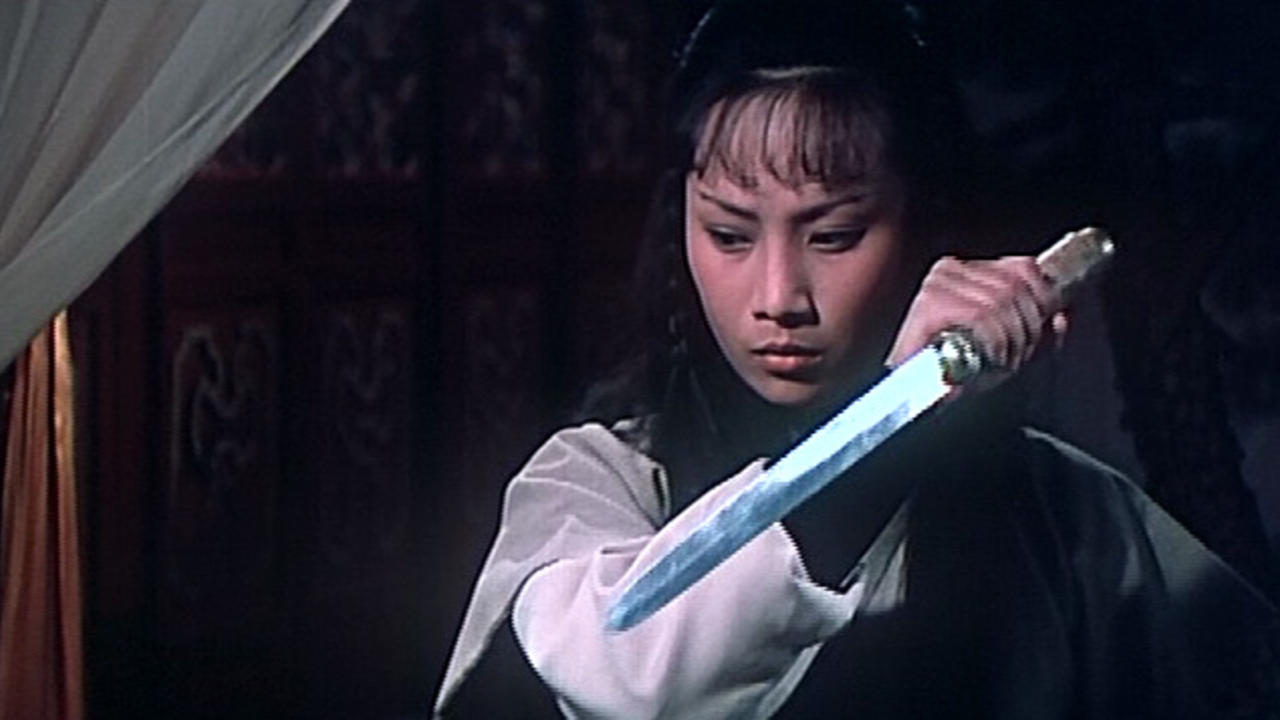
For example, Ah Shu seemed to be built up as a love interest. But he is killed off in a way, as well as the heroine’s reaction to it, which is so casual I wondered why he was even in the story. There is another character supposedly killed – silly me, believing that – who is suddenly back there to support the combatants in their fight again. The whole “she is poisoned and has to be cured” episode feels like a pointless story element, with no good reason except for extending the movie’s run time (admittedly I saw the theatrical version at 98 minutes; there is an extended version around 5 minutes longer), and giving Mao the chance to lay down and take a short break.
The actors here… well, they are Chinese actors in seventies wuxia and act accordingly. One shouldn’t expect Oscar-worthy performances here. The evil villains are evil and the rest of the actors hardly make much of an impression. Angela Mao is adequate as expected, though of course I’m more interested in her fighting skills than her acting talents. She moves elegantly and swiftly and I do believe she can fight off and kill more than half a dozen men, attacking her all at once. She is great “hero material”, and I applaud every action of hers. But I can hardly detect any burning pain underneath, or an insatiably hot appetite for revenge. Comparing that with the painful, tragic, almost longing for death portrayal of Kaji might be unjust. But it is also inevitable.
Of course, the dubbing doesn’t help. Yes, one should see movies like this in the original language version with subtitles, but I prefer a dub when I can get one. I don’t know from when this one comes (possibly the movie’s release in 1977), but the performances aren’t Anthony Hopkins and Jodie Foster acting, to say the least. I’m just happy to get lip-synched dialogue. It mostly plays inside buildings, temples or halls, giving the impression this is first and foremost a studio production. There are only a few scenes on location, though these are nice to look at. While I don’t rank the movie lower for it, I liked the beautiful, natural surroundings of Lady Snowblood much more. It’s just a matter of taste.
That said, as a whole I liked the production design, which makes you feel that the movie’s budget went into it, along with the historical Chinese costumes and some effects. It’s in contrast to Mao’s later Taiwanese films, where I can confirm she was working on a notably lower quality standard. This movie definitely has its qualities. As an old saying (incorrectly attributed to Oscar Wilde) goes: “Imitation is the sincerest form of flattery”. This might be true not only for Lady Snowblood, which Quentin Tarantino paid tribute to in Kill Bill – Vol. 1, but also for Broken Oath, as the fight between Sammo Hung and Angela Mao is definitely mirrored in the one between Chiaki Kuriyama and Uma Thurman.
Here’s a real obscurity. 18 years old, and yet still with a mere seven votes on the IMDb. There, I had to find it by going through the director’s name, as the title brought up nothing. To be fair, it’s not even the best-known film of the year, because some guy called David Lynch made a short called Ballerina in 2007. But it turns out to be an early work from Mauser, whose Lady Outlaw we covered earlier in January. That was certainly better – as it should be, coming almost two decades later, the director having made a good forty (!) features since. It doesn’t look like his budgets have increased much, but Outlaw does a better job of working within it.
Here, the ballerina is Tara, a ten-year-old girl who sees her parents ruthlessly gunned down because of their connection to the Capello crime family. She vows to find and kill whoever was responsible, and is brought up by her big brother Angelo (Jasso). He trains her in the ways of his own profession, as a hitman for the Capellos. Eight years later, Tara (Nutting) still has not been able to take her revenge, and is studying dance at college, while working alongside Angelo. She gets a visit from the mysterious Ruby (Young), a near-legendary figure in the underworld, who offers to tell Tara who killed her parents, if she helps fix things to his advantage. But she may not like what she is told.
Mauser clearly subscribes to the notion that talk is cheap, for it is very chatty. Sometimes, this is ok: Young has a presence which commands the listener’s attention. But too often it comes off as a bad Tarantino wannabe – and even a good Tarantino wannabe would be on thin ice. Witness the lengthy early discussion about smoking, which had me wishing I had a knitting needle to jab into my ears. Fortunately, nothing thereafter is quite as terrible. However, it’s a film more interested in telling, rather than showing. There’s a corrupt female cop (Posas) in the mix, and I liked the way all the police station scenes were shot in shadow. Clearly to hide that they couldn’t afford a set, yet it works well enough.
The action is no great shakes, with Nutting being slow and having a limited set of moves. Certainly, there’s little or no indication of the expected balletic grace. She seems about as much a dancer as I am: I won’t see fifty again, and my knees aren’t what they used to be. Jasso comes off like you ordered Joe Mantegna on Temu, which isn’t necessarily a bad thing, It all builds to an ending which strongly suggests Mauser is a big fan of The Usual Suspects in addition to Tarantino. As a pastiche of better film-makers, it’s just about okay, though the ten-year-old version of the heroine may be the most disturbingly intense thing this has to offer.
Dir: Brett William Mauser Star: :Amanda Nutting, Matthew Jasso, DeMarcus Young, Valerie Posas
When I reviewed Furiosa, I discussed how action heroine films have been having a tough time at the box-office since before COVID-19. Add another data point to that decline, with the underwhelming performance of Ballerina. Or, to give it its clunky and excessive full title (for the first and only time), From the World of John Wick: Ballerina. Which – much like Furiosa – is a real shame, because it’s top-tier stuff. The critics liked it (76% on Rotten Tomatoes) and those who saw it, liked it too (93% audience score there). But it just did not seem to connect in a large-scale way with the cinema-going public, and will struggle to cover its $90 million budget, not excessive by today’s standards.
Admittedly, it was a rather troubled production. Filming began all the way back in November 2022, and it was in post-production the following February. But a year later, word came out that additional shooting under John Wick director Chad Stahelski was taking place. There’s uncertainty how significant those were. Suggestions that much of the film was redone have been denied by both Stahelski and Wiseman, who said they were actually due to the studio providing them with additional resources. This allowed them to add scenes, such as the opening depicting the death of the heroine’s father. But regardless, the extra work was certainly a factor in the film being pushed back a full twelve months from its original release date of June 2024.
To be honest though, I really couldn’t tell based on the end product. I have read a lot of criticism suggesting, in brief, “Nobody asked for this.” While that’s dumb – nobody asked for John Wick either – there is an element of truth in it. If they wanted a spin-off, they might have been better using Sofia Al-Azwar, the existing character played by Halle Berry, who was key to one of the best scenes in John Wick: Chapter 3 – Parabellum. It’s worth noting, the script by Shay Hatten, written back in 2017, was not originally part of the Wick universe (although Hatten was inspired by the trailer for John Wick 2), and subsequently got tooled into it. But I wonder, how often are spin-off movies ever successful? Ok, except the Minions franchise.
It’s not the first effort to expand the Wick-iverse which has fallen short either. In 2023, they made a TV mini-series The Continental, which… Um, well… We watched the first episode? You’re certainly left to wonder what might happen about the other spin-off film, focused on Caine, the blind swordman played by Donnie Yen in John Wick 4. We love Yen, and have since the days of In the Line of Duty IV, over 35 years ago. But he has a much lower profile in the West than Ana de Armas, and the appetite for films “from the world of John Wick” which do not have Wick front and center, certainly appears to be muted. Enough about such coarse, commercial considerations. How is Ballerina as a movie?
In this world, there are two specific tribes of assassins. The Ruska Roma, who are structured and orderly, and another group, known as the Cult, who are anarchic and savage. Lawful Neutral and Chaotic Evil, for those who know their D&D alignments. The two groups don’t get along, but generally tolerate each other, basically agreeing to go their separate ways and not interfere, under the current leadership of the Director (Huston) and the Chancellor (Byrne) respectively. A decade or so ago, there was Romeo and Juliet-style romance across the divided houses, resulting in the birth of Eve. When her parents tries to leave their factions, both are killed, her father dying in front of her after being killed by the Cult. She is then brought up in the Ruska Roma.
Eve (de Armas) is trained both as an assassin and a ballerina, although the latter is never of any real significance. On one of her missions, she encounters a Cult member and realizes they are responsible for killing her father. Against the express wishes of the Director, she goes in search of them, finding their headquarters in the remote (and very lovely) Austrian town of Hallstatt, and chewing her way through the Cult towards the Chancellor. But when the Director hears about Eve’s quest for vengeance, posing a threat to the uneasy truce between the Ruska Roma and the Cult, she sends a certain J. Wick (Reeves) after her, to restore the balance and keep the peace.
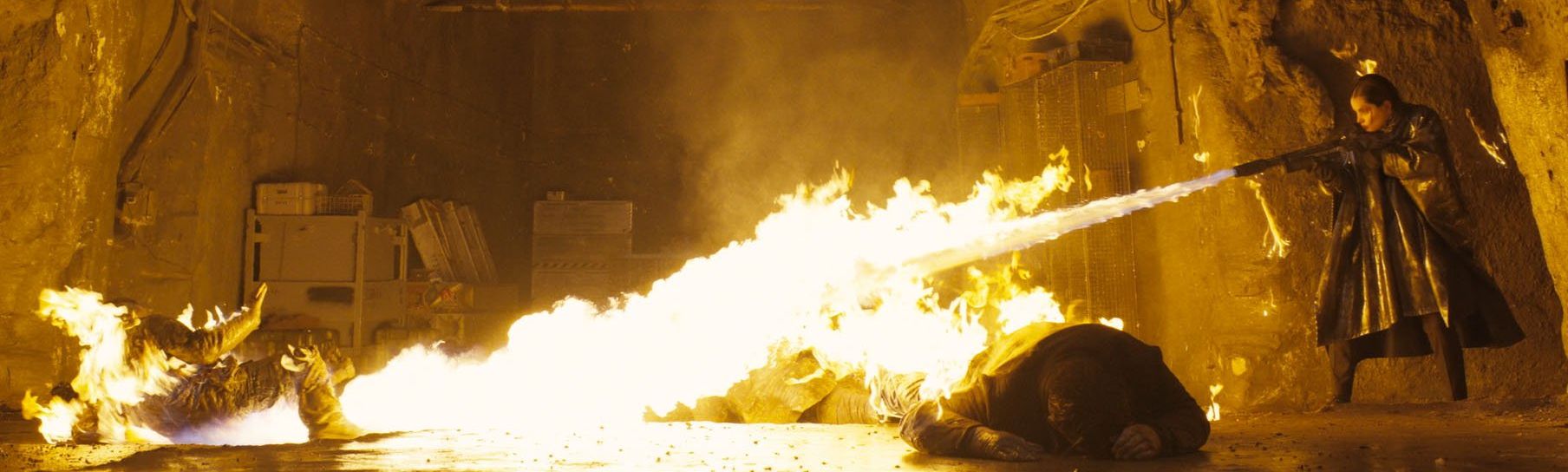
It’s borderline awesome, and on occasion, there’s no “borderline” about it. Let’s just say, I will now be looking into acquiring a flamethrower for home defense. Ok, I should explain. There’s a scene where Eve and one of the Cult members have a – bold font, capital letters, please – DUEL WITH FLAMETHROWERS. It’s every bit as epic and wonderful as that sounds, and it escapes me how they could possibly have achieved it, without reducing the entire stunt team to charcoal briquettes. That’s just the action highlight in a film which has a number of them. I was also impressed with the nightclub sequence – is this obligatory for every film in the Wick-iverse? – of Eve’s first mission, as much for the thumping techno tunes, as for the high-quality fisticuffs.
I do say, some elements feel under-developed, and I wonder if they were a result of the adjustments made during production. The character of Daniel Pine (Norman Reedus), seems particularly an afterthought, not least the fact he’s supposed to be the Chancellor’s son. Adding John Wick in does feel like an unnecessary afterthought and, to be honest, smells a little of desperation. It’s just not necessary, because de Armas is capable of carrying things. This is likely, not just to be the best action heroine film of the year, it’s quite possibly – admittedly, I haven’t seen the last Mission Impossible film yet – going to end up as the best action film of 2025. Such a pity it appears likely to be one and done for this tiny dancer.
Dir: Len Wiseman Star: Ana de Armas, Gabriel Byrne, Anjelica Huston, Keanu Reeves
Right in the middle of us watching this, Chris got a text from our daughter: “I think we rented the wrong version of Ballerina…” Yes, independently, she was watching the same film. The difference is, we understood what we were getting into. We knew this was a mockbuster from infamous purveyor of such things, The Asylum. I thought the concept of people mistaking Asylum movies for the real thing was an urban legend. Courtesy of our daughter, we now know better. Or worse. For this is, of course, not fit to lace up Ballerina‘s shoes, and anyone expecting it will be sorely disappointed. Yet it’s not irredeemable. I’ve seen considerably worse. From The Asylum, in particular.
Though I will question the title. Heroine Maria Herrera (Kaur) is not particularly an assassin. She’s really an agent, working for a shadowy government agency run by Bixby (Keating). She is, however, a former ballerina. This comes in handy for her new mission, in which the agency seeks to trap cartel head and aspiring politician Javier Aguilar (Sellar) on his trip to the United States. Maria is tasked with getting close to his wife, Carmen (Scotto), who is going to an audition for a spot in a ballet troupe. Naturally, it’s not that simple. Maria soon discovers there is someone in the agency who is actually collaborating with Javier, and has a strong desire to see her taken out of the picture. Permanently.
As stories go, it’s fairly workmanlike. You won’t find it hard to work out who’s the mole. To be fair, the film doesn’t stretch this element out too long, which would have been irritating. It then becomes a battle for possession of a hard-drive containing incriminating evidence. Loyalties shift – Javier in particular is surprisingly sympathetic for a cartel boss – all the way till the final scene. Kaur, who also starred in The Asylum’s Furiosa mockbuster, Road Wars: Max Fury (review of that coming next week) is okay. She’s not particularly pretty, but that kinda works for the character. I was amused by her using her ballet skills to get through a laser corridor, like the kind first seen in Resident Evil.
There’s also a combat drone brought up early on, and you just know it’s going to end up chasing down the heroine. However, when it eventually does, the results are underwhelming, and this goes for the majority of the action. It’s basic stuff, with very little imagination or flair, and nobody here is able to carry it off at any level above the barest minimum. As cheap entertainment – we literally got it through our local library for free – it just about passes muster, if you’re in an undemanding mood. But it’d be much better off not inviting comparisons to what’s likely to be the best action heroine film of the year. Our daughter was highly unhappy about the deceptive marketing, and I cannot blame her in the slightest.
Dir: Michael Su Star: Preet Kaur, Dominic Keating, Nicolas Sellar, Rocio Scotto
Rebecca Ryan (Goose) is an undercover cop, who has been working for three years as “Margaret”, infiltrating the McCann family, a South London organized crime outfit, with Darius Cruise (Ofoegbu) as her handler. He’s just been given a new partner, Abby Barrett (Air), and isn’t happy about it. Rebecca, meanwhile, has fallen in love with Harry McCann (Calil), but his sister, Marla (Riana Husselmann), recently out of jail, suspects something is up with ‘Margaret’. When an incident appears to blow her cover, and Rebecca returns home to find her daughter murdered, she decides it’s time to make the entire McCann family pay for their actions. As the title suggests, everything subsequently unfolds over the course of a single day.
It’s all a bit wobbly at the beginning, with the director struggling to get all the various plot threads up and running. Trimming them back would have been helpful, such as Abby’s contentious relationship with her former partner; it adds little. Air’s performance isn’t the best either; she’s considerably less convincing as a cop than Goose or Ofoegbu, although the latter is clearly channelling the spirit of Idris Elba as Luther. As a low-rent version thereof, he’s not bad, with the script throwing on copious quantities of cynicism, such as Darius telling his partner, “The only thing I don’t believe in anymore is this job.” Goose is decent too, playing a woman who is teetering on the edge of losing herself, with her daughter providing the sole reliable anchor in her life.
When that tether gets removed, there’s really only one way things can go: downhill, quite rapidly. The problem is, the further in we get, the more likely it is that the McCann’s weren’t responsible (though I have to say, the actual resolution doesn’t feel credible, especially for a British-set movie). But by the point Rebecca discovers the truth, a quote from Lady Macbeth fits the anti-heroine very well: “I am in blood stepped in so far that, should I wade no more, returning were as tedious as go o’er.” It does feel almost Shakespearean, in the sense that tragedy seems inevitable, and the characters are largely powerless to do anything about it.
I’d like to have seen more of Marla, who makes an immediate impression from her first scene. The character has a calculating edge, and a civilized veneer thinly covering a most unfeminine fondness for brutality. I almost wish the makers had gone the whole way, and made Darius a woman as well, to complete the quartet of strong female characters. The low budget does occasionally show through, and some of the action might leave a bit to be desired, though the inevitable brawl between Marla and Rebecca does achieve a satisfactory resolution. However, by concentrating on the women, it does stand out from the slew of “gritty” British crime film to come out in the two thousands. While it’s no Luther, I found myself adequately entertained and surprisingly engaged.
Dir: Ian David Diaz Star: Claire Goose, Donna Air, Anthony Ofoegbu, George Calil




 There can’t be many Westerns of the fifties where the Yankees are the bad guys. Yet here we are. In mid-19th century California, to be precise, just after it became part of the US. The new owners enthusiastically threw the existing, Mexican inhabitants off their lands, in the search for gold, using harsh taxation as a weapon against them. And worse, if this is to be believed. For it begins with the callous murder of the Montalvo family, but the legalized thugs responsible don’t realize daughter Zara (Britton) has survived. She takes on two false identities out of necessity: white girl Lola Belmont for Detroit, but also Zara, masked, whip-wieldiing outlaw. As the latter, she seeks justice for her parents, and also “Robin Hoods” the stolen gold back to its rightful owners.
 Director West certainly knows his way around an action film. He is probably best known for Con Air, but I’m also a fan of his Chinese disaster porn flick, Skyfire, about a volcano-themed holiday resort (guess how that works out?). So, despite the critical drubbing this received, I was hoping this might still be entertaining. Unfortunately, it is not. It’s a comedy-action movie, that manages to fire blanks from both barrels. There is not a shred of originality to be found here. What isn’t stolen here from Die Hard, is ripped off from Bridesmaids – heroine Wilson plays her role like the makers ordered Melissa McCarthy on Temu. Writer Shaina Steinberg should be ashamed for the lazy sloppiness, painfully apparent here.
 On seeing the title and poster (which looks suspiciously AI-generated, and I know
  To some extent, Sonia (Arnezeder) is the very antithesis of an action heroine here. For she spends the vast bulk of the ninety minute running-time, sitting in the driver’s seat of her car. Admittedly, this is for good reason, because somebody has wired an anti-tank mine into the car’s circuitry, in a number of diabolical ways. There’s a countdown timer, anti-tamper device and it’s also liable to be triggered if the weight in the car drops below a certain amount. Making matters worse, her two kids are in the back. The reason is because of her work in bomb disposal, part of a charity that disarms mines in the Ukraine, a task which has made her certain enemies.
 And if the above phrase doesn’t make any sense – it’s basically an underwhelming outcome during a baseball game – then you are probably not the target audience for this sporting drama. After almost a quarter-century living in America (much of it spent running a site about the local team as a sideline!), I’m fairly well-versed in baseball’s intricacies. But in contrast to some of the other Korean movies in this genre, such as
  I guess, the old saying “just there for Godzilla” definitely applies to me. This movie is far from perfect, but as long as I see some skilled fighters in fancy costumes battling it out, I’m in. Additional points are given if the respective dub is at least tolerable. Broken Oath is actually an interesting movie. It is kind of a remake of Japanese classic
  Broken Oath follows the story beats of Lady Snowblood quite closely – until it slowly becomes its own thing. It’s comparable to how
  For example, Ah Shu seemed to be built up as a love interest. But he is killed off in a way, as well as the heroine’s reaction to it, which is so casual I wondered why he was even in the story. There is another character supposedly killed – silly me, believing that – who is suddenly back there to support the combatants in their fight again. The whole “she is poisoned and has to be cured” episode feels like a pointless story element, with no good reason except for extending the movie’s run time (admittedly I saw the theatrical version at 98 minutes; there is an extended version around 5 minutes longer), and giving Mao the chance to lay down and take a short break.
 Here’s a real obscurity. 18 years old, and yet still with a mere seven votes on the IMDb. There, I had to find it by going through the director’s name, as the title brought up nothing. To be fair, it’s not even the best-known film of the year, because some guy called David Lynch made a short called Ballerina in 2007. But it turns out to be an early work from Mauser, whose
  ★★★★½
★★★★½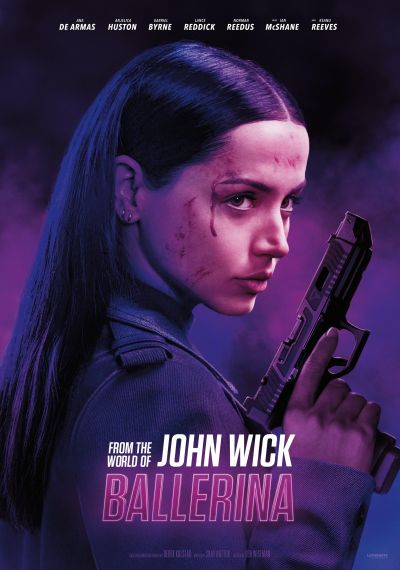 To be honest though, I really couldn’t tell based on the end product. I have read a lot of criticism suggesting, in brief, “Nobody asked for this.” While that’s dumb – nobody asked for John Wick either – there is an element of truth in it. If they wanted a spin-off, they might have been better using Sofia Al-Azwar, the existing character played by Halle Berry, who was key to one of the best scenes in John Wick: Chapter 3 – Parabellum. It’s worth noting, the script by Shay Hatten, written back in 2017, was not originally part of the Wick universe (although Hatten was inspired by the trailer for John Wick 2), and subsequently got tooled into it. But I wonder, how often are spin-off movies ever successful? Ok, except the Minions franchise.
  It’s borderline awesome, and on occasion, there’s no “borderline” about it. Let’s just say, I will now be looking into acquiring a flamethrower for home defense. Ok, I should explain. There’s a scene where Eve and one of the Cult members have a – bold font, capital letters, please – DUEL WITH FLAMETHROWERS. It’s every bit as epic and wonderful as that sounds, and it escapes me how they could possibly have achieved it, without reducing the entire stunt team to charcoal briquettes. That’s just the action highlight in a film which has a number of them. I was also impressed with the nightclub sequence – is this obligatory for every film in the Wick-iverse? – of Eve’s first mission, as much for the thumping techno tunes, as for the high-quality fisticuffs.
 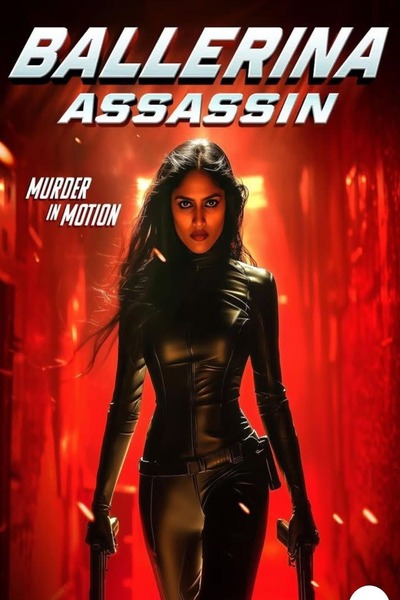 Right in the middle of us watching this, Chris got a text from our daughter: “I think we rented the wrong version of Ballerina…” Yes, independently, she was watching the same film. The difference is, we understood what we were getting into. We knew this was a mockbuster from infamous purveyor of such things, The Asylum. I thought the concept of people mistaking Asylum movies for the real thing was an urban legend. Courtesy of our daughter, we now know better. Or worse. For this is, of course, not fit to lace up Ballerina‘s shoes, and anyone expecting it will be sorely disappointed. Yet it’s not irredeemable. I’ve seen considerably worse. From The Asylum, in particular.
 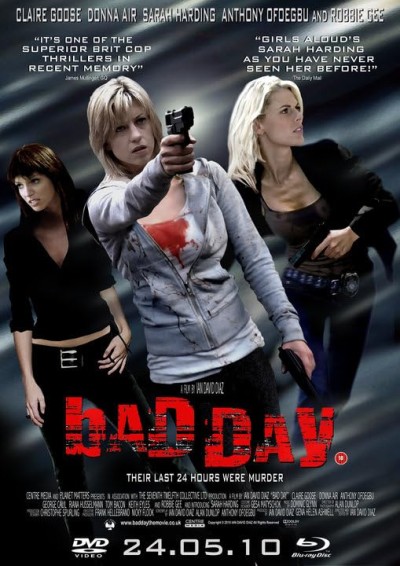 Rebecca Ryan (Goose) is an undercover cop, who has been working for three years as “Margaret”, infiltrating the McCann family, a South London organized crime outfit, with Darius Cruise (Ofoegbu) as her handler. He’s just been given a new partner, Abby Barrett (Air), and isn’t happy about it. Rebecca, meanwhile, has fallen in love with Harry McCann (Calil), but his sister, Marla (Riana Husselmann), recently out of jail, suspects something is up with ‘Margaret’. When an incident appears to blow her cover, and Rebecca returns home to find her daughter murdered, she decides it’s time to make the entire McCann family pay for their actions. As the title suggests, everything subsequently unfolds over the course of a single day.