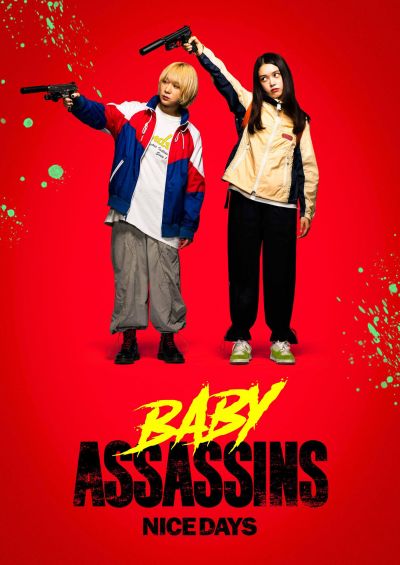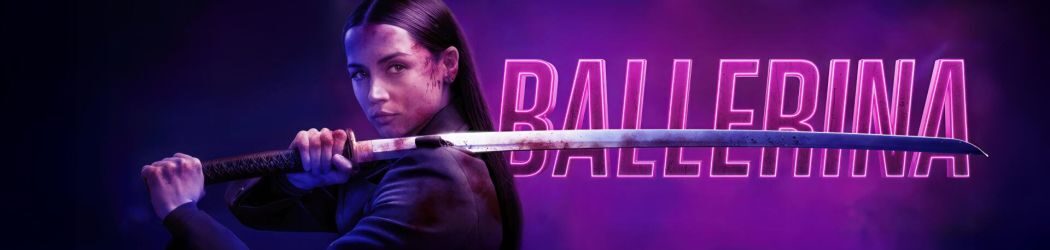

I am increasingly coming to the conclusion that the Baby Assassins franchise may be some kind of surrealist joke, being played on me by its makers. I really want to love the series and, as with both Part 1 and Part 2, there are moments where I do. At points, I was genuinely considering this as a Top 10 movie I saw this year – not just among GWG movies either. But then, it’ll grind to a halt, with such dedication to being mind-numbingly tedious, that it feels almost like wilful self-sabotage. In reality, I think it’s more likely to be cultural and societal impenetrability. Some elements here are ones which are relatable to a Western audience. Others? Not so much.
It takes place in Miyazaki, a seaside city in Japan. Our heroines, Chisato (Takaishi) and Mahiro (Izawa) are on a working holiday there. Or a holiday where work keeps interrupting, it’s hard to say. However, their commission becomes an issue, because another, non-guild assassin, Fuyumura (Ikematsu), is also on the job. The guild are unhappy, and order the pair not just to complete the commission, but also eliminate Fuyumura for cutting in on their turf. This will be easier said than done, even with the largely unwelcome help of guild supervisor, Minami (Maeda). She is less than impressed with the Gen Z approach of Chisato and Mahiro, who would rather be in a restaurant eating the renowned local beef.
As before, it’s the action which really resonated with me, in particular a stunning series of close-quarters battles. And when I say “close”, I mean fights where the combatants are frequently inches from each other. The early sequence where Chisato goes up against Fuyumura is a good example: while there is a gun involved, there’s not enough space between them, for either to point it effectively at their opponent. [This is when I was thinking, potential top ten movie] It’s also notable that, in this installment, most of the sequences involve professional assassins going up against each other in one-on-one, or two-on-one, action, not the mass brawls of previous films. This exchange of quality for quantity is a better opportunity for the participants to show off actual skills.
But the stuff between the fights? Dear lord, this is mostly terrible. And, in a film which runs an entirely unnecessary one hundred and twelve minutes, it’s terrible at near-excruciating length. There are only so many times you can listen to Mahiro worry about forgetting Chisato’s 20th birthday before it becomes a chore, rather than a pleasure. For me, that limit is “once.” Being charitable, this kind of stuff probably plays better to a local audience, or maybe simply one closer to the protagonists’ ages. My tolerance for Gen Z shit is certainly closer to Minami’s, and may be lower still. I’ve no doubt I’ll be waiting for Baby Assassins 4; I just hope the makers decide that joke isn’t funny any more.
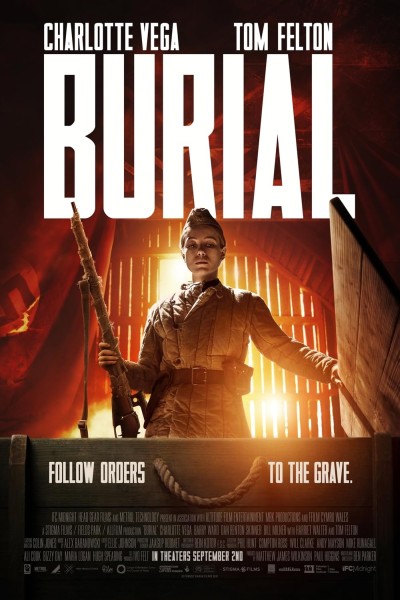
There’s an interesting idea here, which somewhat works. But it’s perhaps a little too grounded for its own good. It starts in a London flat, where senior citizen Anna Marshall (Walter) ambushes an intruder, handcuffing him to a radiator. Turns out he’s not just a burglar. He knows about her past, and wants the truth. So she tells him a story… At the very end of World War II, her identity was Brana Brodskaya (Vega). She was one member in a small group of Russian soldiers, who have been given a very important task: transport a box back from Berlin to Moscow. Oh, and bury it every night. Inevitably, their curiosity overcomes them, and the box is opened, to reveal Hitler’s corpse inside.
Naturally, the remaining German forces are very keen to re-capture the Fuhrer’s body, to preserve the myth of his escape and survival. The group become bogged down in a Polish village, under attack from Nazi Werwolfs. Not, please note, actual werewolves. Though I have to say, that would have been pretty damn cool [I’m a big fan of Dog Soldiers, which does pit British soldiers against actual werewolves] The Werwolfs were resistance forces, left behind by the Nazis behind Allied enemy lines, as they advanced towards Germany. This is fact. As depicted here, they wear animals pelts when they attack, while burning mushrooms and lichen which cause their target to hallucinate. This is… rather less certain, albeit also kinda cool.
Brodskaya is, clearly, the moral compass of the group, who tries to keep her comrades on task too – neither of which prove easy. When half of them split off seeking the “spoils of war”, she goes after them to stop them from committing war crimes on the civilian population. The locals are just tired of the conflict, and have little patience for either occupiers or liberators, not trusting either side. Parker does a good job of depicting the murkiness of a situation like this, where the lines of morality aren’t as clear-cut as you would initially expect. But the heroine is mission-oriented as well, and when control of the cargo is lost, she leads the charge to recover it, knowing the threat its loss would pose.
Unfortunately, I found there to be significant issues with pacing, especially in the middle third which seems to contain several too many underlit action scenes in the woods. I’ve read multiple complaints about it being marketed as a horror movie, and certainly, if that’s what you are expecting, you will be severely disappointed. I had no such prejudices and so didn’t mind too much. Though I would have extended the flashback further, since there seems to be a lot of interesting material covered at the end, in a bit of an info-dump by Marshall. Between that and the non-lycanthropic werewolves, this is why I reckon there’s a lot of potential left unexplored here. An excellent concept, let down by only average execution.
Dir: Ben Parker Star: Charlotte Vega, Tom Felton, Barry Ward, Harriet Walter
Before we go any further, you need to know one thing: do not expect complete resolution. This literally ends with “To be continued…” One of the major plot threads is wrapped up. But another remains largely unresolved, and the final few minutes start off another, almost entirely new one. The original intent was for this to be the first in a series of made for Lifetime movies. But since this came out in June 2022, no further installments have appeared. Instead, you get something which is so abrupt, I started to look and see if the copy I was watching had failed to download completely. It’s unfortunate, because until then, it might be the best Lifetime TVM I’ve seen.
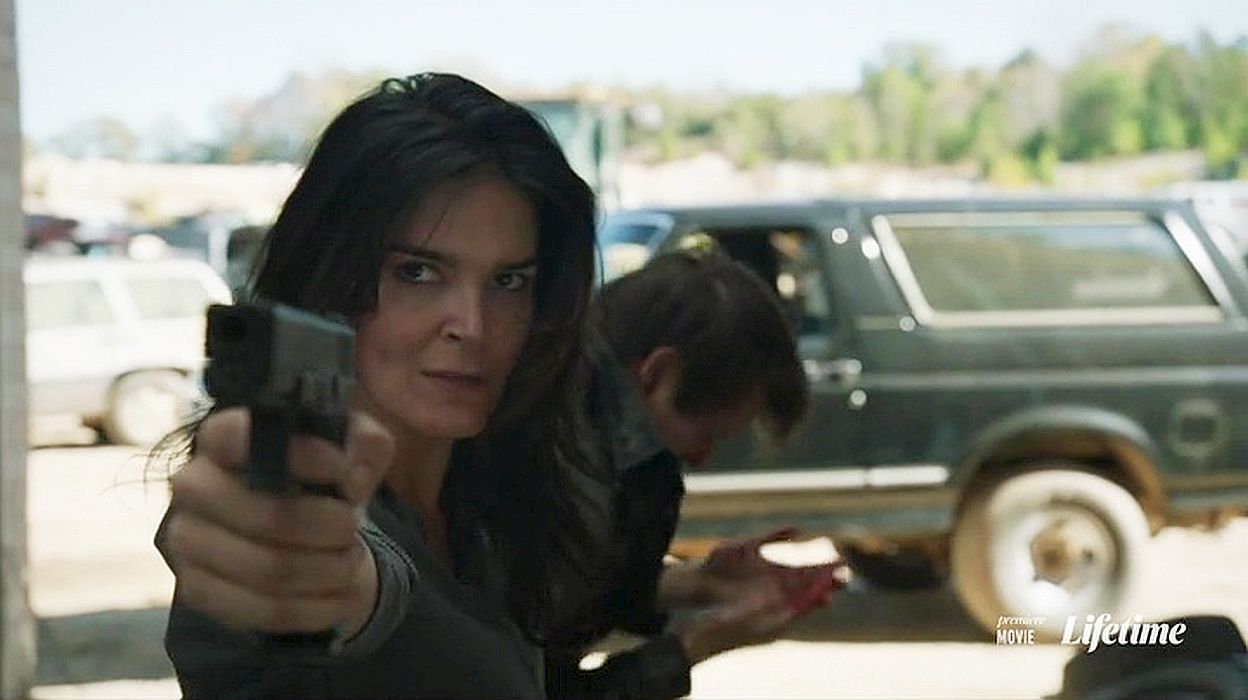
That begins with an opening caption: “This program contains strong violence. Viewer discretion is advised.” Ok, we are still talking about strong violence… by the standards of Lifetime TV movies. Do not expect founts of arterial spray and disembowelment. But it does mean that when someone gets their nose broken, there will be some blood. It’s surprising how a little helps there. The nose-breaking is delivered by Hazel King (Harmon), a single mother who runs a diner on the road to Las Vegas, and is fiercely protective of daughter Joy (Richards). So when Joy’s scuzzy boyfriend gives her a black eye, she isn’t standing for that. Or, as she puts it, “He raises a fist, I raise a gun.” Scuzzy boyfriend subsequently vanishes.
Because, it turns out, Hazel is not just a momma bear, but a former mob assassin, who quit the job years ago. Of course, it isn’t that simple, and eventually her old boss, Von, comes calling. This being a Lifetime TVM, there is inevitably a romantic interest, in the shape of hunky dishwasher (!) and former heart surgeon (!!) Elliott (Polaha). However, this turns out not just to be purely for the obligatory sucking of face. Indeed, it’s integrated with surprising grace, tying in to Joy’s previous, but eventually discarded, ambitions in the medical field. Really, up until the final moments, this was almost indistinguishable from a “real” movie, in terms of plotting. Harmon’s performance, too, is polished and effective.
Never more so than when she’s going after scuzzy boyfriend, where there’s a genuine degree of intensity which I did not expect. I was entirely convinced she was both capable of murdering him, and had every intention of doing so. This all unfolds inside the first twenty minutes and, while we don’t get anything quite as effective thereafter, it makes an excellent impression, and establishes a great deal about Hazel as a character. It’s a real pity that we are now approaching four years since the broadcast of the film in June 2022, and there has not even been a peep about a follow-up. It’s a shame – both in terms of the concept not being developed to its potential, and because this, on its own, deserves to have received a better ending.
Dir: Howard Deutch Star: Angie Harmon, Lauren Ashley Richards, Kristoffer Polaha, George Paez
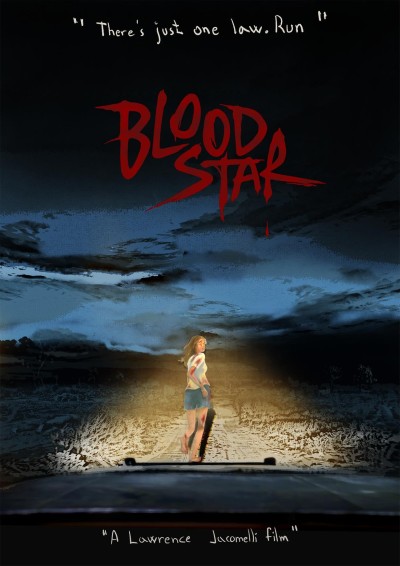
I get the idea of what this is trying to do: really, be a female-centric version of The Hitcher. Though to some extent, that franchise went there itself, in The Hitcher II: I’ve Been Waiting. Here, we have Bobbi Torres (Camacho) driving across New Mexico in her sweet muscle car, and when she stops for fuel, has an awkward encounter with Sheriff Bilstein (Schwab). Things get worse when she gets back on the road, and is quickly pulled over by the officer for speeding, which gets her a thousand dollar ticket she is unable to pay. Thanks to a prologue, we know Bilstein has a psychopathic fondness for tormenting and killing young women. This ain’t gonna end well.
It is one of those films where you can tell whether someone is good or evil by their genital configuration. Every man Bobbi meets is evil; every woman we see is part of an unspoken sisterhood. I sense the aim was some kind of riot grrrl agenda, but it manifests itself in some spectacularly clunky ways. There’s one conversation which is especially cringey, Bobbi trading abuse stories with a diner waitress, Amy (Brumfield). It ends in a manner that is clearly intended to be shocking, but I was more relieved the pair had simply stopped spitting out clichés. And I am fairly sure that getting jabbed with a syringe does not typically result in instinct heroin addiction, as alleged here.
Nor does it help that Bobbi isn’t very likeable, the script mistaking smart-ass and mouthy as endearing. Schwab does better as the authority figure, exuding menace with every sentence. Though despite sharing a fondness for toying with his victim, the Sheriff is inevitably nowhere near as memorable as Rutger Hauer’s mythical road warrior. The agenda here is less interesting as well: I’ve seen a few reviews which compare this to the Wolf Creek movie, and I’d not argue – in part because I didn’t like that Australian road-slasher very much either [the TV series, however, is worth a look] The scales here are tipped considerably in favour of torture porn (albeit more mental than physical), with the inevitable explosion of Bobbi limited to the final fifteen minutes.
There are some positives to be found, such as the impressively sparse desert landscapes (looks like California played the part of New Mexico), and Bobbi’s car, a 1977 Ford Mustang, which arguably has more personality than its driver. There’s a plot point established about it having a balky starter motor, but I don’t recall this being as crucial as I expected. I did like the sense anyone could die at any time, with a couple of deaths out of nowhere. It needs a heroine who is considerably more aggressive, except verbally, in the first half. Bobbi ends up being too passive for too long in the face of the Sheriff’s obvious threat, which belies the strong, confident woman the script wants her to be.
Dir: Lawrence Jacomelli Star: Britni Camacho, John Schwab, Sydney Brumfield, Travis Lincoln Cox
There can’t be many Westerns of the fifties where the Yankees are the bad guys. Yet here we are. In mid-19th century California, to be precise, just after it became part of the US. The new owners enthusiastically threw the existing, Mexican inhabitants off their lands, in the search for gold, using harsh taxation as a weapon against them. And worse, if this is to be believed. For it begins with the callous murder of the Montalvo family, but the legalized thugs responsible don’t realize daughter Zara (Britton) has survived. She takes on two false identities out of necessity: white girl Lola Belmont for Detroit, but also Zara, masked, whip-wieldiing outlaw. As the latter, she seeks justice for her parents, and also “Robin Hoods” the stolen gold back to its rightful owners.
There’s another outlaw, Carlos del Rio, a.k.a. Joaquin Murietta (Reed), also operating along similar lines. But also complicating matters is the local tycoon for whom “Lola” falls, Dan Hinsdale (Parker). Because it turns out his wealth largely stems from being the acceptable face of these legalized thugs. When Murietta is captured, it’s Zara who has to break him out, and the pair them team up, both romantically and in their causes. Their predations have caused enough problems to merit the army getting called in, but there’s also a movement to repeal the tax laws at the heart of the land grabs: which will succeed in their goal first?
It’s obviously a feminine knock-off of Zorro, to the extent in Germany it was released as Zorro’s Daughter. Given the obviously Hispanic leanings, it’s a shame the players involved are so thoroughly and obviously non-Hispanic. The honourable exception is Garralaga as local priest Father Antonio, who for much of the film is the only person to know the truth about both Zara and Joaquin. I wouldn’t expect too much from the heroine here: riding a horse and cracking a whip is about the limit of the on-screen action. Though she is responsible for the (off-screen) deaths of those present when her parents were killed, and does shoot the big villain in the final showdown. If unconvincing as a Mexican, Britton has a righteous intensity about the situation that is effective, and held my interest throughout.
She is certainly more interesting than Parker or Reed, who are blandly handsome in the way leading men of the time typically were. Making a bigger impression in the supporting cast is little person actor Angelo Rossitto, whose career spanned sixty years, including both cult classic Freaks and Mad Max: Beyond Thunderdome. Running barely over an hour long, this is probably a case where less is more: the narrative is generally slight, but good enough. I particularly enjoyed the heroine switching from Lola to Zara, then back again, in order to free Joaquin without causing suspicion. Despite the obviously low budget, this was not a chore to watch, and is as good as some of the other Zorro-related entries we’ve covered here, such as Zorro’s Black Whip.
Dir: William Berke Star: Barbara Britton, Willard Parker, Phillip Reed, Martin Garralaga
Director West certainly knows his way around an action film. He is probably best known for Con Air, but I’m also a fan of his Chinese disaster porn flick, Skyfire, about a volcano-themed holiday resort (guess how that works out?). So, despite the critical drubbing this received, I was hoping this might still be entertaining. Unfortunately, it is not. It’s a comedy-action movie, that manages to fire blanks from both barrels. There is not a shred of originality to be found here. What isn’t stolen here from Die Hard, is ripped off from Bridesmaids – heroine Wilson plays her role like the makers ordered Melissa McCarthy on Temu. Writer Shaina Steinberg should be ashamed for the lazy sloppiness, painfully apparent here.
Sam (Wilson) is a secret agent, a fact which repeatedly interferes in attempts to reconnect with childhood friend Betsy (Camp), who is just about to get married. For instance, Sam has to abandon the bachelorette party, in order to recover a bio-weapon. On the day of the wedding itself, Sam is fortuitously away from the wedding party when a group of thieves, led by Dorff, attack the event, take everyone hostage and begin cracking the multiple locks on the family safe. But they are not just ordinary thieves, and Sam is the only hope to neutralize them. Sound just slightly familiar? That noise you hear is Steven de Souza preparing his demand for a screenwriting credit.
On the other hand, having seen the end product, I would sue to get my name taken off this heap of nonsense. I kept going back and forth as to which element was less effective: the comedy or the action. In the end, I would have to say the former, because I don’t think I cracked a single smile over the entire hour and three quarters. The characters are of the sort intended to be “larger than life”, but in this case, it means gratingly annoying. Sam wasn’t the worst to be fair. There are others here, whose company I would gnaw my own leg off to escape from, if I ever met them in the real world. Again, I put the blame for these failures, squarely on the shoulders of the script.
The action is not much better, with it being painfully obvious that Wilson needed to be doubled for any scene requiring speed, strength or flexibility. Basically, anything more than standing about – possibly stretching to swinging something like a fire-hose around for a few seconds. Why they couldn’t cast someone semi-plausible in the role escapes me. Spy did a far better job with the similarly plus-sized McCarthy. It all builds to… um, some kind of chase scene involving hovercrafts laden with gold bullion? To be honest, my attention was drifting elsewhere during the action climax, which is a savage indictment of its shortcomings. If the action heroine genre is struggling at the box-office, this kind of garbage is the reason why.
Dir: Simon West Star: Rebel Wilson, Anna Camp, Stephen Dorff, Anna Chlumsky
On seeing the title and poster (which looks suspiciously AI-generated, and I know AI-generated warrior nun imagery) for this, I immediately knew two things. Firstly, I had to review it for the site. And secondly, it was going to suck like an Electrolux. And, verily, the prophecies did come to pass. Here is the review, and it is, indeed, pretty terrible. Chris’s sarcasm did flow mightily, and I’m going to have watch a large number of episodes of Anthony Bourdain’s No Reservations with her, to make up for this abomination. Not that there isn’t scope for an interesting story, involving a cadre of warrior nuns, seeking revenge for a long-past atrocity. It’s just that this is not that movie. Indeed, it’s barely a movie at all.
The three Sisters of No Mercy here (have I used that joke before? It feels vaguely familiar) are Mary (Wunna), Sarah (Rakhvalova) and Eva (Legallais-Moha), operating under the guidance of a priest (Kouros), and seeking to find those responsible for the 1992 massacre of an orphanage. Quite why they have waited so long before embarking on this mission is unclear, as is why they insist on questioning people far too young to have been in any way involved. Except possibly as orphans. They gradually work their way up the chain, in scenes which are excruciating only in their lack of pacing to find the man supposedly at the top, Victor Vargas. Only to find – gasp! – there’s one final twist as to who was behind the incident, and its purpose.
There’s about enough material in this for a quarter-hour short. It actually runs ninety-eight glacial minutes. The difference is filled with scenes in which one of the nuns walks into a room in her underwear and puts on her nun attire, with no sense of urgency at all. Seriously, if there’s one of these scenes, there’s at least six of them. They are seen lounging by the pool in bikinis once, so I’m not going to claim the title is entirely inaccurate. But I feel that Nunderwear would have been more appropriate. I will defer to the experts over at Nunsploitation.Net to pick apart the film’s accuracy, for things like nun accessories worn inside out, etc. I wasn’t expecting accuracy, or even anything convincing.
But, if I may be forgiven an appropriately religious appeal: Christ, this is dull. Witness the strip poker scene which had us wondering if we had misunderstood the whole purpose of the game. I mean, why do you need poker chips? Don’t you bet with your clothes? Isn’t that the point? If the makes had actually bought wholesale into the premise, and had fun with it, this could have worked. There is a tension between Old Testament vengeance, and New Testament forgiveness, which could have been fertile ground for exploitatative exploration. Instead, this would have had more energy if performed by a troupe of sloths. Blasphemy has never been so dull.
Dir: Sushank Kini Star: Chrissie Wunna, Clara Legallais-Moha, Christopher Kouros, Anna Rakhvalova
To some extent, Sonia (Arnezeder) is the very antithesis of an action heroine here. For she spends the vast bulk of the ninety minute running-time, sitting in the driver’s seat of her car. Admittedly, this is for good reason, because somebody has wired an anti-tank mine into the car’s circuitry, in a number of diabolical ways. There’s a countdown timer, anti-tamper device and it’s also liable to be triggered if the weight in the car drops below a certain amount. Making matters worse, her two kids are in the back. The reason is because of her work in bomb disposal, part of a charity that disarms mines in the Ukraine, a task which has made her certain enemies.
Fortunately, she’s not alone. Her other half, Fred (Kiwitt), is there for moral support, and – probably more helpfully – colleagues from her agency are also present, in particular Igor (Bukvic) and Camile (Mortensen). Together with Sophie, they have to figure out both a solution to the immediately explosive situation, and find out who’s responsible. There are no shortage of candidates, and no shortage of strong female characters either, even beyond Sophie and Camile. These are involved on both sides of the scenario, as it eventually turns out. Though I must confess, I’m a little uncertain about the motivation of those involved. In particular, why the rather complex approach taken here, was deemed to be the most appropriate method. Sometimes, simpler is better, when it comes to evil plans.
That said, it’s a film which doesn’t hang about. Barely a couple of minutes pass before Sophie and her kids are sealed in, with a literal ticking clock. Though we do know this won’t be the end, because the countdown is for only half an hour, it sets the tone early. Peirani-Vignes then does a solid job of keeping the tension high, for the rest of the way. Every time you think you know where this is heading, the script, by the director and Pablo Barbetti, finds a new wrinkle to go in a different direction. As noted, I… have questions about some aspects. However, these did not stop me from remaining engaged, in particular during the front two-thirds of the film.
It did seem to struggle down the stretch. You know there’s inevitably going to be some heroic sacrifice needed. It wasn’t the character I expected: a bit of a mixed blessing, because I really wanted to see them get some degree of payback and/or redemption. Considering the entire movie takes place in an underground car-park, it feels impressively unrestricted, and the calm behaviour of the players is in sharp contrast to the ever-looming lethality of the situation. You will probably learn more than a little about the art and science of bomb disposal. While I cannot vouch for the authenticity of the information, it has the ring of plausibility. In the context of a thriller such as this, sounding legit is what matters.
Dir: Vanya Peirani-Vignes Star: Nora Arnezeder, Pierre Kiwitt, Radivoje Bukvic, Sara Mortensen
a.k.a. Déflagrations
And if the above phrase doesn’t make any sense – it’s basically an underwhelming outcome during a baseball game – then you are probably not the target audience for this sporting drama. After almost a quarter-century living in America (much of it spent running a site about the local team as a sideline!), I’m fairly well-versed in baseball’s intricacies. But in contrast to some of the other Korean movies in this genre, such as Run Off or As One, you really need to know the sport going in to understand this on more than the surface level. Do not expect the film to explain what a knuckleball is, or the importance of spin rates.
The central character is Joo Soo-in (Lee J-y), a high school student who has dreams of becoming a professional baseball player. The main problem there is, she’s a teenage girl, and no woman has ever played professionally in Korea. While she pitches well enough – for a girl – she doesn’t throw with enough velocity to catch the eye of scouts. It doesn’t help that nobody really believes in her dream, with just about everyone trying to dissuade her. Even when she does get an offer from a professional team, it turns out to be to front their women’s outfit. Not least among Soo-in’s critics is her own mother (Yeom), already dealing with a feckless husband, who just wants her daughter to get real and start working in the same factory she does.
There are basically few surprises to be found here at all, with everything unfolding more or less as you would expect. It feels as if the script started off with a single word – “empowering” – and everything was developed from that point outward. For example, you will likely not be shocked to discover that mom is eventually won over to her daughter’s cause. Though I was amused by the scene where she’s told by the pro team the deposit on her daughter’s services is $60,000. Her response is, “I can’t give you that much money right now,” unaware the team is the one paying! Otherwise, it often plays like an All-Star Game of sports cliches, such as the gruff coach, romantic interest, etc.
I will say, the baseball stuff is well done: the actress seems to know her way around a pitching mound, and her mechanics look sound. [I wonder if CGI was used for the baseball, or if she really was throwing at 80+ mph?] It’s interesting that we never actually see Soo-in play in an actual game. Instead, it’s all training sessions and try-outs, as she tries to learn a new pitch, which relies less on velocity. As a fan of the game, I probably got a bit more out of this than most viewers, and was still never more than moderately engaged. When the outcome of any sporting contest is obvious, there’s not a lot of point, and much the same goes for sporting movies like this.
Dir: Choi Yoon-tae Star: Lee Joo-young, Lee Joon-hyuk, Yeom Hye-ran, Song Young-kyu
I guess, the old saying “just there for Godzilla” definitely applies to me. This movie is far from perfect, but as long as I see some skilled fighters in fancy costumes battling it out, I’m in. Additional points are given if the respective dub is at least tolerable. Broken Oath is actually an interesting movie. It is kind of a remake of Japanese classic Lady Snowblood with Meiko Kaji from 1973. The difference is that this Golden Harvest production, from producer Raymond Chow, stars Angela Mao.
She was probably the biggest female martial arts star at the time in Asian movies and had the status of a female Bruce Lee. She had starred with Lee in Enter the Dragon and one-time James Bond George Lazenby in two other movies, and also worked with classic directors like Chang Cheh and King Hu. Some of her famous films include Lady Whirlwind, When Taekwondo Strikes, Hapkido, The Fate of Lee Khan and many others. In the seventies. she could hardly walk down a street without being instantly recognized.
Broken Oath was to be her last movie for Golden Harvest which is quite inexplicable because she was a major star – did they let her go or was that her own decision? After that, she began working in Taiwanese movies with obviously lesser budgets. She lasted in movies for quite some time until the early 90s when she retired from film business. In a way it’s a pity that her golden era more or less ended in the 1970s, considering the success stars such as Michelle Yeoh, Jackie Chan, Jet Li or Donnie Yen would later enjoy – and continue to do so – in the West.
Broken Oath follows the story beats of Lady Snowblood quite closely – until it slowly becomes its own thing. It’s comparable to how Temptress of a Thousand Faces freely emulated the French Fantomas movies of the sixties. Like the Japanese original, it starts with a woman sent to prison where she gives birth to a child. On her death-bed she reveals her story of how her husband, General Liu, was killed by a gang of hoodlums; after resisting a rape attempt by one of them, she was sent to prison because the police didn’t believe her.
She gives birth to a girl and asks her “sisters” (inmates) to take care of the child, and to raise it to take revenge for the death of her parents. Instead, one of them, subsequently referred to as the girl’s godmother, gives her to a Buddhist nunnery with the blessings of the abbess who doesn’t think that the cycle of violence should continue. In the English dub, the little girl is called “Lotus”; the subtitles call her Jie Lian, though her original name was Xiao Mei. In any case, she has violent tendencies, though for some unspecified reason these Buddhist scholars are constantly fighting when not listening to the wisdom of Buddha. Lotus ends up killing three drifters in the wood when they try to rape her.
As she has “broken her oath” (to Buddha, I guess), she has to leave the nunnery and goes to live with her godmother, from whom she learns how to become a pickpocket and gets to know her friend and colleague Ah Shu. From there on, the movie loses connection to the original movie which I see as a good thing. Jie Lian finds the murderers, though the plot is essentially hardly more than the bones of a story, rather than a fully fleshed-out narrative. It unnecessarily complicates itself with the introduction of new characters and side-stories, but in the end the overall simplicity is indeed for the better of the movie.
For some time, I wondered if this movie was really worth my attention: I just wanted to see Angela Mao show me how hard and high she could kick. Fortunately, the film didn’t let me down. But it has to be said, it needed more than half of the movie until the whole martial arts machinery kicked – as it were! – into high gear. After being saved by an old, wise man named Qi Feng from the poisonous dust of one opponent. and his subsequent death at the hands of uber-villain Zhao Cai (both took part in the raid on Jie Lian’s parents, with Qi Feng now getting redemption by saving Lotus), things escalated quite quickly.
I have to say, I personally still prefer the melancholic elegiac beauty of Lady Snowblood and Meiko Kaji’s unmistakable charisma (I’m aware that Jim gave that movie a low rating, but for me that Japanese chanbara movie is an absolute high-ranking classic. To each their own, as they say), but the sheer number of ideas that this movie here bombards you with is remarkable. Let’s see… Steel claws as weapons; a liquid, one villain uses to spit fire and burn his victims to death; blades on a string used like a yo-yo. by an opponent played by Sammo Hung; a hat that goes over the whole head of Master Yun (later revealed to be Zhao Cai); sword fights; butterfly needles; group attacks, attack scorpions; and secret passages through stone caves hidden behind book shelves.
Really, the last 30-40 minutes of this go like gangbusters! I only wish the first half of the movie would have been like that, too. Granted, a story needs time to be built up, but let’s be honest: there is not much of a story here. Just the outspoken will for revenge, and that only happens after the godmother tells Lotus about her past. It is revealed at the end that the villains had planned to overthrow the government 20 years ago; General Liu discovered their treachery and was therefore killed. Better a good reason late than never, I guess. These things can’t quite disguise some carelessness in the story-development.
For example, Ah Shu seemed to be built up as a love interest. But he is killed off in a way, as well as the heroine’s reaction to it, which is so casual I wondered why he was even in the story. There is another character supposedly killed – silly me, believing that – who is suddenly back there to support the combatants in their fight again. The whole “she is poisoned and has to be cured” episode feels like a pointless story element, with no good reason except for extending the movie’s run time (admittedly I saw the theatrical version at 98 minutes; there is an extended version around 5 minutes longer), and giving Mao the chance to lay down and take a short break.
The actors here… well, they are Chinese actors in seventies wuxia and act accordingly. One shouldn’t expect Oscar-worthy performances here. The evil villains are evil and the rest of the actors hardly make much of an impression. Angela Mao is adequate as expected, though of course I’m more interested in her fighting skills than her acting talents. She moves elegantly and swiftly and I do believe she can fight off and kill more than half a dozen men, attacking her all at once. She is great “hero material”, and I applaud every action of hers. But I can hardly detect any burning pain underneath, or an insatiably hot appetite for revenge. Comparing that with the painful, tragic, almost longing for death portrayal of Kaji might be unjust. But it is also inevitable.
Of course, the dubbing doesn’t help. Yes, one should see movies like this in the original language version with subtitles, but I prefer a dub when I can get one. I don’t know from when this one comes (possibly the movie’s release in 1977), but the performances aren’t Anthony Hopkins and Jodie Foster acting, to say the least. I’m just happy to get lip-synched dialogue. It mostly plays inside buildings, temples or halls, giving the impression this is first and foremost a studio production. There are only a few scenes on location, though these are nice to look at. While I don’t rank the movie lower for it, I liked the beautiful, natural surroundings of Lady Snowblood much more. It’s just a matter of taste.
That said, as a whole I liked the production design, which makes you feel that the movie’s budget went into it, along with the historical Chinese costumes and some effects. It’s in contrast to Mao’s later Taiwanese films, where I can confirm she was working on a notably lower quality standard. This movie definitely has its qualities. As an old saying (incorrectly attributed to Oscar Wilde) goes: “Imitation is the sincerest form of flattery”. This might be true not only for Lady Snowblood, which Quentin Tarantino paid tribute to in Kill Bill – Vol. 1, but also for Broken Oath, as the fight between Sammo Hung and Angela Mao is definitely mirrored in the one between Chiaki Kuriyama and Uma Thurman.