



★★★★
“The Family That Slays Together, Stays Together…”
 I’ve literally sprinted through from the living-room, where the two-hour season finale has just finished, leaving an aching void in our Sunday evenings that will remain until the third season starts in the fall. It was hard to see how the second series could live up to the first but, with a few relatively minor misgivings, it’s safe to say that the show has.
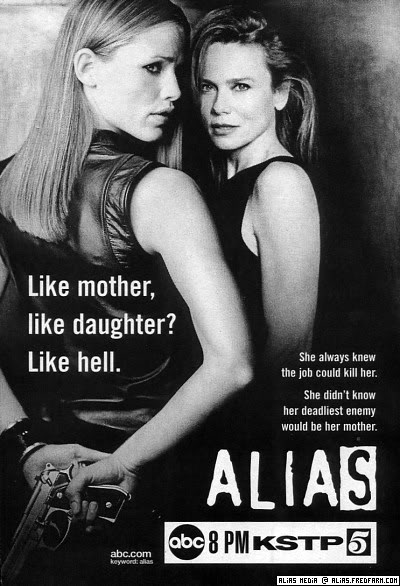 Would have to admit that the start was somewhat slow. It was hardly a surprise to discover that most of the characters who were “dead” at the end of the first series made a miraculous comeback in the second. It’s exactly the sort of thing you expect from shows like this, and you wonder why they even bother. Indeed, much of the first half of the series was too predictable, revolving around the can-or-can’t Sydney trust her mother dilemma. No prizes for guessing the right answer there either.
The recovery began when ABC handed Alias the coveted post-Superbowl slot (though once the score in the game reached 34-3, its impact on ratings for Alias became doubtful). Still, it proved a pivotal episode, giving Abrams a chance to reinvent the show, and introduce it to a whole new audience too lazy to change the channel (due to overconsumption of beer and nachos, probably). This was apparent in some rather clunky back-exposition, and also an opening which featured Sydney in two sets of lingerie – a shameless, gratuitous piece of shallow exploitation, clearly designed to appeal to nobody but the gridiron fans. :-) They probably mistook it for another Victoria’ Secret commercial…
Luckily, there was a lot of actual content, too: The CIA moved in to take SD-6 down, and from then on, no longer was Sydney struggling to maintain her secret lives. The show would become a quest for Sloane, trying to stop him before he…well, no-one was quite sure what he was up to, but it never seemed likely to involve puppies and flowers. This episode also marked the start of an increasing body-count with one character murdered and replaced by an evil doppelganger, while later on, two spouses would also bite the dust.
With the Rambaldi story making a welcome reappearance, the season picked up steam, helped by cool guest stars: Rutger Hauer, Danny Trejo & David Carradine (a Buddhist monk!) – we just needed Udo Kier and we’d have been in cult heaven. Apparently lost in the duplicitous double-crossing was the action element, a disappointing facet. For example, not until the last 10 minutes of the two-hour season finale did Sydney get in some serious butt-kicking; we wondered if this was connected with Garner’s apparent weight gain. Too much comfort ice-cream after her recent break-up? Perhaps; though if she’s pregnant, you heard it here first.
 With so many threads too, the story arcs seemed disjointed: in some cases, you’d go for weeks without hearing anything, before an abrupt reappearance. However, a continuing strength was the development of the supporting cast, with Sloane switching from evil mastermind to sympathetic antihero, even within the course of a single episode. Dixon, too, enjoyed a spectacular character arc over the second half, going from committed SD-6 employee to a borderline psychopath, whose obsession with catching Sloane surpassed even Sydney’s.
Our favourite episode of the season had beloved uber-geek Marshall going on a mission to London with Sydney. It combined action, humour, drama and pathos to great effect, ending with one of the best cliffhangers the series has yet managed – admittedly, we speak as big Marshall fans, and look forward to the character receiving a spinoff series. Hey, if it can happen to a mopey vampire, anything’s possible.
Fortunately, the Vaughn/Bristow romantic angle that begin to lurk, iceberg-like, towards the end of season one, has been played subtly enough that we are mostly able to ignore it. More remarkably, the Will/Francie relationship managed to become a genuine plot thread, thanks to a startling twist which raised the hairs on the back of our necks every time they shared a scene. Let’s just say that Francie isn’t the woman she used to be. :-)
Despite ratings that generally remain disappointing – it ranked only 92nd in prime-time shows – Alias was still renewed, a decision for which ABC can only be commended. However, they still seem uncertain about how to promote the show. Here we are, two seasons down, still waiting for the first to arrive on DVD – they could learn a lot from Fox, which got a huge boost to the ratings for the second run of 24 from the first’s availability on disc. [By coincidence, both Alias Season 1, and 24 Season 2 are scheduled for DVD release on September 2nd, 2003]
 So where do we go in Series 3? We still have the Rambaldi machine; assembly now complete, but expect further machinations as they piece together the instruction manual, and discover they need a 240/110V convertor. :-) It looked for a moment like we would be missing one major character (who finally Got The Point), but sounds like he’s okay. However, the main thread appears to be Sydney, and her efforts to recover from what could simply be the mother of all hangovers – I mean, I sometimes wondered how I got home, but at least I usually woke up on the same continent. Funnily enough, I suspect there might be rather more to her blackout than one too many Babychams. The truth probably lies somewhere between that, and abduction by aliens, but we’ll have to wait until autumn to find out.
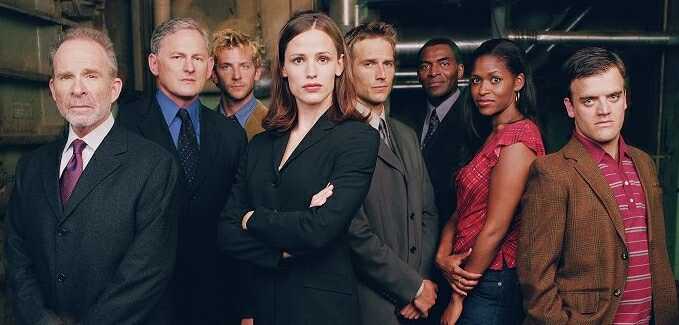
Star: Jennifer Garner, Victor Garber, Michael Vartan, Ron Rifkin


 It’s amusing to see that even New Concorde – who released it – don’t seem to have watched the film, their website describing it as “about the legendary lost tribe of warrior women”. Er, no: the A word doesn’t actually get used in the movie, which is really about the quest for a legendary sword, the only thing which stands between an evil sorcerer and world domination.
 Add supporting roles for Michiko Nishiwaki and Yukari Oshima to Khan and Lee, and you should have a winner, all four being in perhaps the top half-dozen or so action heroines from Hong Kong. Yet while the fights here are grand, the film wastes far too much effort elsewhere. Khan is a Chinese cop who comes to Hong Kong and bumps into gangstress Lee while looking for former lover Waise Lee, who is a) also Lee’s love, and b) now involved with a painting that hides documentation on Japanese wartime human experiments, which Nishiwaki is trying to sell to Oshima. Like I said, far too much effort (if you want to know about those experiments, track down the grim but jaw-dropping Men Behind the Sun).
 Things do perk up later on; after all the oestrogen, Chin Kar Lok is welcome light relief as an amusing dumb cop, and the finale is excellent, with echoes of Thelma and Louise. However, it’s too little, too late. It’s worth pointing out that while the title and artwork imply some kind of team-up, as in The Heroic Trio, the reality is unfortunately totally different, and nowhere near as interesting.
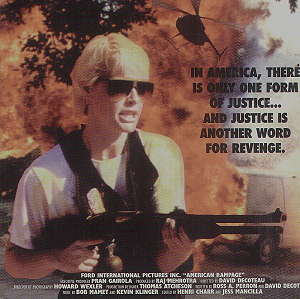 While not averse to the idea of gratuitous nudity in movies, this movie presents some of the most startlingly unattractive examples I’ve seen in some time – but then, director Decoteau is now making (more or less openly) gay-interest movies, so his judgement in such things is highly suspect. Even the heroine, Detective Samantha York, is…well, let’s be kind and say “homely”, though this could count as refreshing realism, given LAPD officers don’t win many beauty contests. I would like to think, however, that they are better shots; York couldn’t hit a barn if she was standing inside it.
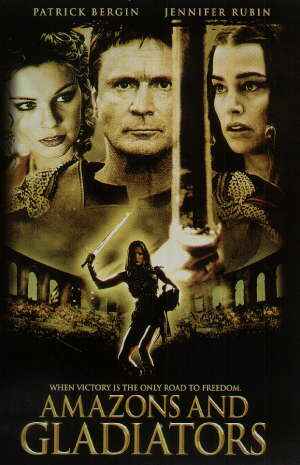 Benefiting from a slew of decent performances, A&G manages to surpass most of the competition and become a worthy entry in the “gladiatrix” sub-genre. This is perhaps because the cast have been hired either because they can act or because they can fight, while simultaneously not embarrassing themselves in the other department. Pity poor Hiltz, who is in virtually every scene, yet doesn’t even get her name on the cover.
 After thirty minutes, I was toying with the idea of giving this the first ever 0 star rating. On that basis, eventually creeping up to two counts as something of a miraculous recovery. The heroine is an alien, transporting her child across the English countryside, while being pursued by white-masked hunters. There is almost no dialogue, which is so obviously a penny-pinching device it hurts – the video stock and woeful “martial arts” don’t help.
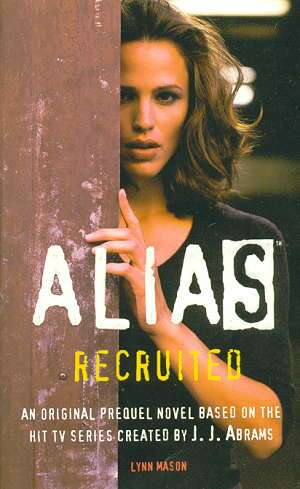 To tide you over the summer until the new series starts, as well as an ‘official companion’, Random House has published two novels, which fill in the back story before the show. Recruited tells of how Sydney Bristow was brought into SD-6, while A Secret Life details her first overseas mission, infiltrating a Paris fashion house being used as a cover for gun-running.