
Convoy 48

★★½
“Derailed train of thought.”
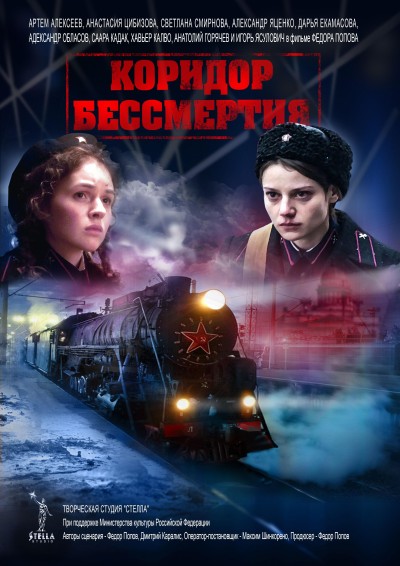
I guess this is a slightly different take on the typically heroic stories to come out of Russia concerning their battles against Germany in World War II. Rather than focusing on members of the military, it’s the story of civilians – many with little or no previous experience – who were brought in to keep the railway supply line to Leningrad open. These wee crucial to the city’s survival, as the Nazi blockade threatened to starve the city into submission, being responsible for thee-quarters of the resources going into the city. Naturally, the German forces wanted to cut this off, so subjected the tracks and trains to a relentless bombardment, from artillery, mortars and planes, placing those operating the trains in near-constant danger. 

With a severe shortage of engineers and staff, it’s very much a case of all hands available. Which is how Masha (Tsibizova) and Sonya (Smirnova-Katsagadzhieva), barely out of school, find themselves assigned to the 48th Locomotive Unit, after the most basic of basic training in how to operate a train. This comes courtesy of Georgi (Alekseev), one of the few people around with relevant experience. The otherwise novice crew have to handle dangerous terrain and the ever-present threat of German attack, as they ferry supplies in to the besieged city. Things get murky, when they evacuate orphans out in a Red Cross train: but there are those in the Soviet administration who want to take this opportunity to piggyback on to this, a considerably less humanitarian mission.   

It’s alright, I suppose. But it’s largely predictable, with elements such as the burgeoning romance between Masha and Georgi being straight out of the usual playbook. It’s also so unremittingly heroic as to feel like it might have been a product from the Soviet Ministry of Propaganda, in the later stages of the war. There are a couple of interesting touches: the nearest we get to seeing the enemy is a pilot who bails out when his plane is shot down, and is immediately beaten to death with shovels. Otherwise, the closest to an antagonist is one of the crew who turns out to be a saboteur. It does mean there’s not much sense of direct conflict, with no specific “villain”.

There’s a lot of train stuff here, to the extent that it feels occasionally to border on railway porn. If you are not a train spotter, this could feel overdone, and at a hundred and forty minutes, there feels like a lot of time to fill. Our heroines do get more back-burnered than I would prefer, in favour of their mail colleagues in the second half, though the climactic run, involving the orphan-laden train, requires full commitment from everyone. And, to my complete lack of surprise, no shortage of heroic and ultimate sacrifice. By this point, however, I’d gone beyond my capacity for footage of trains going through the forest, and I’d be lying if I said I cared more than on the most superficial of levels. 

Dir: Fedor Popov
Star: Svetlana Smirnova-Katsagadzhieva, Artem Alekseev, Anastasia Tsibizova, Igor Yasulovich

Guilty Beauty

★★★
Thoroughly lost in translation.”

Well, this is a real roller-coaster ride of style and incompetence. It’s been a long time since I’ve seen a Chinese film where the subtitles were quite so incomprehensible. Even though this one is on the YouTube channel for an official Chinese streaming service (iQiYi), the soundtrack was entirely muted at some points, and the soundtrack replaced by jaunty elevator musak at others. Despite being a mere sixty-six minutes, the presentation is therefore something of a test of endurance, and I am also not prepared to guarantee the accuracy of the plot synopsis, character names or actors. There was heavy use of Google Translate required, there being no IMDb page for the movie. I did my best.

Though this is not immediately clear, it takes place in… 1930’s Shanghai, at a guess? Not sure if the Japanese are actually occupying the city, or if it’s just a Casablanca-style nest of spies and intrigue. Working for a quasi-governmental part of the Chinese authorities (yeah, it’s vague) are our trio of heroines: Qiu Di (Zhang Y.), gothette Lü Yun (Wang) and schoolgirl Cui Ya (Zhang T). They have to recover a roll of film stolen by the Japanese military, now in the possession of gangster Huang Sen. In order to get close to him, our trio opt to go through his godson, Kwok Tin-ming (Ke). Di’s mad musical skills make her best suited, so she makes contact with Kwok and becomes his girlfriend, while her two colleagues…

Um, well, I’m not sure exactly what the plan was here, because Di doesn’t do very much: her associates complete their mission without any real trouble, and we’re only twenty minutes in. Thereafter… more stuff happens. I remain vague, not out of a fear of spoilers, more because but I would not be prepared to wager money on many of the specifics. It seems like a former ally of the trio is now working for the Japanese? Maybe? I initially thought they already got the film back, but apparently not, because Di keeps hanging out with her target. He finally realizes he is being played, and Di looks surprisingly broken-up about it. Genuine feelings, maybe?

I was certainly hoping for more action, given the poster and brisk opening, something along the lines of a Chinese version of the original Charlie’s Angels movie. There’s an opening fight, a spot of action during the film recovery heist and then a long lull before a moderately rousing finale. Everyone suddenly remembers about the film again, Di has to fight a slew of kabuki-masked ninja types, and then try to rescue her boyfriend, before a final scene which… I have no clue about. I will say, the movie does look good overall, with super-crisp photography and a sense of style across its characters and settings. If you told me this was an adaptation of a local comic-book, I would believe you – it possesses that sort of aesthetic. The film is below: perhaps you can make more sense of it than I!

Dir: Sun Jiayi
Star: Zhang Yinan, Ke Jiahao, Wang Xiran, Zhang Tong

Mardaani 2

★★★
“Naan but the brave.”

This sequel to Mardaani sees Rani Mukerji return in the role of hard-edged police superintendent Shivani Shivaji Roy. She’s now on the hunt for a serial killer, who is brutally murdering and raping victims in her jurisdiction, the city of Kota in the northern Indian state of Rajasthan. The killer is Sunny (Jethwa), a 21-year-old psychopath, whose father murdered his mother, and who also works as an assassin for rising politician Govind Mishra (Ketkar). When Sunny sees SP Roy on television, making disparaging remarks about the killer, and vowing to catch him, he decides to target her. This is in addition to his work for Mishra, though after that relationship goes sour, Mishra’s family becomes yet another target of Sunny’s unhinged wrath. 

The director of this was the writer on the previous movie, and it’s slightly less effective overall, mostly due to a tendency to descend into polemic on occasion. For example, it opens and closes with the kind of trite, “Well, actually” nuggets of information you’d expect to find on Twitter. There’s also a television interview late on, which seems to serve no purpose, except to allow Roy to go off on a rant about how downtrodden women are in Indian society. I mean, she’s not wrong. It’s just that a moral lecture is not why I’m here. I am here for the heroine slamming her car-door on a suspect’s head. Fortunately, the film is able to deliver this as well.

The two performances at the centre of this are spot-on, and do a fine job of keeping your attention, when the storyline occasionally falters. Sunny is barking mad, with enough issues for an entire conference of forensic psychologists, and the details of his crimes, even if just described, are grim. Yet he is undeniably smart, though fatally flawed by his ego. He breaks the fourth wall on a number of occasions, directly addressing the audience to explain himself. It’s highly creepy. Meanwhile, SP Roy is every bit as driven on her side, willing to bend protocol into a pretzel in pursuit of justice. She just doesn’t care about anything else: she may be married, but her husband is entirely irrelevant to proceedings. 

There’s a ticking clock too. After a possible witness is killed by Sunny, she is reassigned, and only has 48 hours to close the case, over the holiday of Diwali. That’s the Hindu festival of lights, and offers a glowing backdrop against which the climax of the movie can unfold. When it dies, there’s a good sense of catharsis in the way things unfold. It’s not only Roy who gets to punish the evil in the world, doing so in a way which is as much about making a statement as anything else. Despite occasional missteps, this is a decent sequel, and if you’re worried about it being Bollywood, there are no musical numbers to derail proceedings. Mardaani 3 is in production, and I’m looking forward to it.

Dir: Gopi Puthran
Star: Rani Mukerji, Vishal Jethwa, Prasanna Ketkar, Shruti Bapna

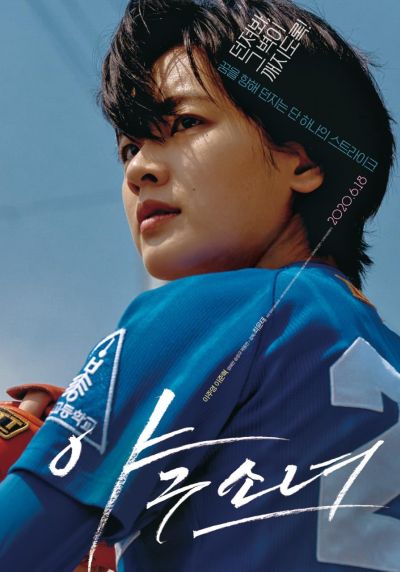
Baseball Girl

★★½
“Pop-up on the infield.”

And if the above phrase doesn’t make any sense – it’s basically an underwhelming outcome during a baseball game – then you are probably not the target audience for this sporting drama. After almost a quarter-century living in America (much of it spent running a site about the local team as a sideline!), I’m fairly well-versed in baseball’s intricacies. But in contrast to some of the other Korean movies in this genre, such as Run Off or As One, you really need to know the sport going in to understand this on more than the surface level. Do not expect the film to explain what a knuckleball is, or the importance of spin rates.
The central character is Joo Soo-in (Lee J-y), a high school student who has dreams of becoming a professional baseball player. The main problem there is, she’s a teenage girl, and no woman has ever played professionally in Korea. While she pitches well enough – for a girl – she doesn’t throw with enough velocity to catch the eye of scouts. It doesn’t help that nobody really believes in her dream, with just about everyone trying to dissuade her. Even when she does get an offer from a professional team, it turns out to be to front their women’s outfit. Not least among Soo-in’s critics is her own mother (Yeom), already dealing with a feckless husband, who just wants her daughter to get real and start working in the same factory she does.

There are basically few surprises to be found here at all, with everything unfolding more or less as you would expect. It feels as if the script started off with a single word – “empowering” – and everything was developed from that point outward. For example, you will likely not be shocked to discover that mom is eventually won over to her daughter’s cause. Though I was amused by the scene where she’s told by the pro team the deposit on her daughter’s services is $60,000. Her response is, “I can’t give you that much money right now,” unaware the team is the one paying! Otherwise, it often plays like an All-Star Game of sports cliches, such as the gruff coach, romantic interest, etc.

I will say, the baseball stuff is well done: the actress seems to know her way around a pitching mound, and her mechanics look sound. [I wonder if CGI was used for the baseball, or if she really was throwing at 80+ mph?] It’s interesting that we never actually see Soo-in play in an actual game. Instead, it’s all training sessions and try-outs, as she tries to learn a new pitch, which relies less on velocity. As a fan of the game, I probably got a bit more out of this than most viewers, and was still never more than moderately engaged. When the outcome of any sporting contest is obvious, there’s not a lot of point, and much the same goes for sporting movies like this.

Dir: Choi Yoon-tae
Star: Lee Joo-young, Lee Joon-hyuk, Yeom Hye-ran, Song Young-kyu

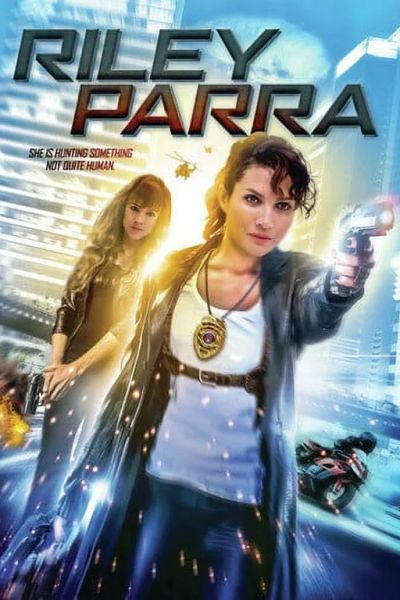
Riley Parra: Better Angels

★★
“Wings of desire.”

The idea here is considerably stronger than the execution. Police detective Riley Parra (Hassler) works the scummiest part of town, which is ruled by mysterious and possibly legendary figure Marchosias (Landler). However, while working a murder case, Riley discovers the area is, in fact, Ground Zero for an ongoing war between demons and angels. More startlingly yet, she’s directly involved, because she is the “champion” on the side of the angels. This revelation has the potential to destroy the shaky truce which has been in place between the two sides. Riley also has to deal with pesky journalist, Gail Finney (Sirtis, sporting an Australian accent for some reason), and attraction to new medical examiner Dr. Gillian Hunt (Vassey).

This is based on a series of books by Geonn Cannon, and is a mixed bag. I like the idea that the police department is entirely staffed by women, and nobody particularly cares. That they all appear to be lesbians? Hmm. Geonn is a male author, I should mention, which makes this… interesting. It’s all very much PG-rated, but really, I feel all the relationship stuff seriously gets in the way of the plot. Not least, because this ends with none of the major threads anywhere close to tied-up. Instead, it finishes with Riley just having solved a murder which doesn’t even take place until 65 minutes into the movie. Originally a webseries, it seems more a pilot than an actual film. Five years later, there’s no continuation, so do not expect resolution.

There are also silly little gaffes, such as Dr. Hunt picking up evidence at a murder scene with her bare hands. Or Riley getting a call and being texted the location of the same murder, then saying, “I’ll be there in 15 minutes” – without looking at her phone. Be where exactly? It’s all minor, but indicative of a rather sloppy approach to film-making. Shame, since the characters here are quite interesting, and the performances are decent. Everyone here seems like they could be a real person, even Marchosias and his outrageously French accent (that actor actually is French, so I’ll let it pass).

It feels fairly pro-religion, both in its central concept and sympathetic presentation of the priest, to whom Riley turns for advice. I’d have liked to have seen more action: I think the only person Riley shoots is her partner – not much of a spoiler, since it happens early on. Oddly, that barely leads to any disciplinary action or investigation, more evidence of the slapdash approach to detail. I do suspect some characters are not what they seem. I think either Riley’s boss, or Gail Finney, are actually agents for Marchosias. The latter would be interesting, being the kind of crusading, anti-police journalist you might expect to be the heroine in another story. Guess we’ll never know. Well, unless I read the novels and… Yeah, I probably wasn’t sufficiently into this to justify the effort there.

Dir: Christin Baker
Star: Marem Hassler, Liz Vassey, Karl E. Landler, Marina Sirtis

BLACKFOX: Age of the Ninja

★★★½
“Fox hunting.”

I’d not heard of this, and we pleased to find it was directed by Sakamoto, a well-respected action choreographer, best known for Power Rangers, but who also worked on 009-1: The End of the Beginning, among others. There’s an interesting back-story here, in that this was created as a live-action spin-off to accompany the anime film BLACKFOX, and was released on the same date. It’s a prequel, with one of the heroines here, Rikka Isurugi (Yajima), a distant ancestor of the heroine in the contemporarily-set anime movie – they have the same name. This, however, takes place back in feudal Japan, and we start with Miya (Yajima), a young girl with an unusual, if uncontrolled, power to manipulate electricity.

Her father was teaching her to use it, until he was killed by the Negoroshu clan, under Lady Hakku (Fujioka) – they are also after Miya. To get revenge on them, Miya seeks out a mercenary gang called the Foxes, run by Hyoe Isurugi (Kurata). They agree to take on the mission, and Miya befriends Hyoe’s grand-daughter, Rikka. However, Hyoe gets a better offer, and hands Miya over to Hakku. This causes a rift between him and Rikka, who feels they should honour a deal once struck. She sets out to rescue Miya, though that’s going to be tougher than ever, since she has now been passed on to the person who hired the Negoroshus in the first place.

While most of the plot unfolds as you would expect, there are enough twists and surprises along the way to sustain interest. In particular, loyalties are not necessarily what they seem, and as well as our saintly heroines, there’s more moral grey on view here than I thought there might be. Never mind the plot though. We are here mostly for the action, and Sakamoto does not disappoint, with Yamamoto doing most of the heavy lifting. There are perhaps too many times when she’s masked – albeit, usually with masks that are necessary to the plot – to give her full credit. But she definitely is executing enough of her own stunts to make me interested in seeing her elsewhere.  And she’s a World Junior Wushu Championship gold medalist, so there’s that.

Fujioka also does well, both in action and acting, making Lady Hakku perhaps the most interesting and well-rounded character in the film.  I will confess to initially suspecting I’d seen this before. But I was clearly confusing it with another film which had ninjas and/or samurai running around in the forest. There are quite a few, to be fair. It is clear that this was not a large-budget production, and the ending is a little too sequel-leaning. Yet the limited resources don’t often distract from the important things: the story, characters and action, which are all decently-handled. My expectations were low going in, until I saw the director’s name, and for something stumbled across by accident in the depths of Tubi, it punches well above its weight. It’s also available on YouTube, and is embedded below for your viewing pleasure.

Dir: Koichi Sakamoto
Star: Maimi Yajima, Chihiro Yamamoto, Yasuaki Kurata, Mami Fujioka 

Blood Valentine

★★½
“Dubbed to death”

This is another in a recent burst of Thai action heroine movies, including The Secret Weapon. But it’s less successful, although the deficit is not entirely the movie’s fault. The only version I could find was a dubbed one on YouTube: over the years, I have developed a strong preference for watching films in their original language, unless absolutely necessary. Here, that proved to be the case, and it was basically a reminder of why I prefer subtitles. This isn’t just dubbed into English, it was dubbed into English by Indians. Imagine watching a gangster film set in New York, where everyone has a Swedish accent. It’s immensely off-putting, and I had great difficulty in getting past it.
The plot has a hitwoman, Chris (Kingpayome), who has worked for Mr. Ralph (Macdonald) since before the birth of her daughter, Rin (Prommart). The daughter is being brought up in the family business, along with another girl, Joi, who was rescued from a crime scene. However, Rin is now in those difficult teenage years, and is being distracted by a schoolgirl crush on Sun, a senior at her college. This causes her to lose focus and make mistakes in the assassinations she carries out with her mother, for “Ralph Elimination Ltd”. Coming under pressure from her boss, Chris decides to take the liability of Sun out of the picture. Needless to say, Rin is not exactly happy about this decision.

It’s better in the second half then the first, once it stops being badly-dubbed teen soap-opera, and turns into badly-dubbed action, which is tolerable. Things aren’t exactly what they seem initially, and the dynamics of the situation become considerably more interesting as a result. I’ve seen enough of this kind of thing to feel I knew where this was going. I was expecting it to have Chris eventually coming to terms with her daughter’s wish for a normal life, and then protecting Sun from Ralph’s murderous intentions. No. Does not happen. Well… it kinda does. But the way it gets there, is in a rather more plausible manner, with everyone from Chris to Ralph having credible motivation for their actions.

Outside of the dire dub, the main issue is perhaps the somewhat underwhelming action, both in quantity and quality. It’s only okay in both departments, except for Rin’s final assault, which is a nicely-staged attack on Ralph’s headquarters. That is a shame, since the script is one of the better ones, and Prommart feels a little like she is channeling Natalie Portman in Leon. Though that might just be a combination of her hairstyle, and the way the movie ends. It does teeter over into melodrama on occasion, not least with a lengthy, emotive video message from Chris to her daughter. Overall, however, there is an impressive fatality rate, and it would likely be close in entertainment value to the preceding entries – if only it was available in a similar format.

Dir: Isara Nadee
Star: Metinee Kingpayome, Ray Macdonald, Nitchanart Prommart, Phiravich Attachitsataporn
a.k.a. Ladies First

[July 2025 update. A subtitled version has now shown up on Tubi, under the title of Viper. This would, needless to say, be the preferred option, despite it trying to look like a new movie with a claimed date of 2025!]

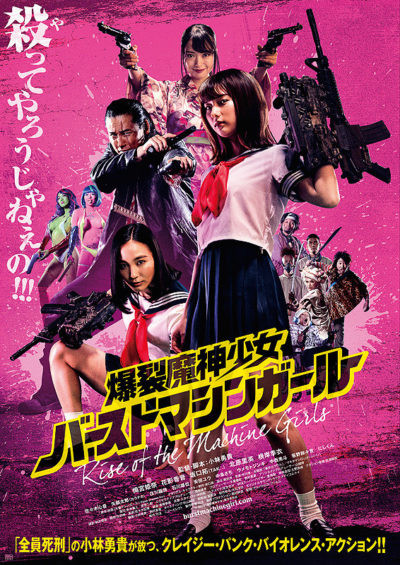
Rise of the Machine Girls

★★★
“Rage against the Machine Girls.”

A decade after the splattery joy which was The Machine Girl, we get this – not quite a sequel, not quite a reboot. Creator Noboru Iguchi helped on the script, but hands the directorial reins over to another, and… Well, it’s amusing and moderately entertaining, rather than the jaw-dropping and ground-breaking spectacle which was the original. Part of this is simply the passage of time: what was fresh and original at the time, has now become much more familiar. There is still no shortage of invention here, but it does seem  haphazard. It’s less a story, than a series of skits, albeit ones heavily drenched in gore – unfortunately, a lot from blood group CGI-minus.

It takes place in a futuristic dystopia, where the poor are left to sell whatever they can to make ends meet, including their children, limbs and internal organs. Sisters Ami (Nagimiya) and Yoshie (Kanon)  are both a bit short in the body-part department, but make a living as idol performers. Less the singing kind, more as combat performers, though they yearn to be one of the more kawaii (cute) variety. Yoshie moonlights as a vigilante, taking out the organ traffickers she feels responsible for her plight. This brings her the wrath of Aoyama Dharma (Negishi), leader of the local ring, who captures Yoshie. Fortunately, help for Ami is available, in the form of wandering assassin, Matsukata (Sakaguchi) , ranked the #5 hitman by his company.

There are certainly some cool moments here. The pregnant killer… though pregnant with what, I can’t even begin to describe. Or the Battle Bust Sisters, who are exactly what you think they would be from their name, e.g. one sibling’s bosom is capable of inflating into a pair of large, bullet-proof airbags as a defensive mechanism. But it never manages to gel cohesively, and I occasionally even got the feeling that new director Kobayashi was frankly bored of the whole endeavour. For instance, there’s what should have been a glorious, extended one-shot when Matsukata and Ami storm the Dharma HQ, dispatching minions with fists, swords and head-shots. But half of it is played out in fast-forward, entirely negating the point of the whole exercise.

There are some dry jabs at things like idol culture, fans being admonished pre-performance, “If you must jack off, please do so in your pocket.” [This is somewhat ironic, given the copious number of panty shots present!] It seems to lack a forceful personality at its heart, with neither of the sisters having the same presence of Ami v1.0 from the original. Negishi does deliver an enjoyably villainous performance, chewing scenery in a way that’s fun to watch. I certainly wish they had gone with a more practical approach to the effects; while some things obviously need CGI (those airbags mentioned earlier), there’s really no excuse for ever using it to fake arterial spray. It’s fun, but forgettable, and probably won’t stray across my screen again.

Dir: Yûki Kobayashi
Star: Hina Nagimiya, Hanakage Kanon, Tak Sakaguchi, Kimono Negishi

Where We Disappear

★★★
“A chilly tale of isolation”

It’s the end of World War II in Russia, and Anastasia (Haig) is at the station to welcome her husband home from the front. Except, realizing he is still the same abusive jerk he was, she stabs him dead. This gets her an extended stay in a Siberian gulag, as a guest of HM Stalin’s government, a situation for which she is entirely unsuited. As soon as she arrives in the remote prison, the first cabin-mate she meets comments on the softness of her hands, and she’s told she won’t survive a week. The biggest threat, however, may not be the Arctic conditions, but the other inmates. In particular, Masha (Andersen), who has taken over as leader after previous top dog, Lubov (Isabelle), suffered an “accident”. The question is, what is Anastasia prepared to do, and how far will she go, in order to survive?

Although this lasts only 73 minutes, end-to-end, it feels longer. That isn’t particularly a bad thing, since it’s mostly a reflection of the near-constant tension. There’s a perpetual sense of menace here, with violence and abuse – physical, mental or spiritual – always lurking just beneath the surface, whether from guards or other prisoners. That tends to make for a stressful experience for the viewer, as they can never relax. The pace is relentless. Things unfold not quite in real time after Anastasia’s arrival, but it does take place over her first night there. Another prisoner escapes, and the women have to decide how to handle that, especially with Lubov, who has a “cozy” relationship with one of the guards, now indisposed. Fresh meat Anastasia and her soft hands is the obvious replacement; not a task she’s willing to take on. Eventually, she’s coerced into the task, which doesn’t unfold as anyone expects.

This was based on Arthur M. Jolly’s stage play, A Gulag Mouse, and its origins in the theatre are frequently clear, both in the limited locations and importance placed on  dialogue. It might have been nice had Fink taken greater advantage of the freedoms afforded by cinema, but I imagine the claustrophobic atmosphere generated is entirely intentional. I must confess to being rather confused by the final act, which seems to throw the hard realism in which the rest of the picture is grounded, completely out of the window. By the end, I was far from clear how much of what I’d witnessed previously, had taken place in any subjective reality. It could be virtually any number from zero to a hundred percent, and I found its unwillingness to commit somewhat aggravating.

However, the performances are well-executed, each drawing the different aspects of their characters well. Andersen perhaps stands out, as a woman whose presence in the gulag is due to something far darker than the “stealing an apple” to which she blithely confesses. There’s enough potential generated in the first hour for a 13-episode series, and it’s a bit of a shame that the ending proves incapable of doing it justice.

Dir: Simon Fink
Star: Georgina Haig, Jolene Andersen, Katharine Isabelle, Vera Cherny

Steele Wool

★★★
“Puts the ‘hard’ in hard of hearing…”

Daphne Wool (Varela) has finally had enough of her abusive husband, so has killed him, chopping up the corpse and keeping it in a storage locker. Which actually is a good thing, because it turns out he was wanted by the Mob, and there was a price on his head. For their “help” in carrying out the hit, Daphne and pal Tony Steele (Cappello) are rewarded, but things go further. Daphne becomes a full-time assassin for the gangsters, learning to kill with everything from a paper-clip up, while Tony acts as her facilitator. However, they quickly become a liability to the organization, and are given a “poison pill” contract, being sent to kill weapons inventor Vincent McCabe.

The approach here is very much light in intent. Witness how Daphne’s training is largely watching movies like La Fille Nadia [sic], or the way in which she does, in fact, use a paper-clip as the instrument of one target’s demise. The film does a decent job of countering this with an awareness that this is a dirty and unpleasant business, as when she visits (from a distance) the widow of a target and their now fatherless child. It is a difficult balance for a movie to strike, and I’m not convinced Cappello gets it right, resulting in some awkward lurches in tome from the comedic to the supposedly heart-felt. Both come off a bit flat: I never got past a wry smile, and was never completely engaged.

This is not Varela’s fault, nor that of her character. Daphne is played gloriously against all the tropes of the female assassin: it’s no coincidence her most effective undercover disguise is an estate agent. Add to this, Varela is deaf: this element affects, yet does not define, her character and that’s exactly the way disability should be portrayed. It is even worked nicely in to the plot, with one of McCabe’s weapons in development being a sonic cannon. However, I’d like to have seen more of her in action; perhaps for budgetary reasons, this is limited, or perhaps Cappello just wasn’t interested in that aspect.

This brings me to the other issue: Cappello the director is too much in love with Cappello the actor. The latter wears out his welcome well before riding to the rescue of the supposed heroine, in McCabe’s underground lair. This is a shame, since Daphne is such a gloriously unconventional character, the reverse should have happened. Tony is never interesting to begin with, the script (also by Cappello, naturally) forgetting to give him any particular reason to exist, beyond Daphne needing someone to talk to. Having him become the hero for the finale, feels forced and unnatural. This is not enough to derail an excellent concept, or negate what I think is likely only the second disabled action heroine on this site, after Ready, Willing and Able. Yet it’s definitely a pity.

Dir: Frank A. Cappello
Star: Cami Varela, Frank A. Cappello, Nicholas Ontiveros, Arina Manta