




 ★★★★
★★★★
“More Mums with Guns.”

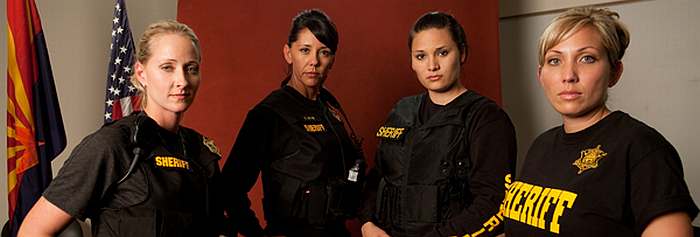
 The second series of TLC’s “mommy cops” reality series struck close to home, centered as it was on Phoenix. It didn’t come as much surprise as our local sheriff, Joe Arpaio, is infamous locally as a media whore, who wastes no opportunity for self-promotion, and is a sharply-divisive figure locally, adored and loathed by about equal parts of the population. We wondered how long it would take before Joe slimed his way onto the screen: six minutes into the first episode, we had our answer. Fortunately, this was more of a blip, and our fears of an Arpaio-centered show proved largely unfounded [see the execrable Smile… You’re Under Arrest for how bad this could have been].
The series was an improvement on its predecessor, and not only because of the thrill of seeing local places [though we soon realized the editors played fast and loose with geography, consecutive shots often being miles apart]. The Florida show was actually quite depressing in many ways; seemed like the majority of crimes were a) drug-related, and b) ethnic. Here, there’s a good deal more variety: it seems like the sheriff’s office spent as much time serving warrants to deadbeat dads as anything [this is one of Sheriff Joe’s tactics to pad his crime numbers and make him look good, because those are piss-easy warrants to serve, compared to those involving real criminals. Again, see S…YUA]
 As notable as what is shown, is what was not included. The MCSO are notorious for “crime sweeps,” which are much about illegal immigration, a massive hot-button political issue in Arizona, as any other offense. However, these have come in for criticism from civil liberties groups, and there was not a mention of these high-profile activities on the show. The only real coverage of the topic was in chasing down “coyotes”, those who smuggle illegals across the border. On the other hand, whiny, liberal media outlets such as the Phoenix New Times bleat “Can’t The Tourism Board Shut This Show Down?” Actually, I like the New Times in general, and we’re good friends with one of their reporters, but the paper’s politics are a different issue entirely.
But outside of the the “Ooh! Been there!” local interest, I think the characters here were generally a slightly more personable bunch. As before, it centres on four women – again, mostly single moms, which makes me wonder whether the job attracts them, or leads to marital stress. There’s Deputy Amie Duong, who is the “Shelunda” of the series – when you see her arrive, you know a domestic dispute isn’t far behind. There’s Deputy Kelly Bocardo, the token minority representative, whose three brothers (among her 14 siblings, apparently!) also work for the department. And there’s Detective Lindsey Smith, whose accemt appears to drift, chameleon-like, depending on to whom she’s speaking.
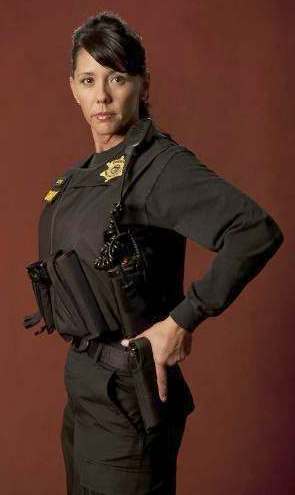 Finally, there’s Detective Deborah Moyer (right), who is completely marvellous, and the main reason to watch the show. A 19-year veteran, we’d be entirely happy if the show was 100% about her. While the other women occasionally seem very scripted when they are talking to the camera, that isn’t the case with Moyer: there’s a definite sense that what you see is what you get with her. While her policing style may not be “by the book” – in one episode, she basically arrests a teenage girl for failing to hug her father – her reactions are entirely natural and certainly had us nodding in approval more often than not. She just comes across as being very normal: when she encounters a young perpetrator, she tends to think about her own kids of the same age.
But all the police here are more interested in “justice” rather than the letter of the law. That’s in contrast to the Broward County show, where there was far too much entrapment going on: I don’t think the police should be involved in creating crime. It was also notable that the cops in Arizona seemed to have much more discretion. If you were respectful and polite (the New Times would no doubt say “subservient”), you stood a much better chance of getting off with a warning than if you gave them attitude. I’ll file that away for the next time I encounter law-enforcement here, though one speeding ticket in a decade hardly makes me a habitual offender. Still, if we got to meet Detective Moyer as a result, we might considar a life of crime!
What the show did best of all was make us appreciate that, behind the grandstanding, publicity-seeking nonsense of Sheriff Joe Arpaio, are a number of dedicated, hard-working officers who have a very difficult job to handle. They’re not Robocops, and so are both imperfect and fallible, but law-enforcement personnel are human, just like you and me. Being reminded of this fact is something that is never a bad thing.
 While there’s no denying the
  The final – to date – installment of Dirty Pair adventures on the screen, is a bit of a mixed bag. Of the five episodes here, two are pretty good, one mediocre, and two are more than a tad creepy, thanks to the level of, from what I recall of my days in anime, used to be called ‘fan service’. There is an entire episode centered around beach volleyball, which is nothing more than a flimsy excuse to see Kei and Yuri in a variety of miniscule costumes, bordering on the fetishistic. Now, I just don’t find cartoons sexy – no, not even Jessica Rabbit – and given both of them are technically under-age, it all gets a tad sleazy. Things get worse in the fourth episode, when an even younger boy, rich and clever, but very weird, builds a mechanical replica of Yuri and falls in love with it.
 Where are Kei and Yuri, and what have you done with them? That might be the anguished cry of the Dirty Pair fan after watching these five episodes, most of which eschew any efforts at high-octane action, in favour of generally unamusing comedy and tedium. All five parts are set on World’s World, a theme-planet that recreates 20th-century life for tourists. Our heroines are sent there because the computer is virus-infected, to bodyguard the network engineer Touma (Ono) who is going to fix it. Their presence becomes necessary, as it’s soon clear someone is out to stop Touma from doing his job. That only occupies the bookend episodes: the middle three are, while still set on the same planet, largely unconnected. In them, Kei and Yuri must look into ghostly goings-on at a girls’ school, help Touma with his love-life and bring a con-artist to justice.
 The surprising thing about this, is that the six episodes, basically, form a single plot, a radically different approach to the first phase anime, where the individual OAVs stood on their own, with little or no ongoing story arc. Here, the parts mesh, starting with the pair, off-duty, coming into possession of an encrypted card, which they must get back to 3WA headquarters, in the face of significant opposition. From this develops the uncovering of a galaxy-wide conspiracy involving the malevolent Lucifer group, which must be foiled, since they have control of galactic communications. However, a significant subplot involves Lady Flair, a sniper who humiliates Kei in the second episode, provoking her into a fury which leads, later on, to our redheaded spitfire quitting the 3WA in order to pursue Flair on her own terms.
 This 8-woman tournament took place on October 2004 as part of All Pro Wrestling’s Halloween Hell weekend, in in Hayward, California and.was the first under the ‘Chickfight’ banner. If you’re used to the Diva “matches” [quotes used advisedly] put on by the WWE, this will come as a pleasant surprise – it’s closer to the Japanese style, where technical skill is more important than breast implants. Perhaps the most surprising thing is the length of the bouts: rather than being a five-minute distraction, 15 or 20 minutes being not uncommon. The wrestlers come from Mexico and Japan as well as the US, though they really deserve better than both the location, which appears to be a lock-up garage complete with a roll-up door on one side, and the crowd, the bouts taking place in front of an audience that hardly seems to number fifty.
 This is one of those which split the panel here. Chris was thoroughly unimpressed with its lack of a well-defined conclusion: “I
  While undeniably a product of its time – which would be 1991 – this has stood the test of time very well, and remains a solid piece of action SF. Eve Simmons (Soutendijk) is a researcher working for the US government on creating life-like robots for surveillance missions, and her creation, Eve VIII, not only looks like her, but has her memories and psychology too. When on a test run in San Francisco, Eve VIII is caught up in a bank robbery and a bullet sends her off the grid, and on her own mission. Jim McQuade (Hines), something like a proto-Jack Bauer, is brought in to track down the lost little robot, who has all of her creator’s complexes, but none of the social restraints, leading to a fondness for automatic weapons, which she uses with abandon as she works out her psychiatric issues [cheaper than counselling, and a good deal more fun]. Oh, and Eve VIII also has a nasty little surprise package tucked away inside. It’s up to McQuade and Simmons to stop the killing machine before things
 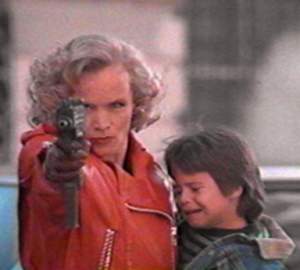 But as a straightforward B-movie, it works nicely, with Hines having a nicely sardonic wit: “A spinach lasagne, in a light tomato and basil sauce,” is the reply, when Simmons asks dubiously what is McQuade’s “specialty” as a government agent. I’m still trying to work out if the film is feminist or chauvinist: you could read it either way, with the ‘liberated’ (if robotic) woman a free spirit, though the ending firmly puts Even back in her place, to say the least. She also emasculates one man, somewhat familiar territory for Soutendijk, who previously wielded a scissors to leg-crossing effect in The Fourth Man. Gibbins, meanwhile, died in the 1993 Hollywood fires, while trying to rescue a cat. Guess there’s never an unstoppable robot around when you really need one.
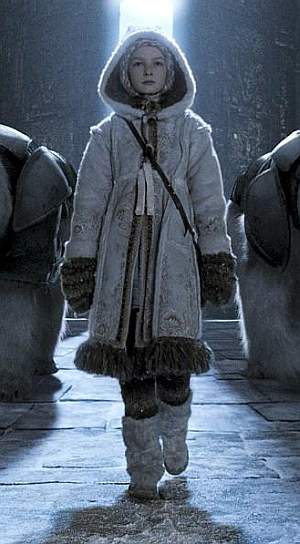 There aren’t that many decent action heroine films for kids: much as I love Bloody Mallory or Kill Bill, they aren’t really child-appropriate. At the other end, films like the Harry Potter or the Narnia series, while containing female characters of some importance, sideline them in favor of the boys. That makes this a refreshing breath of fresh air, in that the heroine is firmly front and center as she goes through her adventures. It’s set in an alternate universe where people’s souls take the form of animals that accompany them everywhere, known as daemons. Childrens’ daemons shapeshift, but adults’ ones are static in form. Things are run by an authoritative group called The Magisterium, but Lord Asriel (Craig) who has found “dust” in a far Northern land, that could challenge the established order – the Magisterium have been kidnapping children for use in human experiments to counter dust. Into this is dropped Asriel’s niece, Lyra Belacqua (Richards), who is given the last golden compass, a device able to answer any question in the right hands. she is about to head North with Mrs. Coulter (Kidman), only to find she has a central role in the kidnapping – as Lyra’s best friend has now vanished, she bravely heads off, initially on her own, to rescue him.
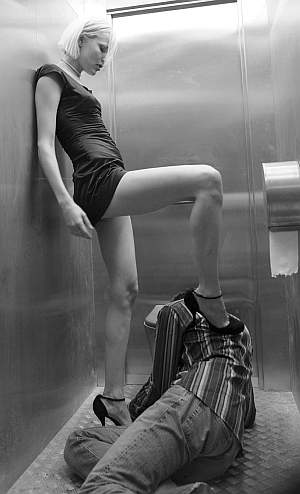 Andre (Debbouse) is at the end of his tether, owing large amounts of money to at least three separate gangs. He decides to end it all by leaping off a Parisian bridge into the Seine below, but is beaten to it by the tall, leggy blonde, Angela (Rasmussen, who you may remember in a bathroom stall with Rebecca Romijn-Stamos in the opening of Femme Fatale). His suicide forgotten, he jumps in to save her, and as they sit, dripping on the river-bank she vows that she will repay his selfless act by taking care of him. This may not be quite the way he expects; for example, she hijacks a negotiation with one of the mobsters to whom Andre owes money, marches upstairs and emerges not long afterwards, the debt apparently forgiven and with tens of thousands in bonus cash. Just as important as resolving his pecuniary problems are the emotional ones which plague Andre, and Angela is perhaps even more adept at addressing those: his lack of self-confidence, trust issues, an inability to give or receive love and so on. She sees the good person who is buried