
Bad Day

★★★
“Not-so fair cops.”

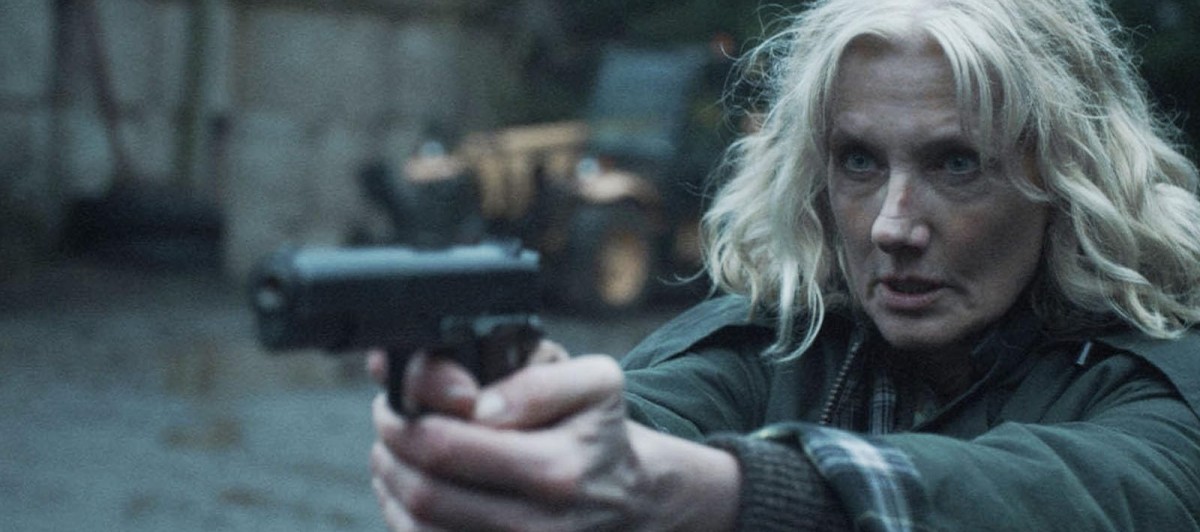
Rebecca Ryan (Goose) is an undercover cop, who has been working for three years as “Margaret”, infiltrating the McCann family, a South London organized crime outfit, with Darius Cruise (Ofoegbu) as her handler. He’s just been given a new partner, Abby Barrett (Air), and isn’t happy about it. Rebecca, meanwhile, has fallen in love with Harry McCann (Calil), but his sister, Marla (Riana Husselmann), recently out of jail, suspects something is up with ‘Margaret’. When an incident appears to blow her cover, and Rebecca returns home to find her daughter murdered, she decides it’s time to make the entire McCann family pay for their actions. As the title suggests, everything subsequently unfolds over the course of a single day.

It’s all a bit wobbly at the beginning, with the director struggling to get all the various plot threads up and running. Trimming them back would have been helpful, such as Abby’s contentious relationship with her former partner; it adds little. Air’s performance isn’t the best either; she’s considerably less convincing as a cop than Goose or Ofoegbu, although the latter is clearly channelling the spirit of Idris Elba as Luther. As a low-rent version thereof, he’s not bad, with the script throwing on copious quantities of cynicism, such as Darius telling his partner, “The only thing I don’t believe in anymore is this job.” Goose is decent too, playing a woman who is teetering on the edge of losing herself, with her daughter providing the sole reliable anchor in her life.

When that tether gets removed, there’s really only one way things can go: downhill, quite rapidly. The problem is, the further in we get, the more likely it is that the McCann’s weren’t responsible (though I have to say, the actual resolution doesn’t feel credible, especially for a British-set movie). But by the point Rebecca discovers the truth, a quote from Lady Macbeth fits the anti-heroine very well: “I am in blood stepped in so far that, should I wade no more, returning were as tedious as go o’er.” It does feel almost Shakespearean, in the sense that tragedy seems inevitable, and the characters are largely powerless to do anything about it.

I’d like to have seen more of Marla, who makes an immediate impression from her first scene. The character has a calculating edge, and a civilized veneer thinly covering a most unfeminine fondness for brutality. I almost wish the makers had gone the whole way, and made Darius a woman as well, to complete the quartet of strong female characters. The low budget does occasionally show through, and some of the action might leave a bit to be desired, though the inevitable brawl between Marla and Rebecca does achieve a satisfactory resolution. However, by concentrating on the women, it does stand out from the slew of “gritty” British crime film to come out in the two thousands. While it’s no Luther, I found myself adequately entertained and surprisingly engaged.

Dir: Ian David Diaz
Star: Claire Goose, Donna Air, Anthony Ofoegbu, George Calil

Desolation, by David Lucin

Literary rating: ★★★½
Kick-butt quotient: ☆½

When the apocalypse comes, if popular fiction is any guide, it’s going to be undead and craving brains. But not far behind in terms of literary popularity, appears to be an EMP. This is a high altitude nuclear detonation, which would unleash an electromagnetic pulse – hence the name – capable of frying anything with a circuit board, continent-wide. It is generally not good for civilization. I think this is the first such book I’ve covered, and I was particularly intrigued, because it’s set here in Arizona. Which is a little weird, because the author appears to be based out of Vancouver, British Columbia. I presume some connection to the state.

It mostly takes place in the northern mountain town of Flagstaff, where Jenn Jansen is attending college when the power goes out, and the world grinds to a halt. Not that it’s exactly a great world to begin with, already teetering on the edge of famine and war, with multiple conflicts around the globe (in particular between the US/NATO and China), while most of the population live in poverty, even in the United States. Jenn’s parents are down in Phoenix, which… the author doesn’t seem to like much, calling it a “desert hellscape” among other things. [Looks out window] OK, he’s not wrong… But it doesn’t get any better after the city gets hit by multiple air-burst nukes. Help is not coming to Flagstaff any time soon.

Jenn has to figure out what to do, though at least initially, basic survival is not too rough. However, she gradually realizes not everyone is willing to pull together, and hard times make for difficult moral decisions. She’s rather better at these than her boyfriend, Sam, who comes from a more privileged background. His family are in Payson – between Flagstaff and Phoenix – and the pair head down there to bring them up to Flagstaff. That pushes Jenn further along her evolution. According to the author, “By Book 4, she’s not the impulsive, bossy, and sometimes annoying girl from Book 1; she is a soldier and a cool-headed leader,” and I can see the early signs of this appearing already, though I never found her especially annoying. 

Action-wise, it is fairly restrained, but there is a sense of escalation, with the book giving us good insight into Jenn’s thoughts. Of note, her reaction to having to use increasing degrees of violence is explored in more detail than I would have expected. It’s not easy or facile, but by the end, the blood on her hands is mounting. I sense that’s only going to increase, as it appears the next part has her becoming part of a reconnaissance expedition to Phoenix. That’s a story I am interested in reading, and not just for reasons of personal familiarity, also to see how Jenn develops. But perhaps my neighbourhood might make an appearance. Even if it’s going to be a bit radioactive.

Author: David Lucin
Publisher: Highway 3 Publishing, available through Amazon, both as a paperback and an e-book
Book 1 of 6 in the Desolation series.

Closure

★★½
“The truth is out there. Somewhere.”

Surprising to see a rough, occasionally nasty slice of rape-revenge was funded by the British government, through the National Lottery scheme. Not that I’m complaining: it’s preferable to period nonsense or kitchen-sink dramsa depicting inner-city life. But I would not typically have expected something as unrepentantly exploitative to get money from such a source. The film kicks off when Alice (Anderson) and her boy toy, Adam (Dyer) are on the way home from a party. A road rage incident leads to him being savagely assaulted, and her being gang-raped, leaving both of them severely traumatized by their experience. Interestingly, it’s Alice who is the one most intent on finding the perpetrators and taking revenge.

Turns out her recently deceased father was a soldier, who taught her not to turn the other cheek, and left her a weapon with which she can carry out her vengeance. This makes her considerably more interesting a character than Adam, who now mopes around smoking weed and suffering from erectile dysfunction. Alice locates one of the attackers, Heffer (Calf), and sets her plan in motion. However, things become increasingly complicated, first with the presence of his daughter, and the discovery that his participation in Alice’s sexual assault was not as purely predatory as it seemed at the time. She begins to understand that retribution can be messy; on the other hand, Adam is becoming more gung-ho about the process, and refuses to back down from his revenge.

I guess these two sides of the coin, and their contrast, are key to the film’s message, though the sudden way in which it ends might leave you wondering if there’s any genuine message intended at all. Maybe it was all the fulfillment of some weird, albeit understandable, Gillian Anderson fetish for writer-director Reed (there are a couple of scenes which lean towards that interpretation). She is certainly the best thing about this, and her journey from predatory cougar through to literally predatory cougar would have been worth following. Dyer continuing to get roles remains a mystery, not least because he was at least five years older than his supposed 23-year-old character here, and can’t exactly make up the deficit in acting ability.

“Do you know what they did after they finished with me? They laughed.” That’s Alice’s chilling explanation of why she’s so hell-bent on making Heffer and his colleagues pay. While I did appreciate the way the rapists were neither your stereotypical yokels nor yoofs, being middle-class and middle-aged, it’s really only when Anderson is on screen that this movie shows credible signs of life, Anderson again proving that she is considerably more than Dana Scully. Even here though, the film manages to fumble things in a final act which feels a severe cop-out, albeit after we are treated to the site of Alice sticking a gun where a gun is not normally expected to go. Take that mental image with you, the next time you buy a lottery ticket.

Dir: Dan Reed
Star: Gillian Anderson, Danny Dyer, Anthony Calf, Adam Rayner 
a.k.a. Straightheads

The Killing

★★★★
“Happy endings are for losers!”

Spoilers will follow! At one point, Scandinavian noir, was a genre mostly well-known only in Europe and to die-hard crime novel readers. But the ground-breaking female characters who have made the genre recognized worldwide in the past two decades consists of a trio. In addition to the most well-known, Lisbeth Salander of the Millennium series, there is Saga Norén of Bron: The Bridge, and Sarah Lund of The Killing. All of these have been remade in a number of other countries – not only America. But I think it’s uncontroversial to say that none ever came close to the originals. There is something to the way these series are constructed and conceptualized by our Scandinavian neighbours, that film crews in other countries just can’t re-create.

It’s not just, for example that American productions have higher budgets. Other, non-American remakes or “new versions” aren’t able to re-create that special “air” either. It’s a specific atmosphere these series have, even though those in charge of production usually understand the attraction of the original. Although Scandinoir existed well before those three series. Elements like more realistic depictions of criminal acts, very often with social aspects interwoven, and investigators with personal problems, can be traced in literature back to the 1960s, and on television to the 1970s and 80s. A realistic local background with more down-to-earth investigators, as opposed to classic Anglo-American super-detectives like Sherlock Holmes, or private investigators like Philip Marlowe, started around then, and can still be found in long-running classic German TV crime series, Tatort (literal: “scene of the crime”).

Though before these new shows, some starring some quite “damaged” women, hardly anyone except die-hard fans of crime stuff noticed. The show that served as a wake-up call for everything was The Killing. This Danish-German co-production ran for three seasons, from 2007-2012. [It seems whenever there is a new Scandinavian crime series, ZDF, the second public TV channel of Germany, is involved. They also co-produced the Millennium and Bridge shows, among other Scandinavian series.] The original version totalled 40 episodes of 55 minutes; some countries broadcast it as 20 episodes of around 110 minutes. The German version was like that: you always can tell the break between episodes, by the two-minute montage, with music underneath. It received a number of remakes, in America, Turkey and Egypt.

As typical for these Scandinavian shows, they are slow-burn mysteries. This means taking their time, introducing countless suspects and going far beyond the case, such as adding a political dimension to the scope. I was astonished to discover they did really only cover one case for an entire season. In an average episode of Tatort the case would be solved and finished after the usual 90 minutes. Here, it takes longer – much longer! – especially in the first season. It started to drag a little bit, as solving the single case of a vanished girl lasted almost nineteen hours on screen. That said, the longer experience definitely has its advantages.

For perhaps the first occasion, the suffering of the family members left behind after a beloved person dies, is shown in what feels like almost real-time. That’s remarkable, as in almost any crime story I have ever seen, these feelings are usually only vocalized in one or two sentences. Just recently, I watched an old Italian giallo and it felt almost ridiculous how the main character seemed hardly moved at all, as her entire family was exterminated, one by one. Is such behavior normal? Normal people mourn their beloved ones. Maybe some do it more quietly than others, but most movies or series leave this, very important, aspect out, with it usually secondary to finding the perpetrator. The Killing takes that time, showing us the after-effects on a family barely able to go on, needing psychological help, and taking pointless, misguided revenge, with acts that can’t bring back what has been lost.

Admittedly, they might have gone on in this direction a bit too much – especially in the first season, which is twice as long as the others – and I was starting to look at my watch. Though things are always happening, you may lose a bit of patience as yet another suspect is presented to you. What, they are proven innocent? Okay, how about this one? Oh, and there is new evidence, it might actually have been the one we let off the hook last episode! And so on.

In all three seasons, a pattern of political involvement is found. For example, a pool car belonging to a political party might have been involved in a kidnapping, with the story taking place in the run-up to elections. Suddenly, the whole process of parties in electoral battle mode can be affected by the outcome of the investigations, as well as individuals’ dirty laundry being brought up by the other side or the police. One of the main politicians in the first season is played by Lars Mikkelsen (Mads’ brother), who’d go on to play a great villain in the Benedict Cumberbatch “Sherlock” show. In other seasons, the police have to deal with other institutions and organizations hampering their work, such as the military or the secret service. The third season deals with a major industrial corporation, as the company chief’s daughter is kidnapped and might be held in one of his shipping containers.

But the main character is always the introverted police commissioner, Sarah Lund (Gråbøl). Lund doesn’t come across as the most accessible character, to say the least. It’s a character trait she shares with her sisters in spirit, Salander and Norén. Though of the three, she might be the most “normal”, and her biggest problem an inability to communicate. Maybe it’s too cold in Denmark, and you don’t want to open your mouth if it’s not necessary? She can be quite talkative – when it’s about the case. But it’s always about the case and not her family. In season one, Lund’s fiancé and son wait for her to come to them in Sweden. Though she wants it, there is always something. Her superior insists she has to continue her work, as the only one who can, despite her successor already waiting in the wings. Even after boarding the plane, she returns once again to solve crime for another day in Copenhagen. Then everything changes when her colleague gets shot.

She gets smarter in the second season, now carrying her gun with her at all times. This will save her life at the end of the series, which deals with a series of murders of former Danish soldiers. Sometimes you can’t solve everything just with your mind! But there is always an apparent lack of social competence. Lund doesn’t seem to understand the emotional needs of her family (and others) and that’s why she loses them. The case is always more important for her. She becomes quite obsessive in her investigations – even after everyone, including her new chief Brix (Morten Suurballe) sees a case as solved. You thought Columbo with his, “There is still a little question I have…”, could get on your nerves? Wait, until you meet Sarah Lund!

There is a learning curve and character arc for the character. She is hesitant to come back to work in season 2, and in season 3 realizes that she has failed, not only as a mother but in her social life in general. She would like to have a closer relationship with her son, but he doesn’t want anything to do with her anymore. She manages to take care of his pregnant girl-friend, though even in front of the hospital room where the girl and her son are holding her newborn grandchild, she still turns around because… Well, you know… The case… Ultimately, the show can be seen as a tragedy. Yes, the cases all get solved in the end. But that doesn’t mean that we get a truly happy ending.

Season 1. The father of the murdered girl kills the murderer, and will most likely go into prison for that. Season 2. The minister of justice uncovers the corruption of the ruling government, but can’t do anything against it, as everyone is covering it up. He can only decide between joining them, thereby keeping his career, or quitting. Season 3 is the worst of all. While the kidnapped girl is saved, the industrialist must remain silent about the cover-up of his board of directors, in order to keep the company going. Meanwhile, Lund finds out who raped and murdered another girl years ago, and sees no alternative but to shoot the murderer. The ending has her leaving her home country, perhaps to return one day with new evidence to justify the killing, instead of finally getting together with a past love from her youth (Kass, who would later enjoy success as Jussi Adler-Olsen’s Carl Mørck).

As there never was a fourth season, she might still be searching that evidence abroad. But happy endings certainly look different in Scandinavia. After all is said though, this is a good show with great and convincing actors. You can enjoy its complex story-lines, its gritty, sometimes almost cynical, world view and darkness, if you are willing to be patient and have enough time. The second and third seasons are much easier to watch than the first. The Scandinavian approach to crime series is definitely different one from what other European or American series offer their audiences. But if you get used to them, they can be quite addictive as this show showed. On its release, The Killing became especially successful in Great Britain, which might then have drawn the attention of American producers in this direction.

It started the new wave of Scandinavian noir in 2007, which seems to have lasted for about a decade, ending ten years later in the Hollywood adaptation of Jo Nesbø’s The Snowman, with Michael Fassbender as Harry Hole. But if you are in the mood for more psychologically damaged, Scandinavian, anti-heroines, you’ll find plenty of others, such as Annika Bengtzon or Rebecka Martinsson. There are also reports that Amazon Prime is planning a new show on good ol’ Lisbeth Salander. Who knows, maybe the era of troubled Scandinavian female investigators isn’t over yet?

Creator: Søren Sveistrup
Star: Sofie Gråbøl, Søren Malling, Mikael Birkkjær, Nikolaj Lie Kaas

Agent of Death

★★½
“Multiple personality new world order”

I quite liked the idea here, but the execution just wasn’t quite good enough to do justice to the concept. It feels like a matter of resources to some degree. But I also feel that a few tweaks to things would have paid significant dividends. The heroine is Tara Croydon (Fox), a CIA agent who experiences a crisis after an operation means she’s not around when her father passes away. In her depression, she signs up for a cutting-edge but rather dubious experimental project under the oversight of Hype (Medina). This involves her being given the ability to transform, physically, into one of fifteen different personas which have been implanted into her.

Once she has come to terms with this, it obviously offers a wealth of possibilities for use on missions. However, this is not entirely without a downside, not least the instability of one of the personas, Maeve (Miller). As a result, Tara is cautioned against using Maeve. She also discovers eventually that the whole operation is not as officially sanctioned as she  believed, and there’s an unexpected connection to her father. The ending doesn’t exactly tie everything up, leaving the film too open-ended for my tastes. Clearly, Marder was angling for this to spawn a franchise, but since work on this apparently started in 2018 (it seems to have begun as a series called Shifter, which premiered in November 2019), I suspect everyone involved has more probably moved on to other things by now.

With regard to the resources, it tries to be considerably more global than it can manage. Tara’s first mission post-implants is to the former Soviet republic of Georgia, and this is followed up by one to central Africa. Except, in both cases, it’s painfully clear that the production likely never got outside the TMZ of Hollywood or wherever. There’s no reason things had to take place overseas: I could easily come up with domestic operations that could have used her talent just as well. The other problem is the 15 personas are only somewhat different versions of Tara. It would have been much more fun to see her occupying a broad range of shapes, skills and personalities.

It doesn’t help that the thunder has been stolen by Netflix series, In From the Cold, also about a spy with the ability to shapeshift. That came out in January 2022, while this was presumably sitting on a shelf somewhere. It leaves Agent of Death looking like a knock-off, even though that isn’t the case. Something of a pity, since this contains a decent amount of hand-to-hand action (and surprisingly little gun-play for an American show involving the CIA!), with Fox and the various actresses representing her personas, doing reasonable work. On the other hand, Fox’s acting tends to come over as wooden: for example, she’s never able to sell the death of her father adequately. While the time passed here, it’s telling that the cliffhanger ending neither excited nor annoyed me very much.

Dir: Matthew Marder
Star: Alanna Fox, Hugo Medina, Samantha Grace Miller, Richard Rivera

Candy Land

★★★★
“Remy is feeling a little cross…”

Sheesh, they’ll adapt anything into a movie these days. Hey, I guess if Clue, Battleship and Ouija can become films, why not Cand… Yeah, to be clear I am joking. Do not, for the love of God, mistake this as about the quest for King Kandy. Though I am amused the Wikipedia page for the game specifically says, not to be confused with this film. For it’s actually about truck-stop hookers being stalked by a murderous psychopath. Which could, I admit, probably be adapted into a pretty decent board-game. The central character is Remy (Luccardi), an escapee from a religious cult, who finds herself stranded at the truck-stop, and befriended by Sadie (Quartin) and the other “lot lizards” there.

Remy eventually becomes part of the “team,” also including gay-for-pay Levi (Campbell), who service the truckers who pass through the high-altitude location – as well as local sheriff Rex (Baldwin). It’s a tough life, with violence a risk they face on an everyday basis, such as when a trucker shows up in a toilet stall with his throat slit, or someone decides Levi is a bit of rough. However, things escalate considerably, because the problem is: you can take the girl out of the cult, but you can’t take the cult out of the girl. After getting a visit from another member, Remy decides, as she puts it, “We must cleanse the world before we can cleanse ourselves of it.”

No prizes for guessing what that means, as if the poster doesn’t make it abundantly clear. Swab manages to do a decent job of straddling the exploitational and the thoughtful. This certainly doesn’t stint on the nudity, from the first scene which sees Sadie riding her client like she was trying to start a fire, through one of the girls taunting the cult leader by opening her legs in front of him. It’s pretty damn gory as well. But it’s not just mindless sex and violence. For instance, it would be easy for Swab to paint the victims as… well, just victims, but they’re depicted as there, and doing this work, of their own choice and free will.

I did feel that the shift from religious advocate to prostitute to spree killer for Remy was a bit abrupt. A little more time for the transition might have helped, or perhaps making her more clearly dedicated to her lethal cause from the get-go. Yet the way things turn out, perhaps indicate that was the case all along. Credit to Swab for not pulling punches either, with things continuing to escalate and the body count continuing to mount until, literally, the final shot. Hardly anyone here gets out alive, and I was left wondering if the religious fundamentalists had won. There’s a lot of films while look to recreate the bygone grindhouse era. This seeks to look forward instead, and is likely all the better for it.

Dir: John Swab
Star: Olivia Luccardi, Sam Quartin, Owen Campbell, William Baldwin
[This review previously appeared on Film Blitz]

Our Girl, seasons one and two

★★★
“Too much soap, rather than opera.”

Having very much enjoyed the Our Girl movie, I was interested in checking out the TV series version, which ran for four seasons from 2013 through 2020. You’ll notice, however, that only two are being covered here. Part of the reason for that is logistical: only seasons 1-2 are available on any of our current streaming services. That wouldn’t necessarily be an absolute show-stopper. But there were also reasons why we – mostly Chris – opted to draw a line under the second season. Each series tells the story of a different nurse in the British army. The first is about teenager Molly Dawes (Turner), who joins to escape a dead-end life in East London. The second follows established soldier Georgie Lane (Keegan).

The first is considerably more successful, with a better character arc for the lead – it’s basically an extended remake of the film, with all its strengths, including a fine performance from Turner. It goes further into her career, going through her first tour in Afghanistan, where Molly’s relationship with a local girl opens a whole can of worms. There is some soap opera stuff, in a love triangle between her, commanding officer Captain Charles James (Aldridge) and fellow soldier Dylan Smith (Iwan Rheon), but it’s not overpowering. The action side of things is well-handled – South Africa stands in for the Middle East – with the tension of patrols in a hostile environment, where even a child is a potential threat, being particularly apparent.

In the second season, however, the balance tips. Lane has a mission in Ethiopia, where she draws the ire of British jihadist Abu Jasser (Michael James), which continues to imperil her after she returns to Britain. While this strand, as well as the kidnapping and rescue of Georgie which precedes it, is fine, there’s another love-triangle, and this one is much more annoying. Georgie was previously stood up at the altar by a comrade, Elvis Harte (Pasqualino), and is now engaged to Dr. Jamie Cole (Royce Pierreson). However, while in Ethiopia, Harte shows up and begins to work his way back into her affections. It’s this element which caused Chris to lose both sympathy for and interest in the lead character, and eventually, the show.

I can see where’s she’s coming from, because it’s hard to empathize with a heroine whose sense of loyalty appears to be so weak. I get that this angle was injected to add dramatic tension. But Georgie’s eventual, not unreasonable, realization that she’s not the marrying kind, didn’t require her to (and I quote) “slut around.” On the heels of a not dissimilar situation in season 1, the implication is that women in the armed forces will inevitably end up getting romantically involved with their fellow soldiers, which I suspect is not the intended message. Discovering the two further seasons continue to follow Georgie, rather than a new character, was enough to get us to pull the plug prematurely, and move on.

Creator: Tony Grounds
Star: Lacey Turner, Michelle Keegan, Ben Aldridge, Luke Pasqualino

Axira, Episode One, by Odette C. Bell

Literary rating: ★★★
Kick-butt quotient: ☆☆½

The first volume is free on Amazon at time of writing, but all four are available for 99 cents, so you certainly can’t complain about value. It’s an interesting concept, too. Axira is a “spacer”, a member of an alien race feared to such an extent that they are almost legends. For centuries, she has been mentally chained up by a member of the Kore sects known only as “Master”, and compelled to do his bidding. Which usually involves copious amounts of violence, directed toward his enemies. Finally, Axira is able to break free and regain her independence, and vows to take revenge on Master.

The only force she can think of who can defeat him is the Galactic Coalition – the same force she was pitted against for 450 years. Adopting a completely new identity, Em, and a different species, she switches sides and joins the Coalition as a recruit in their academy. Her skills have the capacity to make her easily a top student there. But after spending so long as nothing more than a meat puppet, her social skills leave a lot to be desired. She’s soon an object of much curiosity, due to her stamina and tolerance for alcoholic beverages. But she is befriended by Elle Singh, another recruit, after helping her get through the first day.

Elle’s mother is the Admiral in overall charge of the whole program. Her brother, Jason, is also present at the Academy, but he’s a graduate on an undercover mission to find and neutralize a spy operating in the area. This leads to the book’s major action set-piece, when Axira and Jason take on a pair of robotic Kore assassins. But Axira’s identity could be exposed, as part of the course involves probing by a telepathic specialist, Kendra. Axira’s reluctance, for obvious reasons, to allow this is a bit of a red-flag. This is a bit of an odd scenario, having someone so old – both in literal and psychological years – showing up to study alongside teenagers. It’s like if Back to School was SF rather than comedy, or if Gandalf became a freshman at Hogwarts.

The narrative switches between the perspective of Axira and Jason, though the big question is: how did Axira escape from her master? It’s simply not addressed. I suspect that may be corrected down the line, but in this volume is a yawning gap, literally left as a “Five years later” heading. It does seem all her subterfuge might have been unnecessary, since it turns out the Coalition is willing to accept people with questionable pasts – though whether that extends to Axira remains to be seen. She’s basically an unindicted war criminal, though that doesn’t necessarily make her a bad person… At less than a buck to finish this story off, there’s a non-zero chance we’ll be revisiting the series at some point down the road.

Author: Odette C. Bell
Publisher: Self-publised, available through Amazon, both as a paperback and an e-book
Book 1 of 4 in the Axira: A Galactic Coalition Academy series.

EFC

★★½
“Ducks one set of cliches, walks right into another.”

I wanted to like this more than I did, because the makers are aware of the tropes of the mixed martial arts genre, and in the first half, make a concerted (and largely successful) effort to avoid them. However, the movie is much less successful in the second half, and ends up replacing those cliches with a different set. The result leaves the film just as formulaic – albeit not in the direction I expected. It begins in expected fashion, with a title bout in the EFC, between Alexa Star (Aboya) and Cassady Jones (Rose). The former prevails, but the champion is then attacked after the bell by her opponent.

For reasons never quite explained, Star is stripped of the title, and an eight-woman tournament set up to crown a new champion. This event is hotly anticipated, due to the previous events having gone viral. However, sleazy shareholder Frank Russo (Zeppieri) has other plans, to asset strip the federation, in contrast to EFC President Donna Carter (Jones), who wants to make women’s MMA the equal of the men’s version. I was expecting the tournament to progress to the expected Star-Jones rematch, saving the company in the process. Doesn’t happen. For Cassady loses her first round bout, but Carter throws her a lifeline, suggesting that with the business degree, she can be of more help to the federation as a manager, fighting in the boardroom rather than the ring.

This was definitely not what I was expecting, and credit to the script for going in this unexpected direction. However, it feels as if they are much less comfortable in the world of high-finance, television right and leveraged buyouts. These elements never ring true, and there’s a certain point where it becomes easy to predict where things will end up. If you guess this may be with Cassady making an impassioned plea to the shareholders, to elect her to the board and let her take the company to the next level… I can neither confirm nor deny. There’s also a subplot about fighters failing their drugs tests, which gets started, then dropped very quickly, only to resurface out of nowhere as a “gotcha” for Russo.

I think I might have preferred the results if the film had stuck to the beaten track, because the action sequences are well-staged enough, that they do not deserve to get sidelined in favour of unconvincing business negotiations. All the actresses involved manage to look the part, and at least give the impression of knowing their way around a punching-bag. Less successful is Rose’s transition from MMA to MBA, especially after you’ve heard her character unleash a torrent of F-bombs at Donna for daring to suggest Cassady use her college degree. Her academic credentials should have been established first, with an intellectual fighter in itself being a novel proposition. The overall result is something which I can’t call a success. Yet as failures go, it’s definitely one of the more interesting.

Dir: Jaze Bordeaux
Star: Karlee Rose, Richard Zeppieri, Kathryn Aboya, Stephanie Jones

The Casino Job

★★★
“Stripper’s 11.”

Make no mistake, this is a cheap and tawdry excuse to show nekkid women, which may well leave you with a more cynical view of human nature. But if you’re going to watch a cheap and tawdry excuse to show nekkid women… You could probably do a lot worse. The main area in which this punches above its weight is in the script, which has had some thought put into it. The viewer may actually leave the film knowing more about Nevada gaming regulations than they did going in: nekkid women and genuinely informative. I did not see that coming. It also has a final twist which will make you rethink much of what has happened.

It takes place in Las Vegas (though the less glitzy resort of Laughlin stands in for Sin City at certain points). Sleazy strip-club and casino owner Barry (Mauro) needs four of his ladies to make a good impression on his business partners, but the evening ends with one woman, Jennifer (Joiner), alleging he raped her. Due to lack of physical evidence, the cops won’t take action, but Jennifer’s friends, led by Amber (Martinez), swear to take revenge, and cook up a scheme that will relieve Barry’s casino of a good chunk of cash. The aim is more than simple larceny, but also to drop him in hot water with the gaming authorities, who require casinos have enough on hand to cover winning payouts.

Doing so requires them to bring on board a friendly blackjack dealer, Scribe (Franke), and also use their womanly wiles to ensure everything goes to plan. That’s what I meant about human nature, because every man here can be easily manipulated to do anything, with the promise of a little action. This is absolutely required by the plot, in order for the heist to work. And every woman is perfectly willing to do the manipulating. By the end, you could argue the case that nobody here, even Jennifer, should be classified as a nice person. And I write as someone who, in my youth, was not unfamiliar with strip-clubs, and so is under no illusions about the illusion, if you see what I mean.

Still, if none of the characters were likeable, the mechanics of the heist managed to keep me interested, along with the way Barry is kept out of touch and unable to deliver the needed funds. He then ends up trying to take revenge on the girl-gang, and it’s that what proves his ultimate downfall. There’s a lovely montage at the end, showing everybody getting laid… ending with Barry in jail, also getting laid. I genuinely LOL’d at that. The women are undeniably easy on the eye, particularly Irina Voronina as the club’s top earner, Paradise. Really, its clear the makers have kept their ambitions here restrained and, I suspect, on those terms, it should be considered a success. Clearly nonsense, yet was I not entertained? Yes: yes, I was.

Dir: Christopher Robin Hood
Star: Amylia Joiner, Dean Mauro, Ilsa Martinez, Jay Anthony Franke