Ink Mage
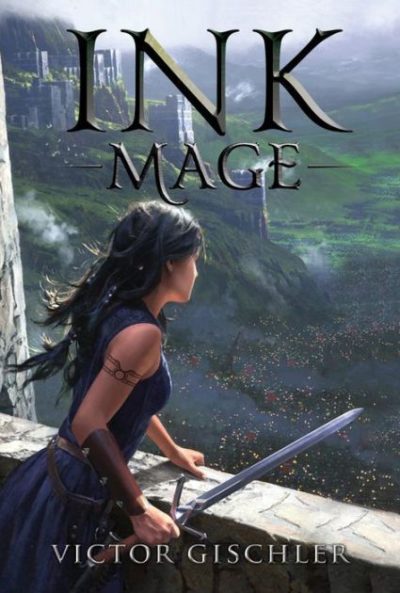 The small duchy of Klaar has been impervious to invasion, due to a secure location offering limited access. But when betrayal from within leads to its fall, to the vanguard of an invading Perranese army, heir apparent Rina Veraiin is forced on the run. She is fortunate to encounter one of a handful of people who know how to create mystic tattoos that will imbue the recipient with magical abilities. With her already significant combat skills radically enhanced, and her body now also blessed with a remarkable talent to heal, Rina can set about trying to recover her domain. It won’t be easy, since the king is not even aware the Perranese have landed. But she has help, albeit in the motley forms of a stable boy – sorry, head stable boy – a gypsy girl and a noble scion, whose charm is exceeded only by his ability to irritate.
Despite the young age of the protagonist, who is still a teenager, this isn’t the Young Adult novel it may seem. It’s rather more Game of Thrones in both style and content, with the point of view switching between a number of different characters. Some of these can be rather graphic, particularly the story of Tosh, an army deserter who ends up working as a cook in a Klaar brothel. But even this thread turns out more action-heroine oriented than you’d expect. For the madam gets Tosh to train the working girls in weaponcraft, so they can become an undercover (literally!) rebel force against the Perranese. Can’t say I saw that, ah, coming…
Gischler seems better known as a hard-boiled crime fiction author – though I must confess to being probably most intrigued by his satirical novel titled, Go-Go Girls of the Apocalypse! The approach here does feel somewhat fragmented, yet is likely necessary, given the amount of time Rina spends galloping around the countryside. It may also be a result of the book’s original format as a serial. However, it translates well enough to a single volume, and I found it became quite a page-turner in the second half. There, Rina readies her forces to return to Klaar, and take on the occupying forces, which have settled in for the winter.
The tattoo magic is a nice idea, effectively providing “superpowers” that can help balance out the obvious limitations of a young, largely untrained heroine. It is somewhat disappointing that, after significant build-up involving the Perranese’s own tattooed warrior, the actual battle between him and Rina seemed to be over in two minutes – and decided through an external gimmick, rather than by her own skill. In terms of thrills, it’s significantly less impressive than a previous battle, pitting her against a really large snake, or even the first use of Rina’s abilities, which takes place against a wintry wilderness backdrop – more GoT-ness, perhaps?
Such comparisons are unlikely to flatter many books, and this is at its best when finding its own voice, as in the tattooing, or the gypsies who become Rina’s allies. He does avoid inflicting any serial cliffhanger ending on us, instead tidying up the majority of loose ends, and giving us a general pointer toward the second in the three-volume series. Overall, I liked the heroine and enjoyed this, to the point where I might even be coaxed into spending the non-discounted price for that next book.
The Tattooed Duchess
A Painted Goddess
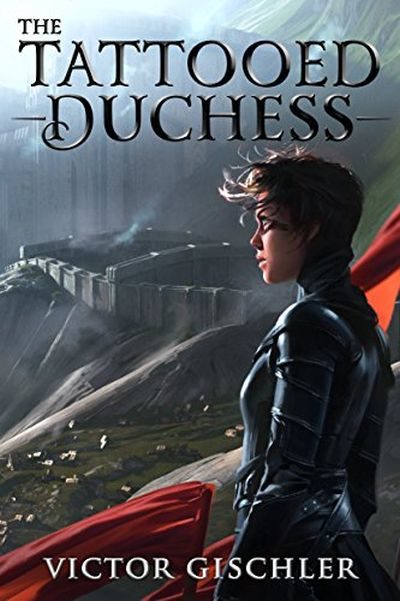 It makes sense to treat the second and third volumes in the series as a single entity. Ink Mage worked on its own as a one-off, with a beginning, middle and reasonably well-defined end, and the eight-month pause between installments was not a problem. Duchess and Goddess, however, really need to be read back-to-back. Mage ended with Rina Veraiin having recovered her family’s territory of Klaar, thanks largely to the magical tattoos covering her skin. But the new duchess is discovering that fighting to get territory is one thing, ruling over it on an everyday basis, quite another. Especially since the Perranese invaders repelled in the first volume, are on their way back with a vengeance. For their Empress Mee Hra’Lito needs a big win to keep control of things on her side of the ocean.
Rumbling in the background, and coming to a head particularly in Goddess, is a changing of the guard in the Kingdom of Helva’s divine pantheon, with the current incumbent as top god being challenged for that position. Disturbingly, the likely replacement is the god of war: never a good thing, especially when he can raise an army of unstoppable dead soldiers and send them after Rina and her allies. Dealing with both those threats, requires Rina to ink up some more. Since she’s otherwise engaged, that means sending expeditions to the furthest corners of the lands and beyond, to retrieve the templates needed for Rina’s power-ups. [Though part of the problem is, these don’t come with instructions, explaining what a tattoo will do…]
In particular, off to the Scattered Isles go stable-boy Alem, who carries a torch for Rina, and gypsy girl Maurizan, who is interested, both in Alem and getting some magic ink of her own. Meanwhile the noble Brasley and a new character, near-immortal female wizard Talbun, are exploring the depths – or, rather, heights – of the Great Library. This is a building so vast, it remains largely unexplored, with its origins and contents lost in the mists of time. Rina, meanwhile, is on a diplomatic mission, aimed at securing support for Klaar, only to be abducted by a group of Perran soldiers and their own mages, left behind when the army withdrew.
 Especially in the second volume, poor Rina is largely relegated to a supporting role. The major threat to her is, not deities or monsters, but the arguably more insidious danger of an arranged marriage, necessary for the defense of Klaar. Maurizan becomes the action heroine focus, supported by members of the “Birds of Prey”, ex-prostitutes who have become the castle guard, as well as Talbun. It’s decent, yet almost inevitably, suffers from the bane of trilogies, “second volume syndrome”, lacking both a beginning an an end [I will say, for understandable reasons, explained by the author on his site]. It was originally published in serial format, so feels a bit episodic too, though I can’t say this impacted my enjoyment particularly much.
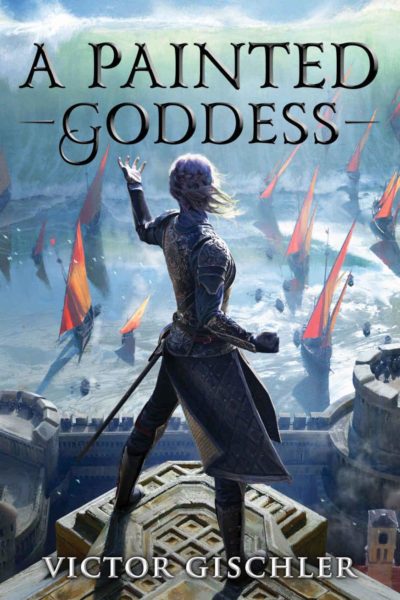
Rather than having to wait for the next part, as readers at the time had to do, I was able to head straight on into volume three. And Gischler redeems himself admirably for any flaws, with an excellent final volume. Rina has pretty much completed her set of tats, now possessing superhuman strength, speed and healing, as well as the ability to have anyone believe what she says, plus more. However, there’s a darker side to her talents, which becomes apparent to everyone when the Perranese lay siege to the port of Sherrik. With great power comes… scary responsibility, it appears: Rina has to make some unpleasant decisions about how far she is prepared to go, in order to repel the massive invading fleet. And they aren’t even her toughest adversary.
There are a lot of disparate elements across the series, yet Gischler melds them together into a coherent whole, rather than feeling like he’s simply plugging in fantasy tropes. I was particularly impressed by how even minor characters feel well-developed, such as Mee Hra’Lito. She didn’t need to be in the book at all, being simply the force behind the big bad (or more accurately, the secondary big bad). Yet seeing her motivations, adds depth to proceedings and enhances the epic scope. On the other hand, perhaps the series’s main weakness is lacking a truly central character. Is this Rina’s story? Alem’s? Maurizan’s? The answer is both all of the above, and none of them.
Still, this is the first true series I’ve completed since beginning book reviews on the site, and I’ve certainly enjoyed the experience. Gischler hinted at further volumes in February, saying of his universe, “I feel there’s more there to be mined,” and I wouldn’t mind in the slightest – even if Rina’s role would need… let’s say “serious revision”, based on how this ends, and leave it at that. Or a Peter Jackson trilogy of films based on these: that’d do, just as well.
Author: Victor Gischler
Publisher: 47North, available in both printed and e-book versions, as folllows:



 The above line of dialogue is a perfect litmus test for what you’ll think of this. If your reaction is a derisive snort, this pair of hour-long items – I have qualms about calling them anything as high-minded as “feature films” – is probably not for you. And I cheerfully admit, snorting is probably the default, and understandable, reaction. If, on the other hand, you are giddy with anticipation at the very thought, then I probably cannot recommend it highly enough.
 Tied somewhat to our March feature on the earliest action heroines in cinema, is this Chinese film, It’s not just the oldest surviving action heroine film from that country, it’s the oldest martial-arts film of any kind. This silent feature dates from all the way back in 1929 – I had to keep reminding myself that the “red” in the title was not a Communism reference, this being from well before such things. It’s most likely an attempt to cash in on The Burning of the Red Lotus Temple, a now-lost film series whose highly successful release had begun the previous year.
 “Have you not learned by this time that I am not a weak woman, but a strong one? You have harried me and injured me and wronged me and set tortures for me, but here I stand, unharmed. This day I will have my revenge.”
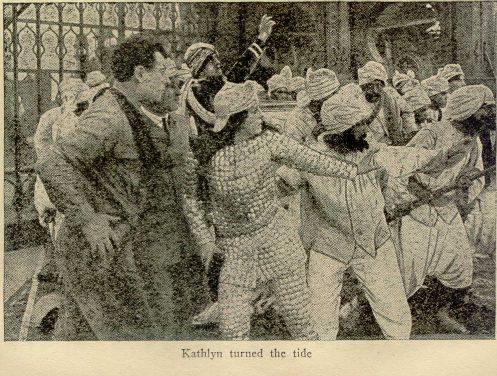 The writing style, while enthusiastic, is occasionally odd in that it chooses to skip over what should be thrilling moments. I wonder if perhaps this was the book’s way of not stealing the serial’s thunder? For example, as Kaitlyn sets off, accompanying a big cat her father was shipping to its end buyer, a major incident is all but entirely skipped over thus: “How the lion escaped, how the fearless young woman captured it alone, unaided, may be found in the files of all metropolitan newspapers.” Uh, what? But there are times when MacGrath does hit it out of the park, descriptively: “In the blue of night the temple looked as though it had been sculptured out of mist. Here and there the heavy dews, touched by the moon lances, flung back flames of sapphire, cold and sharp.”
 Not to be confused with the
  This workmanlike effort, if not particularly memorable, does at least cross two genres not frequently combined: the Western and the post-apocalypse movie. For it takes place in a world where global warming and other stuff have created a poisoned wasteland. Consequently, the currencies of choice are water purification tablets and silver, the latter being the raw ingredient in the air filtration masks which have become essential. Using vehicles powered by fossil fuels is totally outlawed, and those who do have rewards placed on their heads, attracting the attention of bounty hunters.
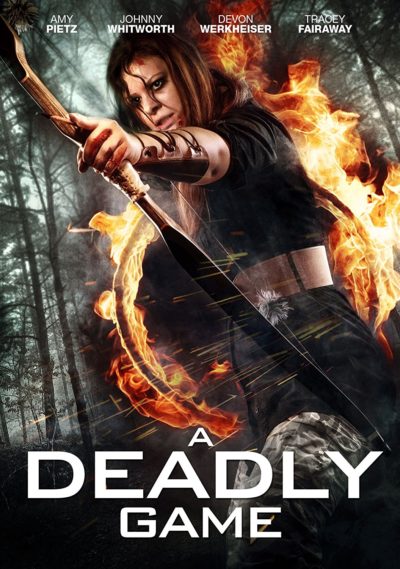 Winner of the “Most misleading DVD cover of the year” award, the gap between expectation and reality has rarely been wider. It starts off promisingly enough, with young woman Kayla (Fairaway), carrying a bow and running away from a man in a car. She’s rescued by a passing motorist, but they are run off the road by their pursuer. There’s then a flashback, to explain how these events came about. Which would be fine, except for the flashback lasting close to an hour and a quarter of thoroughly mind-numbing chit-chat, before anyone even picks up a bow in anger. It’s not
  In an effort to pay off gambling debts their brother Michael (Haze) has run up, sisters Leah (Eastwood) and Vee (Manning) plan and execute a bank robbery. While smart in intent – they set up a diversion, and have a cunning escape route prepared – it’s not long before the operation goes wrong. The bank’s safe does not hold anywhere near the expected haul: fortunately, the assistant manager (Franco) helpfully informs them of an undisclosed vault in the basement holding six million dollars in cash. Sending some of their gang down to the vault, The sisters can only watch on CCTV aghast, as the men are picked off by mysterious figures. For, it turns out, the bank was the site of a robbery in 1982, leading to a hostage situation that ended in multiple deaths. The ghosts of those involved are still in the basement, and opening the vault has apparently released them to take revenge.
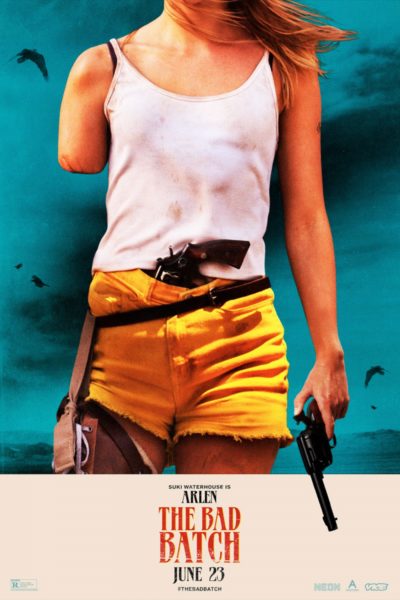 In the film’s defense, it’s not clear quite how post-apocalyptic this is meant to be, since we don’t see anything of the world at large. Everything takes place inside a stretch of desert which has been used, apparently for some time, as a dumping ground for the dregs of society. Into this environment is dropped Arlen (Waterhouse), who soon gets first-hand experience of the situation, when a cannibal mother and daughter capture her, and cut off an arm and a leg. She escapes, and is found and rescued by the Hermit (Carrey), who brings her to Comfort, the nearest the zone offers to civilization. When she’s well again, Arlen returns to take revenge on the mother, but believing the daughter to be innocent, takes her back to Comfort. Which provokes the ire of Miami Man (Monoa), a tattooed behemoth who turns out to be the girl’s father, and wants her back.
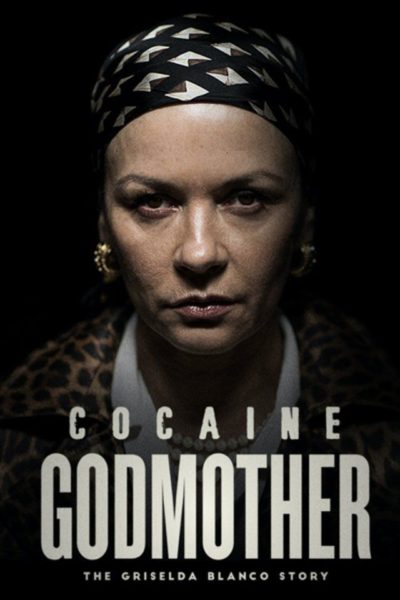 As we mentioned in the 2018 preview, this has had a rather tortuous journey to the screen, with Zeta-Jones inked to the part of Griselda Blanco as long ago as October 2014. That theatrical film appears to have died on the vine, but the actress’s interest clearly did not. Last May, Lifetime gave the go-ahead to a TV movie version instead, telling the life story of a character who has already