★★★★
“The shark was otherwise engaged, torturing Blake Lively…”
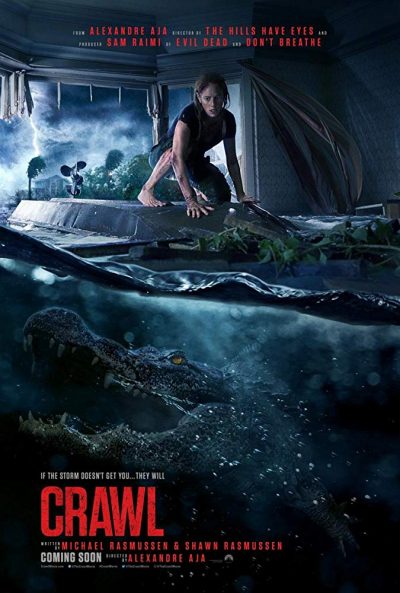
 I have to say, I’m neither an expert on that strange sub-genre of “animal horror,” nor am I a particular fan of it. I’m mainly looking for a movie that can give me a suspenseful time in the cinemas. This is becoming more and more difficult. Partly because in by my time of live, I have has seen quite a lot of movies, of all sorts; but also because I feel modern film makers have forgotten how to create real suspense and a feeling of slowly rising and constant terror in movies.
Mostly we are left with nonsensical pictures of man-killing animals that seem to have supernatural abilities. Usually it’s played for laughs because of all the silliness that comes with these kind of movies. That’s a pity. Sure, as a cinema-goer you can’t expect the greatness of classics like Hitchcock’s The Birds (1963) or Spielberg’s Jaws (1975) an ymore. But is it really that difficult? Create a modicum of interest for the main characters; introduce the predator; put the future victims in an isolated spot with the animals; and play with the ambiguity of the question as to whether said territory is safe at the moment – or not! That’s not rocket science, folks!
But for that you have to take the movie and the characters of your story seriously and the timing of every scene is essential: You’ve got to know where you set up your “beats”. How long can you ratchet up suspense before you’ve got to deliver? Where do you put the shocks, without which you can’t do a good horror movie? Do you put in a little bit of humor and to what degree? When is it time to give some relief to the audience, e. g. with character or relationship moments which seem obligatory background for these kind of stories? Whom do you kill? Whom do you have survive? And should you kill off the family dog or not? 😉
Alexandre Aja is a French film-maker who has got to show his talents across very different horror movies. His great High Tension, a psycho-thriller produced by Luc Besson, was followed by a The Hills Have Eyes remake, the good but not great Kiefer Sutherland vehicle Mirrors and later the (consciously) ridiculous Piranha 3-D. After a good start, in recent years it seemed as if he had lost “it” a bit. So, the offer from producer Sam Raimi to film an original story by Michael and Shawn Rasmussen came at the right time.
While the script has a few humorous moments (if you’re looking for them), it plays its story straight and Aja also focuses on creating genuine suspense and danger. Yet he also delivers in the important categories of shock and gore – something not really that evident from the trailers. That makes sense: you won’t show your climaxes in a trailer of an action movie. I’ve to say my expectations were pretty low when going into the movie. As a fan you know the score, so can a film still get you? To my surprise and delight, this was not only able to do that but also surpassed my expectations by far. But let’s start with some background info on what I want in such a movie.
Though you never expect a character study, I’m always happy if the characters get enough backstory or character traits, that they don’t appear as totally bland, two-dimensional audience stand-ins. That’s definitively true for Crawl‘s main actors Kaya Scodelario and Barry Pepper. Neither had that much luck with past roles: Scodelario, I remember from the Maze Runner movies but hardly seemed to register anywhere else much. I think I saw Pepper last with a supporting villain role in the True Grit remake (2010). I also need predators I like and respect. Some animals won’t really work for me, e. g. bears are simply too sympathetic. But for my money reptiles of all sizes always deliver the goods. And I’ve got an enormous respect for crocodiles or alligators.
 Next, the simple but effective story in a nutshell. Florida, hurricane time. Swimmer Haley Keller (Scodelario), who just failed in a swimming competition, receives a phone call from her sister She’s worried because she couldn’t reach their dad. Neither sister has had much contact with him, since their mother and father divorced; he was Haley’s former trainer, leaving their relationship no on the best of terms. The streets are beiing closed due to the dangers of the approaching hurricane and the rising water levels.
After finding her father’s house abandoned, save for his dog, Haley drives on to their former family house which he was renovating. Following the sound of a radio, she descends into the derelict cellar where she finds Dave, her wounded father (Pepper), who tells her that two alligators have entered the cellar through the drain. While they have some sanctuary in the cellar, they have to make an escape, due to the rising water that is coming up through openings in the cellar floor…
This may sound maybe a bit dry (pun not intended). But, believe me, the screenwriters and Aja have used every trick in the book to push and pull us, the audience, emotionally through our seats, in the same way the alligators push and pull the two likable yet imperfect protagonists through their surroundings. I was very pleasantly surprised about the high level of suspense and tension here. But also how the important ingredients mentioned above were perfectly blended together. The movie really creates suspense and grisly anticipation – yet also doesn’t forget that audiences need moments of relaxation so they can breathe a little, before the next furious attack or moment of extreme danger arrive. It’s a very well-written and executed entertainment, showcasing a kind of story-telling we don’t see much any more.
That said, the movie doesn’t reinvent the wheel. I personally wouldn’t be surprised if the Rasmussens saw two other recent animal horror movies with female leads: Burning Bright (2010) told the story of a young woman, locked together with her autistic brother in a house with a wild tiger by her evil uncle during a hurricane. And, of course The Shallows (2016, is it really already that long ago? It feels as if I saw the film just a couple of weeks ago…), which showed us Blake Lively on a rock in the rising water off an unknown beach while a blood-thirsty shark circles. As a matter of fact, both of these movies would make for a good triple-bill with this. And once Crawl comes out on DVD, it will find its place directly next to them on my shelves!
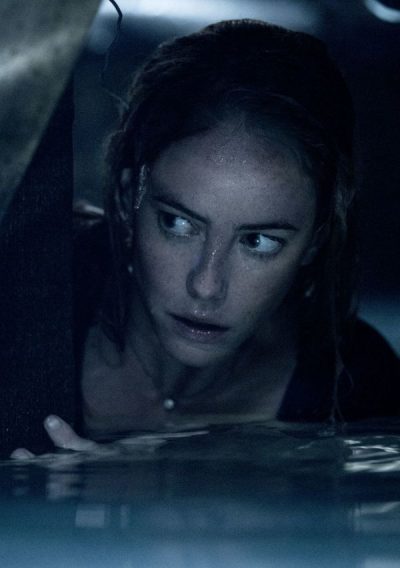 What is it about all those young women fighting predators with large pointy teeth? I’m no psycho-analyst but I guess it has something to do with the re-integration of certain character traits into the female psyche. Whatever these may be. I do remember an early trailer when The Shallows came out that had a voice-over of what sounded like a life coach trainer, encouraging the Blake Lively character. I wonder if the idea of the father who trained his daughter to extraordinary achievements was inspired by that trailer?
Actually, this movie goes a different way from some recent action-heroine movies, that looked to discredit father figures or put them in a negative light. Haley may have felt betrayed by her parents divorce and her father “abandoning” her. Yet during the course of the story, she finds out that her parents were not as happy as she thought and that her dad, who always loved her and believed in her, is just a normal guy. [Though I must credit him for absolutely convincing me how every household needs a utility belt for hand tools!] Having to survive and fight for what is left of her family, with the support of her father makes Haley overcome her own anxieties, through facing more than one deadly situation. Certainly, crawling through the drain by which the reptiles came into the house evokes quite distressing birth trauma… That’s a very positive message. After so many negative portrayals of father figures and “family values”, I found this a highly sympathetic and, for 2019, unusually traditional depiction.
But it only has to work – and it does that very well. We are not immediately tossed into shock-infested seas, there’s a nice build-up, so when the gators appear they evoke the desired audience reaction.Haley and her father have enough back story that you are on their side and want them to survive, while at the same time worrying if they will make it. Despite being just that just 90 minutes, the movie is full of ideas of how the imprisoned father-daughter couple could get help from outside (which leads to an unpleasant looter-reptile encounter) or escape the cellar and the house. It really plays with giving you hope, just to take it away again. One of my favourite moments is when Haley and Dave make it to an escape boat outside, when the levees break and a wave of water throws them back into their house – only one floor higher. Well-timed elements of humor, such as Haley’s reaction when normal house spiders fall on her face, help make for very satisfying entertainment.
A fascinating side-fact is that the movie was shot in Belgrade, Serbia, which doubles for Florida perfectly. And a little “tidbit”: Scodelario’s and Pepper’s family name in the movie is “Keller”. For German cinema-goers that’s extremely funny as “Keller” is the German word for “cellar”. But one last question: will the dog survive? Watch the movie to find out! It gets four well-earned stars from me. Your mileage may vary, but honestly I think it’s on the same level as The Shallows, which also scored highly with me. So, if you enjoyed that, this should be right up your (flooded) street.
Dir: Alexandre Aja
Star: Kaya Scodelario, Barry Pepper


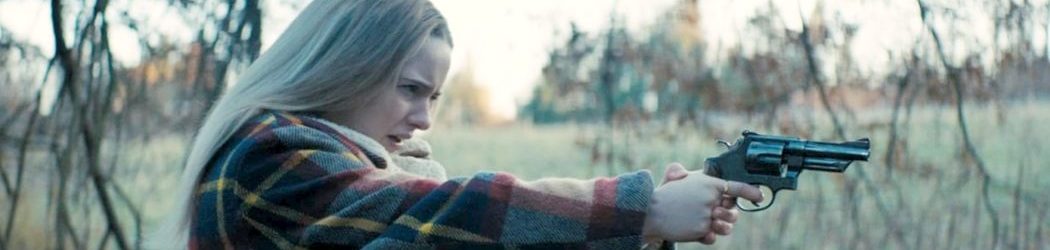

 It’s quite a feat for a film which runs a crisp 67 ½ minutes to outstay its welcome, so… Well done? The problem is mostly that far too much time is wasted on the set-up, introducing us – in quite excruciating detail – to characters in whom we have little or no interest. These would be the friends who decide to spend a weekend in upstate New York, unaware they are about to cross paths with a pair of bored locals who have decided to alleviate the tedium by going on a killing spree. When one of them gets cold feet, however, it’s left up to Cat (Rafferty) to follow through on the original plan, which she does with some enthusiasm. Just a pity this doesn’t happen until roughly the final twenty minutes.
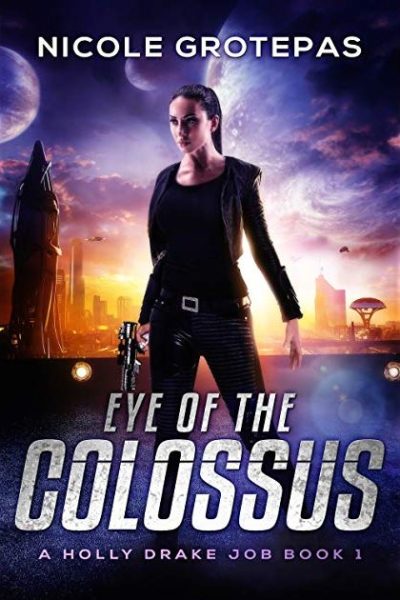 This probably picked up half a star in the final couple of chapters, because up until the end, the plot seemed to have some huge deficiencies. While most of these were certainly addressed by the final resolution, it still left a rather questionable taste in my literary mouth [if you see what I mean!]. The heroine is Holly Drake, who has been unjustly sent to prison after killing her abusive husband. Unfortunately, he was a police officer, and some of his dubious colleagues helped ensure Holly went to jail for it. On release, her previous career as a teacher is no longer an option, and she’s largely thrown on to the charity of her sister, Meg, also a cop.
 Four exotic dancers go on a trip to vineyard, courtesy of a customer at their club. However, they get more than they bargained for, falling unconscious and waking up to find themselves test subject in a scientific experiment run by Gibson (Wagner – no, not that one). He is attempting to convince the military-industrial complex to invest in his project to create “super soldiers”. To this end, he has a serum which vastly enhances both aggression and compliance, and has invited Senator Graham (Farino) to witness a test, under carefully controlled laboratory conditions. Oh, who am I trying to kid: he actually just shoots up the strippers with the serum and makes them fight to their deaths. In sports bikinis. And face-paint. In subdued yet artistic lighting. Because science! And that’s how government funding works!
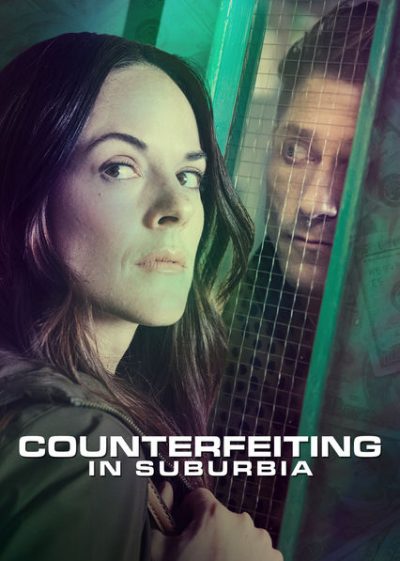 High-schoolers Reilly (Albuquerque) and Erica (Wallace) have discovered a way to literally print money, forging hundred-dollar bills. They then use these to buy high-end fashion, and sell these ill-gotten gains on to their schoolmates for genuine cash. The more cautious Reilly wants to stop, but realizes she can do good by helping Karen (Butler), her aunt and guardian, who is in financial trouble. So when Erica is insistent they expand, Reilly goes along with it, and they use the school’s art-class resources to up their game, laundering the fake money through foreign exchange stores. However, this criminal empire comes under threat, after art teacher Tim Sylvester (MacCaull) discovers what they’re up to. Because by chance, he owes a large sum of money to some nasty people, and starts a relationship with Erica, to make sure she’ll keep working for his benefit. Worse still, the Secret Service have been alerted to the flood of funny money, so are also investigating.
 Erica (Kriis) is an attractive con-artist, who seduces married men in hotels, then drugs and robs them, knowing they’ll never be able to report the crime. She has just brought on an apprentice, Lauren (Patrikios), to learn the dubious trade, watch her back, etc. Their next score turns out to be the jackpot. as they discover the target was carrying a stash of diamonds with a seven-figure value. Absconding with their ill-gotten gains, the pair decide to lay low for a while, and head to Erica’s hideout on the holiday destination of Isabelle Island. They’re disturbed to read news reports that the target turned up dead in the room, and it quickly appears that the owner of the diamonds is closing in on them. But who is the threat? Local policeman, Mike (McCullough), for whom Lauren has a thing? Visiting boat-owner and part-time magician Tom (Berdini), with whom Erica has a fling? Or the creepy bald guy who arrives on the island and appears to be stalking Erica?
 Coincidentally, this one-man production was watched immediately after another, also put together toward the north-west corner, around the USA/Canadian border. But Carter Johnson is relatively restrained compared to
  Alexis Carew is a third-generation settler on the planet Dalthus, and the ward of her grandfather, her parents having been killed in an accident. But her future is murky, for Dalthusian law prohibits women from inheriting property, such as her family’s estates. With the alternative being a marriage Alexis really doesn’t want, the 15-year-old girl instead signs up to become a midshipman in Her Majesty’s Navy (or, at least, the space version thereof), on the interstellar sloop Merlin. However, this is largely just exchanging one set of problems for another, whether winning the respect of her colleagues, fending off the
  Around the turn of the millennium, Parvana (Chaudry) is an 11-year-old girl living in Kabul, Afghanistan – then under the strict religious rule of the Taliban, in the aftermath of the Russian retreat. Her father is arrested and taken off to prison, leaving his wife and children without a male guardian. Which is kinda important, because under Taliban law, women are not allowed out in public unaccompanied. With no other option, Parvana cuts her hair and dresses as a boy in order to be able to get supplies for her family. Teaming up with another boy-who-isn’t, Shauzia (Bhatia), they find work. Parvana starts saving for the bribes necessary to see, and hopefully win the release of, her father; Shauzia is saving up for her long-held dream of seeing the ocean. Of course, it’s never that easy, especially post-9/11, when the country is invaded by America and its allies.
 We know very well that, on low-budget films, people have to wear many hats. Hell, my IMDb entry began when a film I was supposed to be helping my wife produce, had an actor drop out. You can only respect those who can turn their hands to multiple jobs. And, yet… There’s a point at which it become self-defeating, because nobody can be