
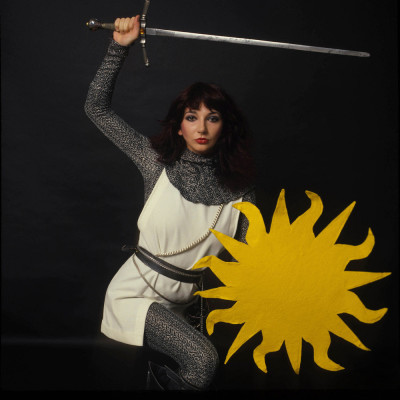
 It remains a matter of some small pride that the first album (kids, ask your parents!) I ever bought, was Kate Bush’s The Kick Inside. Unlike some artists from my days as a callow youth, she has stood the test of time very, very well, and over three decades later, despite many wannabes over time (coughToriAmoscough), there has still been no-one like her. I’ve been on a bit of a Kate Bush revival of late, inspired by her current return to live performance in London, after a gap of 35 years. Reviewing her work, both aural but particularly, the visual, I get the sense she had some action heroine tendencies of her own.
James and the Cold Gun
“It’s hot and sandy, the land is old and dry. Here rides a man with a sheet of ice by his side.” Those lines were penned by Bush to accompany the sheet music for the song from her debut LP. I always presumed that it was inspired by James Bond, but that doesn’t seem to have been the case, Kate saying in an interview when asked if it referred to anyone in particular, “The answer is: nobody. When I wrote the song, James was the right name for it.” Her record company wanted this to be her first single, but Bush held out for Wuthering Heights. Good call, I suspect: this is a great deal more conventional, but lacks the drop-dead, “what the f—?” impact of Heights.
Still, Gun got its moment in the sun. An extended version of the song, over eight minutes long, became the show-stopper for the third and final act of her first, and until this week, only live tour in 1979, demonstrating the mix of music, ballet, mime and theatre in which she has been interested since the very beginning. Reviewing the show, The Guardian wrote “The erotically charged denouement of James and the Cold Gun depicted her as a murderous gunslinger, spraying gunfire – actually ribbons of red satin – over the stage.” Ok, I’m sold. Here’s the sequence in question, taken from the live VHS, so apologies for the mediocre quality – why it has never been re-released on DVD escapes me. Now would seem the perfect time…
Babooshka
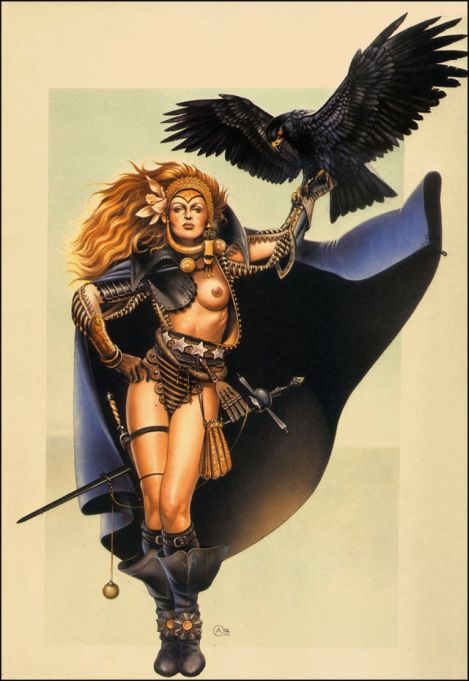
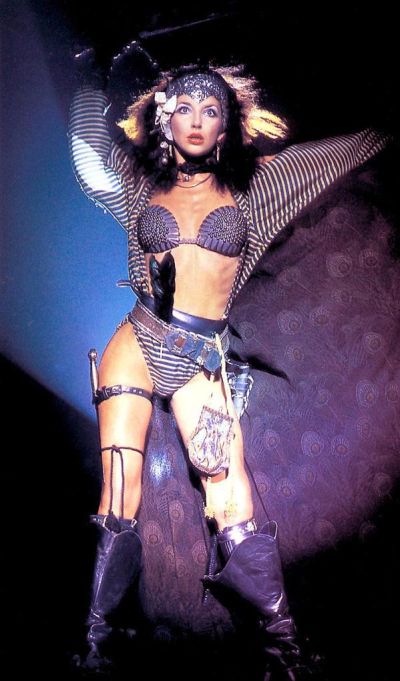
Her third album, Never For Ever, gave us one of the most iconic images of her career, as part of the video for Babooshka, a song about a woman who adopts a second identity to test her husband’s fidelity – only for it to be found wanting. In it, Kate adopts two personae, the staid wife, clad entirely in black, and with a veil, and the alter ego, who is dressed in a way much more befitting the heroine of a sword-and-sorcery novel. Which is not surprising, because the style was inspired by drawing from renowned illustrator Chris Achilleos. It wasn’t his first brush with the music industry, as the previous year, he gave the world the controversial cover for the Whitesnake LP Lovehunter, with a naked woman straddling a giant snake
This work was positively subtle in comparison, originally for the first book in the Raven, Swordmistress of Chaos series by “Richard Kirk” – actually a pseudonym for two writers, and not the noted industrial musician. Bush’s take, along with designer Pamela Keat, was somewhat more modest, as you can see in the side-by-side below. But I was fourteen when the song came out, and can still remember watching the video for the first time. My picture can be found in the dictionary to this day, beside the word “gobsmacked.” :)
The Wedding List
Kate was always extraordinarily well-versed in culture, right from Wuthering Heights: how many 18-year-olds can pepper a song with a sly reference to Armenian philsopher George Gurdjieff? But bonus points have to be awarded for her being inspired by a French girls with guns film even I haven’t seen, Francois Truffaut’s The Bride Wore Black. One of Truffaut’s contemporaries, Jean-Luc Godard is often credited with saying “All you need to make a movie is a girl and a gun” (he was actually quoting D.W. Grifiths), and Truffaut’s film is a fine example. It stars Jeanne Moreau as a widow, who hunts down and kills the men responsible for the death of her husband on their wedding day.
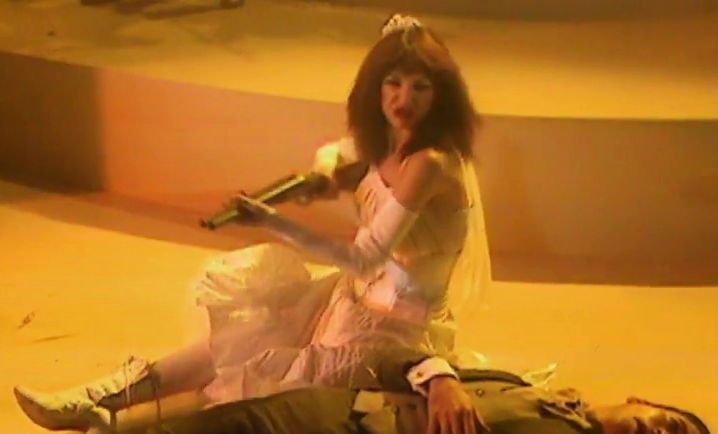
It seems a clear influence on Kill Bill, even down to the “Bride” crossing of her victims’ names in a notebook. Quentin Tarantino denies having seen it, but then he professed unfamiliarity with City on Fire too. But the best part of a quarter-century earlier, Kate Bush took inspiration from Truffaut for another song on Never For Ever, about a wronged woman who seeks vengeance on her spouse’s murderer – in a particularly Bushian (Bushesque?) twist for additional tragedy points, the widow commits suicide, and is then found to be pregnant. Here’s a sample of the lyrics.
Now, as I’m coming for you, all I see is Rudi.
I die with him, again and again, and I’ll feel good in my revenge.
I’m gonna fill your head with lead and I’m coming for you!
And when it’s all over you’ll roll over the butt of my gun:
One in your belly, and one for Rudi.
You got what you gave by the heel of my bootie.
Bang-bang–Out! like an old cherootie,
And I’m coming for you…
Damn. Kate and the Cold Gun, indeed. While this was never released as a single, it was one of the songs which formed part of her 1979 Christmas special for the BBC, from which the image above is taken, and which is available, with a little searching online. There’s almost an old West feeling to the version here, along the lines of Hannie Caulder – amusingly, the target for her vengeance is played by Kate’s brother, Paddy. And now, if you’ll excuse me, I need to go and track down a copy of The Bride Wore Black. For now, here’s the trailer.
Running up That Hill
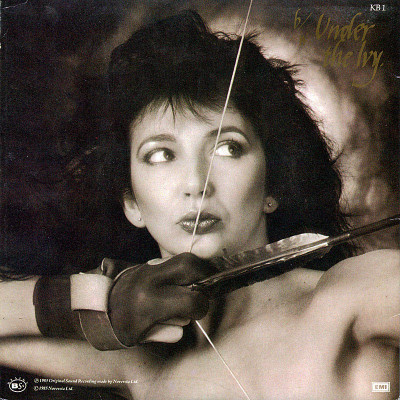
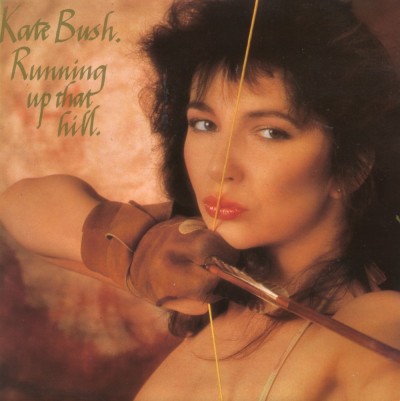
But before I got, mostly as an aside. Kate’s fifth release, Hounds of Love, is considered by many fans to be her best, and certainly, contains some of her most memorable songs. Running would be one of them, and remains to this day, her most successful song in the United States. The theme here is, how many relationship issues would be solved, if the people involved could just swap places and see things from the other person’s perspective. Not quite sure how the archery motif seen on the sleeve fits into that, but I note that the gesture of drawing a bow is also seen multiple times in the video for the song. It may be another reference to The Bride Wore Black, as the heroine does wield a bow during her quest for revenge.