

Guardian

guardian★★★½
“A coherent plot. It’s vastly over-rated…”

How you react to a film isn’t always a logical exercise. I’m a great proponent of “guilty pleasure” films: movies that, by objective standards, are generally not very good, yet still manage to be, on one level or another, thoroughly entertaining. Barb Wire is one: as soon as you realize it’s a post-apocalyptic sci-fi version of Casablanca, it’s totally awesome. Add this Indonesian movie to the same pile: it contains many things which, on their own, I loathe; yet here, for whatever reason, the whole ends up being a great deal more entertaining that you’d expect from the sum of its woeful parts.

Let’s start with that plot. Which is certainly a great deal more than the film does. Seriously: it takes 50 minutes for anything approaching a meaningful plot element to show up. It opens with a man driving home, being ambushed and stabbed to death. His wife and young daughter find him. Fast-forward ten years, and some thugs attack the house with what may be the longest single burst of automatic weaponry in cinema history, followed up, for no particular reason, by two rounds from a rocket launcher. Cue mother Sarah (Diyose) and pouty teenage daughter Marsya (Camesi) going on the run: Mom has clearly been anticipating this for a while, and has a hideout, stash of weapons and martial arts training. Turns out, there are two factions at play here: the one seeking to kill the family is led by corrupt cop Captain Roy (Fernandez), while playing defense is Paquita (Carter, best known for her role in Falling Skies), who… Well, you will find out eventually. Just don’t hold your breath.

guardian2.jogFor before you reach that point, there follows alternating scenes of ludicrous excessive gun-battles, and Marsya whining “What’s going on? Make it stop? I said, WHAT’S GOING ON? I want an ice-cream!” [I may have imagined the last, I’m not sure] Normally, this kind of thing would be incredibly grating. But let’s face it, she’s basically echoing what the audience is thinking, so it’s okay.  Throw in Kardit’s style of action, which consists of jerking the camera back and forth while simultaneously zooming in and out, and you’ve got the recipe for a headache-inducing exercise, about as far from fellow Indonesian flick The Raid as possible [seriously, if you haven’t seen The Raid, go do so now. It’s the best action movie of the past decade. You can thank me later.].

And yet… If you can handle the fact that the ratio of bullets to reloading scenes is several hundred to one, cope with not knowing what the hell is going on for half the movie, and tolerate characters that are basically a procession of shallow genre tropes, you’ll have fun. Against the odds, I did: there’s at least four women here with no qualms about kicking ass in industrial quantities, and both Divose and Carter bring the necessary intensity to their roles [there’s one awesome shot where Paquita is chasing after a car on foot and is just screaming at it]. There’s a chunk at the end where all three leading ladies are simultaneously fighting for their lives, and that’s a good deal more progressive than you’d get to see in most Western films. For all its many, copious flaws, I was kept entertained – as much by the daft insanity on view, as in spite of it. In the right hands, this could have been awesome: Kardit clearly is not those hands, yet it’s still more fun than I expected.

Dir: Helfi Kardit
Star: Dominique Diyose, Belinda Camesi, Sarah Carter, Nino Fernandez
Traitors

★★★½
“Punk’s not dead.”

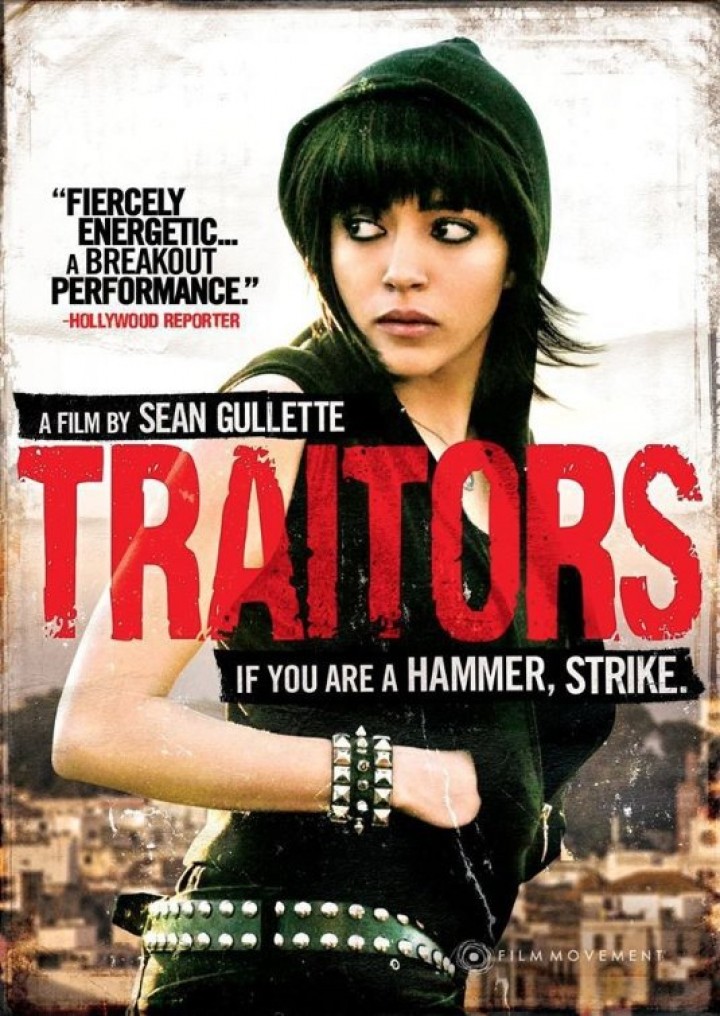
traitorsWhat counts as an “action heroine” is dependent on culture. As was saw in Offside, if you’re Iranian, something as apparently normal as going to a football game can be a dangerously transgressive act. The heroine here, Malika (Ben Acha), has a little more freedom, living in Morocco, but it’s hardly an oasis of feminist freedom by Western standards. Still, she’s pretty out there, being the lead singer in a punk band, the titular Traitors, and also a dab hand with a monkey wrench, working intermittently in her father’s garage. It’s the former that she sees as her ticket out, and a door opens when a producer expresses interest in the band, and offers to help them record a demo. The catch? They have to pay for the studio time themselves: that’s several months’ wages, and it doesn’t help that Malika has just been fired. But a garage customer (Zeguendi) offers her a solution: a one-night job doing a little driving for him.

She’s under no illusions about the reality of what she’s driving, but on the journey from the mountains to Tangiers, she talks to her fellow “mule,” the veteran Amal (Issami), and discovers the unpleasant truths about those she’s working for – worse still, the people above them – as well as that leaving the organization will probably be a lot harder than joining it. When Malika finds out that Amal is pregnant, she hatches a plan that’s either very brave or extremely foolhardy (not that these things are mutually exclusive), to allow her colleague the change to escape. However, doing so will certainly bring down the wrath of her employers, who have a track record of not tolerating employee disloyalty with a forgiving eye.

This is one of those films that is on the fringes of qualification for the site. Malika doesn’t wield a gun or kick anyone’s arse,  but there’s an exchange between the two young women which convinced me of its worth, and that in spirit at least, the heroine is part of the sisterhood we cover here.

Amal: “There was a proverb my mother used to say: if you are the nail, you must endure the knocking.”
Malika: “That’s only half of the proverb. The other part is: if you are the hammer, strike.”

I want that on a T-shirt, and it exemplifies Malika’s attitude perfectly: she’s a hammer made flesh, like her hero, the late Joe Strummer. Of course, the downside of that is, when you’re a hammer, everything else starts looking like a nail. However, Ben Acha does a good job of making a character that could easily have been obnoxious and abrasive, sympathetic instead. The film’s biggest weakness is a script that seems to run out of steam before the end, without anything like a satisfactory climax; instead, it peters out in a not very satisfactory and largely unconvincing manner. Perhaps this is related to this feature being developed out of a short film featuring the same character? Still, it’s a unique little item, and who knew there was such as thing as Moroccan punk – even if it’s every bit as shitty as much of the Western variety!

Dir: Sean Gullette
Star: Chaimae Ben Acha, Soufia Issami, Driss Roukhe, Mourade Zeguendi

Cat Run 2

★★½
“Time for this cat to be put out.”

The original Cat Run was an unexpected pleasure, lifted far above its expected delivery of slick, vapid entertainment by Janet McTeer’s wonderful turn as polite hitwoman Helen Bingham. The sequel lacks McTeer and it’s no surprise that this time, it is no more than slick, vapid entertainment. Leads Anthony (Mechlowicz) and Julian (McAuley) are back, still dabbling in private eye work, and end up in New Orleans after Julian’s cousin, a soldier, is involved in a strange incident at an army research base. Two hookers, brought in for the pleasure of the officers, turn out to be on a mission to steal secret blueprints: one is gunned down, but the other, Tatiana (Zoli) escapes, and a cover-up is instigated by the military. The more our heroes dig, the worse things get, as they attract the attention of the criminal cartel behind Tatiana, led by Hannah Wollcroft (Branch).

catrun2Unfortunately, the makers retained the most irritating part of the original – the two main characters, who remain as blandly irritating as they were previously, delivering the sort of witty banter between friends which only occurs in movies like this. To little or no purpose, they also lob in a meandering, weak subplot about Anthony opening a restaurant and needing to find his inner soul in order to win a televised cooking contest. I’d rather have had more sequences of naked, cybernetically-enhanced Eastern European assassins kicking ass: while your mileage may vary, I suspect I’m not alone there. Zoli does her best, yet is certainly well short of McTeer, even if the script tries to give her the same kind of character arc, and the story does provide her character with a spot more background then usual. Then, at the end, for some reason the script decides it wants to be Iron Man. I’m sure there’s a world in which that story decision made sense.

Still, there are moments which work, such as the the sequence where Tatiana has to take on a ninja posse while simultaneously distracting a guy she picked up speed-dating. It’s clear Stockwell has seen far too many badly-dubbed kung-fu flicks, and I’m right alongside him there. When it isn’t trying too hard, and the film is content to be that slick, vapid entertainment I mentioned, it’s fair enough, with some well-staged action such as a hovercraft chase through the bayou, and a solid sense of atmosphere and location, not present in the original. However, the absence of McTeer leaves a gaping hole, and helps explain why this is a significant step down in almost all other ways.

Dir: John Stockwell
Star: Scott Mechlowicz, Alphonso McAuley, Winter Ave Zoli, Vanessa Branch

Warrior Princess

★½
“Putting the “que?” in ‘Mongolian barbeque’…”

warriorprincessOh, dear. This spectacular misfire looks nice, with some good cinematography, pretty landscapes and occasionally decent action sequences (though let’s just mention, I doubt the equines here performed under the supervision of the American Humane Association). But the script. I say again: oh, dear. It’s a complete mess, with no sense of narrative flow, peppered with jumps like “eight years later”, and heavily populated with messengers breathlessly rushing it to deliver account of actions off-screen, that typically sound a damn sight more interesting than what’s actually depicted.

The heroine is Ahno (Davaasuren), a princess who falls for a nomadic priest, Galdan (Mondoon). Initially, his vows of celibacy prevent anything from happening, but after his brother is killed (cue the breathless messenger), Galdan takes over as leader, which conveniently allows him to forgo the whole celibacy thing and marry Ahno, who had been betrothed to the brother by her father despite her love for Galdan. However, it’s not long before their relationship is strained, with Ahno torn between duty to her husband and Dad, who are both jostling for position in the power structure of late 17th-century Mongolia. Not helping matters is the Chinese emperor, lurking in the wings and saying ominous things such as, “May one wolf devour the other.” Eventually – and I mean after you’ve endured leaden dialogue such as, “Why would you say something like that to me, knowing it could mean the destruction of my relationship with my nephew?” – this leads to a battle, where Ahno finally straps on her gear. Because the “warrior” part of the title has basically been AWOL, since she accidentally fired an arrow at Galdan, in basically the opening scene of the film.

Part of the problem is my unfortunate decision to watch this in a dubbed version, which rarely helps and can fatally wound even great movies e.g. try watching the English dub of Heroic Trio [no, please don’t]. That can’t explain the horrendous approach to story-telling: it wouldn’t have surprised me to discover the movie originally ran three-plus hours. and was edited down to 95 minutes for a Western audience. While I’ve found nothing to say that was the case, it gives you an idea of what to expect: scenes have no connection to those that precede or follow them, sometimes ending in fade outs that give the impression of a bad TV movie. Maybe it makes more sense to a local audience, since Ahno, who was a real historical figure, is apparently a bit of a national heroine, a la Joan of Arc.

Technically, it is actually slick, and as background viewing it might reach two stars, providing you are not expecting actual warrior princessing of the Xenaesque kind. However, it’s telling that, while I generally use movie watching as an excuse to put off running on our treadmill, in this case I ended up embracing the treadmilling enthusiastically, rather than having to give the film my full attention. Watch Myn Bala instead, if you want a central Asian historical epic.

Dir: Shuudertsetseg Baatarsuren
Star: Otgonjargal Davaasuren, Myagmarnaran Gombo, Myagmar Mondoon, Bayarmagnai Yeguzer

Tigresa

★★½
“Tigresa, tigresa, burning bright…”

tigresaTIL there’s a genre of cinema – indeed, an entire culture – called “Nuyorican”, which is for and by the immigrants from Puerto Rico who now live in and around New York. del Mar made five such movies, mostly in the late sixties, but this 1969 production is the sole action heroine entry. It has a nice sense of local atmosphere, feeling a bit like the early work of Abel Ferrara, but also has it’s moments of berserk insanity, which one can only presume must have made sense at the time.

The heroine is Patricia (Faith), a young woman who is bullied by her schoolmates, and whose life reaches a low after she is assaulted by a bedroom intruder, an attack which also results in the death of her father. But, in a plot twist I defy anyone to see coming, she is left half a million dollars in the last will of a Jewish store-owner for whom she works, and this lets Patricia dye her hair blonde and sets her up as the owner of a nightclub, the ‘Chateau Caribe’. She has also developed a heck of a lot more self-confidence, allowing her to take revenge on her former tormentors, rescue other women from assault and continue looking for the man responsible for her assault and her father’s demise. However, her friend, Maria (Lee), has plans to rob Patricia, with the help of her boyfriend, Jimmy (H) – who, it turns out, was also the rapist. They concoct a scheme for Jimmy to seduce Patricia, providing a distraction which will allow them to break into her safe.

There are also subplots involving the local mafiosi, and a police detective (Crespo), who doggedly attempts to solve the crime by dressing as a transvestite hooker. I’m not quite sure hoe that’s intended to work: it might take a while, to say the very least, and my instinct is it probably says more about the cop’s personal proclivities than anything. Certainly puts a new spin on “to protect and serve”. I liked Faith’s performance, since she genuinely manages to get your sympathy, as the dysfunctional nature of her relationship with her father becomes apparent. He gets drunk because its the only way he says he can see his late wife; so she then gets drunk, wanting to see her dead mother too. This is accompanied by a tinkly, music-box like score that’s quite poignant – well, up until the point that the musical cue gets overused to death, anyway.

After her transition into the tigresa [incidentally, the “La” part of the title seen on the DVD sleeve appears to be entirely the distributor’s addition], she’s still quite a laudable character, taking no shit from the organized crime boss. She refuses to let him use her club as a front for drugs and prostitution, but does partner with him in exchange for his help finding her attacker. Though this just consists of wandering local gyms trying to find someone with the distinctive back scar which was her assailant’s sole distinguishing feature – I’d have expected better from the mob. It’s just a good thing absolutely no-one in these places ever wears a shirt. There’s another bizarre diversion where she meets a gangster, who then goes home to discover his wife in bed with another man. So he drowns her in the bathtub and decapitates her lover, before vanishing from the film entirely.

Yeah, it’s like that: nonsensical in many ways, and obviously cheaply made, with performances all over the place, from the monotone to the hysterical. Yet it’s strangely hypnotic, and you find yourself watching, just to see what will happen next and in what surreal way things will develop. For all its many faults, I can’t say I ever found Tigresa dull. There are GWG films which are so forgettable, I find myself struggling to write 300 words on them. This was certainly not one of those.

Dir: Glauco del Mar
Star: Perla Faith, Johnny H, Cindy Lee, Guillermo Crespo

Amazon Warrior

★★★
“Where’s Lana Clarkson when you need her? Er… Never mind…”

amazon warriorI’ve seen some painfully cheap, poorly made excuses for movies in the post-apocalypse genre in my time, and I was actively braced for another one here. To my pleasant surprise, this didn’t suck. While it certainly delivered on the first half, apparently being made on a budget of spare change off the producer’s bedside table, the film possesses a script into which some work has gone, and decent leading performances, neither being expected. Indeed, this is likely some production values away from being genuinely good, at least in a nostalgic way, harking back to the Argentinian sword ‘n’ sorcery flicks that were churned out for the video market in the mid-eighties.

After the world has gone to hell in a hand-basket [and a bad digital effect], it returns to a tribal state. One of these are the gynocentric Amazons, but their territory is invaded by the marauders, an alliance of tribes under General Steiner (Storti), who perpetually needs to find and takes over new territory, to stop his alliance from splintering. You could read a political subtext into this, although that would likely be giving the script too much credit, I suspect. The only survivor of the slaughter that follows is Tara (Rodgers), who grows up, vowing revenge on Steiner and his crew. We join the vengeance in progress, with Tara now a mercenary who notches her belt for each marauder killed, but has taken time out from her busy revenging to escort two young women from one spot to another, at the request of their father (Sherer). On the way, she meets Clint (Jerman), a like-minded individual, who also had his family killed by Steiner, and so who is on his own personal mission. Or, is he?

It’s this angle which is one of the facets that keeps things interesting, with the storyline taking some unexpected twists and turns, right up to the final scene. Rogers is also effective in a role that could easily have become a collection of cliches, and the supporting performances are appropriate to their tasks. The fight sequences just about pass muster – it helps if you squint at them sideways, rather than giving them your direct attention – and it appears that after civilization has collapsed into anarchy and chaos, what remains will resemble an SCA get-together, albeit with rather more fur bikinis. The audio could also have done with some significant clean-up, not that hearing every word of dialogue is exactly crucial. Still, this comfortably exceeded all expectations, even if those were basically flat-lined going in; it retained my attention and was entertaining throughout. If you can manage your hopes realistically, not anticipating something on a par with the upcoming Mad Max remake, this should do the same for you.

Dir: Dennis Devine
Star: J.J. Rodgers, Jimmy Jerman, Raymond Storti, Bob Sherer

Fair Play

★★★
“Czech out those legs…”

fairplayTeenage sprinter Anna (Bárdos) is on the edge of making the Olympics with the Czech national team, but still needs to meet the qualifying time. She’s being brought up by her mother, Irena (Geislerová), a former tennis prodigy, now reduced to working as a cleaning lady – in part because of the defection for the West of her husband. Irena also secretly transcribes underground documents for a dissident, Marek. Coach Bohdan (Luknár) pushes Anna hard to reach her maximum potential, and gives her “Stromba”, a substance that helps her performance, but screws up her health. She stops taking it, believing it to be an illegal steroid: when her coach finds out, he enlists Irena’s help to inject her daughter surreptitiously, saying it’s the only way Anna will make the squad. Reluctantly, Irena agrees, unwilling to see her daughter lose out in the same way she did. But as the authorities close in on Marek, the two women become pawns in a political game, with their common Olympic dream now used as leverage against them.

This makes an interesting companion piece to Goldengirl, with both films telling a similar story about female runners in the early eighties, whose family and mentors are prepared to go to any lengths to achieve success at the Olympics. Goldengirl unfolded in the lead-up to 1980’s Moscow Games, but subsequent history rendered it obsolete, as America boycotted them. Fair Play shows things from the other side of the Iron Curtain, in the lead-up to the 1984 Los Angeles games – which the Eastern Bloc similarly spurned. The benefit of time allows the film to incorporate this history into an ironic postscript for its narrative and, while less SF-oriented than its American cousin, the attitudes of both heroines, and the approach of their supporting cast, have a surprising amount in common. The main difference here is, the doping regime is state-sanctioned; in Goldengirl, it’s free-market forces driving the “win at any costs” mentality.

The piece makes a pointed connection between Anna and Irena’s situations, both coming under pressure to compromise their personal morality for personal gain – one sporting, the other judicial. It’s this stand which represents the true heroism to be found here, though the script struggles to escape from the obvious clichés of Soviet Bloc culture. The other main weakness is the actual athletics, which never give the impression of anyone moving at more than an energetic jog, while the thread involving Anna’s relationship with a boy doesn’t go anywhere of significance at all. In the final analysis, it’s a worthy enough effort, if rather too earnest to be wholly successful. You can see why it became the official Czech entry for this year’s Academy Awards – and equally as much, why the Academy then decided it wasn’t worthy of making the final nominees.

Dir: Andrea Sedláčková
Star: Judit Bárdos, Roman Luknár, Anna Geislerová, Ondrej Novák

Deliverance Creek

★★★½
“Once in a Lifetime.”

deliveranceThere’s one thing it’s vitally important to understand before watching this. It’s not a stand-alone Western movie. This is what’s called a “backdoor pilot”: something aired as if it were a discrete entity, with the aim of gauging audience reaction to see if it gets picked up. This matters, because it explains the film’s otherwise inexplicable failure to resolve… Well, just about any of the plot threads it constructs during its 90 minutes. If you expect closure, you’re going to be massively disappointed, and there are other aspects which are similarly out of place, such as Skeet Ultich as a local saloon pimp, who serves absolutely no purpose. However, if you take this for what it is – an introduction to the setting, characters and situations – it’s actually more than serviceable, especially since it’s a product of Lifetime, whose output tends to the bland in the same way as vanilla pudding. Thanks largely to Ambrose, this rises above that, and leaves me definitely interested in seeing more.

She plays Belle Barlow, struggling to keep things going on her farm as the Civil War grinds on; her husband was fighting for the Confederates, but has not been heard from in forever. Things aren’t made easier by the neighbours, the Crawfords, who own the local bank and the loan on which Belle is falling behind. Her sister, Hattie, is also involved in helping the underground railroad, the network which smuggled escaped slaves to freedom: Belle has mixed feelings about this, but finds herself hosting one such refugee as her “slave”, Kessie. Meanwhile, a bunch of renegade soldiers, led by Belle’s brother Jasper (Backus), arrive on the farm, intending to knock off a delivery of army gold that will be held temporarily in the bank. Initially opposed to this, Belle’s opinion is changed after a tragic accident, for which she blames the Crawfords, and it turns out Kessie holds the key (literally) to pulling off a successful robbery.

I can’t stress this enough: do not go in, expecting any one of these threads to reach a satisfactory conclusion. It’s the journey which you need to enjoy instead, because the destination is never reached. Fortunately, I was forewarned, and so didn’t suffer the same sense of “Is that it?” as some reviewers. Instead, I was able to appreciate a heroine that’s a good deal more complex than many, and the film also does a good job in portraying the murky nature of the Civil War, where people from the same town (or even family) would sometimes be on different sides. I particularly liked Belle’s little rant in regard to the Crawfords:

I want revenge too. But a bullet for each of them while they sleep is little comfort. I want them to suffer, as I have suffered. I want them to feel what it’s like to have everything they love stripped away from them, piece by piece.

That speech does a really good job of setting up her character’s direction for the rest of the movie, and providing credible motivation. As yet, I haven’t heard of any series following and that’s a pity, because this has potential and I’d like to know where it might have gone. While it’s obviously much easier to write a film where you don’t have to worry about the ending, don’t let the attached name of Nicholas Sparks (The Notebook, and other sappy romances) put you off, for this is better than many TV movies, and definitely better than almost all Lifetime ones.

Dir: Jon Amiel
Star: Lauren Ambrose, Wes Ramsey, Christopher Backus, Riley Smith

The Godmother

★★★
“Romain in place”

godmotherDefinitely not to be confused with the upcoming film starring Catherine Zeta-Jones as Colombian drug-queen, Griselda Blanco, this is likely a much gentler piece of work. Jennifer (Anderson) in an English teacher, happily married to a Romanian accountant, Radu (Bucur) and with a young son, David (Iamcu). But her life is turned upside-down when her husband is arrested, for it turns out his main job was keeping the books for the area’s top mobster, Spanu (Alex). To prevent him from testifying, Spanu sends his goons after his accountant’s family, and Jennifer has to rely on her wits to survive. Eventually, she decides the best form of defense is attack, and sets up her own criminal organization, with some unlikely help in the shape of the local cops, some of husband’s book-keepers, and a former mobster turned monk.

It is, of course, all entirely implausible: in reality, a scenario like this would end in only one way, and would be neither gentle nor amusing. Fortunately, Spanu is largely incompetent, to the extent that it’s inconceivable how he could ever have made it to the top of the criminal underworld, and his minions are little better. Still, given that conceit, I spent most of the movie with a goofy smile on my face, watching “fish out of water” Jennifer coming to terms with her situation, and the oddball characters who surround her – the gangster monk, who spends most of the time drinking heavily and/or floating in the pool, was probably the most amusing. Though I do feel this missed a trick, not having a heroine whose character was located somewhere between Mary Poppins and Nanny McPhee, with a steely determination and implacable sense of propriety, e.g. scolding the villain for his poor table-manners. Still, Anderson brings a peppy likeability to the role. though the wrap-around section, concerning two street kids apparently finding her diary, doesn’t fit well with anything else.

It’s filmed in a mix of Romanian and English, which is a bit flaky at times, since some of the characters are clearly not acting in their native tongues. However, the script holds the threads together nicely, and even manages to find a way for the heroine to triumph – such an obvious conclusion, it doesn’t even count as a spoiler – that is not entirely contrived or impossible. Without giving too much away, it involves “turning” an operative sent into her camp, with the help of a strange medical student who sells body-parts on the side. While I’d like to have seen more action, that isn’t the real focus; however, it does show occasionally surprising invention, that allowed this to skate around its weaknesses.

Dir: Jesús del Cerro, Virgil Nicolaescu
Star: Whitney Anderson, Velea Alex, Stefan Iancu, Dragos Bucur

The Bod Squad

★★★
“Several virgins short of a six-pack.”

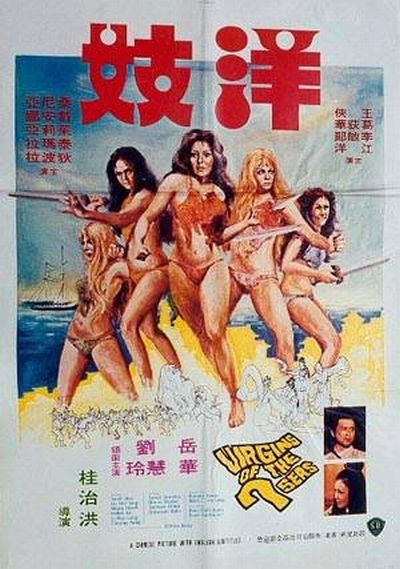
7seasIn the 1970’s legendary Hong Kong studio Shaw Brothers sought to broaden their market with a series of co-productions. The results included the likes of Legend of the 7 Golden Vampires, from a partnership with Britain’s Hammer Studios, plus Cleopatra Jones and the Casino of Gold. But perhaps the most bizarre such product is this, which crosses martial arts with the softcore sex films from the time, the best-known of which is probably Hofbauer’s Schulmadchen Report (Schoolgirl Report). The results are… Well, I’d be hard-pushed to call them great cinema, but I would have to confess to being rather more entertained than I expected.

Contrary to one of the alternate titles, Enter the Seven Virgins, there are actually only five women here, and some of those aren’t exactly virgins. They are captured by pirates, and brought to their island lair, where buccaneer boss Chao (Hsieh) leers at them and puts them through a training course designed to get them ready to be sold into white slavery. Except, he doesn’t know that one of his minions, Ko Mei Me (Liu), is actually working, along with her brother, to take him down, and trains the captives in martial arts, as well as the ancient Chinese art of spitting olive pits at such high-velocity, they can punch a hole through a vase. After copious amounts of gratuitous nudity, the women eventually break free, get recaptured, escape again, and take on Chao and the rest of his henchmen in a battle which makes up for in duration, what it may lack in quality.

Actually, that’s a little unfair: considering the Western cast were more used to films with titles such as Campus Pussycats, they perform credibly enough. There’s not as much stunt doubling as I expected, and they’re clearly giving it all they have, occasionally impressively. Bray stands out in particular – and I mean that literally, since it seems she’s taller than most of the men in the cast. Liu, however, clearly has the most experience, and its understandable why she gets given most of the action. In some ways, this can be seen as a primitive ancestor of Category III films such as Naked Killer: while lacking quite the same lurid insanity, and featuring a degree of casual racism that’s fairly off-putting [apparently, the sight of Western flesh is enough to send most Chinese men into drooling imbeciles], it’s still fun for the undemandingly open-minded. Admittedly, a fondness for Benny Hill may help, and providing you can get past hearing Chinese people dubbed into German, as well as subtitles that may have lost their way a bit in translation. I’m still trying to figure out the meaning of, “It’s a bank holiday, it’s Mothers’ Day in Africa.”

Dir: Kuei Chih-Hung + Ernst Hofbauer
Star: Liu Hui-Ling, Wang Hsieh, Sonja Jeannine, Gillian Bray
a.k.a. Virgins of the Seven Seas
a.k.a. Enter the Seven Virgins
a.k.a. Karate, Küsse, blonde Katze [Karate, kisses, blonde cats]