




★★★
“Cecily, Warrior Princess”
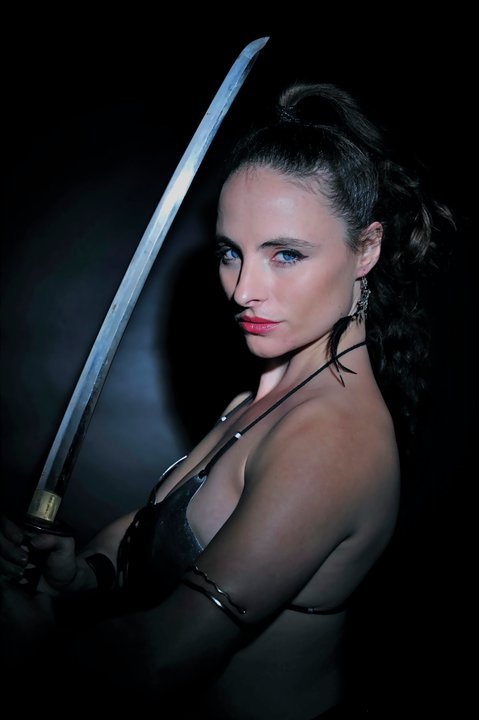 This is one I’ve been aware of since as far back as 2010, but it seemed to have been lost in post-production hell, so I was surprised to see this had finally got a release, coming out on DVD in its home territory of the UK last May. It’s one of those films where you need to know, going in, that this is not a slick Hollywood blockbuster with massive production values, and instead is clearly a work of love for those involved, doing their best with limited resources. In fact, I can’t really do better in setting those expectations than another review, which said the film was, “Best described as ‘Xena filmed on a Doctor Who-circa-1980 budget by way of a Robin of Sherwood LARPing weekend'”. I can’t really improve much on that, though would perhaps add, “Set on Steampunk Sunday at your local Renaissance Festival.”
The story is triggered by a prophecy, which sees Boudiccu (Fey) first win custody of a pair of legendary weapons, then journey through a post-apocalyptic landscape, where humanity has largely reverted to tribal savagery. However, the crypto-fascist Falonex clan still appear to have a handle on some old-school technology and appear to be massing to establish their dominance. On the way to the prophesied location, where she will face another warrioress in a battle which will hopefully lead to a champion rising who can defeat the Falonex, Boudiccu is joined by White Arrow (Simpson), who is seeking revenge on those who killed her family. Or something. They have to fend off attacks, share flashback sequences and, eventually, have a twist revealed in their relationship that should come as absolutely no surprise to anyone paying attention.
What works? Simple: the action, led by Fay. She’s a tiny thing – 4’9″! – yet it’s entirely convincing, because the style of her fights don’t show her using strength and power to beat her opponents (which would be implausible), they instead emphasize skill, quickness and agility, which she has in spades. Credit, too, for Boyask, who consciously avoids the rapid-fire style of editing, knowing that the best thing he can do with a talent like Fay, is point the camera in her direction, then let her get on with it. [Sometimes, knowing not to do anything is more important than trying to do it] There’s a battle, not long after Boudiccu leaves her village, in which she takes on half-a-dozen other women, which is just glorious: it’s probably the best action heroine sequence ever to come out of the UK. But therein lies a problem, in that nothing during the hour thereafter is as great: good, sure, sometimes very good, but the final battle in particular feels like a letdown.
What doesn’t work? Sadly, way too much of the stuff between the fights, which feels like a slapdash grabbing of elements lifted from elsewhere, lobbed into a storyline which might just about have passed muster on a wet Sunday at my college D&D society. The efforts at generating any kind of broad, post-apocalyptic landscape are feeble, particularly the Falonex, who are represented by a ropey CGI backdrop and the interior of a single tent, which does not succeed in making them the kind of global threat they are supposed to be, especially since their scenes are play largely for laughs. But what’s really missing from the dialogue and performances, is any sense of intensity. They’re purely functional, intended to get the story from A to B (where A and B are almost certainly fight scenes). It’s clear from the action scenes, everyone involved had a passion for what they were doing there. Unfortunately, that passion is absent from everywhere else, and weakens the overall product to an extent that many will be unable to look past the flaws, and appreciate the positive attributes to be found here.
Dir: Ross Boyask
Star: Cecily Fay, Joelle Simpson, Christian Howard, Merrilees Fay Harris






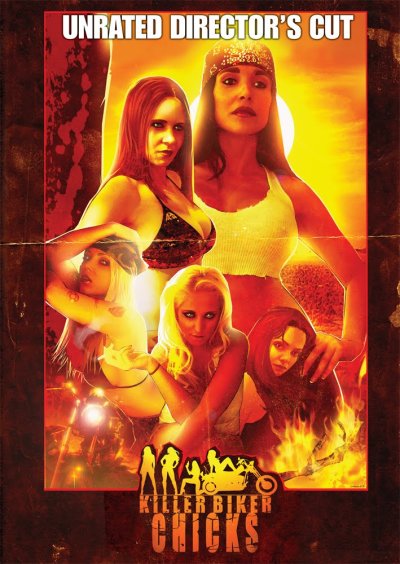 Oh, dear. I’m sure those involved with the production and their mates loved this. To anyone on the outside… Much less so. However, the problem is not actually the concept, of an all-female biker gang, which had a long, disreputable B-movie pedigree, going back at least to the sixties, with Herschell Gordon Lewis’s She-Devils on Wheels and similar films. The women here operate under the leadership of “Mother” (Gorlano), and in something apparently inspired by Sons of Anarchy, run a garage/bar that doubles as gang HQ, from where they also deal meth to passing truckers (and midgets), while taking their tops off at random intervals – in particular Baby Doll (Roth). Possible related: there may be a strip-club that’s part of it, but the film is vague on the details of their infrastructure. The movie starts well enough, with them out in the desert torturing a man who had done one of them an unspecified wrong, dousing him in gas and setting him on fire.