
Hostile Intentions

★★
“Not brought to you by the Mexican Tourist Board…”

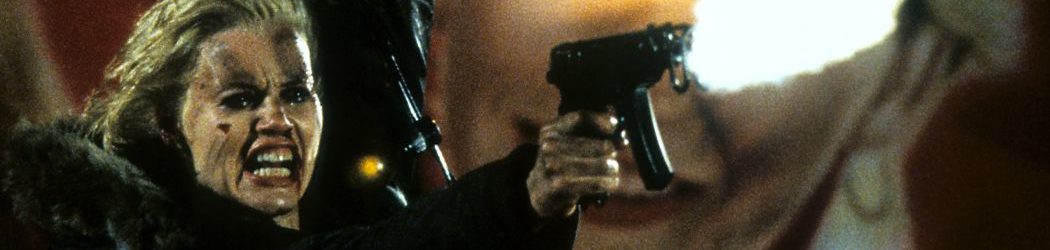
Nora (Carrere) and her two American friends cross the border to Tijuana for a weekend of partying. It doesn’t quite go as expected: the trio instead end up locked up in a Mexican police-station. When two cops on guard at the jail attempt to rape one of her pals, Nora grabs a gun and shoots them both dead. While this perhaps does solve the immediate problem, it obviously creates some rather heftier issues. The three women go on the run, assisted by another inmate, Juan Delgado (Gómez), who has the local knowledge they need to survive south of the border. It turns out Juan was just about to sneak across the American border, and he agrees that if they will fund the payment to the coyotes for him and his family, they can come too.

To say this doesn’t present a positive portrayal of Mexico as a holiday destination would be putting it mildly. Even though the incident which kicks everything off is actually the result of uncouth actions by another group of tourists, it doesn’t exactly depict the locals – the police, especially – in anything except a horrible light. Of course, this is also the poster-child for Bad Decisions Made Overseas, so it’s not as if Nora and her pals deserve to escape the consequences of their own actions. #1 would be “Going to Tijuana,” which in the mid-nineties was a major drug-hub, the local cartel being among the most feared gangs in Mexico. [In 1997, the DEA called the Tijuana Cartel “undeniably the most violent” organization.] So, my sympathy for Nora’s predicament is muted at best.

Even Juan and his family aren’t exactly sympathetic. Between cheerfully confessing that “everybody” wants to sneak across to America, and the gun-battle that breaks out between the illegal immigrants and the federal agents on the U.S. side, they’re basically walking advertisements for Trump’s wall. While this may be partly the result of societal changes over the two decades since this was released in 1995, I think it probably seemed dubious at the time, based off the poorly-considered scenes spent both at the American consulate and behind the scenes with the Border Patrol. I kept expecting these to play some role in subsequent events: never happens. 

The main positive from this is Carrere, whose portrayal of Nora provides – despite the snark above – an energetic enough heroine, pro-active rather than reactive. She especially seems so, when set beside her two travel-mates, who largely sit around bemoaning their fates. There’s no particular reason why there need to be three women here at all; the others serve little purpose, except for an embarrassing subplot where one of them slept with the other’s boyfriend. Not that this has any significant impact, thanks to the “sisters before misters” philosophy on view. If this had been a solo adventure for Nora, Carrere has the charisma to have pulled it off. Instead, we get an ill-conceived exercise, which can’t figure out whether it wants to be liberal or conservative hogwash.

Dir: Catherine Cyran
Star: Tia Carrere, Lisa Dean Ryan, Tricia Leigh Fisher, Carlos Gómez

Demon Hunter

★★★
“Hey-ho… Let’s go!”

Behind a remarkably generic and forgettable title sits an entirely reasonable slice of low-budget Irish action-horror. It’s clear creator Kavanagh knows what has gone before, and if the resources here don’t allow her to reproduce them on anything approaching the same scale, she knows her limitations and works well enough within them. Besides, who can resist a film that works a Ramones lyric into its dialogue? Taryn (Hogan) feels responsible for the death of her little sister, abducted and killed on the way home from school. She gets a chance to do something about it, when approached by the mysterious Falstaff (Parle) after her sister’s funeral. He reveals a secret world of demons and sacrifices – Taryn’s sister being one of the latter – and offers Taryn a chance for revenge, if she’ll come and work for him.

We don’t actually learn much of the above until some way into this. We start with the heroine stalking and enthusiastically decapitating one such demon, only to be arrested by the local cops. They’re peeved she won’t reveal where the severed head of the victim is located – not least because she insists this is necessary to ensure he stays dead. Falstaff, meanwhile, has not intention of letting his minion remain in police custody, and informs them there will be a fresh murder every 24 hours they do not let her go. For, it turns out, Falstaff has an entirely separate and significantly less helpful agenda with regard to Taryn, and has simply been using her towards his own ends.

The main asset this film has is Hogan, whom production kinda lucked into, after the original actress pulled out two weeks before shooting started. For Hogan is a third-degree black belt in Shotokan karate, with a slew of titles both national and international. The physicality her experience allows her to bring to proceedings can’t be learned at drama school, and bumps up the action credibility several notches. Given this, it’s a shame that we don’t get see more of her: after the opening head-removal, Taryn is then locked up in custody for the rest of of the first half, and we also have to go through the flashbacks explaining how she became a demon hunter. It might have been better for the makers to figure out whether they wanted to tell an origin story or subsequent tale: this is a little of each, and both likely suffer as a result.

The lazy comparison would be Buffy, but that can be applied to virtually anything where a young woman is battling supernatural creatures. Bloody Mallory is probably closer, with its heroine who is more surly and aggressive than frothy and ironic, and the dark tone here has echoes of The Crow as well. Kavanagh was working on the project for close to a decade before it reached the screen. The struggle to find funding is apparent in some rough edges, and her lack of experience in a story that can’t sustain itself for the full duration. Yet it’s still remarkably polished for not just a first feature, close to Kavanagh’s first narrative film of any kind, with her background being mostly in music videos.  I’m looking forward to seeing where she (and Hogan) might go from here.

Dir: Zoe Kavanagh
Star: Niamh Hogan, Alan Talbot, Michael Parle, Aisli Moran

Forever the Moment

★★★
“Women with balls.”

Every four years, when the Olympics arrive, we fall in love with handball. What is handball, you might be asking. Basically, think seven-a-side soccer, except (obviously), played with the hands rather than feet. It’s an amazing sport, all but unknown in the UK and US, and deserving a far wider audience – a YouTube search for “Olympics handball” will get you sorted. Which is why we were fascinated by the idea of a film focusing on it, specially, the story of the 2004 South Korean women’s team. What they did was roughly that country’s equivalent of the 1980 ‘Miracle on Ice’. The once-dominant Korean team had fallen far from grace, and barely qualified for the Athens Olympics. But they reached the final, against the Danish side, which went into double overtime, and then a penalty shootout.

Yeah, much of this is a compendium of sports cliches, right down to the requisite training montage. The fact it’s largely based on true events does not exonerate the movie from criticism here, though I was impressed how closely the depiction of the final match did mirror the real thing, still regarded as an all-time classic contest. Thus, you get tropes such as the veterans, brought back for one last crack at glory, such as Han Mi-sook (Moon), who is now working in a grocery store to try and make ends meet, after her husband is defrauded by his business partner. They inevitably butt heads, both with the younger players, and new coach Ahn Seung-pil (Uhm), who is not only the replacement for interim coach Kim Hye-gyung (Kim J-e), but also her ex. There may eventually be bonding. I won’t spoil that.

It would be very easy for this to topple over into sentimental cliche, yet the strength of the performances generally help it stay just in bounds. Director Im seems particularly interested in developing her characters, and they come across as especially real, as they progress from a sparsely-attended opening game to the cauldron of the Olympic gold medal match. Especially memorable is the feisty Song Jung-nan (Kim J-y), who won’t back down from any confrontation, most notably when some of the other athletes at the Korean training complex try to bully some of her team-mates. Weightlifters or judokas, all learn quickly not to get in her way.

I should mention, you don’t need to know much about handball, since it’s largely self-explanatory. Though even our relatively untrained eye could detect the difference between the actresses playing the game, and their opponents who are the real thing, being actual professionals from a Danish handball club. For the Korean audience, there won’t be any surprises in the eventual outcome; that’s an area where the movie perhaps had a greater impact on us. Im handles the final moments particularly deftly, not even showing the final shot, just the reactions to it, and finishing with archive post-game interviews from the real participants. These do an excellent job of bringing home the reality of what happened.

At a length of over two hours, we could likely have done with more handball and less personal drama (not to mention the unfounded suggestion of biased officiating). Yet I’d be hard-pushed to consider the time wasted, and it was nice not to have to wait until 2020 to have our love of the game rekindled once more.

Dir: Im Soon-rye
Star: Moon So-ri, Kim Jung-eun, Kim Ji-young, Uhm Tae-woong

Operation Lipstick

★★★
“I have a knack for stealing hearts, just like the way I steal your wallet.”

So warbles Li Bing (Cheng), a second-generation thief who has abandoned the criminal life and now performs a cabaret turn which is part song-and-dance, part magic act. These efforts to go straight are derailed when her former partner (Lee) shows up, demanding shelter due to being pursued for a wallet he lifted. She agrees to help, only if he returns the stolen property: when they try to do so, they find the owner now lacking a pulse.

It’s all part of a convoluted caper involving a dead nuclear scientist, and the microfilm containing the secrets of the atomic engine on which he was working. Various parties want said data, including: a Triad gang specializing in espionage, who operate out of a rival nightclub; the local counter-intelligence authorities, who recruit Li to their cause; and freelance operative Zhang Yee (Chung), who reluctantly partners up with Li and provides the romantic interest. The trail involves the key to a locker in a Turkish bath-house, which in turn leads to a hollow statue that does NOT contain the microfilm. So, where is it?

I would likely have appreciated some kind of scorecard, to help me figure out who was part of which faction, and perhaps with a chart indicating the McGuffin in play at this particular point. The key? The statue? The fake copy of the key, which I may have forgotten to mention earlier? It’s all rather confusing, a cinematic version of three-card monte, in which the elements are swirled around at a dizzying speed, apparently designed to perplex, rather than enlighten. Yet, it remains entertaining, in the way only a Cantonese cover-version of James Bond could be.

Depite the poster, the talents  of Cheng that are put to use here are more towards the musical end, rather than the martial side. Indeed, save for a battle around the bath-house against a pair of enemy agents, and a roof-top face-off against the head of the Triad gang, it’s light on the meaningful action for her. Despite this, it certainly qualifies for inclusion, with Li demonstrating a persistent level of smart feistiness that is not out of line with her more fisticuff-oriented roles. [I’d love to have seen a prequel depicting her thieving days, and explaining how she ended up becoming a nightclub act!]

The best parts are when the film is at its most inventive, such as the trio of singing assassins with their lethal musical instruments, also a nightclub act. Bit of a giveaway that the lyrics to their song go, “We are world-famous for assassination, a few notes and you’re dead”! And if I ever become an evil overlord, who has access to a fiendish death machine, I will always check who is in said machine before I activate it, even if I am sure I placed my prisoner in there a few minutes earlier… Although sporadic, I found those fun moments did provide enough entertainment to repay my investment of time.

Dir: Umetsugu Inouye
Star: Cheng Pei Pei, Paul Chang Chung, Pang Pang, Lee Kwan

Petra by Cheri Lasota

Literary rating: ★★★
Kick-butt quotient: ☆☆

Petra is a teenage Roman slave at around the birth of Christ. She is completely under the thumb of her sadistic master, Clarius, until a strange conjunction of events and a poisonous herb with mystical qualities changes the power dynamic entirely. Both of them, together with her lover, Lucius, attain immortality. But it’s an immortality which requires the two men to drink from Petra annually, or they will degenerate into sub-human monsters. Neither is happy with the arrangement: Clarius is not used to being reliant on anyone, least of all his former property, and Lucius hates the fact Petra agreed to submit to their ex-master, in order to save him. As the centuries stretch into millennia, Petra begins, slowly, to put together a group people who will be capable of defeating Lucius and the immortals he has recruited, allowing her to live in eternal peace with Lucius.

If you’re getting a bit of an Interview With The Vampire vibe here, you are not far off the mark, with the story spanning multiple human lifetimes. Fortunately, it largely stays clear of the vampiric cliches, and what could have been little more than Twilight with delusions of historical significance becomes a little more. It’s recounted in flashback from the 18th century, though there are huge gaps in the narrative, where you’re left to wonder what Petra was doing during the 1,300+ intervening years. I’m still a little vague on the specific mechanism of the immortality, too: it is based on Petra’s blood, the herb, or is it the combination? But my major problem was the overpowering emphasis on the romantic angles. Look, we get it: Petra and Clarius are super in love. Now, can we move on to interesting anecdotes about life everlasting?

Proceedings take a sharp right turn in the 14th century, when Lucius has had enough of it all, and bails. This volume is, frankly, much more interesting with him not about. Petra goes in search of him, and the resulting adventure is easily the strongest section of the book. Hearing stories of an “immortal”, she heads out from Genoa, hoping that it’s her lover, and finds herself trapped in Kaffa, a port on the Crimean Peninsula, which is being besieged by the Mongol hordes. It’s a hellish landscape, made all the worse by the plague-infected corpses which the attackers lob over the walls (this actually happened – it was the first recorded case of biological warfare, and helped decimate Europe, as merchants who survived the siege brought bubonic plague with them when they returned home). This is a very well-handled meshing of historical events with fictional characters, working to good effect. I’d like to have seen more of this, and less sloppy romance.

Petra says that she’s an accomplished swordswoman – and given the hundreds of years she’s had to practice with weapons, that makes sense. There’s rather more talk than walk, in this volume, though I sense this may be a case of the author wanting to keep her powder dry for subsequent volumes and the battles against Clarius which seem destined to come. Would I read them? Hard to say. Lasota showed she has plenty of potential, but there’s still a risk this could end up collapsing into teenage mush. Probably a case where I’d borrow volume 2, or wait for a 99 cent sale on Amazon.

Author: Cheri Lasota
Publisher: CreateSpace, through Amazon – this was part of the Dominion Rising collection for Kindle.
Book 1 in the Immortal Codex series.

Beach Volleyball Detectives

★★★
“So, illegal underground beach volleyball matches?”

The above line of dialogue is a perfect litmus test for what you’ll think of this. If your reaction is a derisive snort, this pair of hour-long items – I have qualms about calling them anything as high-minded as “feature films” – is probably not for you. And I cheerfully admit, snorting is probably the default, and understandable, reaction. If, on the other hand, you are giddy with anticipation at the very thought, then I probably cannot recommend it highly enough.

It’s one of those cases where the title pretty much explains the basic idea. Three young, photogenic members of the Foreign Affairs Department, led by Haruka, get paired up with Wakana, a equally young and photogenic visiting policewoman from Hawaii, after they discover blueprints for a mini-nuke, capable of wiping out everything in a 100-mile radius. To find those behind the scheme, the four law-enforcement officials have to go undercover at the training camp for an international volleyball tournament, and figure out which of their opponents – Chinese, Russian or Indian – are after the blueprints.

This manages to be incredibly tacky, while also remaining remarkably chaste. There is no actual content here which would be worse than PG-rated. But it’s all shot in a way that resembles Russ Meyer in heat: focusing on the actresses’ erogenous zones, sometimes to the exclusion of everything else in the frame. Which makes sense, considering the director’s filmography includes what I can only presume are far more explicit titles, such as her debut, Chronic Rutting Adultery Wife. And who can forget Miss Peach: Peachy Sweetness Huge Breasts? Meanwhile, the writer is Takao Nakano, who gave the world – and this site – Big Tits Zombie.

It also turns out that, much like the Force and duct-tape, beach volleyball has a light side and a dark side. These are, respectively, White Sand Beach and Black Sand Beach. This mystical philosophy may help explain the superpowers on display here. For instance, the Indian team can levitate, the Russian player can turn into multiple mirror images of herself, and the Japanese and Chinese have a whole slew of super-powered moves, up to and including “Intercontinental Ballistic Missile No. 1”. I should mention, all these different nationalities are played by Japanese ladies, though in deference to her cultural heritage, the “Russian” does wear a headscarf. The Chinese are defined by their frequent spouting of Socialist dogma, such as “Go ahead and vote on it, you silly democratic people.”

The execution is woefully inept, The matches play like a low-rent version of Shaolin Soccer, right down to the ball turning into a dragon, a result of the appropriately named “Dragon Spike” move. Except, here, the CGI might barely have passed muster in the 1980’s. What passes for “combat” is hardly any better, if at all. Yet this incompetence actually becomes part of the trashy charm, and there’s a surprising amount of plot here. Our heroines have to handle not just their enemies, but also betrayal from within, and jealous fights between Haruka and Wakana over the attentions of their coach, with the help of a Yoda-esque monk, Harlequin. It’s all undeniably goofy, yet I was amused and entertained – likely more than I should probably admit…

Dir: Yumi Yoshiyuki
Star: Arisu Kagamino, Sakurako Kaoru, Chihiro Koganezaki, Kaori Nakamura

Red Heroine

★★½
“The more things change…”

Tied somewhat to our March feature on the earliest action heroines in cinema, is this Chinese film, It’s not just the oldest surviving action heroine film from that country, it’s the oldest martial-arts film of any kind. This silent feature dates from all the way back in 1929 – I had to keep reminding myself that the “red” in the title was not a Communism reference, this being from well before such things. It’s most likely an attempt to cash in on The Burning of the Red Lotus Temple, a now-lost film series whose highly successful release had begun the previous year.

Heroine, like Temple, was a serial, in this case consisting of 13 feature-length episodes. This was #6, and I’m not sure quite how it fitted into things – it stands on its own perfectly well. The heroine is Yun Ko (Van – for all character names and credits, I’m using the names given in the intertitles), whose village is threatened by the approach of an invading army, under General Chiny Che Mang (San). While trying to flee, her blind grandmother is killed and Yun Ko captured.

She’s just on the edge of being forced to become one of the General’s scantily-clad harem – an aspect which seems very racy for the twenties! – when she is rescued by a Daoist monk, the White Monkey (Juh). He had met Yun Ko’s cousin (Wen), who informed Monkey of her plight. After being taken to her grandmother’s grave, she vows that those responsible will pay, and becomes a pupil of the monk. Three years later, with the invaders now in full control, the General is still up to his lascivious tricks, arresting a girl’s father on trumped-up charges, to get her to accept his sordid demands. It’s time for White Monkey and Yun Ko finally to strike.

In some ways, it’s most impressive how little has changed in the almost 90 years since this was released. The most standard of all martial-arts movie plots – “You killed my (insert family member), and you must pay” – is clearly in play, as is the student who must learn from a master in order to take that revenge. I also note that crappy subtitling was there, right at the birth of the genre. On the other hand, I’m quite impressed a print with any English-language content survived at all, even if it’s at the level of this exchange between Yun Ko and White Monkey:

“Are you not care to revenge?”
“As I am so weak, how could I to revenge?”
“Don’t kill yourself. I’ll teach you my military skill.”

The first third of this is very solid, with Van making for a good heroine. She has the extraordinarily expressive eyes essential to a silent star, putting across the horror of what has befallen her, and the “worse than death” fate yet to come. However, once she teams up with her kung-fu guru, they both vanish from the film until the very end: clearly the concept of the “training montage” had still to be invented. What replaces them – the General’s conniving against a completely different target – is far less interesting, little more than silent soap-opera, draining the film of almost all its energy.

Our revengeful duo finally return, sailing briefly through the air in an early and extremely primitive version of flying fantasy or wuxia. Equally primitive are the fight scenes, which certainly remind the modern viewer we’re still four or more decades before Bruce Lee showed up. This is still a somewhat interesting watch, for anyone with an interest in martial arts films. However, it’s really only of note for being the first of its kind, and this aspect is purely a result of circumstance, rather than its own inherent merits.

Dir: Wen Yeh Ming
Star: Van Shih Bong, San Kwan Wu, Juh Yih Fong, Wen Yih Ming
a.k.a. Hongxia

The Adventures of Kathlyn by Harold MacGrath

Literary rating: ★★★
Kick-butt quotient: ☆☆☆☆

“Have you not learned by this time that I am not a weak woman, but a strong one? You have harried me and injured me and wronged me and set tortures for me, but here I stand, unharmed. This day I will have my revenge.”

As we discussed earlier this week, the novel is an adaptation of the 13-part serial by the same name starring Kathlyn Williams. The first episode was originally released between Christmas and New Year 1913, and the book was published a few days later, as a tie-in. With both the serial and the feature-length version of the story, released in 1916, both almost entirely lost (one episode and print fragments remaining), the book is virtually all we have to go on in terms of documenting the proto-action heroine who is its titular character.

Kathlyn Hare is the daughter of Colonel Hare, a noted “bring ’em back alive” hunter, who provides animals to circuses and zoos. He had spent many years searching for big game on the Indian sub-continent, in particular the country of Allaha, where he saved the king from a leopard attack. Years later, the senile king makes the Colonel his successor, much to the chagrin of Prince Umballah. The Colonel returns to Allaha, intending to abdicate, leaving a sealed letter behind, for Kathlyn and her sister Winnie to open if he doesn’t come back.

When that comes to pass, the letter triggers Kathlyn’s departure across the world to Allaha, on a courageous mission to rescue her father. Before it’s over, and Umballah is finally defeated, there will be encounters with wild creatures, wilder locals, and an almost endless stream of perils, both natural and man-made. Fortunately, there’s the brave explorer Bruce to help out, as well as some friendly natives, and not least, Kathlyn’s very particular set of skills, involving a particular affinity for animals.

With its action-wilderness setting and breathless pace, Kathlyn feels almost like the ancestor of Lara Croft, though she defers significantly to the men when it comes to the heavy lifting and most of the fighting. But there’s a lengthy period where she has to fend entirely for herself in the jungle. Considering this comes from a time before women were even allowed to vote, she still makes for a striking character. Of course, this dates from a different era, and the unfortunate attitudes of the time, more than a century ago, are frequently reflected in the content. When Kathlyn is informed she is to marry Umballah, there are a million valid reasons to be horrified: he has basically abducted her, after all. But the one the author chooses to have Kathlyn express? “Marry you? Oh, no! Mate with you, a black?”

But, wait! There’s more:

  • Sexism! “Not a sign of that natural hysteria of woman, though [Kathlyn] had been through enough to drive insane a dozen ordinary women.”
  • Racism! “The Hindus are a suicidal race.”
  • Sexism and racism! “The women of [Umballa’s] race were chattels, lazy and inert, without fire, merely drudges or playthings.”

Painful though such sentiments obviously are, I feel you can’t validly judge a vintage book by modern standards, any more than you can complain that Shakespeare’s play do not depict parliamentary democracies. If you feel such things are important, however, this novel is likely not for you.

The writing style, while enthusiastic, is occasionally odd in that it chooses to skip over what should be thrilling moments. I wonder if perhaps this was the book’s way of not stealing the serial’s thunder? For example, as Kaitlyn sets off, accompanying a big cat her father was shipping to its end buyer, a major incident is all but entirely skipped over thus: “How the lion escaped, how the fearless young woman captured it alone, unaided, may be found in the files of all metropolitan newspapers.” Uh, what? But there are times when MacGrath does hit it out of the park, descriptively: “In the blue of night the temple looked as though it had been sculptured out of mist. Here and there the heavy dews, touched by the moon lances, flung back flames of sapphire, cold and sharp.”

Or there’s this stirring description of Kathlyn, in her role as a “Joan of Allaha”: “With the sun breaking in lances of light against the ancient chain armor, her golden hair flying behind her like a cloud, on, on, Kathlyn ran, never stumbling, never faltering, till she came out into the square before the palace. Like an Amazon of old, she called to the scattering revolutionists, called, harangued, smothered them under her scorn and contempt, and finally roused them to frenzy.” It’s sections like this which make me feel it’s a real shame we’ll never be able to experience the theatrical version of this story. On the other hand, the book does have the advantage of being able to include dialogue, something not available in the silent era, so it might still be more accessible to the modern audience.

I found it an interesting snapshot of a bygone era, and if you’re happy to take this for what it is, and forgive the crude stereotyping, it’s an entertaining and fast-paced read (if occasionally repetitive, in terms of story – how many times is Kathlyn and her family going to escape the clutches of Umballah and not GTFO?). Time for a remake starring Saoirse Ronan, I’d say!

Author: Harold MacGrath
Publisher: Originally in 1914 by the Bobbs-Merrill company, it is now available free from Project Gutenberg, in a variety of formats.

The first action heroines

“Within a sensational action-adventure framework of the sort generally associated with male heroics, serials gave narrative preeminence to an intrepid young heroine who exhibited a variety of traditionally “masculine” qualities: physical strength and endurance, self-reliance, courage, social authority and freedom to explore novel experiences outside the domestic sphere.”
   — Melodrama and Modernity: Early Sensational Cinema and Its Contexts by Ben Singer

Despite what some people apparently think, the action heroine predates Ellen Ripley by… oh, almost eight decades. What should likely be regarded as the first of its kind actually appeared just five years after the Lumiere brothers shocked the audiences with a train arriving at a station. It was called Le Duel d’Hamlet and was released in 1900, as part of a program at the Exposition Universelle in Paris that year. The film clocks in at just under two minutes, and is an excerpt from Shakespeare’s Hamlet, in particular the fencing scene with Laertes – it’s basically nothing but action! This is notable, not just for being the first filmed “version” of the play, but because the part of Hamlet is played by Sarah Bernhardt, at the time one of the most renowned stage actresses in France (or any other country).

However, the crown of the earliest “true” film action queen perhaps belongs to the little-known Gene Gauntier. She got her start in the first decade of the 20th century, before credits became established, which partly explains why her place in history has almost evaporated. She literally walked on to her first film set with no experience to become a stunt-woman, being thrown into 30-foot deep water – despite not being able to swim! While acting was not her sole talent – she wrote the scenario for a 1907 adaptation of Ben Hur, which ended up costing her studio $25,000 in a landmark copyright case – it was her role of “Nan, the Confederate Spy” which merits her claim to the title here. In 1909-10, the character appeared in The Girl Spy, The Girl Spy Before Vicksburg and The Further Adventures of the Girl Spy.

Similarly ground-breaking was What Happened to Mary – note, no question-mark, it being a statement rather than a question. This was the earliest motion picture serial made in the United States, the first of its 12 monthly episodes being released in July 1912. This was also a very early example of cross-promotion. The idea originated as, and was then tied to, a series of stories in Ladies’ World Magazine; these were left unfinished, as a contest for readers to submit their own endings. However, each episode stood alone, with titles such as The Escape from Bondage or A Race to New York.

The series helped make a star of Mary Fuller, who had previously appeared in 1910’s Frankenstein, the first cinematic adaptation of Mary Shelley’s story, playing the doctor’s fiancée. After Mary, she’d go on to further serial success with Dolly of the Dailies, which depicted the adventures of Dolly Desmond, lady reporter extraordinaire. In an October 1914 poll of stars in Motion Picture Magazine which garnered a total of 11 million votes, she finished third among actresses, behind only Clara Young and Mary Pickford. She was also a screenwriter, who had eight scripts turned into films between 1913 and 1915. But her career was basically over by 1917; she subsequently had more than one nervous breakdown and spent the last 26 years of her life in a psychiatric institution, before dying in 1973, all but forgotten.

Sadly, both these are now largely lost. Only a couple of episodes of Dolly survive, one discovered in New Zealand of all places (apparently, it was often the final worldwide stop for prints during the silent era) in 2010. That entry was #5, titled The Chinese Fan. In in, Dolly goes to Chinatown to review a play. Unfortunately, the brooch she is sporting is actually a Triad symbol, leading to her being kidnapped by a Chinese gang. However, this ordeal simply allows our heroine to help free a heiress, also abducted for the usual nefarious purposes of Chinese gangs from the era, fortuitously getting a scoop for her paper at the same time.

The popularity of Mary and Dolly led to a legion of imitators, including The Adventures of Kathlyn, which introduced the “cliff-hanger” concept to serials. It starred Kathlyn Williams, who like Fuller was a writer, and also directed on occasion. Kathlyn was a 13-episode series, which takes place in the Indian sub-continent, in the fictitious country of Allaha, as the heroine goes to rescue her kidnapped father from Oriental intrigue. While little remains of the series, or the feature version two years later, the novelization by Harold MacGrath is available through Project Gutenberg, and we have reviewed it here.

You will see her bound by fanatical natives on the top of a giant funeral pyre and watch the flames creeping ever nearer her helpless form. You will see her tied with thongs in a tiger trap as human bait for the blood thirsty beasts of the jungle. You will see her swimming for her life to escape a maddened water-buffalo in the black waters of a Bengal river. Time after time, in scene after scene, this actress takes her life in her hands and walks grimly up to the very jaws of death in order to portray with lifelike realism the actual adventures of MacGrath’s heroine.
  — Advertising poster for The Adventures of Kathlyn

The series was ground-breaking in other ways, particularly its advertising. The film is credited by some as being the first use of a trailer: a short clip from the next episode shown at the end, to whet the audience’s appetite. Spin-off merchandising associated with it included a cocktail, face-power, perfume and more than one song. And like Mary, it was among the first examples of media cross-promotion, with the story being serialized in newspapers from Los Angeles to Boston. In Chicago, Kathlyn and Dolly ended up facing off directly. The former had her story serialized in the Chicago Tribune, the newspaper paying the then remarkable price of $12,000 for the rights – 10% of the cost of making the series, and about $300,000 in modern money. Following its success in boosting the publication’s circulation, its local rival the Evening American, under legendary mogul William Randolph Hearst, bought the rights to Dolly of the Dailies, in order to run its story there.

1914 saw action heroines become a veritable craze, giving us The Exploits of Elaine and The Perils of Pauline (both starring Pearl White), Lucille Love, Girl of Mystery (starring Grace Cunard) and The Hazards of Helen. White was perhaps the name most associated with serials in the public’s eye, appearing in half a dozen over the rest of the decade. [Though she was firmly based on the East coast, and apparently never even visited Hollywood] But Pauline remains perhaps the best known serial, with its simple yet open-ended plot. If Pauline Marvin (White) dies before she marries, she will not inherit her fortune; instead, it’ll go to her guardian, Koerner (Paul Panzer). No prizes for guessing where this leads. Repeatedly…

Grace Cunard was a particularly interesting character, who was a prolific writer, and co-directed many of her own adventures, alongside frequent co-star Francis Ford (the older brother of renowned Western director, John). Cunard created the character of “My Lady Raffles,” described as, “a jewel thief with a delightfully reckless charm,” and also played the Queen of the Apaches, a Robin Hood-like heroine, in the 1916 serial, The Purple Mask. The advertising for the latter series promised: “The most mysterious plot; the swiftest action; the most fascinating locale – Parisian high society and the Apache underworld; dare-devil stunts;  romance, adventure – a true love-story”

“Miss Holmes is everywhere in the picture, flipping cars on fast moving trains, boarding engines and remaking train schedules after cutting into the train dispatcher’s wire from all sorts of remote mountain way stations; fording rivers up to her neck in icy water, and holding up members of the raiding gang at the point of her trusty automatic.”
Reel Life, May 05, 1917

However, it was The Hazards of Helen which became the longest-running of these serials, with 119 episodes through February 1917. The first fifty or so episodes of Helen starred Helen Holmes, but when she left the studio, they turned to the woman generally recognized as Hollywood’s first stuntwoman, Rose Gibson (renaming her Helen Gibson, naturally!), who had occasionally doubled for Holmes. Gibson had first performed in a Wild West Show at age 17, but when her current employer suddenly closed, stranding the performers in California, she ended up working part-time in the fledgling movie industry. Her first billed role was in Ranch Girls on a Rampage, which is not as good as its title sounds.

Helen recounts the adventures of its titular heroine, a telegraph operator stationed at a remote outpost in the West, who saves the company from ruin and disaster on a near-weekly basis. There may have been some inspiration from Holmes herself, who was the daughter of a railroad engineer, and she also took a significant part in production behind the scenes. In a 1916 interview for The Green Book Magazine, she said, “If a photoplay actress wants to achieve real thrills, she must write them into the scenario herself. And the reason is odd: Nearly all scenario writers and authors for the films are men, and men usually won’t provide for a girl, things they wouldn’t do themselves. So if I want real thrilly action, I ask permission to write it in myself.”

Worth noting these early action heroine were not strictly limited to serials, however. The year also gave us the standalone short feature (1000 ft, which I think works out to about 14 minutes) When The Cartridges Failed. In this, Gertrude McCoy plays an office worker who stands in for the usual armed guard on a wage delivery. She has to defend the money from an attempted robbery, despite the revolver she was given having only two bullets loaded into it. While the movie itself is gone, the one still image which survives (above), suggests this may well be an early, standalone “girls with guns” film.

“I have always been afraid. But I would be ashamed to let fear rule me.”  – Pearl White

These women didn’t just play daring heroines. Being an actor was a risky job in the early days, because it was a time before stands-in were at all common. If something dangerous needed to be done, it was usually the player who did it, and there was no respecting the gentler sex, when it came to embracing danger. For instance, in her diary entry for April 6th, 1914, Mary Fuller wrote, “They blew me up with a Black Hand bomb today, doing Dolly of the Dailies (No. 7). The charge of dynamite was very heavy. The shack was wrecked, my clothes were torn and blackened, and blood ran from a scalp wound,” adding almost laconically, “It was exciting. I hope my fans will like it.” She also almost drowned, filming a scene for Mary in which she played a mermaid.

Similarly, the Des Moines News in 1912 said admiringly of Kathlyn Williams, “She has never refused to risk her own safety for the sake of a good picture.” Her area of particular renown was working with animals, including big cats (as shown in the picture above), causing Kathlyn to be known as “the Unafraid”. Even before her serial, she required stitches in a head wound after a lion tore a gash in her scalp during the filming of Lost in the Jungle. The Los Angeles Times said of another Williams’ film, The Lady and the Tigers, “Miss Williams was required to enter the cage of three tigers lately brought from the jungle, which were untamed and didn’t know a moving-picture genius from a meat-pie.”

Injuries were common, though in the experience of Pearl White, they “never happened when I was doing what looked really dangerous… Why worry about the big things? It’s the little ones that get me.” But there was no shortage of major stunts done by these leading ladies. As an example, those performed by Helen Holmes included “riding a balky horse down a steep cliff and plunging into the river; dropping from an aerial steel cable onto the roof of a boxcar going 20 mph; leaping from a burning building; jumping from the roof of one moving train to another; and dropping from a trestle into an automobile.”

For real sangfroid though, it’s hard to beat Ruth Roland, star of 1919 series The Adventures of Ruth. According to her director there, George Marshall, “I used to shoot at her feet with real bullets. Didn’t bother her none.”

But it couldn’t last. From a modern perspective, the passing of the 19th amendment by Congress in 1919, giving women the right to vote, may have sapped the public’s drive for strong cinematic heroines. But for whatever reason, the genre died out almost entirely in the twenties. By 1936, the Los Angeles Times was able to proclaim, “There are no more serial queens…Helen Holmes, Pearl White and the others have long since retired, and the ladies of the serials now prefer to let their menfolk wear the pants.” It would be several more decades before anyone even remotely comparable would return to the screens in America.

Below, you’ll find a YouTube playlist including a number of the films discussed above, in chronological order. It starts with Sarah Bernhardt’s scene from Hamlet, then goes through Gene Gautier’s The Girl Spy Before Vicksburg, The Car of Death starring Helen Holmes, and the Chinese Fan episode of Mary Fuller’s Dolly of the Dailies, finishing with several parts of The Hazards of Helen, starring both Holmes and Helen Gibson.