
Redhead

★★
“Better dead than redhead.”

Written, directed by, and starring husband and wife team Sam and Johnna Hodge, this is the kind of film it would be easy to deride as poverty-row garbage from the bottom drawer. There’s precious little plot, some of the performances are painfully amateur, and it seems to exist mostly as a show-reel for spraying around corn syrup with red food colouring in it. And yet… If Chris and I made a movie – something we have discussed – it might well end up being not too dissimilar to this. On the other hand, if we had a spare $55,000 lying around – the budget here, according to the IMDb – we’d probably go on a nice holiday instead. 

Autumn Blacksmith (Hodge) survived being abducted and tortured by infamous psychopath Oscar Sawyer (Stinnett), finally escaping after killing him. However, the experience left her severely traumatized, and the slightest unfortunate interaction with any man is sufficient to push her over the edge into a murderous rage. Cue the corn syrup. Rinse, repeat for 90-odd minutes, until the end credits roll. Occasional hallucinations of Sawyer returning from the grave to haunt her, and a brief attempt by her therapist (Holland) to check in, offer a small touch of variety. The West Virginia cops, led by Detective Rogers (Robinson), are not exactly Sherlock Holmes. Then again, locals are remarkably chill about Autumn’s spree. The bartender where she kills her first victim says of him, “He was always an asshole.”

I was reminded of Michael and Anne Paul, another husband and wife film-making duo. They made Roman’s Bride, where the red-headed wife also goes on a killing spree. I think that worked a bit better, because its lead actress had an innocence about her, that provided an interesting contrast to her savagery. Here, Autumn is more blatantly mad, to the point you wonder why any man would try to chat her up. As a viewer, you’re never brought along on the journey into insanity. The way some of the local community end up assisting with, or even active participants in, her murders could have been used to provide another twist to the narrative. Nah. Open another bottle of Karo instead. 

Technically, it’s okay: the camera gets pointed in the right direction, it doesn’t succumb to underlit scenes, and the audio is fine. The soundtrack, also by Sam Hodge (not a surprise), has a nice throwback vibe, sounding like it was ripped off an eighties video nasty. But there is no real sense of progression or development, and the ending feels particularly sudden, going to the end credits immediately after she has disembowelled her final victim, a peeping Tom. We’re very little forward from where we were after her first murder. A sequel is in production though, so it appears there was enough of a market for this kind of thing. Will I watch it? [Sighs heavily] Yeah. I suspect I probably will.

Dir:Johnna Hodge, Sam Hodge
Star: Johnna Hodge, Ashley Stinnett, Will A. Holland, Travis Robinson
Female Special Police Officer

★★★
“Die Hard in… um, a building?”

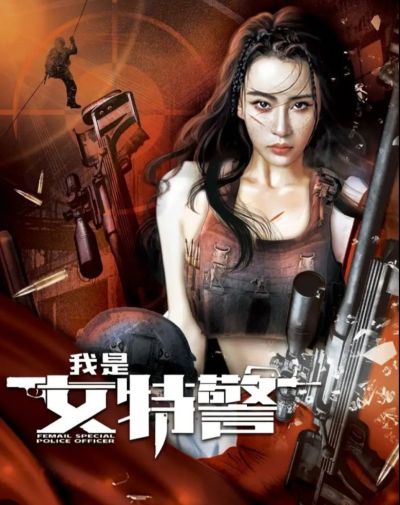
Really, this is so shameless in its appropriation as to be almost adorable. Cop Sheng Nan (Mu) is visiting her other half at a swanky function, when the event is attacked by thieves. Fortunately, when they take over the main room where everyone else is, she’s in the bathroom, and so is able to escape captivity. She is then forced to sneak around, using a combination of stealth and her cop skills to take on the criminals, who have to wait around for a time-locked safe to open. Does any of this sound familiar? If not, perhaps the scene where she drops a dead robber on a car to alert the authorities? Or where she leaps off the roof to avoid an explosion?

Be cautious if looking this up, because there’s another film, made the following year, with an almost identical title – it drops the final R off the title. This makes it seem as if they sit around filing memos and doing light paperwork, but given they’re called the Thunderbolt Women’s Commando Unit, I suspect they do not. There, the enemy is a drug cartel; here, it’s thieves. That all said, I have to deduct points for incredibly lazy script-writing in this. Even before we get to the wholesale lifting of elements from Die Hard, we get another trope so old it can be found carved onto the Pyramids. A hostage rescue, which is actually just a training mission? Never seen that before… [/sarcasm]

However, if the writer needs to be taken to a re-education camp, the execution is surprisingly good, to the point that I enjoyed this more than Cleaner, the considerably larger-budgeted Die Hard knock-off. It’s certainly less pretentious, and has no particular aspirations, beyond an attractive heroine kicking moderate ass. This lack of ambition is laudable, and running only seventy-eight minutes means it has no time for diversions, subplots or social commentary. Not when it has to copy the scene where a frontal assault by police gets explosively repelled (albeit less lethally, perhaps in deference to local cultural mores about killing cops). I may have yelled “The quarterback is toast!” at my television screen.

To be fair, it does become more of its own animal in the second half. The power is cut briefly, allowing two of Sheng Nan’s colleagues in to join her in the building. On the criminal side, things don’t unfold exactly as expected either. Not that anyone here exactly Alan Rickman, and this is probably the area where there’s the biggest gulf separating it from Die Hard. I will say, the finish is also weak sauce, with things just petering out, rather than ending in a satisfactory bang. At least the chief villain didn’t due in a long plummet, with a surprised look on their face. Not a patch on the inspiration, obviously. Yet I’ve seen equally shameless copies which were far less entertaining. 

Dir: Chang Chen
Star: Mu Qi Miya, Cheng Qi Meng, Wei Zi Qian, Mayela Magru 

Sheriff Bride: Rob’s Story, by Joi Copeland

Literary rating: ★★
Kick-butt quotient: ☆☆☆

This is the last (and at 120 pages, slightly the longest) book in the Sheriff Bride series, each installment written by a different author, which my wife Barb and I read together. (She appreciates these books much more than I do.) Here, our focus is on the youngest Hardin sister, Rob (Roberta); and three years have passed since the opening of the first book, so she’s now very close to 18, and probably is 18 by the end of this installment. (In western Texas in the late 1870s or early 80s, she would be viewed as of legitimately marriageable age –and the series title is a clue that this might be a relevant consideration.) While I don’t go so far as to recommend the series to most readers, if you do read it, I recommend doing so in order; you need the understanding of the situation and the characters as these have developed over time in the earlier books in order to properly experience this one.
Joi Copeland is a more prolific author than any of the other three in this tetralogy, and stylistically a somewhat more polished writer, with less of an aversion to pronouns than her colleagues (though there are still places where she under-uses them). This book is also free of editorial issues. Otherwise, its general flavor is pretty consistent with the previous books; plot-wise, it’s distinct from them in two ways. One of these would involve a major spoiler (though the reader learns it fairly early on). The other is that it’s the only one of the four to feature a sustained, multiple-combatant gunfight, with – for this series – a high body count. (It has the highest kick-butt quotient of any of the four books.) However, it has to be said that the author doesn’t handle action scenes very well. With this one, we actually come in on the action only when it’s almost over; then the part we missed is later recounted by a participant, in no great detail. So a lot of the dramatic potential here is simply thrown away. And although the neon lamp wasn’t invented until 1902, when I read the reactions of two characters to each other’s looks in the first chapter, I commented to Barb that we have a flashing neon sign that they’re a couple-to-be. :-)

For me, the main factor that pulled down my rating was the marked implausibility of the plotting, all through the book. Yes, I can see why it’s necessary for Rob to have a new deputy, given that the one in the third book (where we were never even told his name; here we learn that it’s Pedro) had to move to take care of his “ailing” parents. But the misunderstanding surrounding that hire would never have been allowed to occur in real life. Copeland doesn’t explain why Leslie needs the deputy job badly enough for that character’s desperate suggestion to seem realistic. Travel between Waterhole and neighboring Buford, Texas is initially shown to take nearly all day; but it can suddenly be accomplished in vastly fewer hours when the plot needs it to be. Given that all of the Hardin sisters are supposedly very savvy gunfighters, two of them make a ridiculously dumb tactical decision here, and Rob acts at one point with a really amateurish recklessness which even Barb, who’s more inclined to be lenient in judging these books than I am, considered out of character. And though I liked the basic gist of the ending, and though I consider myself an equalitarian feminist, another factor was my feeling that it’s irresponsible for a pregnant woman to insist on being in a physically dangerous situation if it isn’t absolutely necessary.

Ardent fans of Western romance, who like the genre enough not to be too critical, can enjoy this series. But I don’t recommend it to readers who want more accomplished and textured writing.

Author: Joi Copeland
Publisher: Lovely Christian Romance, available from Amazon, both for Kindle and as a printed book.
A version of this review previously appeared on Goodreads.

Dead of Winter

★★★½
“Old, bold and cold.”

Thompson seems to be having a second wind, making her first appearance on this site at the age of sixty-six. That’s a decade more than Liam Neeson was when he became an action star with Taken, and probably makes Thompson the oldest debutante here. This comes on the heels of series Down Cemetery Road which, while not quite qualifying here, certainly was more brisk than expected. At this rate, I might even have to forgive her for throwing shade at Audrey Hepburn. No question about the credentials of Winter for this site, since it plays like a cross between Fargo and Taken. There’s not a lot of fat here, certainly. Things kick off just a few minutes in, and barely stop thereafter.

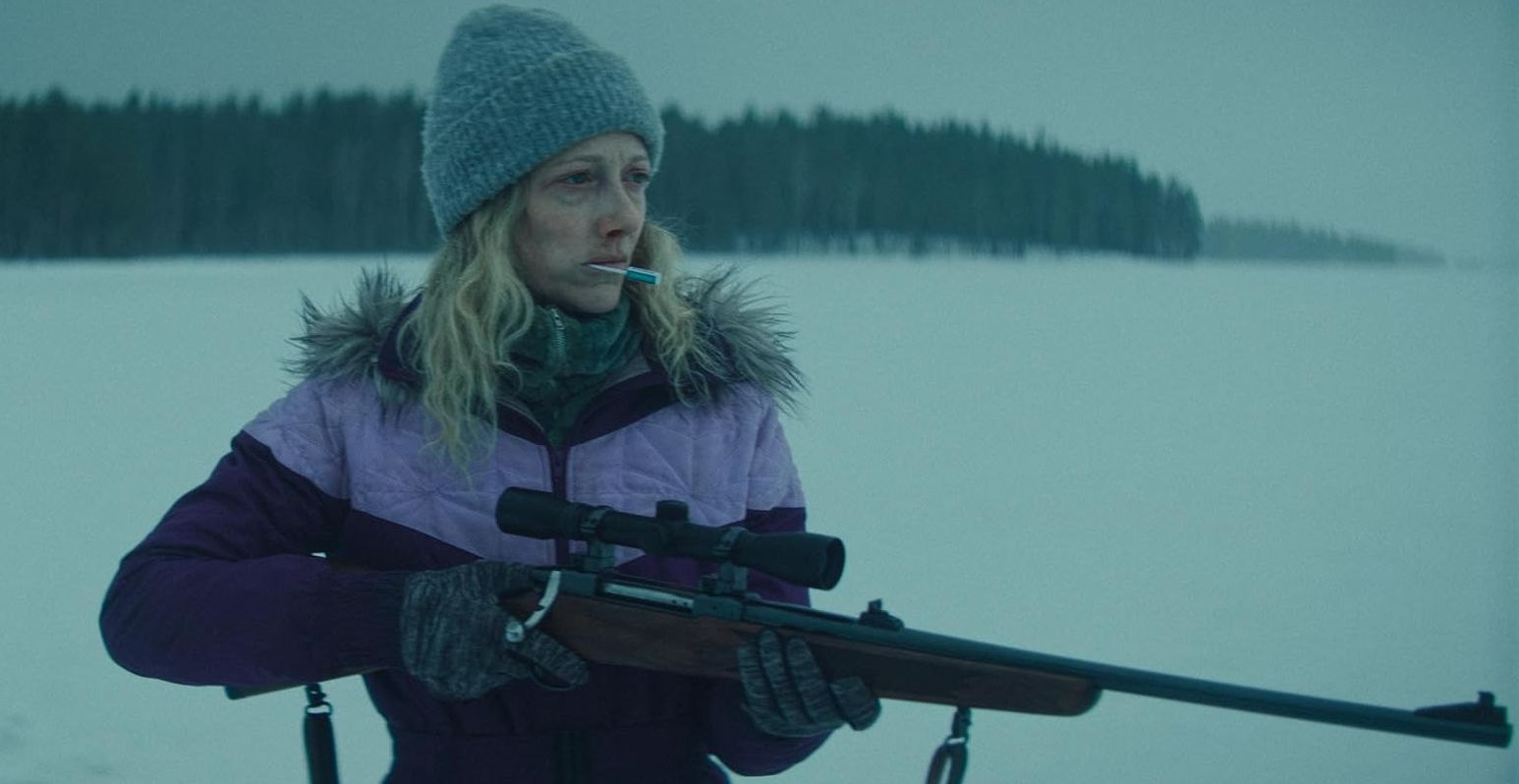
Barb (Thompson) is on the way to a lake in Minnesota – a part played by Finland – for some ice fishing. She gets turned around, and stops at a remote cabin to ask for directions. There she meets an odd man (Menchaca), and notices some blood on the ground. Then, at the lake, she sees the man chasing after and recapturing a young woman (Marsden), so realizes she has stumbled into the middle of a kidnapping plot. After the obligatory “no signal” scene, Barb realizes she is the victim’s only hope. But the man may not be her biggest problem. His wife (Greer) is the real brains behind the operation, very highly motivated, and prepared to go to any lengths to stop Barb from interfering in the grim plan.

I will say, it does take a bit of getting used to, hearing Thompson going full Marge Gunderson, eh? This is no comment on the accuracy of the accent, a topic on which I am not qualified to speak. It’s just odd. However, this is not a particularly dialogue-heavy movie, with Barb spending much of it alone and in the wilderness. We never find out either of the antagonists’ names, incidentally, the end credits just calling them Purple Lady and Camo Jacket. The film focuses increasingly on the two women. Purple has nothing left to lose, generally having the edge in firepower and ruthlessness – as is demonstrated after Barb is able to reach help through a CB radio. But Barb has motivation of her own. 

This comes out in rather clunky flashbacks to the early days of her relationship with her husband. Truth be told, I didn’t feel these added particularly much; the same information could have been provided more efficiently, and in ways which didn’t derail the tension of the current situation. Though I did like how the young Barb is played by Thompson’s real-life daughter, Gaia Wise, I found myself impatient for the film to return to the one-on-one battle, which you know is going to end badly for someone. Or someones. The film doesn’t disappoint there, with a brutal struggle in the middle of a frozen lake, good enough to make me forget the combatants have a combined age of 116. 

Dir: Brian Kirk
Star: Emma Thompson, Judy Greer, Marc Menchaca, Laurel Marsden

Brave Citizen

★★★½
“Bully for you…”

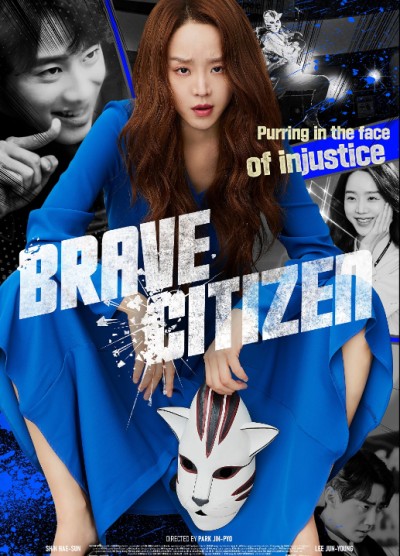
It appears that Korean educational establishments seem to have the same problems as Japanese ones – at least, going by the way they are depicted in the respective country’s movies. I certainly would not want to be a teacher in either country. Here, Mooyoung High has an award-winning anti-bullying policy. It’s a complete fabrication, as both staff and pupils are fully aware. The roost is run by Han Soo-kang (Lee), whose parents hold so much influence, he can do whatever he wants. And what he wants to do is run a reign of terror with his clique. He already drove a substitute teacher to commit suicide, and is now focused on subjecting Go Jin-hyeong (Park J-w) to daily torture.
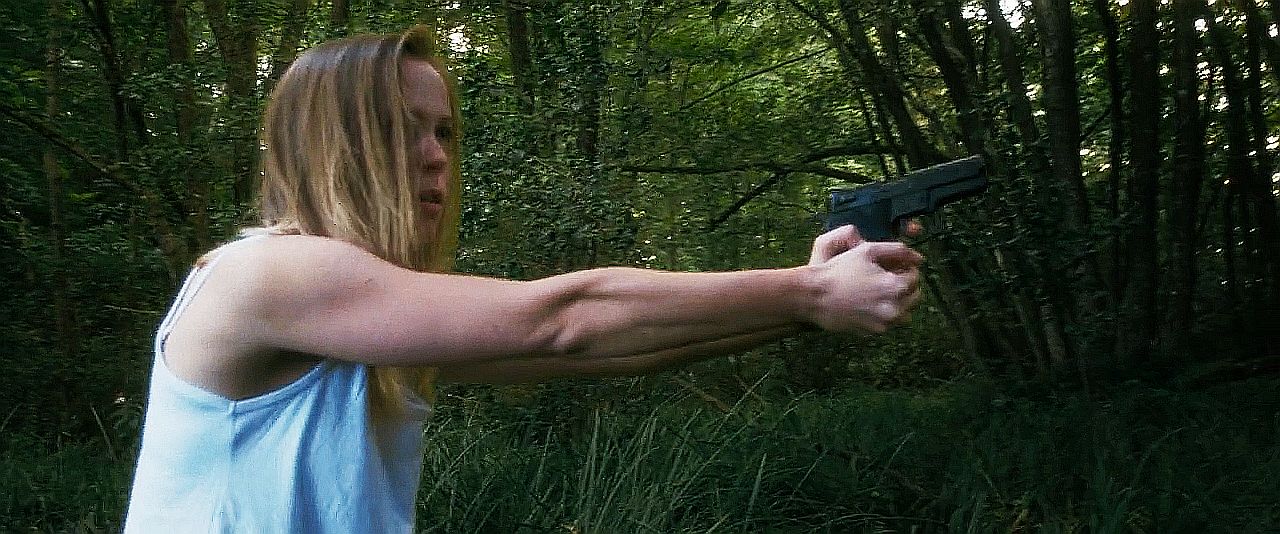
Into the school comes replacement teacher So Si-min (Shin). Initially, she appears meek and submissive, to a fault. But her background is the complete opposite. She’s actually a former boxer, who missed out on an Olympic spot because… of reasons, shall we say, and is also well-versed in a number of other martial arts. When she sees Han brutalizing Go, she steps in, though manages to defuse the situation without violence – at least, initially. Since she wants to become a permanent member of staff, she can’t unleash her skills on the bully openly. So she dons a cat mask, in order to beat Han up. The resulting humiliation drives him mad, and he vows to find and defeat the kitty vigilante, by any means necessary.

There’s a good deal to enjoy here, in particularly the performances by leads Shin and Lee. The former captures a multi-faceted personality in So, who has a strong inclination towards justice, but is aware of the need for restraint – again, at least, initially. I enjoyed how the film is basically romance-free. She has a friend who is a cop. but there’s no indication this is anything but platonic, and the film doesn’t waste any time pretending otherwise. On the other side, Lee makes for an easily hateable villain. Han is entirely aware that he is untouchable by the authorities at the school, and struts about arrogantly, like a psychotic peacock. Right from the first scene, you’ll be very keen for him to get his just deserts. 

It does, probably, take slightly too long to get there. While there’s no romance, the film does tend to stray off into subplots that we could have done without. The main one is So’s strained relationship with her father, dating back to the Olympic try-outs where… yeah, I can’t say that aspect rang particularly true, or added much to proceedings. The action is moderate: the cat mask leaves me wondering how much of it was being done by the lead actress. But even if it wasn’t her, it’s still fairly well-handled. The story develops mostly as expected – if you’re anticipating a final face-off in which her real identity is exposed to the school, you won’t be far wrong. But it doesn’t feel clichéd, and most of the 112 minutes go by more than pleasantly. 

Dir: Park Jin-Pyo
Star: Shin Hye-sun, Lee Jun-Young, Park Jung-woo, Park Hyuk-kwon

Hole

★★★½
“Tree’s a crowd.”

Well, this is unusual. We’ve never had a movie from Slovenia here before, a country I know almost entirely due to art-rock band Laibach. This seems to be barely known either, with a mere 26 votes on the IMDb at the time of writing. But it’s decent, and doesn’t hang about: at 75 minutes, there is not a lot of slack. Indeed, it’s a rare occasion where I would not have minded if this had been 15-20 minutes longer. It is certainly spare in terms of actors, with only three roles of significance. Mia (Cok) and Kevin (Plantan) are a couple of confidence operators, who prey on rich women: Kevin seduces them, and Mia robs them. Their latest mark is Ema (Krhin). 

Things go pear-shaped when Mia believes Kevin is getting too cosy with their target, and in a fit of jealousy, bludgeons Ema to death. To dispose of the body, they drive out into the woods [the only other Slovenian movie I have seen, horror movie Hillbillies, had a similarly rural setting]. However, while they are bickering about who should dig the grave, the corpse escapes, because Ema was merely unconscious, rather than dead. Mia and Kevin begin the hunt, knowing they’d be in real trouble if Ema makes it back to civilization. Kevin makes the ill-advised decision to snort some coke, followed by the consumption of some mushrooms he finds in the woods. That basically marks the end of his role as an active participant in the film. 

Thereafter, it’s the two women facing off, and this is where I would have liked to have seen things extended. It’s clear that both women are seeking to tap into their inner feral nature, and more of it (along the lines of Revenge, perhaps) would have been welcome. Mia and Ema appears to be under the protection of dark and light angels respectively – perhaps representing vengeance and survival? I dunno, I’m just speculating: it’s another angle which might have merited additional explanation. Though what we get in lieu of development is still fun: Mia may be the most foul-mouthed female character of the year, spraying F-bombs about, at a rate which would make Dexter Morgan’s sister blush. 

While the topic is clearly one which would lend itself to horror, events here play out as much in a vein of black comedy. For example, when Ema is wounded, she uses a sanitary pad as an impromptu Band-Aid. Hey, soaking up blood is soaking up blood, am I right? There are other moments which seem almost deliberately surreal, such as Mia hallucinating Kevin having sex with a tree. [Please read that sentence again, because it’s not one I expected to write when I got up this morning] It’s almost as if she was the one who had eaten the magic mushrooms. If there’s a lesson here, that’s probably it: when you go into any Slovenian woods, be sure to bring your own picnic. 

Dir: Dejan Babosek
Star: Lea Cok, Darja Krhin, Marko Plantan
a.k.a. Jama

No trailer I could find, but the clip below shows the final fight. Probably a spoiler :)

Baby Assassins 3

★★★
“Sorry for laughing.”

I am increasingly coming to the conclusion that the Baby Assassins franchise may be some kind of surrealist joke, being played on me by its makers. I really want to love the series and, as with both Part 1 and Part 2, there are moments where I do. At points, I was genuinely considering this as a Top 10 movie I saw this year – not just among GWG movies either. But then, it’ll grind to a halt, with such dedication to being mind-numbingly tedious, that it feels almost like wilful self-sabotage. In reality, I think it’s more likely to be cultural and societal impenetrability. Some elements here are ones which are relatable to a Western audience. Others? Not so much. 

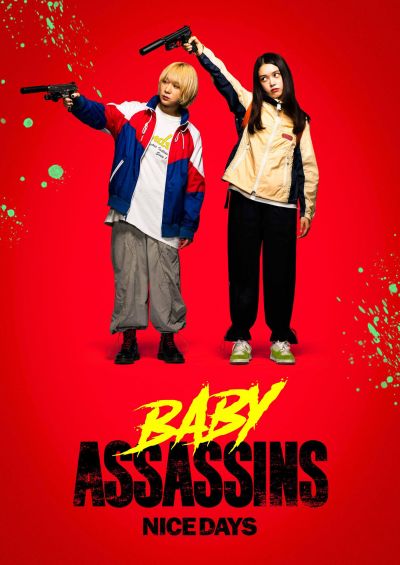
It takes place in Miyazaki, a seaside city in Japan. Our heroines, Chisato (Takaishi) and Mahiro (Izawa) are on a working holiday there. Or a holiday where work keeps interrupting, it’s hard to say. However, their commission becomes an issue, because another, non-guild assassin, Fuyumura (Ikematsu), is also on the job. The guild are unhappy, and order the pair not just to complete the commission, but also eliminate Fuyumura for cutting in on their turf. This will be easier said than done, even with the largely unwelcome help of guild supervisor, Minami (Maeda). She is less than impressed with the Gen Z approach of Chisato and Mahiro, who would rather be in a restaurant eating the renowned local beef. 

As before, it’s the action which really resonated with me, in particular a stunning series of close-quarters battles. And when I say “close”, I mean fights where the combatants are frequently inches from each other. The early sequence where Chisato goes up against Fuyumura is a good example: while there is a gun involved, there’s not enough space between them, for either to point it effectively at their opponent. [This is when I was thinking, potential top ten movie] It’s also notable that, in this installment, most of the sequences involve professional assassins going up against each other in one-on-one, or two-on-one, action, not the mass brawls of previous films. This exchange of quality for quantity is a better opportunity for the participants to show off actual skills.

But the stuff between the fights? Dear lord, this is mostly terrible. And, in a film which runs an entirely unnecessary one hundred and twelve minutes, it’s terrible at near-excruciating length. There are only so many times you can listen to Mahiro worry about forgetting Chisato’s 20th birthday before it becomes a chore, rather than a pleasure. For me, that limit is “once.” Being charitable, this kind of stuff probably plays better to a local audience, or maybe simply one closer to the protagonists’ ages. My tolerance for Gen Z shit is certainly closer to Minami’s, and may be lower still. I’ve no doubt I’ll be waiting for Baby Assassins 4; I just hope the makers decide that joke isn’t funny any more. 

Dir: Yugo Sakamoto
Star: Akari Takaishi, Saori Izawa, Sôsuke Ikematsu, Atsuko Maeda
a.k.a. Baby Assassins: Nice Days

De La Cruz

★★½
“Proverbs 21:15.”

Which, in case you were wondering, is: “When justice is done, it brings joy to the righteous but terror to evildoers.” Though based on this, I would suggest adding “…eventually” to the end. Because you are going to need a lot of patience here. While this is a rape-revenge movie, the sexual assault in question takes almost an hour to show up. Until that point, there are two threads, and you’ll also be waiting for them to connect. By far the less interesting is the teenage soap opera of the pure and innocent Yoli De La Cruz (Diaz), and her friends, the somewhat annoying Daniella, and the immensely irritating Adriana. Boys, parties, etc. You know the score.
The other is rather more intriguing, being the struggle of former MMA fighter, now a cartel hitman, Lobo (Patiño), to leave the criminal life. This comes after a near-religious experience involving Santa Muerte, who is basically the personification of death in Mexican folklore. Meanwhile, Yoli ends up being raped by Victor (Issac GH). The moral here is, you’re clearly far better off being a slut like Adriana, and going with it. Victor is the son of the local police chief, so justice will not be done. However, this is where – after an hour and twenty minutes – the stories join up. Because Lobo turns out to be Daniella’s cousin, and agrees to teach Yoli a very particular set of skills, so she can administer her own vengeance. 

Things definitely improve in the latter stages, not least because Adriana is almost entirely absent. You will need to be extremely patient to get to the good stuff. Lobo holds the film together, and there’s a great scene where he’s talking to Yoli’s father (Gaviria), and explaining why he can’t do anything himself. The way Santa Muerte gets mixed in isn’t bad, though when she rises up behind Yoli before her first bout, it does look like someone cosplaying as the Grim Reaper. There is a reasonable amount of effort put into the heroine’s transition from shrinking violent to avenging angel, though it is a little montage heavy, writer/director Baez being unable to get out of his own way. 

It certainly needs a good half-hour edited out in the early stages, when there is simply far too much faffing around, to use a good old British phrase. There’s also a weird lack of location: while presumably set in Mexico, going by references to cockfighting arenas, etc. there’s a significant amount of English being spoken. It ends in “To be continued…” having opened, one hundred and thirty minutes earlier, with a “Part 1” caption. I had spent much of the previous two hours bracing for a cliffhanger, which mercifully never appears, this being relatively tidy. Would I mind a part two? That depends largely on whether Baez avoids the faffage which dragged the first half here down like an anchor. Lobo and Yoli going 100% vigilante might be of interest though. 

Dir: Michael Baez
Star: Sofia Diaz, Raul Patiño, Noe Issac GH, Fernando Gaviria

Damsel: No More, by P.S. Power

Literary rating: ★½
Kick-butt quotient: ☆☆

It’s rare that I can pin-point so exactly, the moment at which a book jumped the shark. But in this case, I can. I came across a paragraph which was so striking in its badness, I actually put the book down, to ponder what the heck I just read. It did not improve on several repeat attempts, and thereafter, I was simply unable to enjoy the book. Oh, it hadn’t been any great shakes to that point, but it became a genuine chore, and if I did not want to write this warning review, would certainly have become a DNF. Here we go:
Instead, she got out of the car, let Veronica lock up and secure the used towel in the back, in the trunk, which had a change of clothing in it, which the woman grabbed, carrying it with her. Since she still had chemicals all over her, that made sense to see to.

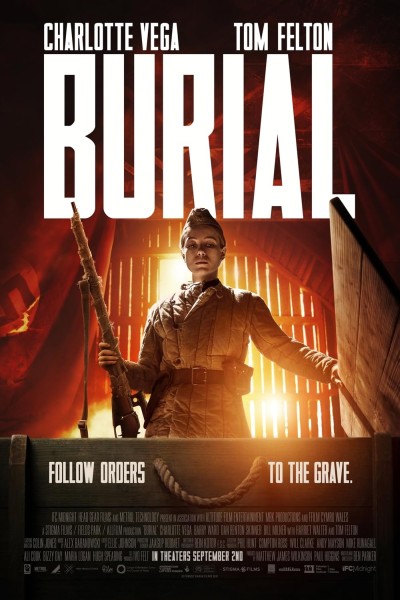
I am not exaggerating when I say that my eleven-year-old self would have been embarrassed to assemble those words in this order in a story. That this book is somehow rated over four stars on Goodreads makes me weep for the literacy of the population at large. The cover is what lured me in. The concept isn’t bad. But the execution is like being trapped inside the head of Kim Kardashian, and I would not wish that on my worst enemy. The heroine is Hannah de Peyser, a rich, vacuous heiress, who has had enough after the fourth time she gets kidnapped. “She might not be a hero, but she isn’t going to be anyone’s victim, not any longer. The damsel is gone, and in her place is a force to be reckoned with.”

Except… not mentioned, is that this is a bad superhero caper, with the world populated by caped crusaders with various powers. Our heroine initially has no such ability, but develops over the course of it, the ability to remote view people. If you’re thinking this could easily be used as a crutch to escape bad writing… No comment. She’s also apparently good at convincing people, including really stupid scenarios, such as that they are coated with an explosive that will blow up if they return to the United States. I feel like I lost measurable IQ points reading that chapter. 

In regard to action, so far, she has spent almost all her time training in VR, with the actual action highlight being her foiling a robbery at a truck stop. There is a lot of space spent discussing thing like a “third gait,” which is apparently a better way of running. I did not sign up for a kinesiology lecture, but apparently some people did: again, four-plus stars on Goodreads. I somehow ground my way through the pages to an underwhelming ending. Do not hold your breath for any more reviews.

Author: P.S. Power
Publisher: Orange Cat Publisher, available through Amazon, both as a paperback and an e-book
Book 1 of 8 in the Damsel series.

Burial

★★★
Werwolfs, not werewolves…”

There’s an interesting idea here, which somewhat works. But it’s perhaps a little too grounded for its own good.  It starts in a London flat, where senior citizen Anna Marshall (Walter) ambushes an intruder, handcuffing him to a radiator. Turns out he’s not just a burglar. He knows about her past, and wants the truth. So she tells him a story… At the very end of World War II, her identity was Brana Brodskaya (Vega). She was one member in a small group of Russian soldiers, who have been given a very important task: transport a box back from Berlin to Moscow. Oh, and bury it every night. Inevitably, their curiosity overcomes them, and the box is opened, to reveal Hitler’s corpse inside. 

Naturally, the remaining German forces are very keen to re-capture the Fuhrer’s body, to preserve the myth of his escape and survival. The group become bogged down in a Polish village, under attack from Nazi Werwolfs. Not, please note, actual werewolves. Though I have to say, that would have been pretty damn cool [I’m a big fan of Dog Soldiers, which does pit British soldiers against actual werewolves] The Werwolfs were resistance forces, left behind by the Nazis behind Allied enemy lines, as they advanced towards Germany. This is fact. As depicted here, they wear animals pelts when they attack, while burning mushrooms and lichen which cause their target to hallucinate. This is… rather less certain, albeit also kinda cool. 

Brodskaya is, clearly, the moral compass of the group, who tries to keep her comrades on task too – neither of which prove easy. When half of them split off seeking the “spoils of war”, she goes after them to stop them from committing war crimes on the civilian population. The locals are just tired of the conflict, and have little patience for either occupiers or liberators, not trusting either side. Parker does a good job of depicting the murkiness of a situation like this, where the lines of morality aren’t as clear-cut as you would initially expect. But the heroine is mission-oriented as well, and when control of the cargo is lost, she leads the charge to recover it, knowing the threat its loss would pose. 

Unfortunately, I found there to be significant issues with pacing, especially in the middle third which seems to contain several too many underlit action scenes in the woods. I’ve read multiple complaints about it being marketed as a horror movie, and certainly, if that’s what you are expecting, you will be severely disappointed. I had no such prejudices and so didn’t mind too much. Though I would have extended the flashback further, since there seems to be a lot of interesting material covered at the end, in a bit of an info-dump by Marshall. Between that and the non-lycanthropic werewolves, this is why I reckon there’s a lot of potential left unexplored here. An excellent concept, let down by only average execution.

Dir: Ben Parker
Star: Charlotte Vega, Tom Felton, Barry Ward, Harriet Walter