




Literary rating: ★★★★½
Kick-butt quotient: ☆☆☆
 Earlier this year, because he knew that I’d greatly liked the two previous Sabel Security novels, my Goodreads friend Seeley James gifted me with the e-book editions of all of the remaining five. This was just an act of friendly generosity, with no actual request for reviews; but I’m glad to treat them as review copies, and (as always) to review them fairly on their merits. This book’s merits earn it very high marks, which came as no surprise to me!
Unlike some series, this one really should be read in order; you need the background of the first two to fully understand the characters and premise, and the previous experiences that shape their situation and relationships. (My reviews of the previous books, also provide background for this review, and a lot of the earlier comments would also apply here.) Here, Pia and her team of veteran agents stumble onto a scheme that clearly involves unethical biological research on natives in the jungles of Borneo. What else it ultimately involves –well, that would be telling, but plumbing the full depth of what’s going on will have our gallant band of heroes/heroines (where gender is concerned, Seeley’s an equal-opportunity writer!) facing danger and death on three different continents, with LOTS of lives, and maybe the future of mankind, at stake. It’s worth noting that, while Pia earns her three-star kick-butt quotient here, we have at least three action-capable ladies among our characters here (one of whom is much more lethal than Pia is), and another one who grows unto the role.
Like the previous book, this one interweaves two narrative strands, one in third person and one in the first-person voice of Sabel Security agent Jacob Stearne. Also like the previous one, its premise builds a fictional narrative on the real-life realities of actual geopolitical problems and a world ruled by elitist corporations and governments that are almost totally devoid of any ethic except self-centered utilitarianism, and in the grip of a hubris that’s willing and eager to play God. (No, we don’t have any concrete evidence that anybody’s planning a scheme like the one depicted here –but at the same time, it’s a pretty plausible guess that there are plenty of people in high places who at least contemplate it, or would if they calculated they could pull it off.) Of the three books I’ve read to date, this one has the most action, with an almost manic pace, and the highest body count. We also have some more revelation of what makes Pia tick psychologically, and a hint of more revelations to come about the murder of her birth parents when she was five years old. (She’s operating to a big extent in vigilante mode here, but for me that’s not necessarily a negative thing; the book will force readers to consider how they feel about that, and my personal opinion of it is that it can be morally justified at times.)
The plotting is complex, and the chapters tend to end on cliffhanger notes, only to switch back and forth between equally precarious narrative strands. Seeley knows a great deal about high-tech surveillance equipment, weaponry, etc., and makes liberal use of what he knows here; but the reader doesn’t have to share that knowledge –we can just accept that things work the way he says they do, and go with the flow. If one had unlimited time to read, this would be a quick read; it took me nearly two months to finish only because I read it irregularly here and there in electronic format. (I’d have blazed through it a lot faster in paper format, and would have read it in one sitting if I could have!) No spoilers, but the ending was particularly good.
My reaction to the read wasn’t without a few quibbles. Although I sometimes got lost in plot details and couldn’t remember a connection, etc., I think that was mostly because of the piecemeal way I had to read the book over a span of weeks, not due to deficiencies in the narration. Mostly, I could follow the action sequences (not always; they’d be clearer in movie format, and this would be a great subject for movie adaptation!). But on at least three occasions, characters with their hands tied behind their backs reverse that by, apparently, jumping backwards through their own arms. I don’t believe this is physically possible, no matter how athletic the person is; and even if it was, I think it would result in two dislocated shoulders. Seeley also tends to forget details from previous books. It was established in the first two books that persons shot with Sabel Security tranquilizer darts need to be injected with an antidote to prevent possible allergic reactions (if I correctly recall the explanation); that requirement disappears here. Jacob specifically mentioned in the previous book that fellow agent Carla was married; here he tells us specifically that he never knew anything about her marital status, and it’s made clear that she’s single.
Bad language is probably within the limits of realism, and there’s no explicit sex (though, Jacob being Jacob, we’re not terribly surprised in the opening scene when he’s rousted out of bed, and is sharing it with a recently-met woman). But the revelation, at one point, of past messed-up sexual escapades and inter-relationships among some of the characters (not Pia) is so off-putting it inspires eye rolling. (However, while I recently dropped another series because I discovered that the author wants us to believe his protagonist really has conversations with animals, I don’t believe Seeley really wants us to believe Jacob has actual conversations only he can hear with the Roman god Mercury. IMO, we should understand this simply as a hallucinogenic coping mechanism when he’s not on his meds, and the “warnings” from that source as really deriving from a sixth sense and highly-keen natural senses and instincts. I could be wrong, though….)
Regardless of quibbles, though, I really liked the book and continue to really like the series. I’m invested in it for the long haul, though It’ll be autumn before I’m able to get to the next book. But I’ll be champing at the bit!
Author: Seeley James
Publisher: Machined Media, available through Amazon, both for Kindle and as a printed book.
A version of this review previously appeared on Goodreads.
 [Warning: this piece will contain significant spoilers for the show. READ ON AT YOUR OWN RISK!] It was always going to be difficult, if not impossible, for the second series of Killing Eve to match the brilliance of the first. That had ended with mousy MI-5 desk jockey Eve (Oh) stabbing ruthless assassin Villanelle (Connor), as they lay on a bed – platonically, but you could cut the sexual tension with a knife. Where would things go from there? The answer, unfortunately, is nowhere particularly much, except for some thoroughly unconvincing plot twists, such as Villanelle going to work for MI-5. Hello? Did everyone forget her cold-blooded murders of agents Bill Pargrave and Frank Haleton in season one? Let’s just pretend she’s one of us, and send her off on a mission without so much as a background check, m’kay?
 After becoming an under-the-radar hit the first time, the second set of episodes seems to have left a lot of people unsatisfied, for a variety of reason. And the ratings reflect this. Having managed the almost unprecedented feat of increasing almost every week the first time round, this season saw fewer viewers for every part after the debut, than the equivalent in series one. Maybe renewing it the day after that opening episode was a mistake? The final scene of this series ends in a mirror image of its predecessor, Villanelle shooting Eve in a fit of pique after she responds to Villanelle’s declaration of love with “You don’t know what that is,” and walks away. Of course, the renewal and critical acclaim basically make it certain Eve isn’t dead. So it’s less a case of “What will happen?”, than “What cheat will the writers use to get out of the corner into which they’ve painted themselves?” I’m going with a bullet-proof vest.
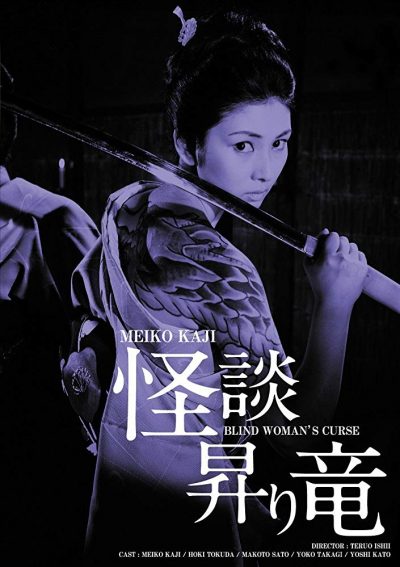 Akemi Tachibana (Kaji) is second in command of her yakuza gang. During a battle with another group, she accidentally blinds Aiko Gouda (Tokuda), the sister of an enemy – an incident Akemi believes leaves her cursed, after a black cat laps up the blood spilled as a result. Following three years in jail, she returns to find the clan on the verge of war against their rivals, the Dobashi group. Various members of the Tachibanas are turning up dead, and with their tattoos flayed off. Turns out that Gouda has joined the Dobashi gang, with the aim of extracting vengeance on the woman who took her sight, even though Akemi has borne the guilt of that event ever since.
 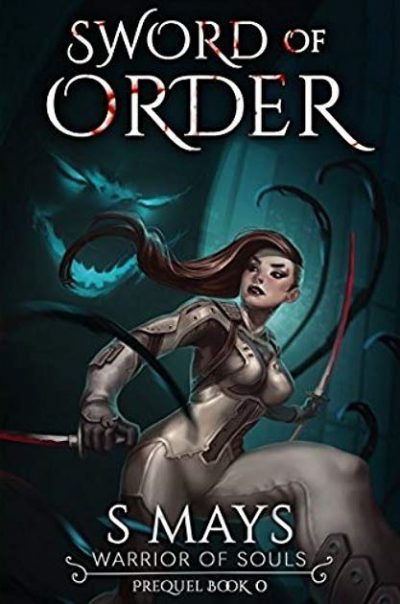 Book 0 in the series? It seems a little odd, as this obviously leads in to the “first” book – Curse of Souls, published in September 2017 – yet Sword came out just three months later. Reading the synopsis, it seems as if Curse may be focused on a different character: college student Sverre Walker, who encounters Jessica Luvkrafft, warrior for the Order of Mankind. Sword is the story of how Jessica became that warrior.
 Cal McTeer (Best) has just got out of prison after serving a 12-year sentence for arson leading to murder, a crime she committed as a teenager. Returning to her home town of Orphelin Bay, she finds her brother, Augie (Jakubenko), now working as a conduit for drugs, with the connivance of at least some local cops, and supplied by the mysterious Adrielle Cuthbert (Pataky). She oversees a commune near town called L’Attente with a zero-tolerance policy for dissent, and uses the proceeds of her narco-aquatics to fund a worldwide search for mysterious fragments of pottery. Turns out she is queen of the Tidelanders: the offspring of humanity and legendary sirens who inhabit the ocean. Though Cal doesn’t know it initially, a near-death experience shows that she is of similar stock. Adrielle doesn’t like the competition. And neither does local gangster Gregori Stolin (Koman), who is intent on muscling in on Augie’s business, and cutting out the middleman, to work directly with Adrielle.
 The elevator pitch version of this sounds like a million other kung-fu films: Shen Ping Hong (Li) seeks revenge on the people who killed her parents and left her crippled. But there’s rather more going on beneath the surface, and shades of grey on both sides. One of her targets, Lord Kao Hung, regrets what happened and wants to help Shen regain the use of her legs. But Shen only agrees to let his son Tien-Ying (Yueh) help, in the belief that it will make her mission of vengeance easier. It feels almost like she’s a mad dog, lashing out at anyone who tries to help; keeping the severed heads of her victims in jars is a clue there. Meanwhile, Kao’s associates – and Tien-Ying’s ex-girlfriend (Chiao) – think he’s helping because he wants to get Shen’s jade sword for his own ends, and are intent on getting their revenge in on her first.
 While this is the sixth installment of the series, because the stories are strictly episodic and not connected to each other, and are set at various times in the 60s, they don’t really have to be read after the first five novels to be understood and appreciated. (It would probably be best to read the first novel first, just to provide a foundation.) In a couple of stories, references are made to events, and characters reappear, which are probably drawn from the novels; but any information about past events that we need to know is supplied. Five of them are written in third person; “I Had a Date with Lady Janet” is unique in that Willie narrates it in first person, which helps to develop his character more deeply. The settings are mostly British or continental European, with one tale taking place in South America. All six adventures involve Modesty in a wide variety of situations, which illustrate various aspects of her personality and abilities; that may explain the collection’s odd title. (Don’t worry –Modesty is not dismembered!)
 “Salamander Four” is the only selection here that indicates Modesty’s openness, on occasion, to uncommitted sex (although there’s no explicit sexual content there, or in any of the stories), but the psychology of it is understandable and she comes across to me as misguided rather than callous and selfish –it’s clear that her intention isn’t knowingly to be hurtful or exploitative. Finally, “The Soo Girl Charity” is the most disturbing of the stories, in that (though without being graphic) it provides a look into the dark reality of the exploitation of women by sexual sadists, and into the even darker reality of what pounded-in cultural brainwashing of females to accept patriarchy and male domination actually does to their psyches. (I didn’t feel that the victim here being Asian indicates racism or cultural stereotyping; I think that simply reflects a reality that, at least in the 60s, traditional rural Asian cultures still tended to promote that kind of brainwashing to a greater degree than Occidental ones –even though the sexism of our culture is bad enough.)
 Outside of Kill Bill, I’ve never been a fan of Quentin Tarantino. But this film did give me some appreciation for him. Because it’s only when you see Tarantino done badly, that you realize the aspects he does well. It undeniably takes some skills to keep a story-line involving multiple sets of characters in the air, especially when centered on a Macguffin like a suitcase whose contents are never revealed. Jackson tries to do exactly the same thing here, and the result is, frankly, a mess, where you’re left caring little or nothing about any of the participants.
 A fine, almost unrecognizable performance by Kidman succeeds in maintaining interest, despite a script which appears to regard time less like an arrow, and more like a big ball of wibbly-wobbly, timey-wimey stuff. Deeply troubled cop Erin Bell (Kidman) wakes up in her car, apparently badly hungover, looking like ten pounds of crap in a five-pound bag. Not far away, her colleagues are poring over a newly-discovered murder scene: a body with a dye-stained hundred-dollar bill on the corpse. And that’s about the last time when I was quite certain of the timeline.
 Maggie (Dragus) just failed the police entry exam in humiliating fashion, and is now taking a course to become a security officer, despite her meek nature. She encounters Tiger (Rumpf), a street punk girl who is everything Maggie is not: brash, confident and perfectly willing to go toe-to-toe with anyone she feels deserves it. The pair strike up an unlikely friendship, with a purloined uniform allowing Tiger to join Maggie in her security work, and in turn engage her increasing fondness for mayhem and violence. Meanwhile, Tiger’s example helps bring Maggie – or ‘Vanilla’, as Tiger calls her in half-mocking endearment – out of her shell. Though Tiger’s drug-dealing friends are less than impressed to find her palling around with a wannabe cop. And as Maggie begins to adopt a more… physical approach to confrontation, it becomes clear that Tiger’s restraint is something Maggie does not possess.