



★★★
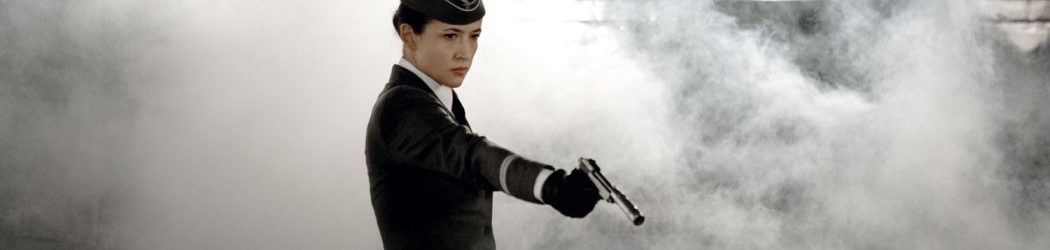
“If you liked the party scene in Ms. 45, you’ll love this…”
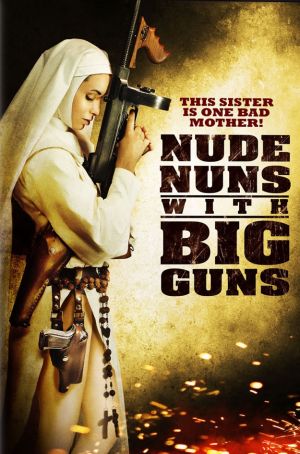 Surely one of the great B-movie exploitation titles of all-time, this inevitably can’t live up to the expectations that generates, though in the early going, it makes a half-decent effort. Certainly, it’s more entertaining than Guzman’s previous Run! Bitch Run!, though it does suffer from some of the same mean-spirited unpleasantness. The heroine is Sister Sarah (Ortega), who has been a long-term victim of the Catholic Church, which is portrayed here as the embodiment of just about every evil imaginable, being neck-deep in drugs, prositution and other equally-dubious activities, with their partners, the Los Muertos biker gang. Finally, Sarah has a vision from God, telling her it’s time to clean house: she starts at the bottom, and works her way up to Chavo (Castro) and Father Carlittos (D’Marco). Along the way, yes, there is no shortage of nude nuns – or other women – though, to be honest, the guns aren’t actually all that big…
Given the title, you have a certain obvious set of expectations. This kind of thing can be enormous fun, as the likes of Machete or Hobo with a Shotgun prove. This doesn’t quite reach the same level of gleeful abandon, and while Ortega holds her own (admittedly in a role that doesn’t require much in terms of emotional breadth), the rest of the cast are acceptable at best, and painfully wooden at worst. After a high-octane and hugely-promising start, the middle section struggles much harder to keep the audience’s attention with anything other than the gratuitous nudity – it’s entirely obvious where things are heading. As in Bitch, the filling here includes some stuff which edges precariously close to rape fantasy, and if you’ve read much of this site, you’ll know that when it comes to rape-revenge movies, I like them to be firmly weighted toward the latter. There’s one particularly dubious and pointless scene of an elderly nun being assaulted, that came close to offending even my broad palate.
However, once the vengeful aspects return to being the focus, rather than Chavo, the film improves again. Though I do feel the villains could have received rather more comeuppance: their fates seem almost trivial, in comparison to what they have dished out over the course of the movie. Ortega does make an impression, and a title like this is, in many ways, entirely review-proof: anyone complaining it is sleazy and tacky, can’t have been paying much attention when they decided to watch it! At least it can’t be accused, like many B-movies, of not delivering on the sleeve’s promise.
Dir: Joseph Guzman
Star: Asun Ortega, David Castro, Aycil Yeltan, Perry D’Marco
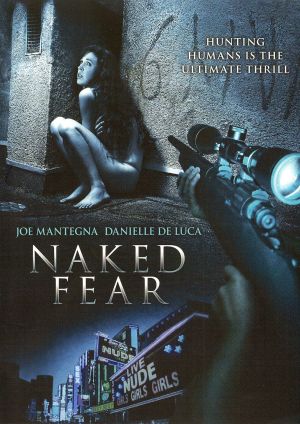 The concept of “hunting humans” has been popular cinematic fodder for over 80 years, since The Most Dangerous Game came out in 1932. This isn’t the first specifically to target women – the Roger Corman produced The Woman Hunt did so in the seventies – but the prey in that needed male help to accomplish much, which isn’t the case here. The heroine is Diana Kelper (DeLuca), whose new dance job turns out not to be quite as expected – she’s more or less coerced into working as a stripper, unable to leave until she pays off the debts to the man who brought her in. The only way to do that is to turn tricks on the side, but her first client is Colin Mandel (Garfield), who is interested in a longer-term relationship. Specifically, one where he can take his female victims into the remote wilderness, where they wake up, unclothed and eventually on the wrong end of a crossbow bolt or bullet. However, with Kelper, he may have bitten off more than he can chew.
 Recent high-school graduate Cassie (Cobb) works at a bank alongside her mother (Quinlan), bickering about the usual things, such as whether to go to college or not. This mundance existence is suddenly interrupted by a robbery: Cassie is stunned to realize the raiders are actually some of her school friends. When they realize this, the girls are forced to take her along, and she discovers the cause of the crime – the father of one (Thomson) has been kidnapped while on business in Mexico. Meanwhile, Mom is tracking down her kidnapped daughter, FBI agent Mendoza (Blasi) is also on the hunt, and one of the girl gang has her own plans for the ill-gotten gains, which doesn’t involve any ransom.
 Great concept: Lilith, Adam’s first wife, condemned to immortality, is now an amnesiac in a minimum-wage job. But when a demon threatens to unleash a plague of biblical proportions on the Earth, she has to be shown her true nature and convinced to hunt down the enemy. Unfortunately, almost every aspect, from exposition through characters to the action and CGI-heavy effects, are awful. Not just bad:
 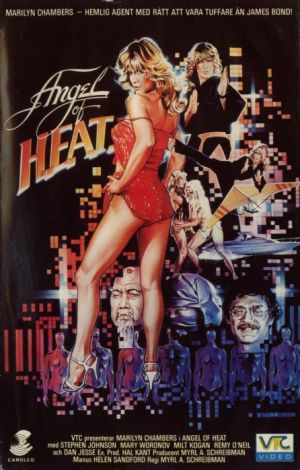 After some hi-tech computer chips go missing, government agents Samantha (Woronov) and Mark (Johnson) are assigned to go undercover at the electronics plant. But also investigating is Angel Harmony (porn star Chambers), with whom Samatha has crossed swords before, and #1 agent one of a group called The Protectors, “international vigilantes, outlaws in the service of peace and freedom” as the introductory title card calls them. Eventually teaming up, they discover the missing chips were only the tip of an iceberg created by a thoroughly-mad scientist (Jesse), who is planning to use high-pitched sound and his army of androids (which have, charitably, been given sex drives!) to take over the world and… Oh, y’know: the usual mad scientist stuff, I guess.
 I don’t watch many silent films: it’s such an entirely different experience, obviously, much less driven by dialogue and more by gestures, leading to a style that can look extremely over-theatrical to the modern viewer. My efforts to enjoy the likes of Nosferatu, for example, have usually ended in my providing an accompaniment of snoring, to be honest. This was much better. Despite a running time of over two hours, this 1916 DeMille epic successfully held my interest, as it told the story of Joan of Arc. The framing device uses the then-contemporary World War I, and an English soldier (Reid) finds Joan’s sword in the trenches, the night before a dangerous mission [Interesting how the English are the enemy in the back-story, but the good guys “now” – at the time of release, America was still several months from entering the war, on the British side]. He then experiences a flashback vision, taking him to medieval France, where he is an English soldier saved by Joan (Farrar) in her milkmaid days. We follow her for the story you know, becoming the inspiration for the French army to defeat the English, before her capture, trial for heresy and – I trust I’m not spoiling this – burning at the stake.
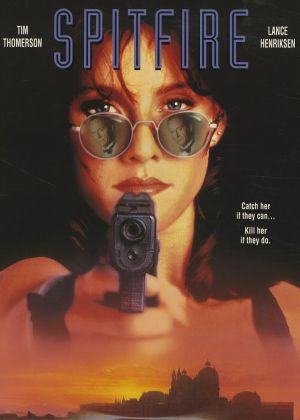 This can only be described as a mess, albeit a crappily entertaining one, with a leading lady in Phillips, who almost made it to the Olympics, being described as “the next Mary-Lou (Retton)”, before trying her hand in low-budget action. She plays an international-level gymnast and martial-arts expert, whose parents are, unknown to her, involved in a plot involving the launch codes for Ukrainian missiles. The mother is killed by villainous Brit, Carla Davis (Douglas – apparently Jenny Agutter was unavailable. Or, more likely, too expensive), who wants to get her claws on the codes for some reason. Hey, she’s a villain: what more does she need? She captures Dad (Henriksen), but not before he has given his daugher the first in a series of clues which will lead her and investigative journalist Rex Beechum (Thomerson), apparently with an unlimited expense account, around the globe from Rome to Kuala Lumpur to Hong Kong and Athens, bumping into various unexpected siblings along the way.
 It has now been almost a quarter-century since GLOW was cancelled in 1990, and there still hasn’t been anything quite like it on television in the Western world: a pro wrestling federation entirely populated by women wrestlers. The brainchild of David McLane, and funded by Pia Zadora’s husband, the owner of the Riviera casino in Las Vegas, GLOW was a marvel of eighties low-budget television, mixing self-effacing comedy (it depicted McLane as having his office in a phone booth) with larger-than-life characters such as Matilda the Hun, and of course, wrestling matches. This documentary tells the story of the federation’s rise and fall – largely through the eyes of the women, as McLane and Matt Cimber, the show’s director, both declined to be formally interviewed (which is a shame, as it would definitely have provided another dimension for the film).
 Kinda odd to see Dickerson – cinematographer on a lot of Spike Lee’s movies, and Eddie Murphy’s Raw – directing this Lifetime original movie. It’s certainly not edgy, though that’s not what Lifetime is exactly about. You largely know what you’re going to get with their output. Something technically decent, usually with decent enough performances, but something that clings to the viewer’s comfort zone like a limpet. Is it wrong to criticize the channel for that, when it has absolutely no interest in pushing the envelope? It’d be a bit like coming down on Disney for making kids movies. It’s what they do: deal with it.
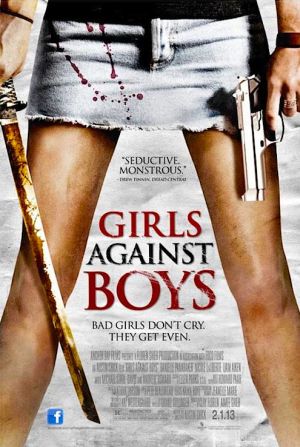 Shae (Panabaker) is not having the best luck with men. Her older boyfriend just dumped her, to try to get back with his wife, and a night where she drinks to forget ends up with her being raped in the stairwell of her apartment building. Fortunately, there to lend a helping hand is Lu (LaLiberte), a barmaid who turns out to have a dark side. A really dark side. As in, when Shae is reporting her rape. Lu takes the desk sergeant to a motel, handcuffs to the bed, sticks a gun into his crotch and pulls the trigger. When the authorities prove about as useful as they usually are in this situation, Lu helps Shae take revenge on the bastard who raped her. Then his friends. Then the ex-boyfriend. But when Shae finds a guy who might actually not be a total douche-bag, Lu is still thoroughly unimpressed.