




★★★★
“The Family That Slays Together, Stays Together…”
 I’ve literally sprinted through from the living-room, where the two-hour season finale has just finished, leaving an aching void in our Sunday evenings that will remain until the third season starts in the fall. It was hard to see how the second series could live up to the first but, with a few relatively minor misgivings, it’s safe to say that the show has.
 Would have to admit that the start was somewhat slow. It was hardly a surprise to discover that most of the characters who were “dead” at the end of the first series made a miraculous comeback in the second. It’s exactly the sort of thing you expect from shows like this, and you wonder why they even bother. Indeed, much of the first half of the series was too predictable, revolving around the can-or-can’t Sydney trust her mother dilemma. No prizes for guessing the right answer there either.
The recovery began when ABC handed Alias the coveted post-Superbowl slot (though once the score in the game reached 34-3, its impact on ratings for Alias became doubtful). Still, it proved a pivotal episode, giving Abrams a chance to reinvent the show, and introduce it to a whole new audience too lazy to change the channel (due to overconsumption of beer and nachos, probably). This was apparent in some rather clunky back-exposition, and also an opening which featured Sydney in two sets of lingerie – a shameless, gratuitous piece of shallow exploitation, clearly designed to appeal to nobody but the gridiron fans. :-) They probably mistook it for another Victoria’ Secret commercial…
Luckily, there was a lot of actual content, too: The CIA moved in to take SD-6 down, and from then on, no longer was Sydney struggling to maintain her secret lives. The show would become a quest for Sloane, trying to stop him before he…well, no-one was quite sure what he was up to, but it never seemed likely to involve puppies and flowers. This episode also marked the start of an increasing body-count with one character murdered and replaced by an evil doppelganger, while later on, two spouses would also bite the dust.
With the Rambaldi story making a welcome reappearance, the season picked up steam, helped by cool guest stars: Rutger Hauer, Danny Trejo & David Carradine (a Buddhist monk!) – we just needed Udo Kier and we’d have been in cult heaven. Apparently lost in the duplicitous double-crossing was the action element, a disappointing facet. For example, not until the last 10 minutes of the two-hour season finale did Sydney get in some serious butt-kicking; we wondered if this was connected with Garner’s apparent weight gain. Too much comfort ice-cream after her recent break-up? Perhaps; though if she’s pregnant, you heard it here first.
 With so many threads too, the story arcs seemed disjointed: in some cases, you’d go for weeks without hearing anything, before an abrupt reappearance. However, a continuing strength was the development of the supporting cast, with Sloane switching from evil mastermind to sympathetic antihero, even within the course of a single episode. Dixon, too, enjoyed a spectacular character arc over the second half, going from committed SD-6 employee to a borderline psychopath, whose obsession with catching Sloane surpassed even Sydney’s.
Our favourite episode of the season had beloved uber-geek Marshall going on a mission to London with Sydney. It combined action, humour, drama and pathos to great effect, ending with one of the best cliffhangers the series has yet managed – admittedly, we speak as big Marshall fans, and look forward to the character receiving a spinoff series. Hey, if it can happen to a mopey vampire, anything’s possible.
Fortunately, the Vaughn/Bristow romantic angle that begin to lurk, iceberg-like, towards the end of season one, has been played subtly enough that we are mostly able to ignore it. More remarkably, the Will/Francie relationship managed to become a genuine plot thread, thanks to a startling twist which raised the hairs on the back of our necks every time they shared a scene. Let’s just say that Francie isn’t the woman she used to be. :-)
Despite ratings that generally remain disappointing – it ranked only 92nd in prime-time shows – Alias was still renewed, a decision for which ABC can only be commended. However, they still seem uncertain about how to promote the show. Here we are, two seasons down, still waiting for the first to arrive on DVD – they could learn a lot from Fox, which got a huge boost to the ratings for the second run of 24 from the first’s availability on disc. [By coincidence, both Alias Season 1, and 24 Season 2 are scheduled for DVD release on September 2nd, 2003]
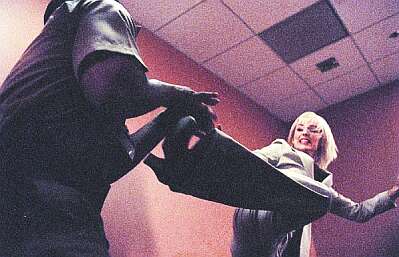 So where do we go in Series 3? We still have the Rambaldi machine; assembly now complete, but expect further machinations as they piece together the instruction manual, and discover they need a 240/110V convertor. :-) It looked for a moment like we would be missing one major character (who finally Got The Point), but sounds like he’s okay. However, the main thread appears to be Sydney, and her efforts to recover from what could simply be the mother of all hangovers – I mean, I sometimes wondered how I got home, but at least I usually woke up on the same continent. Funnily enough, I suspect there might be rather more to her blackout than one too many Babychams. The truth probably lies somewhere between that, and abduction by aliens, but we’ll have to wait until autumn to find out.
Star: Jennifer Garner, Victor Garber, Michael Vartan, Ron Rifkin
 Remind me again: why did I get this? Ah, yes: the DVD blurb. “Sam and her sorority sisters love to get in shape by pumping iron. But when a rival sorority tries to take control of their gym, all hell breaks loose… Sam and her sisters challenge the newcomers to a wrestling match… Will our heroines win back their gym? This is a cat-fighting, knock-down comedy you won’t want to miss.” Wrong in every important respect. The plot
 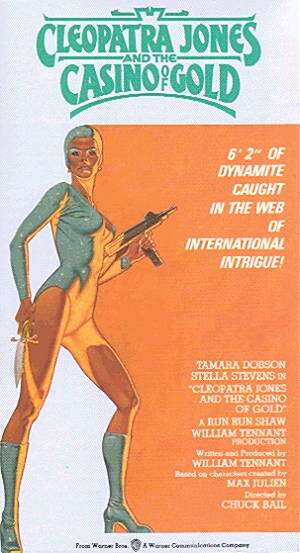 In the 70’s, Shaw Brothers hooked up with Western studios, to various effect, e.g. the inept Dracula and the Seven Golden Vampires, made in conjunction with Hammer. Co-production works rather better here, lending genuine exotic locations, and an endless array of stuntmen, prepared to hurl themselves off things. Jones heads to HK after a couple of her minions are captured by the evil, lesbian, sword-wielding Dragon Lady (Stevens), intent on bringing down the operation, with a little local assistance.
 Though I hope 80’s hair
 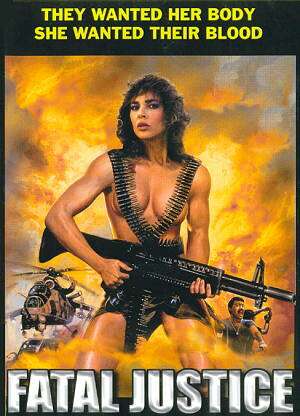 Half a point added for the lurid sleeve, an absolute classic of exploitation, that certainly lurid-ed us (“us?” says Chris – okay, me…) into purchasing, even as I knew it would disappoint. And I was not, er, disappointed in my disappointment. There’s a slight hint of Alias about the plot, in which an agent (Ager) with a penchant for wigs, discovers her father (Estevez) is in the same organization, and that she might not have been working on the side of the angels. It diverges sharply when she is ordered to kill him, along with a training camp for assassins that badly overstays its welcome. [Though it has a decent start, where the would-be hitmen have to cut the patriotic bull and admit they just like killing people.]
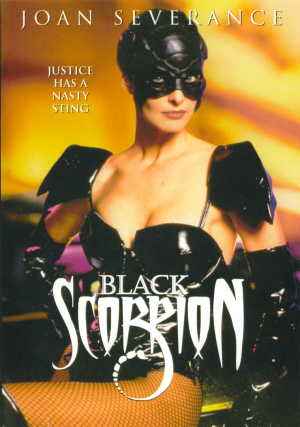 Roger Corman is a man without shame – and that’s in no way intended as an insult. He simply utilises any resource to the best of its ability, as is shown by the
  I used to be a Xena fan; for the first couple of series, I was a die-hard, never missed an episode, bought the merchandise, went to the gatherings, etc. I loved (with one exception) the supporting cast – Joxer, Ares, Autolycus – and still reckon Callisto remains one of the great TV villainesses of all time.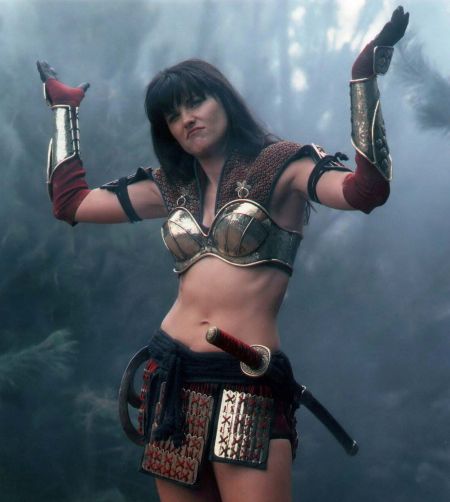
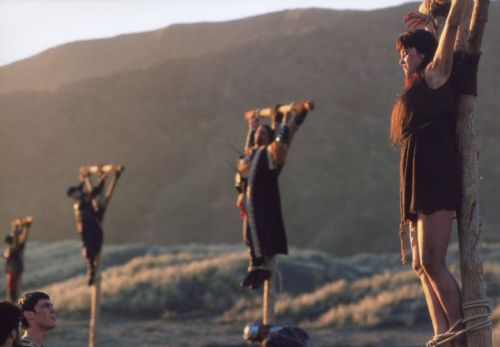 The defining moment of Xena’s sophomore season didn’t take place in any episode. In fact, it didn’t even take place in New Zealand, but thousands of miles away, During a rehearsal for an appearance on The Tonight show with Jay Leno, Lucy Lawless was thrown off a horse after it lost its footing, and broke her pelvis. It’s interesting to compare the reaction of the producers to what the Tapert/Raimi team did when the star of Spartacus, Andy Whitfield, was similarly a victim of severe misfortune, more than a decade later. There, they put the show entirely on hold and opted instead to film a prequel without him.
 In terms of style and approach, the show covers even more ground here than the first time, from absolutely froth to grim darkness. Xena even gets crucified by Julius Caesar in one episode [confusingly, the actor responsible also crops up later, playing Cupid, complete with fluffy wings…]. I’m sure I’m not the only one who found themselves whistling Always Look on the Bright Side of Life, during the scene shown above right. Another unwitting Python reference is the wretched Here She Comss, Miss Amphipolis, a dreadful tale of drag-queen empowerment, featuring perhaps the least convincing female impersonator since John Cleese put on a dress – as on the left, watch that Adam’s apple
 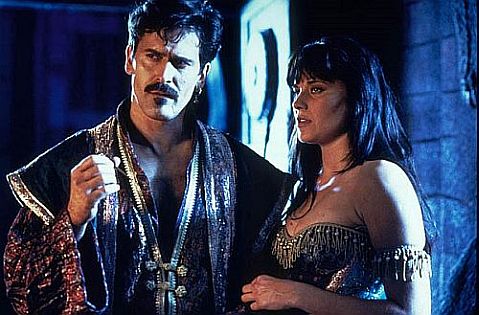 It’s assumed viewers are at least somewhat familiar with Xena’s background, as she is first seen burying her armour in an effort to bury her past. Of course, this is about as successful as it usually is in fiction, and it’s not long before she’s saving villagers, including Gabrielle, from slavery. That includes an aerial battle atop platforms, which is the first sign of the show’s strong influence from Hong Kong action films; it was using wirework, in a way that predated its popular arrival in Hollywood. Similarly, the stunning New Zealand locations foreshadow Lord of the Rings, to the extent that I kept expecting to see hobbits gamboling along in Xena’s wake.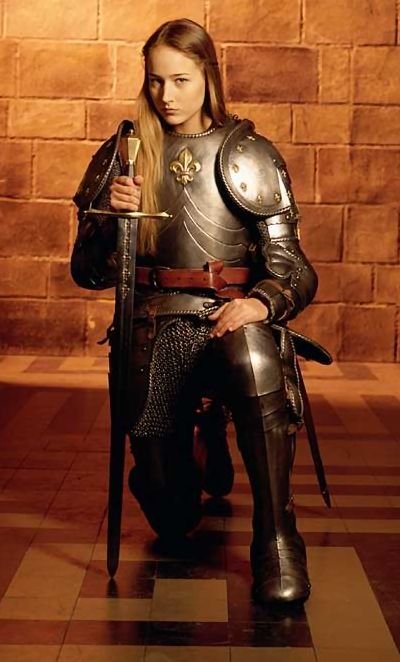
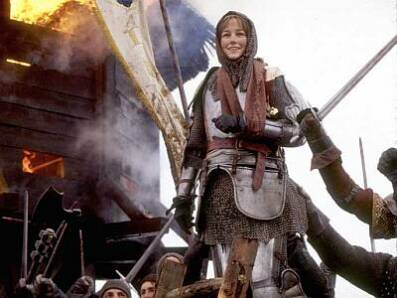 However, the main difference between this and The Messenger is that Joan of Arc is convincing. Perhaps with the advantage of having extra time (the DVD of the miniseries runs 189 minutes), they make the effort to show her interacting with other characters, and Sobieski’s calm, complete assurance is a striking contrast to Jovovich. The viewer can see why people would believe her, and it naturally follows they will too – Sobieski’s Emmy nomination was entirely well-deserved. Despite playing fast and loose with the facts (another example: Joan’s brother was not killed in battle, but lived to see her trial verdict overturned), this strong central performance holds the film together and, with the aid of the other fine actors, makes it eminently watchable. It may not be historically accurate, but it does a fine job of explaining why her myth is still honoured in the third millennium, without coming down in one camp or the other regarding the source of her visions. There are few TV miniseries worth watching, and fewer still worth owning, but this one comes highly recommended.