
Dinosaur Hotel

★½
“Should have gone extinct”

Roughly ten minutes into this, it was clear I’d made a terrible mistake. I’ve seen my share of wretched creature features in my time, and this is down near the bottom of the barrel. It does have an interesting, if totally ludicrous idea. Five women are invited to a remote hotel, to take part in a game-show, competing for a prize of £100,000. Among them is struggling single mother Sienna (Wunna) who, unable to find a baby-sitter, takes her two kids with her. As the cover ever so subtly suggests, the game has carnivorous dinosaurs roaming the hotel and grounds, and “winning” simply means not getting eaten. Naturally, Sienna’s two kids also disobey Mum’s instructions not to leave the room.
There are only two things stopping this from being any good. Unfortunately, those are the budget and a complete lack of film-making ability. Wunna isn’t bad, as the competitor on whom the movie focuses. There were points at which I found myself teetering on the edge of actually giving a damn about her, and the other women are competent enough to pass muster. However, it was a horrendous mistake to have Sienna’s two kids played, it appears, by her two real kids. Professional child actors are bad enough; amateurs like these (“What. Was. That?”)  are completely unwatchable. The Games Master (John) delivers his lines with more emotion, and he’s a robotic eye in the sky.

I suspect the two issues mentioned above interact with each other. By this I mean, the depiction of the dinosaurs is so inept, it hamstrings the director in terms of what he can do. Shot of extinct, hungry reptile. Shot of contestant looking terrified, and probably screaming. Thoroughly unconvincing shot of reptile eating contestant. Rinse. Repeat. There’s no sense of escalation or real development, beyond one of the competitors being a plant. Oops, I’ve spoiled it. Sue me. There’s a (rather unconvincing) gun found at one point, and that might have been an interesting way to develop things, with various “power-ups” being available. The writer couldn’t be bothered, apparently.

Mind you, the same goes for just about every other aspect of the script too, including the logistical one of how no-one has apparently noticed dinosaurs roaming rural England. As a result of this laziness and general incompetence, everything unfolds in utterly predictable fashion. The dinosaurs refuse to eat the children, and the film can’t even be bothered to play by its own rules. It has repeatedly been stressed that as far as winners go, to borrow a line from Highlander, there can be only one. Then, at the end… Nah, never mind. And that’s aside from the question of how the winner is going to get paid after the person running the event has been eaten. Oops, more spoilers. But if you still wish to watch this, after everything I have said above, a) I have failed at my job as a critic, and b) you deserve whatever results.

Dir: Jack Peter Mundy
Star: Chrissie Wunna, Chelsea Greenwood, Alexander John, Ruby Wunna

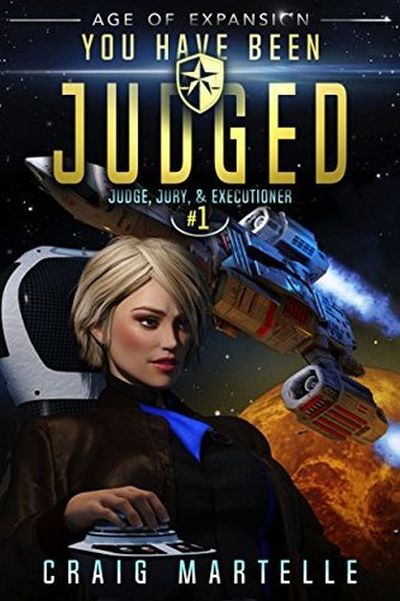
You Have Been Judged, by Craig Martelle and Michael Anderle

Literary rating: ★½
Kick-butt quotient: ☆☆½

This is another entry in the sprawling Kurtherian Gambit universe, which must have well over a hundred books in it, by a slew of different authors. I’m gradually coming to a couple of conclusions: a) it’s a very loosely-tied series, and b) the quality varies. When you give your book a title like this, evoking the spirit of Judge Dredd, you are setting certain expectations. Unfortunately, this is a book which fails to meet them, with a heroine who never achieves the level of intensity necessary to live up to the series title: Judge, Jury, Executioner. It has reached 16 volumes, which suggests either there’s a market for it, or the author has too much time on their hands. No prizes for guessing my opinion.

I guess this is loosely “legal space opera,” with the heroine being Rivka Anoa, a barrister who has the talent to read people’s memories and feelings through simple physical contact. When a criminal she knows is guilty gets released, she can’t control herself and kills him. Arrested, she’s given the Nikita choice. Work for the government as an all-in-one justice system, or pay the price for her homicide. Not exactly a difficult choice, and she is quickly pumped full of nanomachines to enhance her physical abilities, trained in lethal arts by her mentor, Grainger, and sent off across the universe with a bodyguard, Red… to troubleshoot a family squabble.

Yeah, my disappointment was palpable. I get it’s a governor’s family squabble: still, it felt like James Bond being assigned to direct traffic. The other mission in this book, brokering a treaty between two squabbling planets, wasn’t particularly interesting, exciting or a good use of her newly-acquired talents either. Indeed, her original ability, being able to sense emotions and history by touch – something you’d think would make her unstoppable as a member of the legal profession – is hardly ever used. Speaking of which, in terms of law, this is so unconvincing, to the degree it can only be read as childish parody.

With the emphasis there firmly on “childish”. Rivka doesn’t sound at all like a barrister, and even less like a judge. You get absolutely no sense about the moral weightiness of having to hand down capital punishment, and the attempts at witty banter between her and Grainger are flat-out cringe inducing. Do not even get me started on an alien species being vulnerable to being kicked in the crotch. Yeah, we are literally at the “Ow! My Balls!” level of entertainment here, folks. I was quite glad the last 12% of the book was unnecessary filler like the author’s outline, which I could skip entirely. I don’t know how much input Anderle had into this, but I would strongly recommend he exercise a greater degree of quality control over the material which goes out under his imprint. This kind of rubbish leaves me very cautious about buying other Kurtherian Gambit books.

Author: Craig Martelle and Michael Anderle
Publisher: LMBPN Publishing, available through Amazon, both as a paperback and an e-book
Book 1 of 16 in the Judge, Jury, Executioner Book series.

Stolen Future, by Cameron Coral

Literary rating: ★★½
Kick-butt quotient: ☆☆½

A woman wakes up in a bedroom, with no knowledge of where she is, how she got there, or even who she is. Gradually, she (and the reader) find out the answers to at least some of those questions. Her name is Diya, and the bedroom is on Luna, which has now been settled and colonised by humanity. That’s the simple part. The rest? It’s complex. But is summary, she is a cyborg, created as part of a black budget research project by the NeuroDyne Corporation (Earth’s biggest employer – they basically own Iceland). An employee who had moral qualms about the scheme, smuggled Diya off-planet, stashing her with his blind sister Terry and a robot caregiver. But NeuroDyne aren’t letting their investment just walk away. 
It’s a bit of a slow-burn. While there’s no doubt that Diya has been significantly upgraded in a number of areas, her new talents are only gradually revealed. She doesn’t even leave the apartment until about a quarter of the way through, and that’s only briefly, to rescue Terry from some street thugs. The heroine does eventually head off on her own, seeking more information on the streets of Luna, with the help of a memory hacker called Ryken. However, that puts her firmly on NeuroDyne’s radar, who send another cyborg, called a Scyther, to track Diya down and bring her back. It won’t take “No” for an answer, and the company’s power gives their minion an almost unfettered lack of responsibility. 

It feels like Battle Angel Alita is definitely an inspiration, with both having a human-machine hybrid as a heroine, seeking her own identity in a futuristic, urban environment, and starting from a “blank slate”. The world Coral creates is quite detailed, and it’s nice that it is one we discover alongside Diya. This future is clearly one where corporations hold power, though in this volume at least, we only scratch the surface of their influence. That partial nature was, I think, my main complaint. Ending on a cliffhanger is one thing, yet this feels like almost nothing of significance has been resolved. For example, we barely know anything about Newt, the employee who freed her, or why he vanished from the apartment.

To be frank, it’s all a bit less than satisfying. I was left with the impression that the story was just about to get going, when I turned the (virtual) page to see “End of Book 1”. It feels like it wouldn’t be too hard to skip this entirely, start with the second part, and get to the meat of the action. This probably involves Diya realizing her true potential, working out what happened to Newt, and (if my instincts regarding the usual approach in this kind of thing, are in any way accurate) taking the fight to NeuroDyne. I think I am fine just figuring out the rest of the story on my own.

Author: Cameron Coral
Publisher: Independently published, available through Amazon, both as a paperback and an e-book
1 of 3 in the Cyborg Guardian Chronicles series.

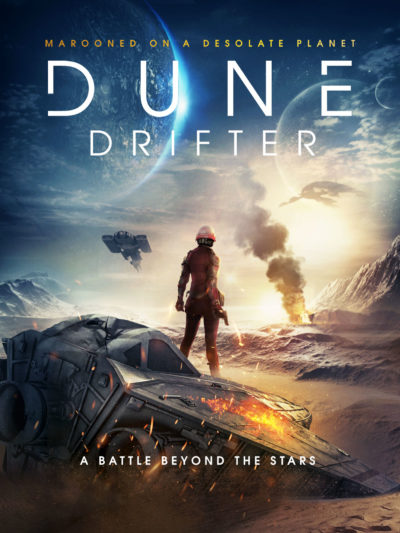
Dune Drifter

★★
“Any similarities are purely coincidental. “

This is likely an admirable effort in terms of its budget. The IMDb estimates it costs $100,000 and it looks like Price squeezed every cent – or, since it’s British, penny – out of that. To give you some idea, also per the IMDb, “Sections of the film were shot during the Covid-19 United Kingdom lockdown with just the occupants of the director’s flat. The director’s girlfriend doubled for any actors and WhatsApp voice notes from cast members were used for any extra lines of dialogue.” This is the kind of thing that can only be respected. Which is why I feel a little bad about having to give this an underwhelming review, because… truth be told, it’s kinda boring. 

It takes place in a future where Earth is at war with an alien race, the Drekk. A platoon of two-man fighter craft are on their way to the planet of Erebus. However, they emerge from hyperspace into the middle of a battle. The ship, crewed by Yaren (Aitkens) and Adler (Sparrow), is damaged and forced to crash land on the planet’s surface. Yaren is badly hurt in the process, and to make matters worse, they are not the only craft which had to make an impromptu descent. There are a number of Drekk present in the area as well, posing an additional problem as Adler tries to attract help and, when that fails, locate the necessary parts to repair her ship and let it take off for home.

This sounds rather more interesting than the reality, which involves a lot of Adler wandering around, talking to herself. She occasionally encounters Drekk – though never more than one, and I’ve a strong suspicion they were all the same actor (Dwyer-Thomas). They’re not particularly alien either, that notion hardly enhanced by the Drekk sporting what look uncannily like army surplus gas-masks. The most effectively unearthly element may be Erebus, whose part is played very impressively by the black rock landscapes of Iceland, where the film spent a week shooting. But I think things take too long to land on the surface. There’s an excessive amount of chit-chat between the ships on the way to their destination, none of which is relevant to the meat of the story. 

Despite its setting on an alien planet, the title isn’t an attempt at a Dune knockoff, unlike the previously reviewed Planet Dune. Indeed, Price regrets using the name, precisely for that reason. Other moments provoke some eye-rolling: the Drekk exhibit stormtrooper like accuracy, while it’s nice to know that future spaceships appear to run on Linux circa 2012, and can use spare parts from craft belonging to alien races. Lacking any sense of escalation, the story doesn’t so much reach a climax as just end. While Sparrow portrays the heroine with a no-nonsense approach, prepared to do whatever is necessary to survive, a good attitude can only take a movie so far. The budget here is less an issue than the script.

Dir: Marc Price
Star: Phoebe Sparrow, Daisy Aitkens, Simon Dwyer-Thomas, Alistair Kirton

Recompense, by Michelle Isenhoff

Literary rating: ★★★½
Kick-butt quotient: ☆☆☆

This is set around fifty years after “the Provocation”, a series of unsolved mass abductions which led to Capernica becoming a strictly-controlled hierarchical society of Uppers, Lowers and the Military. Orphan Jaclyn Holloway is a Lower, living in near poverty in the seaside town known as Settlement 56. The only way out for a Lower is to pass the stringent test which allows entry into the Military. On graduating from the local school, Jaclyn Holloway, known as Jack, narrowly fails to make the grade, but is visited by Willoughby who offers her instead a position in the Axis, a shadowy security organization. It turns out the abductions are starting up again, and Jack has a key role to play in finding who is behind the new wave, and stopping them.

There are chunks of this which are a little too Hunger Games. Most obviously, the authoritarian government and rigid class structure, with the heroine at the bottom. There’s also the (sigh…) love triangle, with Jack increasingly torn between hunky local boy Will, who did pass the Military test, and hunky sophisticate Ethan, her partner in the Axis. Is is just not possible for any YA heroine to remain in one, committed relationship for the duration of a series? Hell, a single volume? That’s the bad news. The good is… well, just about everything else, to be honest.

What I particularly liked was that it’s not the case that Lowers = good and Uppers/Military = bad. It’s easy for this kind of book to settle for simplistic black and white; Isenhoff doesn’t go that route, and it’s the better for it. The motivations of almost all the characters seem legitimate and well thought-out, though as yet, we don’t know much about the real antagonists here. For spoilery reasons, I can’t say a lot, but I imagine they are going to come out of the shadows much more in subsequent volumes. Jack’s ties to them [again, has there ever been an orphan in YA fiction without a dark secret hidden in their past?] weren’t a great surprise, yet help act as a counter-balance to her growing skill-set.

The physical action is quite low in quantity here, not least because the heroine is in training for a good chunk of this book. However, it’s well-handled, and to some extent, the restraint makes the moments that there are, more effective. Particularly notable was towards the end, with Jack scaling a 70-foot high grain elevator to help with a bit of impromptu demolition. Credit is also due to Isenhoff for getting balance right at the end, between tying up loose ends and holding the door open for the next episode. What you get here is fully satisfying, and if you’re not curious what happens next, you’re a tougher critic than I. If I didn’t have forty odd books already in the “to read” pile, I’d likely be interested in seeing where this goes.

Author: Michelle Isenhoff
Publisher: Amazon Digital Services, available through Amazon, both as a paperback and an e-book
1 of 5 in the Recompense series.

Girl Vs. by Xela Culletto

Literary rating: ★★★
Kick-butt quotient: ☆☆☆☆

While a quick read, at 205 pages, after slogging through a couple of what can only be described as “chonkers”, I really didn’t mind. It’s briskly-paced, hits the ground running and largely doesn’t stop thereafter. I have some concerns about where things might go in subsequent volumes, so will probably stop here, just to be safe. However, I enjoyed what I read well enough.

It opens with an alien invasion having taken place, and humanity not getting the best of the subsequent war. The Vela, as the creatures are called, have taken over most cities with brutal force, scattering the surviving population to remote areas. One of these is Rhyan, whom we first meet living in a cave, as part of a small group. She lost the rest of her family to the Vela, and hates them with a passion. Rhyan puts that into effect with her blades, getting rid of any aliens that stray too close to her hide-out. However, circumstance forces her on the road, and she ends up at Springfield, a human stronghold with plans to take the fight to the Vela.

It was only while writing this, that I realized I didn’t actually know much about what the aliens looked like. I know they have claws. But beyond that? Here’s about the only meaningful descriptive passage: “It looked the same as them all—four long legs, bent into a ‘z’, supported the plump abdomen. Rising above that was a middle section from which taut appendages shot forth long serrated claws. The swiveling head, with its unblinking black eyes, was perched on top.” It has to be said, they also die very easily – I lost count of how many a teenage girl took out of the course of the book, with even a dozen being dispatched in one fight – to the point you wonder how they managed to defeat Earth’s armies.

Despite the heroine’s single-minded devotion to the cause, there are suggestions the aliens’ motives may be not as genocidal as they seem, with a theory they were looking to save the Earth from humanity by “thinning the herd.” I did notice the author’s page on Amazon says, “Aliens have always held her fascination, and she hopes to meet one someday,” which makes me wonder if these ones could indeed turn out to be benevolent-ish. To be honest, that’d kinda suck. I much prefer my alien invasions without moral ambiguity.

This is better when it’s not hinting at such things, with a laudable body count on the human side too, and a heroine who is easy to root for, even when some of her acts are morally dubious. There’s hardly a dull moment to be found, as we head to a climax where Rhyan and her colleagues are the only thing stopping a call for alien reinforcements going out. Bit of a helicopter ex machina there, yet I can’t complain about the heroine finally catching a break, after all she has been through to that point.

Author: Xela Culletto
Publisher: Amazon Digital Services, available through Amazon, both as a paperback and an e-book
1 of 2 in the Sinister Skies series.

Shadow Eclipse: Voyage, by E.M. Gale

Literary rating: ★★
Kick-butt quotient: ☆☆

After a brisk and entertaining start, this gets increasingly bogged-down in its own universe as it goes on. And, boy, does it go on. At a thousand pages in the print version, this became a severe slog, and ends in a unsatisfactory way. A second novel seems promised, but this came out in 2019, and has yet to be forthcoming. Maybe the writer got bored of the whole thing too?

As mentioned, it opens promisingly. Florentina Clarke (who hates her first name so much, she insists everyone just calls her Clarke) is having a really bad day. First, she has been turned into a vampire. Then, she and her grad student friends are thrown through time and space when an experiment misfires. They end up two hundred years in the future, on a far-off planet, and have to learn how to come to terms with a whole new way of life. Clarke is best-suited, and ends up getting them passage on a smuggling ship, where helped by her new vampire skills, she becomes part of the mercenaries who defend the ship. However, it turns out her future self – vampires being immortal – is rather famous and/or notorious, and she finds herself having to cope with that, and the resulting threats to her life.

Which all sounds considerably more exciting than it is. There’s a lot, and I mean a lot of agonizing over whether or not to look herself and her pals up in the history books, to see their fates. It’s a painfully responsible approach to time-travel  which really doesn’t do much for the reader. The same goes for her relentless angst about whether or not to tell her friends about her vampiric status. Do or don’t, then move on. Matters aren’t helped by a clunky structure in which it fells like every conversation becomes a three-way dance with Clarke’s internal thoughts chiming in after every single sentence. A long way before the end of the book, I was mentally screaming “STFU!” at her inner monologue.

The action components also seem to decline over the course of the book. There’s a point where the ship – which may not be quite what it initially appears – seems to be under almost constant attack, keeping Clarke and her merc colleagues very busy. However, this fades away and a vampire duel is about all it feels like the second half has to offer. I did like Gale’s world-building, with different races kinda-somewhat getting along, and some thought has clearly gone both into the vampires and the time-travel aspects. However, it’s not clear what Clarke’s eventual place in the universe is going to be, and her friends are also rendered increasingly irrelevant as the story progresses. It ends with her vampire boyfriend getting the chance for revenge he has been seeking, though this felt almost painfully foreshadowed and doesn’t provide much satisfaction in terms of tidying up the threads. Can’t say I’m too bothered whether or not volume 2 ever appears.

Author: E.M. Gale
Publisher: Lightbulb Works, available through Amazon, both as a paperback and an e-book
1 of, uh, 1 in the Shadow Eclipse series.

Claw

★★★
“Jurassic dog park”

Yeah, the scale here is a bit smaller than the Spielberg classic, to put it mildly. As in… there’s precisely one (1) velociraptor. For reasons that are a bit unclear, this is roaming a deserted Wild West attraction on the road to Los Angeles. Heading to LA are wannabe stand-up comic Julia (Walker) and her flamingly gay best friend, Kyle (Rennie). An accident forces them off the road, and with – what a surprise! – no cell signal, they are forced to seek help at the previously mentioned attraction, where Ray (Mede) is the only inhabitant, and is acting a bit odd. Turns out, there’s good reason for this, with a large, carnivorous prehistoric reptile roaming the facility, the work of a mad scientist (Mertz). Will Julia ever make it to Tinseltown?

Clearly, you have to understand that this is a low-budget entity, and not expect the kind of spectacle provided by larger dinosaur movies. That said, if you stick with it – and the 30 minutes it takes for the lizard mayhem to kick in, seems a lot longer – this isn’t without charm. Once it gets going, there is a fairly non-stop degree of energy, and there’s an interesting role reversal to the typical dynamic of couples in these movies. Kyle is the one who spends much of the time cowering in a corner; it may be stereotypical in its portrayal of homosexuality, but not gratingly so, and it allows Julia to become a bit more pro-active than normal.

If she is not exactly Ellen Ripley, to be sure, we are starting from a considerably lower level to begin with, and that does make her a bit more relatable. Most of what she does, is stuff that you or I could do (okay… probably just you. Getting out of bed is a battle, personally!), rather than any kind of superhuman feat. Between the writing and the performances, the film does a good job of making the characters seem like real people, to a better degree than most cheap B-movies. There’s a lengthy coda, after the film basically ends not past the hour mark, with several unnecessary scenes apparently added to reach feature length. It is probably just worth staying around, purely to hear Julia perform her velociraptor-themed stand-up routine.

The dinosaur is mostly CGI, and is integrated adequately enough into proceedings, though its actual interaction with any physical people or things, is limited to put it mildly. On the other hand, it manages to avoid the frequent pitfall of movies shot at night, where most of the action here takes place. You can actually tell what’s happening, without straining your eyes to peer into an underlit darkness. This positive is less common than you might think. Again, I cannot stress enough that it offers small-scale carnage, at best. However, I was still entertained more than I expected, and was left willing to give this the benefit, of the more than considerable doubts I had going in.

Dir: Gerald Rascionato
Star: Chynna Walker, Richard Rennie, Mel Mede, Ken Mertz

The New Prometheus, by Andrew Dobell

Literary rating: ★★★
Kick-butt quotient: ☆☆☆½

The setting is a dystopian version of London, which has become separated into two distinct halves, and classes of residents. It’s a world in which cybernetic enhancements are common. But they come at the cost of a debt – sometimes, virtual enslavement – to the powerful corporations who supply and maintain them. Frankie has resisted these, preferring to retain her humanity, and journeys into the dangerous undercity, to help those less fortunate. But on one such trip, she’s shot and left for dead. Rescued by the renegade Doctor Xenox, she wakes to find herself in a new, artificial and highly-powered body. She’s not too happy about it. Things get worse, for the doctor’s erstwhile corporate employers,  Psytech, consider Frankie v2.0 as their property, and will stop at nothing to get her under control. As a result, with the help of the Doctor, and cop Gibson, she has to fend off the assembled forces of Psytech.

From the title and the lead character’s name, I was expecting more of a Frankenstein theme, but that appears mostly a surface patina. A bigger influence – and this is openly acknowledged in the blurb – would be the likes of Battle Angel Alita, with its young heroine seeking her own identity and self-determination, after having the “benefits” of technology imposed on her. Though the adjustment to her new form is super easy – barely an inconvenience – to the point that I’d be leaving a five-star review on Amazon for the cybernetic implants, and maybe even signing up for that extended warranty. Indeed, there’s disappointingly little internal conflict at all, and that’s where it differs from the various cyberpunk heroines cited as inspiration. Towards the end, there’s a sequence where Psytech hacks its own customers, turning them into meat puppets they can use against Frankie and her allies. Having something like this attempted against her would have helped negate the strong sense she’s over-powered. She largely breezes through her various conflicts, with little if any credible sense of threat to her.

Against this, the world building is pretty good – though, again, the separation into over- and under-class bears more than a slight resemblance to Alita. The concept of “Neo-London”, however, is a nice riff on Akira‘s post-nuclear Neo-Tokyo. I’d liked to have heard more about how it operated, and exactly how the corporations became so seemingly all-powerful. Maybe some more British flavour, too? Although, on the other hand, the ability of one young woman to stand against and defeat everything they throw at her does defuse Psytech’s omnipotence. It does escalate nicely, to a grandstand and action-packed finale after Psytech take over Gibson’s police station. and Dobell does a good job of balancing the need to wrap things up, with opening the door to further volumes. If there’s not an enormous amount new here, and little depth either (it’s not exactly Ghost in the Shell), it’s still well-enough executed to be an adequately entertaining read.

Author: Andrew Dobell
Publisher: Amazon Digital Services, available through Amazon, both as a paperback and an e-book
1 of 4 in the New Prometheus series.

Astrid’s War: Attack on the USS Valley Forge, by Alan Householder

Literary rating: ★★½
Kick-butt quotient: ☆☆☆☆

It’s the year 2369, and Astrid Amundsen is an officer in training, in her fourth year at the Annapolis Naval Academy [we’re talking space navy, obviously]. As part of her education, she and four other recruits are assigned as midshipmen on the USS Valley Forge, for what is supposed to be a calm and untroubled mission, twelve light years from Earth. Except, where would the fun, from a literary point of view, be in that? So, it’s not long before the severely out-numbered and out-gunned training ship finds itself under attack by an enemy fleet of Kerleegan craft. Not helping matters, Captain Jefferson appears to be cracking under the strain and making curious decisions. Should Astrid follow orders, even if she honestly feels they imperil the ship? Or should she side with the cadre of officers and their… Well, “mutiny” is such an ugly word.

I certainly can’t argue with the pace of this. It’s very much one peril after another, as Astrid and her allies have to fend off attack craft, boarding attempts and even figure out what to do with an enemy nuclear weapon which has been welded to the floor of the Valley Forge. There’s no doubt it’s a non-stop procession of problems for Astrid to handle, and her cool approach to coming up with solutions is an impressive characteristic. The main problem for me, was the lack of much context here. It would have been useful to have known, for example, how this war against the Kerleegans started, and what it was over. About all we get is, “They seemed to be one of those spacefaring nations, that loves to roam about the galaxy demonstrating what they perceived to be their ascendancy over all other sentient life.” Hmm, seems not unlike what we see of humanity on Earth.

So there’s no real motivation provided for Astrid’s decision to join the Navy (she apparently wants to join the Marines after graduation), and the battle seems to be largely “because they’re rare.” While self-defense and survival are legitimate reasons for most of Astrid and her colleague’s actions, there doesn’t appear to be any kind of Geneva Convention in space, with summary execution of wounded opponents the norm, which I found a bit jarring. The other main issue I had is, the way everyone up to and including the Captain, seems to be very considerate of, indeed almost deferential to, Astrid’s opinion, and she gets a lot of leeway in terms of independent action. Surely – and I speak as someone with no military experience – she’s little more than a raw recruit? She surely would be taking orders, not giving them? All told, to put the flaws of this book in movie terms, Householder appears to be a better action choreographer than a scriptwriter or a director. More work needed on the latter elements, I feel.

Author: Alan Householder
Publisher: None listed, but available through Amazon, both as a paperback and an e-book
1 of 4 in the Astrid Amundsen Military Science Fiction series.