




★★★½
“Could do with some more action, yet still more than acceptable.”
 The double-pilot. Probably deserving of a place on the FAQ is, “Why don’t you include Sarah Connor?” The reason is simply that she was a supporting character in the first two Terminator films; one essential to the plot, that’s for sure, but clearly over-shadowed by her male counterparts in both movies. The TV series finally moves Connor (Headey) front and center, and also adds an additional action-heroine dimension, in the shape of Cameron Phillips (Glau), a schoolmate of John Connor’s who turns out to be a new model of Terminator, sent back to watch over him. The show starts in 1999, a couple of years after the events of Terminator 2, but soon shifts to the present day; it thus largely ignores the timeline of Terminator 3, in which Sarah Connor was reported to have died of leukemia in 1997.
The concept, as explored in the first two episodes, is very familiar: Sarah must protect son John (Dekker), so he can lead the human resistance after Skynet declares war on us. Skynet sends its unstoppable robotic henchmen back in time to take him out, but she also has an unstoppable robot of her own – this Terminator is more advanced than Arnie’s, being capable of ingesting food. However, there is further development, with the interesting idea that the future John Connor has sent back other humans, to provide a support network for Sarah in her struggle. It is only brushed against in the opening two hours, but may be developed in further episodes. There is also an FBI agent (Jones), who has been hunting Connor since her escape from the mental asylum, and her former fiancee, on whom Sarah bailed.
Glau and Headey both have action experience, from their roles in Serenity and 300 respectively, and they bring the necessary resilience to the role. Glau has a balletic grace and flexibility which helps make up for her obvious lack of size, and while there is clearly some body-doubling done, it’s mostly well-handled and the editing of the fight sequences is above-average. We also liked the deadpan portrayal she brings to the role. Headey does not yet exhibit the ferocious passion which Hamilton brought to her role, so that’s something we want to see develop, and we also hope they do not get bogged down and become a ‘Terminator of the Week’ show. It seems that time-travel may be a significant part of the story, and this would open up an almost infinite range of possibilities. This was a solid, entertaining opening, and fingers crossed the rest of the series can build on the potential.
 The rest of the series If there’s an unfinished feel to the show, that would be because it was. Thanks to the writer’s strike, the final four episodes never made it to the screen, and the storylines will be incorporated into the upcoming second series, confirmed by Fox in April. While not perhaps the makers’ fault, it undeniably had an effect, basically leaving us to turn to each other at the end [which involved a car-bomb] and go, “Is that it?” The rest of the series, however, wasn’t so terrible, though it did feel somewhat stretched. The main plot threads were extensions of the pilot: a) the Connors trying to stop Skynet from becoming active, in particular through locating a chess computer called The Turk, and b) evil Terminator Cromartie trying to stop them. There’s also c) an FBI agent (Jones) who is trying to piece together the pieces, trailing both parties, and d) the arrival of Derek Reese, the brother of Kyle and therefore John Connor’s uncle.
The extra time available to a TV series does allow for expansion, perhaps most notably that Skynet does more to try and affect the past than just send back Terminators – it is supposed to be a super-intelligent system after all. On the other hand, the action elements are significantly reined back, perhaps in association with budget restrictions. However, I particularly liked the SWAT assault on Cromartie in the final episode, set to Johnny Cash’s The Man Comes Around, which I’ve loved since they used it in the opening to the Dawn of the Dead remake. Needless to say, that goes about as well for the SWAT team as you might expect. Glau is particularly good, with her character actually developing in unexpected ways, such as discovering a taste for ballet.
However, there has been a fair bit of sniping regarding Headey, comparing her physical presence unfavourably (the word “weedy” gets used a good deal) with Linda Hamilton’s. Said one such critic: “There are two issues here: having a toothpick-thin, feeble-looking Sarah Connor is a crime against the iconography of the character; and presenting a clearly emaciated actress as a heroine is a crime against women.” Headey’s response was blunt and to the point: “It’s a TV show, for God’s sake!” – and I’m inclined to agree. We’re dealing with a series about time-travelling robots here, folks. If you seek role models for your body here, there’s probably no hope for you. Here’s to the second series, especially if there’s more ass-kicking from Headey and Glau.
Dir: David Nutter and others
Star: Lena Headey, Thomas Dekker, Summer Glau, Richard T. Jones

 It’s been at least a decade since I read this – probably more – but it is still a thoroughly-enjoyable read, and a major improvement in just about every way (plotting, art, pacing, imagination and characterization) over the first stab. Of particular note is the solid way in which the two separate threads of the story are woven together. While on holiday, Kei and Yuri bump into Shasti, a former colleague of theirs in the WWWA. She was actually an android, who went rogue after a criminal’s personality was implanted into her, part of a (failed) experiment to see if it would help with his capture to have her think like him. She’s now apparently leading a group of “freedom fighters” who are planning to hijack a luxurious space-liner, crammed with VIPs and new technology. Has Shasti gone all political? Or, if not, what is she up to?
 Let me be perfectly clear: one of the above stars is purely for entertainment value, since this is one of those movies which is so bad as to become enjoyable, purely on that level. There is hardly an aspect of this film which is not badly-executed: the script is badly thought-out, the performances are almost without exception woeful, and the continuity has to be among the worst of all time. One actress goes from a colored top and no bra, to a bra, to a white top and no bra, in successive scenes, while another enters a pool in a bikini, comes out topless, and five second later has the top back on and is dry. We laughed like drains, I tell you. Oh, you want the plot? Mousy scientist Helen (Kitchen) is trying to find a brain chemical that will unleash humanity’s psychic powers, using imprisoned serial-killer Horn (Marks) as her source. Even though the resulting chemical is green and glowing, in a way not seen since Re-Animator, she decides to test it on herself. This unleashes her alter-ego, Cassandra, who embarks on a plot to enslave mankind to her will. It’s up to her assistant Gary (Klitzner), along with a homicide detective (Rivers) to stop her.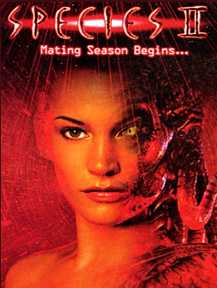
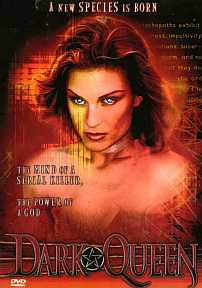 It should be entirely clear which series the distributors of Dark Queen are hoping you’ll mistake their film for an entry in. In reality, this is not fit to lick Natasha Henstridge’s boots; it’s really much closer to Dr. Jekyll and Sister Hyde, yet as such, is still a dismal failure – that whirring sound you hear is Robert Louis Stevenson spinning in his grave. However, even as it fails on just about every cinematic level, fans of bad cinema may find this has its merits. However, even there, it may still divide opinions: I had rather more fun with this than Chris [she, on the other hand, liked the midget-vampire movie, Ankle Biters, which I found almost unwatchable]. You can certainly sense where they were aiming with this; however, the execution is, frankly, so awful as to drain any potential from it, almost entirely.
 If you thought the novel was a quick read, I got through Biohazards during lunch, and that’s only with 30 minutes. Still, being a comic-book, we must cut it some slack, though I can’t say I find action (and there’s a
 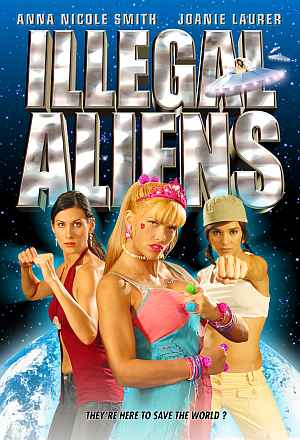 Okay, her swansong won’t be up there with James Dean’s or Bruce Lee’s, but this does at least sense its own idiocy, rendering the movie somewhat bullet-proof, critically speaking. It’s supposed to be dumb, wildly implausible and hideously over-acted. So condemning it for these flaws is complaining because your hotdog tastes of meat. A trio of shape-shifting aliens land on Earth to protect it from the scum of the universe. Thanks to their first encounter with our culture coming in the shape of a porno mag, they opt for the form of attractive women. Two end up getting jobs as FX/stunt people in Hollywood – a sadly underexplored angle – while the third is…Anna Nicole Smith. Then their nemesis (Laurer, the actress formerly known as Chyna) turns up, taking over the body of a mobster’s wife, and prepares to bring about the end of the world. Can she be stopped?
 There’s no doubt this film is, if not cashing in on her death, certainly shrugging its shoulders and taking advantage of an unfortunate situation. I don’t really blame them for that, even if anyone looking for skin will be wasting their time here. In sharp contrast to her previous, ah, body of work, AN’s clothes remain on; as exploitation goes, this is tame and restrained. And that may be the main problem: a failure by the makers to decide which way to go. SF/action or all-out comedy? There’s enough of each to suggest, with greater commitment, either might have worked better. Instead, it comes off as somewhat lukewarm – can’t say we were ever bored, yet I can’t say I was ever more than mildly amused.
 Why let Kei and Yuri blow up one case, when you can save time by giving them two at once? That’s what happens at the start of this, as the WWWA computer assigns them two, apparently unrelated, assignments in the same galactic sector: one is to investigate a spaceship which blew up, and the other involves the disappearance of a scientist and his family. You will not be surprised to hear that these two cases are interconnected, though it does appear to come as a shock to the participants here. Once they reach their destination, it soon becomes clear that someone is out to stop Kei and Yuri – “someone serious,” to steal a line from Leon. Can they uncover the conspiracy before it uncovers them?
 If you’re going to start with Kei and Yuri, this is as good a spot as any; it may not be the first entry in the series, but requires no prior knowledge at all. Even complete novices will be up to speed by the pre-credit sequence, which sees them – oops! – destroying an entire space-station after they decide to pursue the bad guy, rather than handling the explosive suitcase with which he has tried to distract them. They’re then sent to investigate some strange happenings on a mining planet, which is being plagued by attacks from monsters. They discover that the creatures are the results of failed experiments by Dr. Wattsman, who has plans to force nature’s hand, by making the next evolutionary step beyond mankind. Meanwhile, gentlemen thief Carson D. Carson is there, for his own reasons.
 While in English, this came out in Japan, since it was part of a series of translations of popular works, intended as an aid for people learning the language. As a result, the book comes with translation notes at the back explaining, for example, what the phrase “We’re encased in a transparent sheathing of ultrathin reinforced polymer” means. Though I note the word “lesbian” is, apparently, deemed unworthy of further translation. It’s a swift read; discounting the notes, barely 125 pages long, and they’re not large pages either – a lunch-hour might suffice, if your boss gave you a few minutes grace.