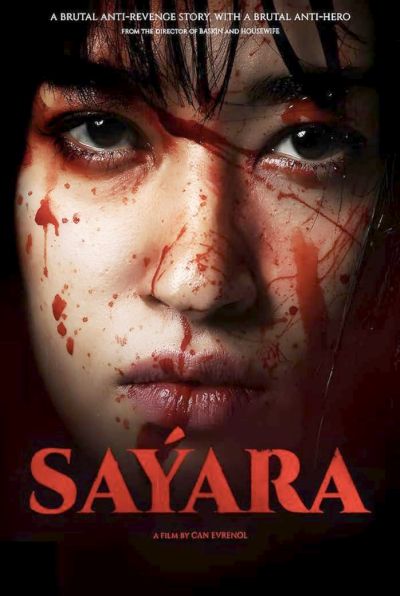
Well, “delight” might not quite be the right word. But who am I to let facts get in the way of a good review tagline? It’s more of a Turkish nightmare, probably the most brutal rape-revenge movie I’ve seen since… Well, probably Revenge. The director is best-known for Baskin, generally considered the best horror movie from Turkey. Though, full disclosure, I wasn’t that impressed by it: strong on atmosphere, but short on a coherent storyline. That’s not an accusation which can be levelled at this. However, the level of savagery and bloodshed arguably puts this into the horror genre as well. It’s the story of two Turkmenistan sisters, Sayara (Kocabiyik) and Yonca (Kosar), both of whom are involved, in different ways, with gym owner Bariş Ataberk (Kizilirmak).
Yonca is having an affair with the married man. But she has been able to leverage this into getting a job at the facility, as a cleaner, for the much quieter Sayara. Bariş offers Sayara a job as a trainer, teaching female clients self-defense, knowing of her skills in this area, but she declines. Worse follows, when Yonca catches Bariş cheating, and threatens to reveal all to his wife. This does not go down well, and ends in Yonca’s death, which is called a suicide officially. It helps that Bariş’s father, Halil Ataberk (Inal), is a senator with a lot of political pull, and can ensure no action is taken against his son.
No official action, anyway. While Sayara may have seemed the quiet and meek sister, we see in flashbacks the relationship she had with her soldier father – now, notably absent. One senses a lot of darkness there. Indeed, he tells his daughter. “I committed many great sins. It doesn’t matter. The darkness in me, is in you too, Sayara. But if someone crosses that line – to you, or your mother, or to your sister – you will go all the way, without blinking. You will go to the bottom of that darkness.” And Sayara does. Boy, does she. Not just against Bariş, but all those involved, even tangentially, and using every weapon at her disposal, from fire to her teeth. The latter provides the film’s most horrific scene.
This establishes its direction early. The first spoken line is “Son of a whore!” and it’s something of a mix of social complaints thereafter. Class, nationality and gender all come into play here in the power dynamics. Though it’s not as one-side as it might seem: Yonca is hardly blameless, and seems to have a fondness for S&M games, as well as no respect for the sanctity of marriage. However, “blurred lines” hardly excuse what happens to her subsequently, and you’ll be firmly behind Sayara on her relentless quest for the bottom of that darkness. You may not find the ending fully satisfying, in the traditional sense. But I’m hard-pushed to deny it’s appropriate, and you will certainly remember it.
This was certainly not what I expected. That, in itself, would not have been a problem – I’m quite used to, and indeed do not mind, films which confound my preconceptions. I respect what this is attempting to do as well, which is a different take on the revenge movie. The problem here is fumbled execution: more on the directorial, writing and technical fronts, though in some of the performances too. Even allowing for the obviously limited resources this had to play with, by the end, it was definitely a struggle to get through, with a lack of narrative thrust in particular, meaning it failed to hold my attention. That’s a bit of a shame. Only a bit, mind you.
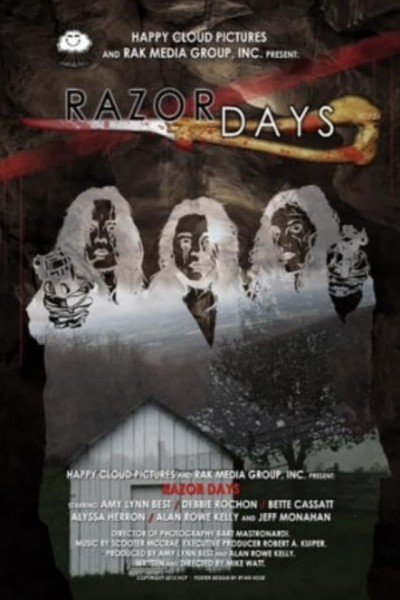
There are three central characters here: Anita (Best), Jessamay (Rochon) and Rena (Monahan). Two of them have severe cases of post-traumatic stress disorder, resulting from their kidnapping and savage treatment at the hands of a rural family, the Logans, who may have cannibalistic tendencies. Jessamay, in particular, suffered brutally, losing an eye and being left with a badly-scarred face. Rena, meanwhile, has largely retired from society. But with the reluctant help of Anita, Jessamay tracks her down and convinces Rena to join them as they head to the Logan farm. As Jessamay puts it, “Time to tell God that he can’t fuck with us and not have any repercussions.” But this does not exactly have the healing consequences for which the trio were hoping.
And that’s the point: revenge is not clean or cathartic. Indeed, part of the message here seems to be that it can end up turning you into the monster too. To quote Friedrich Nietzsche, “Beware that, when fighting monsters, you yourself do not become a monster… for when you gaze long into the abyss, the abyss gazes also into you.” If someone optioned that line and made a movie of it, you’d probably end up with this. Which works for Rochon’s character, because she has the necessary acting chops to pull it off. Despite her reputation as a “scream queen”, she has always been a cut above that in her talent. The others though? Not nearly so much.
Not helping: bad audio, which will either have you leaping for the remote or, in my case, turning it almost all the way down and relying on the subtitles. There are interesting ideas for a revenge film, such as that we don’t see the victims’ ordeal until after the revenge – and even then, it’s through Jessamay’s dreams, an unreliable narrator if ever there were one. Unfortunately, the execution is sloppy and dilutes the points the movie is trying to make. It’s an interesting contrast to the recently reviewed Undercover, where the story was nothing new, but it did it brilliantly. Here, there’s no shortage of innovation, but Watt doesn’t know how to go about getting them off the page and onto the screen.
Dir: Mike Watt Star: Amy Lynn Best, Debbie Rochon, Bette Cassatt, Jeff Monahan
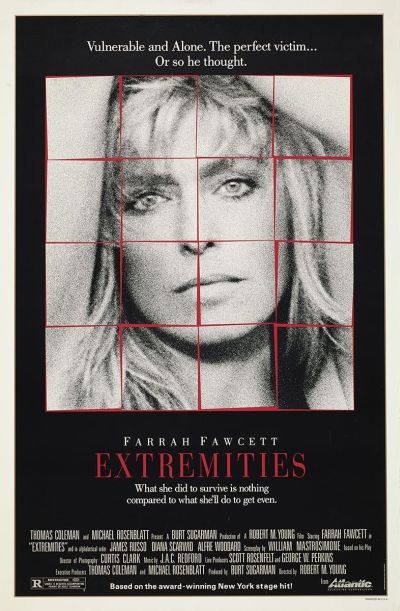
In the mid-eighties, Farrah Fawcett underwent a bit of sharp change in career path. The previous decade had seen her become one of the biggest sex symbols of the seventies, a star in the first season of Charlie’s Angels, and selling millions of posters a year. But here and in 1984’s TV movie The Burning Bed, which addressed the largely taboo topic of domestic abuse, Fawcett’s work took on a pro-feminist tone. While Bed hit screens before this, her connection to Extremities predated it. The concept was originally a stage play, and Fawcett appeared in the original New York production – incidentally, replacing Susan Sarandon (Karen Allen, Ellen Barkin and Helen Mirren have also taken on the lead role).
She was thus an easy choice for the film adaptation, to a mixed reception. While nominated for a Golden Globe, critics Siskel & Ebert called it one of the worst movies of the year – alongside the brilliance of The Hitcher, so I’m ignoring them. The origins on-stage are fairly obvious. The bulk of this takes place in the house shared by Marjorie (Fawcett), Terry (Scarwid) and Pattie (Woodard). Marjorie is recovering from narrowly escaping a rape attempt. With the attacker wearing a mask, the police are unable to act, and she is now living in fear, knowing her attacker has her wallet, and so knows where she lives. Rightfully so, for when Joe (Russo) shows up on her doorstep, it’s not with good intentions.
With the help of a convenient can of wasp spray, she is able to turn the tables on her attacker. Joe is knocked out and tied up, while Marjorie prepares her own brand of justice, digging a grave in the garden, in which he will be buried alive. However, the return of first Terry and then Pattie to the house complicate matters, not least because Joe claims he’s the victim, and he and Marjorie knew each other before. Using information he had found in the mail-box, he’s able to spread dissension in the ranks, with Pattie – a social worker, so clearly a do-gooder on the side of the criminal – particularly averse to Marjorie’s plans. We also learn about an incident in Terry’s past, which colours her opinion.
In contrast to other entries like Hard Candy, there’s no doubt as to the antagonist’s guilt, and that certainty makes it a bit less interesting to me. I was impressed with Fawcett’s performance – the switch from victim to relentless avenging angel is sudden, yet does not feel unwarranted. Russo also deserves credit, for playing a compelling slimeball, who is also convincing enough when pleading innocence. The strong leads help counter what feels unnecessarily restrained, compared to other eighties entries in the genre, both in terms of the rape and the revenge: there were points where I wondered if this was a TV movie. The ending would be one such. I guess we discover that the way to a rapist’s heart, involves his crotch, a sharp blade and threats in lieu of actual mutilation.
Dir: Robert M. Young Star: Farrah Fawcett, James Russo, Diana Scarwid, Alfre Woodard
Mamoru Hosoda is one of the senior figures in Japanese animation, with thirty-five years of experience since he joined Toei Animation in 1991, after graduating from college. He made his feature debut with One Piece: Baron Omatsuri and the Secret Island in 2006, though this came only after he had almost directed Howl’s Moving Castle for Studio Ghibli. He subsequently left Toei, to go freelance, and his works since have met with both critical and commercial success. Mirai was nominated for an Oscar in 2019 as Best Animated Feature – the first non-Ghibli film to be so honoured. 2021’s Belle , loosely inspired by fairy-tale Beauty and the Beast, was the second-biggest movie at the Japanese box-office that year, domestic or foreign.
His latest movie and the follow-up to Belle, Scarlet, was a long production, taking four and a half years to complete. It mixes traditional 2D cel animation with computer-generated animation, and is a take on Shakespeare’s story of Hamlet, with its titular heroine seeking vengeance on the people who murdered her father, the monarch of 16th century Denmark. Her first attempt backfires, when she consumes the poison intended for her uncle Claudius, the leader of the plot. Scarlet wakes to find herself in the purgatory of the underworld. She needs to complete her revenge in order to move on to the Infinite Land; otherwise, her spirit will collapse into nothingness. It turns out that Claudius is in the underworld too…
Both Dieter and Jim watched and reviewed this one independently. Below, you’ll find their respective ratings and thoughts, with Dieter going first.
★★★★★
“The undiscovered country from whose bourn no traveler returns”
On the fourth anniversary of Russia invading the Ukraine a movie like this hits harder, I feel. At the same time, the Berlin Film Festival has ended and while a whole lot of boring message movies got awards, this one was not even in competition. I guess it also won’t win any Oscar awards. For the same reason: it’s just too good. It would blow any competing features out of the water. And yes, this is a strongly subjective review. Watch the movie and judge for yourself, I suggest.
But… I’m already starting with the end. I was honestly blown away by this movie. While neither the idea of a female Hamlet is new (see the 1921 Hamlet: The Drama of Vengeance with Asta Nielsen) nor doing a Shakespeare-inspired anime (there is the anime series Romeo x Juliette from 2007) what director Mamoru Hosoda has done here for Studio Chizu, is fascinating. No idea why he chose the story of Hamlet as an entry point: perhaps because it’s the most universally-known revenge story next to Death Wish? It would have worked just as well with new, fictional characters and other names.
I didn’t mind. It only serves as a basis on which the director discusses the general but often overlooked and therefore more essential questions of humankind: What defines our humanity? What do we live for? What does death mean? What is love? What can be forgiven? What cannot? How much are we shaped by the environment we grow up in? And if we spread a loving and peaceful attitude can we change the world for future generations?
These are big, important ideas which do not normally form a part of “entertainment culture” or political discussions today, as everyone is too much occupied in serving their own self-interest. Actually, I would locate these questions more in the areas of philosophy and religion. At the same time, the animation style itself is impressive: not just the usual 2D cell animation nor CGI animation. I don’t know how to describe it: while most of it seems classically drawn, many of the backgrounds seem photo-realistic as if they are “real”, including the desert, water, ruins and a jungle. Also overwhelming is the sky of this “other land” which looks like waves, over which a giant dragon flies and occasionally erupts in deadly lightning.
While the visual style takes some time to get used to, this is not necessarily a bad thing. It’s different and new and that’s it. I liked it but I can understand if other people might reject this approach. It’s really a matter of individual taste. Putting all these aspects aside, I found the movie really entertaining. It’s an epic, bombastic movie with a passionate heroine, lots of fights (somehow these medieval Danes seem to have quite some knowledge of martial arts) and – surprisingly – beautiful songs. With Scarlet being shown training hard since her early youth, her fighting larger opponents doesn’t seem that much of an overstatement. She also doesn’t always win, which helps to make the fights look more realistic.
If Mamoru Hosoda might not be as famous or successful as Hayao Miyazaki or Makoto Shinkai (Your Name), so far, he has always delivered excellent and interesting movies. Scarlet is his 8th movie (I challenge the uninitiated to discover his other movies, and especially recommend The Girl Who Leapt Through Time and Summer Wars) and was co-produced by Columbia Pictures. I regret that movies like this only ever run for one day here, and occasionally some more in some tiny cinemas as I think they deserve so much more exposure. Here is hoping, I may have contributed to making this excellent movie more well-known, and create some interest in its potential audience watching it, or at least giving it a chance.
★★★
“Better red than dead.”
Up-front confession: I haven’t seen any of Hosoda’s other work, so am not familiar with the style. Indeed, for a while, I was confusing him with Mamoru Oshii, of Ghost in the Shell and Avalon fame. Which isn’t as much of a stretch as it may seem. Oshii’s work seems to rely a lot on a loose narrative, using the virtual world in Avalon as a convenient loophole through which any plot thread can pass. You could make much the same argument for Scarlet, with the underworld being a realm where stuff simply can happen, because it’s the underworld. I’m not a huge fan of this kind of plot armour, and would likely have been happier if Scarlet had been pursuing her vengeance in the everyday world.
The early stages will feel rather familiar to any fan of Game of Thrones. Scarlet can only watch as her father, a beloved figure, is executed in the name of political machinations. She then vows revenge, and undergoes a rigorous training program to that end. Very Arya Stark. Fortunately (or perhaps not?), it finds its own way after she consumes poison, and Scarlet finds herself in the afterlife. It’s necessarily a shock, but she has the mental fortitude to adapt. She’s joined there by Hijiri, a paramedic from the present day. In effect, he acts as her conscience, continuing to treat the wounded as he had done in life, and questioning the need for her revenge. This becomes especially pertinent after we hear the message Scarlet’s late father had for her.
I cannot fault the visual side of things here at all. Dieter encouraged me to see this on the largest screen possible. Unfortunately, it did not last long in cinemas here: two weeks after release, it was down to showing in just twenty-four theatres nationwide. But having seen it in my living-room, I would not have minded a much larger viewing experience, and can only imagine the impact. It’s not seamless, in that you can often tell which sequences were old-school, and which were zeroes and ones. But the overall effect is undeniably impressive, and on that basis alone, I’d say it deserved an Oscar nomination more, say, than Zootopia 2.
However, as the above likely suggests, I was not particularly impressed with the plot. The basic elements were there – you can’t go wrong with revenge of the Shakespearean kind – but there are elements which seem not to serve this. For example, there’s a significant chunk where Scarlet and Hijiri are simply hanging out with elderly souls. It feels like John Wick paused his revenge, to spend an afternoon helping out at the local senior centre. I guess the eventual aim is that Important Lessons™ need to be learned by Scarlet about the value of life. But if you compare this to the works of Hayao Miyazaki, the moral lecturing here comes over as less than subtle.
I did like the contrast between Hijiri and Scarlet. Interesting that the “caregiver” character here was male and from the present times, while the vengeance seeking warrior was female and out of the middle ages. This subversion of standard tropes is thought-provoking, without needing to deliver any explicit messaging, and the relationship between the pair works well. If you’re familiar with Hamlet, you’ll also get a kick out of some of the references (the versions here of Rosencrantz and Guildenstern are particularly memorable). But any film which uses a dragon – another Game of Thrones nod? – as a convenient prop for the story-line, needs to be answering questions about its scripting. It’s this which stopped Scarlet from being more, for me, than just a well-crafted, pretty thing at which to look.
Dir: Mamoru Hosoda Star (voice): Mana Ashida, Masaki Okada, Koji Yakusho, Kōtarō Yoshida
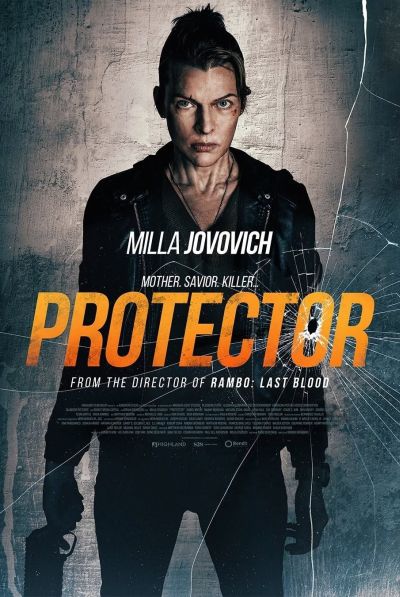
There are certain actors who are capable of elevating the material with which they work. Peter Cushing. Rutger Hauer. Klaus Kinski. They could all appear in B-movies, and make them B-plus films. I’m steadily, increasingly convinced that Milla Jovovich deserves to be thought of similarly. I am pretty sure that, without her in the lead role, its rating would be an entire star lower, if not beyond that. But she compels the viewer’s attention, and the end result is considerably more enjoyable than with almost anyone else. It is, after all, not much apart from a combo platter of elements from Taken and Rambo. Indeed, director Grünberg was responsible for Rambo: Last Blood. He knows disgruntled veterans.
The one here is Nikki Halsted (Jovovich), whose daughter Chloe (Myers) sneaks out to party with friends on her 16th birthday. She gets roofied, and abducted by a sex trafficking group called The Syndicate, run by a shadowy figure known only as The Chairman. However, Nikki is a former Special Ops soldier, which returned from the Middle East specifically to be with Chloe, after the death of her husband, Chloe’s father. So she’s not letting any well-dressed (but curiously white) pimps get in the way. And Nikki has the very particular set of skills necessary to make The Syndicate pay for having taken, um, I mean abducted Chloe. Neither the cops, led by Captain Michaels (Sweeney), nor her former commanding officer, Colonel Lavelle (Modine) can stop her.
There are a couple of odd stylistic choices. It basically skips the first burst of vigilante activity for Nikki, jumping from Chloe’s abduction to Nikki hanging upside down in a meat-packing warehouse. It was rather disconcerting. My other gripe was a fondness for things to unfold in darkness or a close cousin thereof. We are here to see Milla carving off the ears of traffickers, or gnawing chunks out of their faces with her teeth. Not peering into the darkness and “using our imaginations”. Maybe it was a ploy to avoid ratings board issues? Certainly, this does not skimp on the old ultraviolence in general. After a couple of Netflix movies which were very restrained, I found the savagery here quite refreshing.
Then there’s the ending, which… It would be an example of “go big or go home”, with a twist I did not see coming. But does it work? While it does explain some things that seemed a little strange at the time, it may pose more questions than it answers. I think my main concern though, is that writer Bong-Seob Mun has added an unnecessary level of complexity to proceedings. I was enjoying this perfectly well before the revelation showed up, and while it certainly came as a shock, did it add anything overall? Did it really? Mind you, I would be there for a film simply entitled Milla Jovovich Punches People For 85 Minutes – so what do I know?
Dir: Adrian Grünberg Star: Milla Jovovich, Isabel Myers, Matthew Modine, D.B. Sweeney
Although this is very much an Australian movie, in both setting and characters, it feels quite a bit out of place there. We begin with a school shooting in which twenty students are killed. It would be utterly unprecedented there. According to this article, Australia’s most recent school shooting occurred back in May 7, 2012. It adds, “No one was injured.” Well, that’s kinda weak, isn’t it? I was reliably informed, everything in Australia is trying to kill you. Anyway, ex-soldier and police officer Samantha Romans (Garner) is first on the scene here, but fails to engage the active shooter. Her teenage son, Tim, is one of the victims. Inevitably, questions are asked of her in the aftermath. Not least by ambitious journalist Jamie Connard (Tolj), who negotiates a lucrative contract to write about events.
One condition: she needs to get Romans to tell her side of events. Initially, the cop won’t speak to the writer, so Connard ups the ante, posting an online video vilifying Romans and blaming her for Tim’s death. The journo’s husband, Greg (Cousins) is appalled, and asks her to stop. But ambition and greed overpower her common sense, especially because the tactic seems to have worked, Samantha agreeing to meet Jamie. Except… the policewoman doesn’t show up, and when the scribe returns home, she finds Greg and their daughter missing. She soon gets a phone-call from Samantha, and has to begin a hunt which is intended to push to and beyond her mental limits.
And, perhaps, teach her something about what her prospective subject went through on that traumatic day at the school. For in certain ways, it feels a little bit like a sister to The Hitcher, with someone having their life utterly upended by an unstoppable force. Trauma as twisted, Nietzschean life-coaching, if you will: what does not kill you, makes you stronger. The main difference is, there, the victim was picked for no particular reason. Here, it’s very specific, and to be honest, Connard does seem like a bit of a bitch, particularly in the early going. But by the end, she and her family have been put completely through the wringer, and it’s hard not to empathize with them.
However, you also gradually learn about Romans’ past as well, although we know early on she has lost her husband and another child, before Tim. The specifics, beyond that, are likely grimmer than you would have expected, or even imagined in a nightmare, to the point I wondered how she could have continued to function. While the two lead performances are very good, it does have some pacing issues. Where The Hitcher was absolutely relentless, this does on occasion grind to a halt and become static and chatty. In the main though, it remains a strong, if extremely dark, thriller, pitting two women against each other, both of whom are not the kind of characters you see often on-screen.
Dir: Scott Major Star: Nadine Garner, Samantha Tolj, Brett Cousins, Damian Walshe-Howling
a.k.a. Darklands
I don’t think I’ve ever seen an Italian kung-fu movie before. To be fair, the bulk of the lifting in that department is done by Chinese actress Yaxi Liu, who was a stunt double in the live-action Mulan. She plays Xiao Mei – yes, this leads to amusing confusion about Xiao and “Ciao!” – who comes to Rome in search of her vanished sister, Yun. The triad folk who brought her from China expect Mei to work as a prostitute, and soon discover that will not be happening, in impressively violent fashion. She flees, and finds an unexpected ally in Marcello (Borello), whose restaurant owning father knew Yun, and who has similarly vanished.
Meanwhile, behind the scenes is growing antagonism between Wang (Shanshan), who runs the local triad group, and Annibale (Giallini), in charge of the traditional organized crime in the area. Mei’s actions, attacking members of both gangs, are not helping, and things only escalate further when she and Marcello discover what happened to their missing relatives. You can probably work out the rest for yourself, providing the count of kung-fu movies seen previously is greater than about three. Just be prepared for it to take its time getting there. This runs a hundred and thirty-nine minutes, and I found that the main problem. While the basic story is solid, there’s a bunch of stuff on the edges that could be discarded, such as Wang’s rapper son.
There are really only four genuine action scenes in this, and given the duration, that spreads them perilously thin. However, all four are really good, to the point you will certainly wish it had more. There’s Mei’s escape from migrant processing (which has a lovely sequence of kitchen-fu); a battle against two of Annibale’s minions; her frontal assault on the restaurant which serves as a front for Wang’s activities; and, finally, her one-on-one fight with Wang himself. The last named felt like it should have been the climax: instead, it takes place when there is still thirty minutes left on the clock, leaving a long, slow march to the end-credits. I’ve not seen such an over-extended ending to a movie since Return of the King.
That said, I never particularly felt the film was boring: there’s stuff here’s which is superfluous, yet is still adequately interesting. This counts as a well-done gender reversal: typically it would be the male who shows up, looking for his sister, and is helped by a waitress. It helps that both Liu and Borello are left to act in their native tongues, communicating largely through Google Translate (!). This avoid the awkward “acting in a second language” which would otherwise have been necessary. I also enjoyed the backdrop of the Eternal City, filmed in a way which emphasizes its grandeur and history. I didn’t feel like my time – and it used up a lot of it – was wasted. Had Mainetti found reason to throw in a few more fights, this could have been a classic, rather than a well-rounded throwaway.
Dir: Gabriele Mainetti Star: Enrico Borello, Yaxi Liu, Marco Giallini, Chunyu Shanshan
a.k.a. Kung Fu in Rome
This is a rough, to the point of savage, piece of cinema. If you do not like seeing people get their head blown apart, you should stay away, because that happens more then once here. The provider thereof is Jessica Brok (Jones), who was once part of a black ops operation which went across the border from South Africa into Angola, in search of a poaching ring, only to find far worse. The subsequent ambush wiped out most of her team, though she was able to kill the brother of the poacher’s leader. Over a decade later, she is finished with the business, and living quietly with her young daughter, under a new identity. The business, however, is not finished with her.
For the leader, Lazar Ipacs (Lukunku), has been harbouring a grudge against Jessica, and has finally tracked her down. With the help of a former colleague, Daniel (Berning), he lures her into a trap and prepares to make her regret… Absolutely everything. But Daniel has second thoughts, throwing Jessica a lifeline which lets her escape. The hunt is on. The only question is, who is the hunter and who is the hunted? After a few lower-tier henchmen are taken out, Lazar’s wife Sherri (Mboya) discovers Jessica has a daughter, and Lazar kidnaps her, intending to use the child as leverage. If you’re thinking that might be a bit of a poor decision, give yourself two points.
The best thing I can say about this is, while running comfortably over two hours, it doesn’t feel like it at all. There’s not much of a lull: a brief period of peace depicting Jessica’s new life working on a wildlife sanctuary is as quiet as things get. Once she is kidnapped, there is little pause for breath thereafter. It is fair to say that the action here is more inclined towards the comic-book, rather than the realistic. Jessica, for example, takes more damage than any normal human could be expected to survive. She takes an arrow right through the thigh, and basically shrugs it off, while stepping on a grenade booby-trap leaves her with little more than slight tinnitus. However, the same goes for Lazar and Daniel.
Taken in that spirit, I enjoyed this a great deal, and it’s the first film I’ve watched in 2026 to merit our Seal of Approval. The characters here are broadly-drawn, yet no less effective for it. Credit especially to Lukunku and Mboya, who make a spousal pair who are the stuff of your worst nightmares. The script doesn’t do anything particularly new – especially obvious, the way Lazar and his men spurn opportunity after opportunity to kill Jessica, to the point it begins to feel like a deliberate running joke. Yet it feels like its simplicity leaves the film stripped-down and lean, rather than underwritten. I suspect director/co-writer Orr might be a big fan of Revenge. I am too: there’s much worse from which to take inspiration.
Dir: Alastair Orr Star: Danica De La Rey Jones, Richard Lukunku, Clyde Berning, Hlubi Mboya
It’s clear what Snell is going for here. This is a throwback to the spaghetti Westerns of the seventies, along with Italian exploitation films from around the same time. I certainly admire the effort which went into this: for example, rather than shooting digitally and applying effects to imitate film, Snell actually shot on Kodak 16mm stock. I did not know that was still a thing, to be honest. Some of the other elements, like the music, also do a good job of reproducing the era – the movie poster is another one. I’ve seen enough of this kind of movie (mostly through Project Kinski), to appreciate what he’s doing.
Unfortunately, I’ve seen enough of this kind of thing, to be able to differentiate the good from the bad, and a fair bit of this skews towards the latter. Molly Pray (Rippel) can only watch as her husband is gunned down in front of her by a bounty-hunter, having been framed for the murder of a lawyer, But she will not accept this, and begins to unravel the threads of the conspiracy, which made Mr. Pray an unwitting victim. And when I say, “unravel”, I mean with extreme, bloody prejudice. She guts some, blows the faces off others, on her way up to the chain to the person pulling the strings at the top. She’s holding a stick of dynamite. We’ll leave it at that.
If you are looking for a comparison, it would be something along the lines of Hobo With a Shotgun. That’s a film I love dearly, and that might be partly why I’m a little sniffy about this. Because if you compare Hobo to Death, the results do not favour this, almost across the board. Most obviously, while Rippel is decent, she’s barely in the same solar system as Rutger Hauer. The lack of a strong antagonist here is a problem too. Instead, Molly largely chews up one person after another. But because we don’t know much about them – beyond their connection, sometimes tangential, to the death of her husband – there’s a severe lack of emotional impact, even as she’s dismembering them for her pigs to eat.
Finally, the pacing leaves something to be desired, especially the sections where the focus drifts off Molly, such as to the friendly new deputy, who is generally on her side. Almost any time he was on the screen, I found myself quickly losing interest, and keen for it to go back to the directly focused line of Mully’s vengeance. The reliance on mostly practical effects is laudable, and there are certainly some impressively gory moments of which Lucio Fulci and his ilk would be proud. But too many of the supporting performances feel like they come from people who were available. Given the shoot took several years from start to finish, that may not be much of a stretch.
Dir: Austin Snell Star: Sheri Rippel, Jeff Boyer, Devan R. Garcia, Shawn Nyberg
File this synopsis under technically true: “After the shocking discovery of an unconscious man in a locked unit, the lone employee of a remote storage facility must fight to survive the night against a ruthless gang, dead set on retrieving their precious cargo – at any cost.” I guess the word with which I have the most reason to quibble is probably “fight”. For heroine Laurie Saltair (Fugrman) is more from the Brave Sir Robin school of fighting, if you’ve ever seen Monty Python and the Holy Grail. She’s much more inclined to avoid confrontation than seek it out. Which perhaps making sense when facing a larger, better armed and more experienced enemy. But where’s the fun in that?
The man in question is Clayton (Huston), who is on a gurney having been kidnapped from hospital by Jules (Johnson), who is keen to finish the job. What job is that? Well, you find this out towards the end, when Laurie does, and it certainly upends much of what has gone before, to the point you’d be forgiven for annoyance at the film having perhaps wasted your time. What unfolds is, Laurie rescuing Clayton, and they then have to try and escape the storage facility and/or call for help, while Jules and his men hunt them both. Naturally, neither prove exactly successful, and that’s hos the plot unfolds. Mostly through the maze of passages in the facility, with a brief excursion outside for fresh air.
There’s potential here: imagine a film where the heroine can crack open storage units and use the contents against the villains. This kinda happens here – only in about the dumbest and most implausible way you could imagine. Seriously: of all the things potentially to utilize, this was the way Laurie went? I think it was probably the moment at which the film jumped the shark for me, and it was never able to… I guess, un-jump itself thereafter. I feel a vague sense of loss at this, since the central performance are fine. Fuhrman is an engaging heroine, and Johnson is effective in his role. Weirdly, after non-GWG film Day of Reckoning, it’s the second this week where an ambivalent character coughs up blood. Go figure.
It also felt like Laurie only became pro-active at the end of the movie, when it was necessary for the plot. When it happened, part of me was relieved it had finally happened – it probably just pushed the film over the line for inclusion on this site. However, there was another part of me that wondered where the hell this had come from, because it simply didn’t fit in with Laurie’s passive approach to that point. I may have been somewhat prejudiced by Fuhrman’s track record in Orphan: First Kill, where she’s more aggressive. This definitely needed a heroine along similar lines, although it’s the script, and its inability to unlock the potential, which feels the biggest weakness.
Dir: Andy Tennant Star: Isabelle Fuhrman, Don Johnson, Jack Huston, James DuMont




 Well, “delight” might not quite be the right word. But who am I to let facts get in the way of a good review tagline? It’s more of a Turkish nightmare, probably the most brutal rape-revenge movie I’ve seen since… Well, probably Revenge. The director is best-known for Baskin, generally considered the best horror movie from Turkey. Though, full disclosure, I wasn’t that impressed by it: strong on atmosphere, but short on a coherent storyline. That’s not an accusation which can be levelled at this. However, the level of savagery and bloodshed arguably puts this into the horror genre as well. It’s the story of two Turkmenistan sisters, Sayara (Kocabiyik) and Yonca (Kosar), both of whom are involved, in different ways, with gym owner Bariş Ataberk (Kizilirmak).
 Yonca is having an affair with the married man. But she has been able to leverage this into getting a job at the facility, as a cleaner, for the much quieter Sayara. Bariş offers Sayara a job as a trainer, teaching female clients self-defense, knowing of her skills in this area, but she declines. Worse follows, when Yonca catches Bariş cheating, and threatens to reveal all to his wife. This does not go down well, and ends in Yonca’s death, which is called a suicide officially. It helps that Bariş’s father, Halil Ataberk (Inal), is a senator with a lot of political pull, and can ensure no action is taken against his son.
 This was certainly not what I expected. That, in itself, would not have been a problem – I’m quite used to, and indeed do not mind, films which confound my preconceptions. I respect what this is attempting to do as well, which is a different take on the revenge movie. The problem here is fumbled execution: more on the directorial, writing and technical fronts, though in some of the performances too. Even allowing for the obviously limited resources this had to play with, by the end, it was definitely a struggle to get through, with a lack of narrative thrust in particular, meaning it failed to hold my attention. That’s a bit of a shame. Only a bit, mind you.
 In the mid-eighties, Farrah Fawcett underwent a bit of sharp change in career path. The previous decade had seen her become one of the biggest sex symbols of the seventies, a star in the first season of
  Mamoru Hosoda is one of the senior figures in Japanese animation, with thirty-five years of experience since he joined Toei Animation in 1991, after graduating from college. He made his feature debut with One Piece: Baron Omatsuri and the Secret Island in 2006, though this came only after he had almost directed Howl’s Moving Castle for Studio Ghibli. He subsequently left Toei, to go freelance, and his works since have met with both critical and commercial success. Mirai was nominated for an Oscar in 2019 as Best Animated Feature – the first non-Ghibli film to be so honoured. 2021’s Belle , loosely inspired by fairy-tale Beauty and the Beast, was the second-biggest movie at the Japanese box-office that year, domestic or foreign.
 I didn’t mind. It only serves as a basis on which the director discusses the general but often overlooked and therefore more essential questions of humankind: What defines our humanity? What do we live for? What does death mean? What is love? What can be forgiven? What cannot? How much are we shaped by the environment we grow up in? And if we spread a loving and peaceful attitude can we change the world for future generations?
 I cannot fault the visual side of things here at all. Dieter encouraged me to see this on the largest screen possible. Unfortunately, it did not last long in cinemas here: two weeks after release, it was down to showing in just twenty-four theatres nationwide. But having seen it in my living-room, I would not have minded a much larger viewing experience, and can only imagine the impact. It’s not seamless, in that you can often tell which sequences were old-school, and which were zeroes and ones. But the overall effect is undeniably impressive, and on that basis alone, I’d say it deserved an Oscar nomination more, say, than Zootopia 2.
 There are certain actors who are capable of elevating the material with which they work. Peter Cushing. Rutger Hauer. Klaus Kinski. They could all appear in B-movies, and make them B-plus films. I’m steadily, increasingly convinced that Milla Jovovich deserves to be thought of similarly. I am pretty sure that, without her in the lead role, its rating would be an entire star lower, if not beyond that. But she compels the viewer’s attention, and the end result is considerably more enjoyable than with almost anyone else. It is, after all, not much apart from a combo platter of elements from Taken and Rambo. Indeed, director Grünberg was responsible for Rambo: Last Blood. He knows disgruntled veterans.
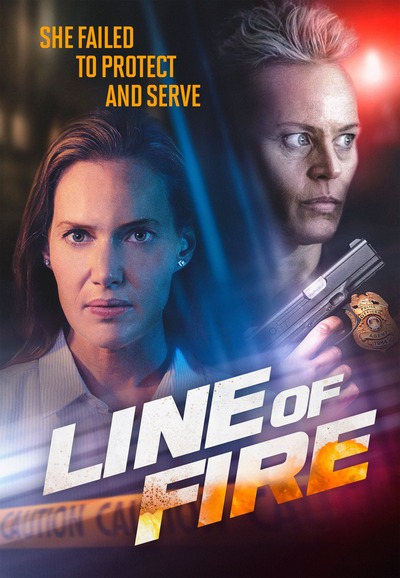 Although this is very much an Australian movie, in both setting and characters, it feels quite a bit out of place there. We begin with a school shooting in which twenty students are killed. It would be utterly unprecedented there. According to
  I don’t think I’ve ever seen an Italian kung-fu movie before. To be fair, the bulk of the lifting in that department is done by Chinese actress Yaxi Liu, who was a stunt double in the live-action
 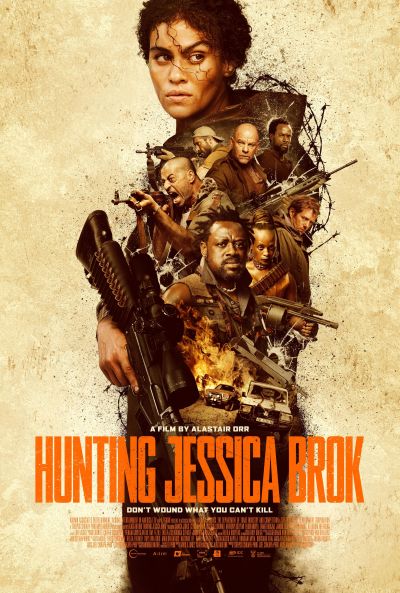 For the leader, Lazar Ipacs (Lukunku), has been harbouring a grudge against Jessica, and has finally tracked her down. With the help of a former colleague, Daniel (Berning), he lures her into a trap and prepares to make her regret… Absolutely everything. But Daniel has second thoughts, throwing Jessica a lifeline which lets her escape. The hunt is on. The only question is, who is the hunter and who is the hunted? After a few lower-tier henchmen are taken out, Lazar’s wife Sherri (Mboya) discovers Jessica has a daughter, and Lazar kidnaps her, intending to use the child as leverage. If you’re thinking that might be a bit of a poor decision, give yourself two points.
 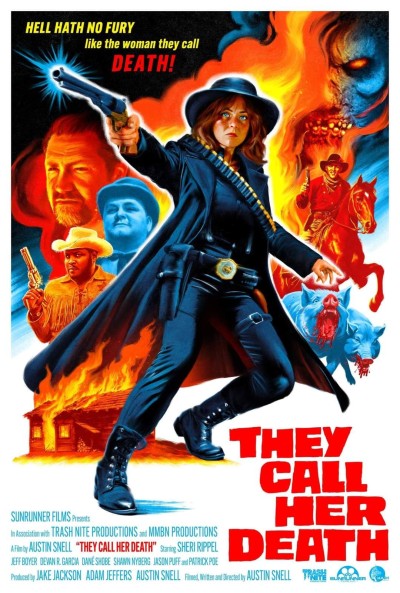 It’s clear what Snell is going for here. This is a throwback to the spaghetti Westerns of the seventies, along with Italian exploitation films from around the same time. I certainly admire the effort which went into this: for example, rather than shooting digitally and applying effects to imitate film, Snell actually shot on Kodak 16mm stock. I did not know that was still a thing, to be honest. Some of the other elements, like the music, also do a good job of reproducing the era – the movie poster is another one. I’ve seen enough of this kind of movie (mostly through
 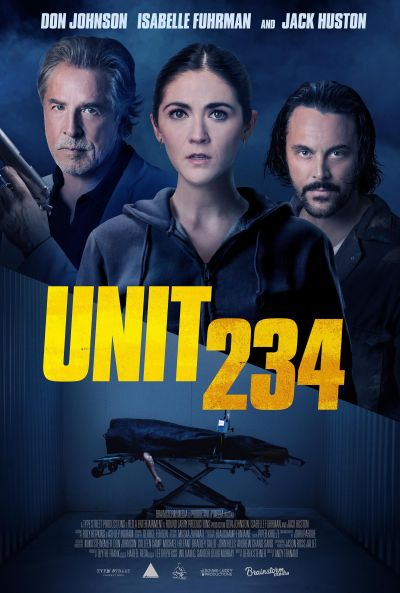 File this synopsis under technically true: “After the shocking discovery of an unconscious man in a locked unit, the lone employee of a remote storage facility must fight to survive the night against a ruthless gang, dead set on retrieving their precious cargo – at any cost.” I guess the word with which I have the most reason to quibble is probably “fight”. For heroine Laurie Saltair (Fugrman) is more from the Brave Sir Robin school of fighting, if you’ve ever seen Monty Python and the Holy Grail. She’s much more inclined to avoid confrontation than seek it out. Which perhaps making sense when facing a larger, better armed and more experienced enemy. But where’s the