




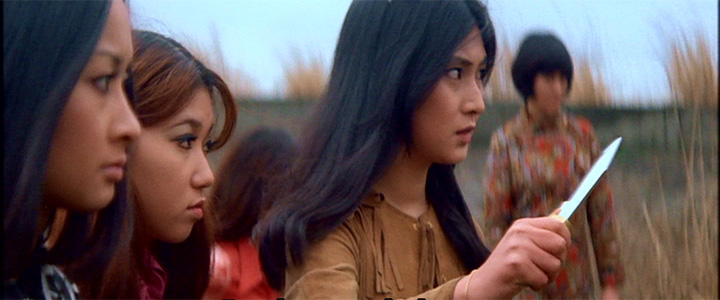
 “Pinky violence” is a genre of cinema that flourished in Japan during the 1970’s. It was spawned from the “pink film” genre of sexploitation movies, which started the previous decade with Satoru Kobayashi’s Flesh Market, which grossed over 100 million yen on a budget of just eight million. It was originally the domain mostly of independent producers and studios, but as the Japanese market became tougher, due to competition from imported movies and other forms of entertainment, major studios like Nikkatsu and Toei moved in to the field. While the former took the more traditional route, Toei opted to merge sex with the other staple of exploitation cinema, violence.
But what makes them of interest here, is their focus on women as the central characters, active participants in the violence, rather than simply being passive victims. Frequently, the heroines are sukeban, a term which means “delinquent girl” or “bad girl”, often operating in conjunction with, or leading, other girls in a gang, This may form part of a larger Yakuza enterprise, or work entirely independently. Sometimes, the focus is on obtaining revenge or justice for some past crime, whether against the girl or someone she loves. The ratio of sex to violence did vary, as did the setting: while most had a contemporary setting, films like Lady Snowblood took the themes are ran them out against a period backdrop.
While the ‘golden era’ of the genre is generally considered to be in the seventies, the influences and general themes continue on. They can be seen in the likes of the Female Prisoner Scorpion and Zero Woman series, and arguably, even in the new wave of Tokyo Gore movies, such as Mutant Girl Squad or Gothic & Lolita Psycho. We started by reviewing the four movies included in the box-set released by Panik House in December 2005. While it’s now out of print, its contents remains available from various sources, and it’s as good a place to begin as any. Further entries will continue to be added during the coming months, with the movies listed in order of release date.
See also
- Operation Pussycat
- Prisoner Maria: The Movie
- Sasori
- Scorpion: Double Venom
- Scorpion’s Revenge
- Sukeban Hunters
And, in chronological order
- Legend of the Poisonous Seductress: Female Demon Ohyaku
- Delinquent Girl Boss: Blossoming Night Dreams
- Girl Boss Blues: Queen Bee’s Counterattack
- Delinquent Girl Boss: Worthless to Confess
- Rika the Mixed-Blood Girl
- Wandering Ginza Butterfly 2: She-Cat Gambler
- Girl Boss Blues: Queen Bee’s Challenge
- Girl Boss Guerilla
- Wandering Ginza Butterfly
- Rica 2: Lonely Wanderer
- Criminal Woman: Killing Melody
- Rica 3: Juvenile Lullaby
- Female Yakuza Tale: Inquisition and Torture
- Girl Boss: Escape From Reform School
- Terrifying Girls’ High School: Lynch Law Classroom
- The Yakuza Wives
- Bloodbath at Pinky High, Part 1
- Bloodbath at Pinky High, Part 2
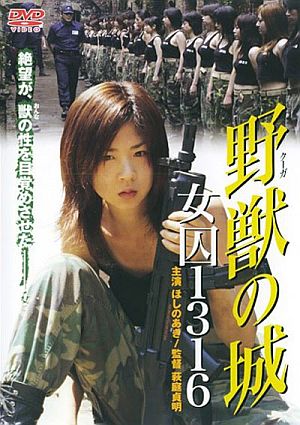 Misaki (Hoshino) is in prison for stabbing a policeman to death, but is taken from her jail to a remote island. There, she joins the rest of the hand-picked prisoners, who are there to be trained by a mysterious government organization, and moulded into operatives who can be used to protect national security. Most of the inmates just want to make things easy, sleeping with the guards in exchange for privileges, but Misaki is made of tougher stuff, and won’t buckle down to the authorities. While she begins plotting how to escape the island, she needs to overcome a number of problems, not least having no idea about where it is, and whether the small boat they stumble across will be capable of getting them to any other land.
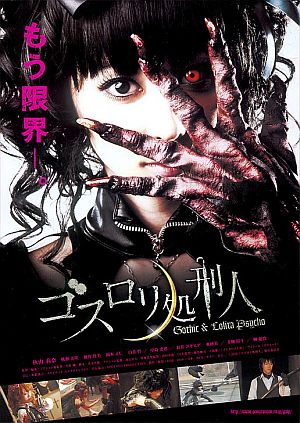 First of all, “Gothic Lolita” is a Japanese style term; Lolita fashion is based on clothing from the Victorian era, and the Gothic sub-genre is…well, suitable for a Victorian funeral, basically. Quite why heroine Yuki (Akiyama) decides to dress like this, after her mother is murdered by a group of five thugs, is never satisfactorily explained. Actually, it’s never even mentioned, putting it alongside the issue of why her father (Yanagi) is apparently a Christian priest, now confined to a wheelchair as a result of the attack. Or where Yuki is now a skilled fighter, armed with a bulletproof, lethal umbrella that can kill you in a variety of ways. Where does she get those wonderful toys, to borrow a phrase.
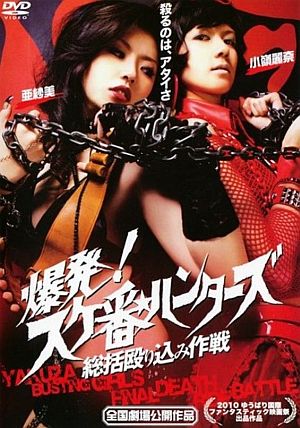 This teetered on the edge of a seal of approval, but didn’t quite make it. While there are some lovely moments, two great leads and the recreation of the pinky violence genre from the sixties and seventies, there’s just too much dead wood and pacing flaws, that leave it just short. Still certainly worth a look, with Asami (Asami) and Junko (Rena) going head-to-head as they battle each other for supremacy in the girl-gang world. Junko seems to have got the upper hand, leaving her rival buried for dead in the desert [or whatever passes for a desert in Japan]. But Asami is just warming up: she claws her way, literally, back from the grave, teams up with her old gang-members, and sets about extracting revengs on Junko and her crew.
 Taking a minimalist approach to its plot, particularly for the first hour, it’s about Kotomi (Tsukui), who is on a quest to find the man (Kanai) who was responsible for killing her father (Nomura), a samurai who wanted to leave his sklls to her. To reach the killer, she has to battle her way through a series of lower-level minions, such as a pack of ninjas, a monk and Pocahontas [ok, that might be a stretch, but honestly, that was my first thought on seeing her]. However, after she has fought her way past these henchmen and henchwomen, to reach the boss
  It isn’t
 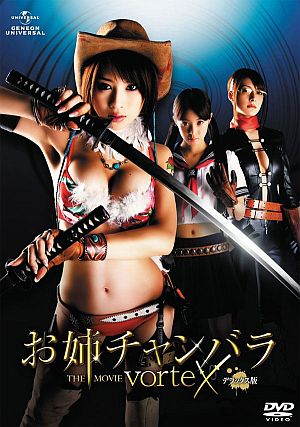 If the
  The Japanese title Onechanbara [variously Oneechanbara], is a portmanteau word, combining “onee-chan”, which means “big sister”, and “chanbara”, the term for sword-fighting movies. But, since this aspect would be lost on a Western audience, who can blame US distributors Tokyo Shock for adding the helpful subtitle, “Zombie Bikini Squad”. Y’know, in case the sleeve left doubts in this area. It’s based on a very popular series of Japanese video games, which consists of the heroines, in a variety of costumes, slicing and dicing their way through an apparently endless line of the living dead. With admirable faithfulness to the source material, the
 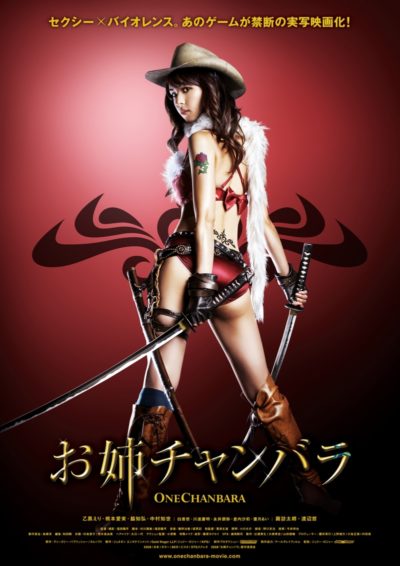 There’s Aya (Otugoro), the stoic sword-wielding one seen on the poster, and Reiko (Hashimoto), the leather-clad one with the infinite-ammo shotgun. Along with fat sidekick Katsuji (Waki), they’re looking for Aya’s sister, Saki – and also Dr. Sugita (Suwa), the mad scientist responsible for the zombie outbreak which has swept the world, setting sister nibbling on brother, daughter on mother, etc. On the way to their goal, they meet other survivors, a zombie version of GoGo Yubari from Kill Bill, and several million gallons of digital blood, including a good chunk sprayed onto the camera lens. Now, I’ve never played the game at all, so can only assume everything makes perfect sense in that universe. Still, as adaptations go, this seems to capture the inherent spirit of mindless slaughter admirably, with Aya’s power-up the most devastating video-game weapon since the Defender smart bomb. I just dated myself horribly, didn’t I?
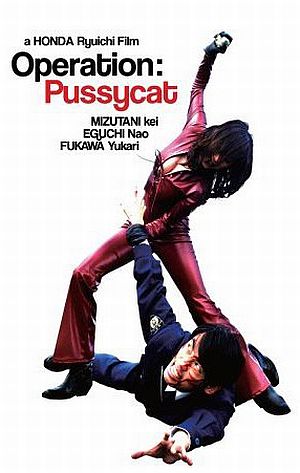 Faster, Pussycat is one of the icons of the action heroine genre, literally entire decades ahead of its time. This Japanese version uses a lot of the same elements, starting with a trio of go-go girls on the lam, under their macho leader. They stumble across a wheelchair-bound man and his muscular if taciturn companion, who appears to be stashing a large sum of money somewhere on the premises. If only they could find it… There’s also an innocent who gets entangled in the web of deceit and counter-deceit – in the original, it was because she witnessed them kill her boyfriend, while in this case, it’s after she apparently witnesses the three beat up a policeman, who stopped them for speeding, and discovered the dead body stashed in the back of their pick-up truck.