Action Heroines of History

The year 2004 will not go down as a great vintage for historical movies, thanks to Troy, Alexander, King Arthur, etc. In contrast, films that feature original ideas, even if they are sequels, have done well, but there are so many interesting stories contained in history that I see no need to stick with the familiar. To illustrate this point I have compiled a selection of pieces on successful women from history, whose stories would all make good movies.

As well as factual details, the pieces include suggestions of how the films could be constructed to marry historical fact and cinematic drama. These are a pair of influences which tend to be uneasy bedfellows, but too often accuracy ends up sacrificed wholesale, for reasons which tend to be questionable at best. This isn’t necessary; as these cases show, there is potential for an interesting film that still remains credible.

The heroines come from widely different eras, and while they vary in their importance as far as making a difference, I find them all fascinating, and feel strongly that they deserve to be better known. Part of the reason they are not is, I believe, down to historians, who seem far more interested in women who meet with a tragic end. For example: Cleopatra (suicide), Boudicca (suicide), Joan of Arc (burned at the stake), or Mary Queen of Scots (beheaded). I’m sure that many people would appreciate a film featuring women who come out a winner, and these articles will hopefully generate some interest in such historical figures.

Making history: historical heroines to Hollywood

See also


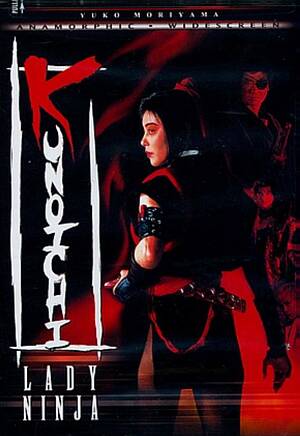
Kunoichi: Lady Ninja

★★
“What?”

A combination of the seventh and eighth in the series, I believe it’s the first entry (I don’t think there’s any connection to Lady Ninja: Reflections of Darkness) to get Western distribution so far, and boy, it shows. I can only presume it makes sense if you’ve seen the preceding six, because it sure as hell doesn’t on its own. A group of seven nuns decide to take revenge for an attack on their convent by becoming ninjas, and acquiring skills like “Nipple Shock Wave”. Which is exactly what it sounds like, even if most of the actual arterial violence is carried out by their ally, a one-eyed swordsman called Yagyu Jubei (Ozawa).

It fails to make sense on a whole variety of levels. Individual scenes are barely coherent; neighbouring ones don’t connect with each other; and the overall result could be imitated by channel-surfing a series of ninja-based TV stations. Mind you, Friday the 13th Part VII would make no sense if it was your first exposure to the series, and if you’re prepared to waive your constitutional right to know what the hell is going on, there’s still moderate fun to be had here – as long as your definition of “fun” encompasses large amounts of spurty dismemberment.

The problem with the heroines is mostly their poorly-defined characters; it’s hard to tell any member of our magnificent seven apart. They look similar, dress the same, and possess few distinguishing features. Overall, I can’t say how much blame lies with the film-makers, and how much with distributors Media Blasters for skipping the first six parts; either way, this isn’t recommended any more than halfheartedly.

Dir: Hitoshi Ozawa
Star: Yuko Moriyama, Hitoshi Ozawa, Non, Momoka Saeki
a.k.a. Kunoichi ninpô chô Yagyû gaiden: Edobana jigoku-hen

Crimson Bat: Wanted, Dead or Alive

★★★½

Director Ichimura returned for the fourth episode, and despite similar problems as the third installment – most obviously, an apparent doubt that Oichi’s character can hold the viewer’s interest by herself – makes a much better stab at things here. Bounty-hunter Oichi finds out what life is like on the other side of the law, after she helps rescue an unwilling bride from a local magistrate; he slaps a 100 gold-piece reward on her head, which naturally, brings other bounty-hunters on her trail, led by Sankuro (Meguro).

She ends up in a fishing village, where the “evil property developer” subplot makes a surprising appearance, despite the historical era. The reconstruction of the harbour threatens to put the locals out of work, but a plot is afoot among the local authorities to pay them only one gold piece each in compensation, rather than the 15 gold pieces actually provided by the federal government. Residents, officials, bounty-hunters and Oichi all inevitably collide, including one character played by Tetsuro Tamba, who remains even now one of the most respected (and prolific – the IMDB lists 193 films for him!) actors in Japanese cinema.

There’s a lot of devious double-crossing and deception here, which is okay to watch, but isn’t really the reason we watch these things. And that it also turns out to be Sankuro’s birthplace is too much of a fluke to swallow. Fortunately, it all builds nicely to an extended finale, where our heroine (now also framed for the murder of a village elder) gets a chance to take out her aggression and resentment on all those who have turned her life into that of a hunted animal. It’s a great urban battle, through the town which is being demolished around her, in and out of buildings until she finally confronts the chief villain of the piece.

Though this was the last entry in the series, there isn’t much sense of closure at the end, with (and I trust I’m not really spoiling this for anyone) Oichi merely walking off into the sunset, alone again, naturally. One senses Shochiku were hoping to continue, but for whatever reason – most likely box-office success, or rather, the lack thereof – it never materialised. However, for a series from the 60’s, it was undeniably ahead of its time, and most of the films have survived the passage of three and a half decades in an impressive style. If any enterprising DVD company were to snap them up, the rewards would likely be significant.

Dir: Hirokazu Ichimura
Stars: Yoko Matsuyama, Yuki Meguro, Tetsuro Tanaba, Reiko Oshida
a.k.a. Mekura No Oichi Monogatari: Inochi Moraimasu

Watch Out, Crimson Bat!

★★

The third entry in the series saw a new director, and unfortunately, a marked turn for the worse, largely because the focus drifts off Oichi. It starts briskly enough, with the heroine coming into possession of a new, effective formula for gunpowder, something barely known at the time in Japan. Understandably, this makes her the focus of attention, in particular for a group with an interest in profiting from the discovery.

I have a number of qualms with the storyline here, not least the concept that “weapons of mass destruction” (as gunpowder was, when compared to the arrows and swords prevalent during this era) are safe in any hands. Moral doubts aside, the main flaw is the introduction of characters such as Gennosuke (Ibuku) and, worse still, an immensely irritating pair of teenage orphans. Together, they succeed in making Oichi feel like a supporting character in her own movie, and she is almost entirely absent from action in the middle portion.

By the time she rides to the rescue…yes, I said “rides”, her previously unmentioned equestrian skills being hand-waved away with “the horse knows where it’s going”…the film is pretty much dead in the water. The final battle does mark another step up in scale, with Matsuyama’s skills again clearly improved, and the quantity of enemies dispatched again setting a high-water mark, even if Gennosuke gets to take out almost as many as Oichi, and the way in which the villainous henchman suddenly switches sides is laughable. In marked contrast to its two predecessors, this does have a proper ending, tying up the loose threads in a satisfying, if conventional, way. It isn’t enough to rescue the day, with interest having succumbed at a disturbingly early point.

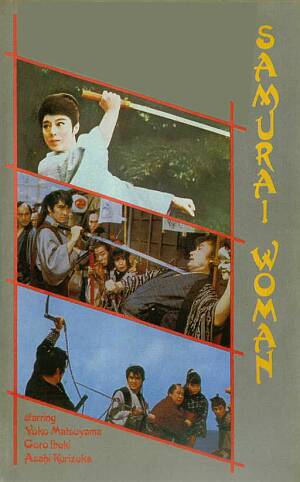
In its incarnation as Samurai Woman (left), I believe this was the only installment to see a release in the UK. When first seen, over a decade ago, it was unimpressive, and it remains weak, particularly when viewed from an action heroine perspective. But even in general terms, it’s a poor piece of cinematic storytelling.

Dir: Hirokazu Ichimura
Stars: Yoko Matsuyama, Goro Ibuki, Kiyoko Inoue, Asahi Kurizuka
a.k.a. Mekura No Oichi Monogatari: Midare Gasa

Trapped, the Crimson Bat

★★★★

Later that same year (1969), Oichi was back in action, and at the start of Trapped, seems quite content with her life as a bounty-huntress. She has even adopted an orphan, just as she herself was taken in herself, but two things wreck this relatively happy situation. She discovers her protege is really a runaway, not an orphan, and consequently has to abandon her – again, as she was discarded. Worse yet, she incurs the wrath of fellow bounty-huntress Oen (Matsuoka), a kitten with a whip and pockets full of venomous snakes, who leaves Oichi for dead. Luckily, she is nursed back to health by Matsuka (Irikawa), a farmer who doesn’t care about her shady past, and Oichi discovers the joys of a simpler existence – specifically, one not involving the slaughter of criminals for cash. Of course, the inevitable eventually happens: local thug Bunzo (Abe) starts taking the locals’ rice stocks, with Oen closely in tow. No prizes for guessing that the quiet life isn’t going to last long, especially after Matsuka is manipulated by Oen into owing a gambling debt to Bunzo.

This is a fine movie, with Matusoka in particular a grand foil for the heroine, her hair covering one half of her face like a veil, and the other half usually displaying a near-psychotic expression. Oichi’s struggles to leave her past behind feel almost like Shakespearean tragedy, and the final shots of the film, while a sudden way to end, hint strongly at an endless, futile struggle. To paraphrase George Orwell, if you want a picture of the future, imagine a Samurai sword slicing up an opponent…forever. Downbeat? Hell, yes. Wouldn’t have it any other way.

The action is decent too, with Matsuyama definitely operating a step above her first outing; although these aren’t usually so much fights, more the swift dispatch of one or more opponents, that’s par for the chambara genre. Matsuka is somewhat of an enigma as a character – it’s hard to see why Oichi falls for him, and the whole “orphan” plotline is not well handled. In particular, it’s lacking any kind of background, to the extent it feels like an entire film was missing. The rest of the story though, is well-crafted and packs a solid wallop; you could certainly argue that this is the best flight of the Crimson Bat.

Dir: Matsuda Teiki
Stars: Yoko Matsuyama, Yasunori Irikawa, Kikko Matsuoka, Toru Abe
a.k.a. Mekura No Oichi Monogatari: Jigoku Hada

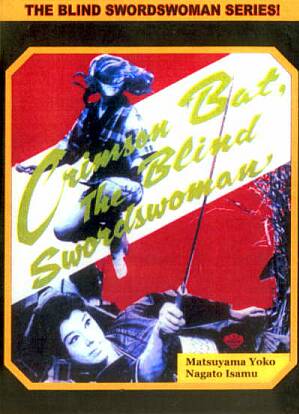
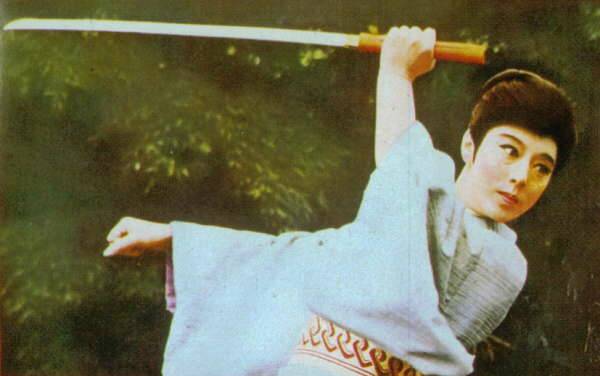
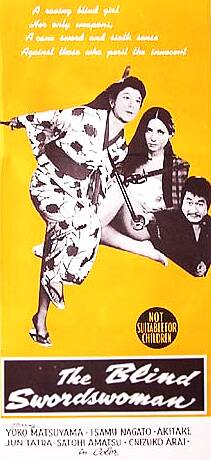
Crimson Bat, The Blind Swordswoman

★★★

We meet our heroine Oichi as a young child, who has just been being abandoned by her mother – not sure what happened to father, but we later discover Mom’s a prostitute, so can probably fill in the blanks ourselves. To make matters worse, the tree under which Oichi takes shelter from a storm is struck by lightning, rendering her totally blind, in a way that’s – probably wisely – left medically unexplained. However, she is then taken in by a kind gentleman, who brings her up, and on into adulthood.

She’s no luckier with her foster parent, who is murdered by a former associate, Devil Denzou (Amatsu); she is saved from the same fate by a wandering samurai. He sees her potential and trains her in the way of the sword, to the point where she has surpassed him. But she mentions the M-word – “marriage” – and he, too, exits like a, er, bat out of hell. On subsequent travels, she uses her skills to save yet another man from being lynched, and eventually, all these disparate plot threads join up, more or less. Though others, such as the woman with a killer yo-yo [GoGo Yubari’s ancestor?] just kinda drift out of the plot.

The film is at its best when there is the threat of violence; much like Sergio Leone, the lead-up lasts much longer than the actual acts, with the director ratcheting up the tension. For example, there’s one scene where Oichi visits a gambling parlour to raise money, and from the moment she sits down, you know it’s just a matter of time before her sword comes out of its red sheath (which presumably is the origin of her name – that, and the copious blood that tends to get sprayed when she’s around). There’s also a nice visual sense at work throughout here, particularly in lighting, which enhances proceedings nicely.

And, being honest, the actual drama needs all the help it can get, since it seems limp in comparison, though allowance should likely be made for the dubbing. That, however, can’t explain the bouncing back and forth in time, which may induce temporal nausea in susceptible viewers; it feels as if the finished film got tossed in the air and is shown in the order it hit the ground. And while there’s a decent “ah-hah!” when everything ties up, this isn’t enough to justify the lengthy set-up. Fewer plot threads, explored in depth, would be a major improvement.

Dir: Matsuda Teiki
Star: Yoko Matsuyama, Isamu Nagato, Jun Tatara, Satoshi Amatsu
a.k.a. Mekura No Oichi Monogatari: Makkana Nagaredoni

The Crimson Bat series

“Up to bat…”

While the samurai is one of the most common archetypes in Japanese cinema, the female version is about as rare as the female gunslinger. Although none of these women reached anything like the popularity of Zatoichi – 26 films starring Shintaro Katsu alone, never mind the recent Takeshi Kitano version – there have been a few that have attempted to break the mould. Azumi and The Princess Blade have both achieved cult status in the West, assisted by Tarantino’s take in Kill Bill, Volume 1. Back in 1973, there was Lady Snowblood, which was successful enough to merit a sequel the following year, but so far, only one samurai-ess series has survived more than two outings.

That swordswoman is Oichi, supposedly based on an animated story and character by Teruo Tanashita – but, really, who are they trying to kid? This was simply the Shochiku’s studio’s answer to Daiei’s Zatoichi, and any protestations to the contrary should be treated with deep scepticism. Both hero and heroine are blind, yet have no problem fighting for truth, justice and the Amer…Japanese way, as they wander through the traditional chambara landscape. [Indeed, in the first film, a blind masseuse wobbles drunkenly through one scene, in what can only be a casual potshot at Zatoichi] Original thought is not something to look for in the Crimson Bat series, even ardent fans will admit. However, Shochiku did strike gold in Yuko Matsuyama; albeit they didn’t have to look very far to find her, since she was married to character creator Tanashita. I get the feeling Shochiku didn’t exactly over-exert themselves in a star search.

With the success of Kill Bill, it seems a little strange that no-one has seen fit to give Crimson Bat proper English-language distribution. However, we don’t let things like that stop us. :-) While dubbed versions of all four films in the saga are available on the grey market, the bootleg prints seem to have Dutch, or occasionally Greek, subtitles. This lends the whole thing a certain surreal air, though as dubs go, they aren’t bad – an opinion no doubt assisted by the characters, who generally prefer to let their actions speak louder than their words. And since even Alex in Wonderland, pretty much the fount of all GWG wisdom, appears to have missed these, we’re proud to present what is (as far as I’m aware) the first review of the entire series to appear on the Internet.

[August 2005, Bill F writes: “You may be interested to learn that after the last film it was turned into a television series. The film series was produced by Shochiku. The TV series was produced by Toei. Like the films, the TV series starred Yuko Matsuyama. The TV series also starred Hiroshi Fujioka and it ran for 25 episodes (4/12/71 – 9/27/71).”]

  • Crimson Bat, The Blind Swordswoman

    ★★★

    We meet our heroine Oichi as a young child, who has just been being abandoned by her mother – not sure what happened to father, but we later discover Mom’s a prostitute, so can probably fill in the blanks ourselves. To make matters worse, the tree under which Oichi takes shelter from a storm is struck by lightning, rendering her totally blind, in a way that’s – probably wisely – left medically unexplained. However, she is then taken in by a kind gentleman, who brings her up, and on into adulthood.

    She’s no luckier with her foster parent, who is murdered by a former associate, Devil Denzou (Amatsu); she is saved from the same fate by a wandering samurai. He sees her potential and trains her in the way of the sword, to the point where she has surpassed him. But she mentions the M-word – “marriage” – and he, too, exits like a, er, bat out of hell. On subsequent travels, she uses her skills to save yet another man from being lynched, and eventually, all these disparate plot threads join up, more or less. Though others, such as the woman with a killer yo-yo [GoGo Yubari’s ancestor?] just kinda drift out of the plot.

    The film is at its best when there is the threat of violence; much like Sergio Leone, the lead-up lasts much longer than the actual acts, with the director ratcheting up the tension. For example, there’s one scene where Oichi visits a gambling parlour to raise money, and from the moment she sits down, you know it’s just a matter of time before her sword comes out of its red sheath (which presumably is the origin of her name – that, and the copious blood that tends to get sprayed when she’s around). There’s also a nice visual sense at work throughout here, particularly in lighting, which enhances proceedings nicely.

    And, being honest, the actual drama needs all the help it can get, since it seems limp in comparison, though allowance should likely be made for the dubbing. That, however, can’t explain the bouncing back and forth in time, which may induce temporal nausea in susceptible viewers; it feels as if the finished film got tossed in the air and is shown in the order it hit the ground. And while there’s a decent “ah-hah!” when everything ties up, this isn’t enough to justify the lengthy set-up. Fewer plot threads, explored in depth, would be a major improvement.

    Dir: Matsuda Teiki
    Star: Yoko Matsuyama, Isamu Nagato, Jun Tatara, Satoshi Amatsu
    a.k.a. Mekura No Oichi Monogatari: Makkana Nagaredoni

    Continue reading →
  • Trapped, the Crimson Bat

    ★★★★

    Later that same year (1969), Oichi was back in action, and at the start of Trapped, seems quite content with her life as a bounty-huntress. She has even adopted an orphan, just as she herself was taken in herself, but two things wreck this relatively happy situation. She discovers her protege is really a runaway, not an orphan, and consequently has to abandon her – again, as she was discarded. Worse yet, she incurs the wrath of fellow bounty-huntress Oen (Matsuoka), a kitten with a whip and pockets full of venomous snakes, who leaves Oichi for dead. Luckily, she is nursed back to health by Matsuka (Irikawa), a farmer who doesn’t care about her shady past, and Oichi discovers the joys of a simpler existence – specifically, one not involving the slaughter of criminals for cash. Of course, the inevitable eventually happens: local thug Bunzo (Abe) starts taking the locals’ rice stocks, with Oen closely in tow. No prizes for guessing that the quiet life isn’t going to last long, especially after Matsuka is manipulated by Oen into owing a gambling debt to Bunzo.

    This is a fine movie, with Matusoka in particular a grand foil for the heroine, her hair covering one half of her face like a veil, and the other half usually displaying a near-psychotic expression. Oichi’s struggles to leave her past behind feel almost like Shakespearean tragedy, and the final shots of the film, while a sudden way to end, hint strongly at an endless, futile struggle. To paraphrase George Orwell, if you want a picture of the future, imagine a Samurai sword slicing up an opponent…forever. Downbeat? Hell, yes. Wouldn’t have it any other way.

    The action is decent too, with Matsuyama definitely operating a step above her first outing; although these aren’t usually so much fights, more the swift dispatch of one or more opponents, that’s par for the chambara genre. Matsuka is somewhat of an enigma as a character – it’s hard to see why Oichi falls for him, and the whole “orphan” plotline is not well handled. In particular, it’s lacking any kind of background, to the extent it feels like an entire film was missing. The rest of the story though, is well-crafted and packs a solid wallop; you could certainly argue that this is the best flight of the Crimson Bat.

    Dir: Matsuda Teiki
    Stars: Yoko Matsuyama, Yasunori Irikawa, Kikko Matsuoka, Toru Abe
    a.k.a. Mekura No Oichi Monogatari: Jigoku Hada

    Continue reading →
  • Watch Out, Crimson Bat!

    ★★

    The third entry in the series saw a new director, and unfortunately, a marked turn for the worse, largely because the focus drifts off Oichi. It starts briskly enough, with the heroine coming into possession of a new, effective formula for gunpowder, something barely known at the time in Japan. Understandably, this makes her the focus of attention, in particular for a group with an interest in profiting from the discovery.

    I have a number of qualms with the storyline here, not least the concept that “weapons of mass destruction” (as gunpowder was, when compared to the arrows and swords prevalent during this era) are safe in any hands. Moral doubts aside, the main flaw is the introduction of characters such as Gennosuke (Ibuku) and, worse still, an immensely irritating pair of teenage orphans. Together, they succeed in making Oichi feel like a supporting character in her own movie, and she is almost entirely absent from action in the middle portion.

    By the time she rides to the rescue…yes, I said “rides”, her previously unmentioned equestrian skills being hand-waved away with “the horse knows where it’s going”…the film is pretty much dead in the water. The final battle does mark another step up in scale, with Matsuyama’s skills again clearly improved, and the quantity of enemies dispatched again setting a high-water mark, even if Gennosuke gets to take out almost as many as Oichi, and the way in which the villainous henchman suddenly switches sides is laughable. In marked contrast to its two predecessors, this does have a proper ending, tying up the loose threads in a satisfying, if conventional, way. It isn’t enough to rescue the day, with interest having succumbed at a disturbingly early point.

    In its incarnation as Samurai Woman (left), I believe this was the only installment to see a release in the UK. When first seen, over a decade ago, it was unimpressive, and it remains weak, particularly when viewed from an action heroine perspective. But even in general terms, it’s a poor piece of cinematic storytelling.

    Dir: Hirokazu Ichimura
    Stars: Yoko Matsuyama, Goro Ibuki, Kiyoko Inoue, Asahi Kurizuka
    a.k.a. Mekura No Oichi Monogatari: Midare Gasa

    Continue reading →
  • Crimson Bat: Wanted, Dead or Alive

    ★★★½

    Director Ichimura returned for the fourth episode, and despite similar problems as the third installment – most obviously, an apparent doubt that Oichi’s character can hold the viewer’s interest by herself – makes a much better stab at things here. Bounty-hunter Oichi finds out what life is like on the other side of the law, after she helps rescue an unwilling bride from a local magistrate; he slaps a 100 gold-piece reward on her head, which naturally, brings other bounty-hunters on her trail, led by Sankuro (Meguro).

    She ends up in a fishing village, where the “evil property developer” subplot makes a surprising appearance, despite the historical era. The reconstruction of the harbour threatens to put the locals out of work, but a plot is afoot among the local authorities to pay them only one gold piece each in compensation, rather than the 15 gold pieces actually provided by the federal government. Residents, officials, bounty-hunters and Oichi all inevitably collide, including one character played by Tetsuro Tamba, who remains even now one of the most respected (and prolific – the IMDB lists 193 films for him!) actors in Japanese cinema.

    There’s a lot of devious double-crossing and deception here, which is okay to watch, but isn’t really the reason we watch these things. And that it also turns out to be Sankuro’s birthplace is too much of a fluke to swallow. Fortunately, it all builds nicely to an extended finale, where our heroine (now also framed for the murder of a village elder) gets a chance to take out her aggression and resentment on all those who have turned her life into that of a hunted animal. It’s a great urban battle, through the town which is being demolished around her, in and out of buildings until she finally confronts the chief villain of the piece.

    Though this was the last entry in the series, there isn’t much sense of closure at the end, with (and I trust I’m not really spoiling this for anyone) Oichi merely walking off into the sunset, alone again, naturally. One senses Shochiku were hoping to continue, but for whatever reason – most likely box-office success, or rather, the lack thereof – it never materialised. However, for a series from the 60’s, it was undeniably ahead of its time, and most of the films have survived the passage of three and a half decades in an impressive style. If any enterprising DVD company were to snap them up, the rewards would likely be significant.

    Dir: Hirokazu Ichimura
    Stars: Yoko Matsuyama, Yuki Meguro, Tetsuro Tanaba, Reiko Oshida
    a.k.a. Mekura No Oichi Monogatari: Inochi Moraimasu

    Continue reading →

The Twins Effect II

★★★
“Film with the trajectory of a ski race; starts off high, goes downhill fast.”

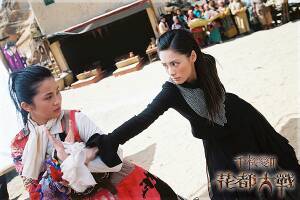
I liked, and enjoyed the original film, and at first, this seems to have a great chance at surpassing it. The opening fight between our two heroines, one (Choi) a slave-trader, the other (Chung) an enforcer for the Empress, is a masterpiece that combines wire-work, CGI and gimmickry – camerawork from Azumi and what looks like a mutant Klingon batleth – to fabulous (if not fully convincing) effect. All this in a mythical kingdom where women rule, and men are reduced to “dumbbells”, while the cast includes both Jackie Chan and Donnie Yen. Even if the connection to the original is tenuous at best, the potential here doesn’t need to be specified.

However, it all goes horribly wrong. Our heroines team up with a pair of jackasses, appropriately named Blockhead (Chen) and Charcoal Head (the talentless Fong, present only because he’s Jackie Chan’s son), and their presence sucks the life from proceedings. One of them – but nobody knows which one – is the ‘Star of Rex’, a future ruler who can defeat the evil empress (Qu Ying) with the aid of the sword, Excalibur. No, really; it must have been on loan from Camelot. As you can imagine, the film proceeds to implode with spectacular speed, a downward spiral that only briefly flattens for a duel between Yen and Chan – the former playing a character called ‘Crouching Tiger, Hidden Dragon’. Oh, hold my aching sides. Even the finale is largely mundane, though the use of an icicle as a weapon by the empress did get our attention.

On the plus side, both Twins put in surprisingly solid performances – Choi, in particular, is much less irritating than before, though remains outshone by Chung. However, they still aren’t enough on their own to sustain a movie, despite the parade of celebrity cameos, especially when co-stars Chen and Fong are woefully short of the mark. With a $10.2 million budget, I just wish they’d spent a few more dollars on the script and some decent actors. Then, it might have lived up to the marvellous first fifteen minutes.

Dir: Patrick Leung, Corey Yuen
Star: Charlene Choi, Gillian Chung, Jaycee Fong, Wilson Chen Bo-Lin

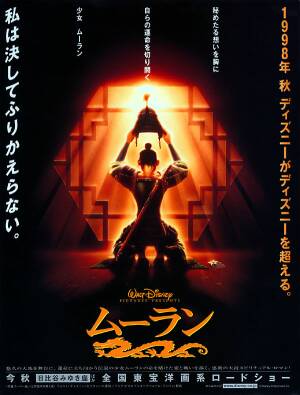
Mulan (animation)

mulan1★★★★½
“Here be drag-ons…”

Disney movies are not the usual place to find action heroines: their classic woman is a princess, who sits in a castle and waits for someone of appropriately-royal blood to come and rescue her from whatever evil fate (wicked stepmother, poisoned spinning wheel, etc.) that has befallen her.

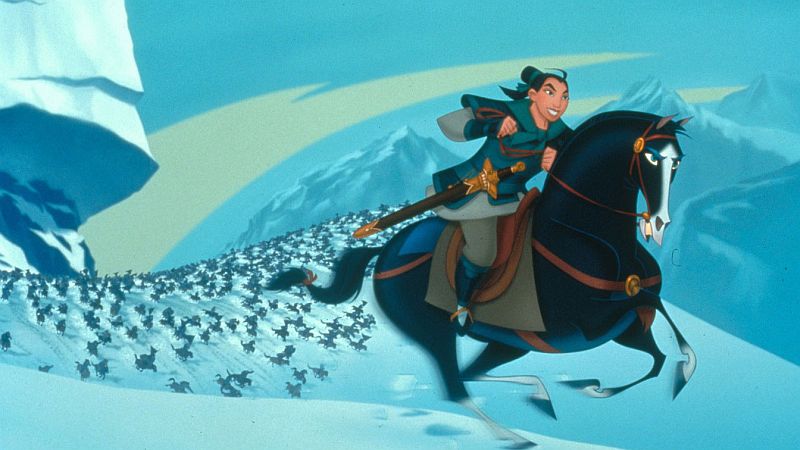
The first inklings of a change to this traditional attitude came in 1991 with Beauty and the Beast, where Belle was an independent-minded young lady who rejected the advances of the handsomely square-jawed hero, because he was an idiotic jerk. Unfortunately, the moral was somewhat diluted by the end when – and I trust I’m not spoiling this for anyone – the Beast turns into a rather convincing facsimile of said handsomely square-jawed hero. So, looks are everything, after all… Much more successful was their 1998 attempt, Mulan, recently released for the first time on DVD, which took a traditional Chinese legend about a girl who dresses as a man to join the army, and converted it into the traditional Disney animated feature format, complete with songs and amusing sidekick. Given the studio’s previous track record (hey, why bother paying writers to come up with new stories, when there’s public domain ones to rape?), qualms here are understandable. Perhaps most memorably, Disney gave Hans Christian Andersen’s The Little Mermaid a happy ending, though turning Quasimodo into a lovable Happy Meal probably comes close – that whirring sound you hear is Victor Hugo spinning in his grave.

And, yes, liberties were taken, though to be fair, you expect this in any screenplay – especially one whose story originally appeared in a poem written by an anonymous Chinese author around the 5th or 6th century AD. [The poem also appears on the DVD, but without any attribution or context; you’d be forgiven for thinking it was written by a Mousketeer] From here sprang a whole raft of tales, with different eras, locations or surnames, largely dependent on the author’s feelings, but having several common threads. The story takes place over more than a decade, and Mulan’s identity isn’t discovered until she has finally returned home and resumed her normal life.
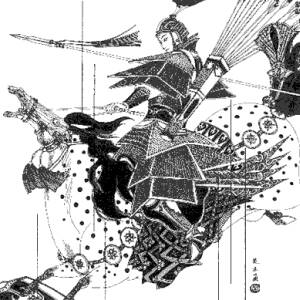
There’s also no threat of execution when her deception is found out – Chinese culture may perhaps actually have a more tolerant approach to such things, though this is admittedly going only by the likes of Peking Opera, and a good chunk of Brigitte Lin’s career. And, of course, both the romantic angle and amusing sidekick were modern additions. This contrasts sharply with one version of the original, which has the Emperor hearing of Mulan’s exploits, and demanding she becomes his concubine. Mulan commits suicide in preference to this fate, an ending that, for some reason, didn’t make it into the Disney adaptation…

Perhaps the surprising thing is that there haven’t been more movie adaptations of the story – contrast the literally hundreds of movies based on Wong Fei-Hung. There have been a couple, most notably 1960’s The Lady General Hua Mu Lan, directed by Yue Fung, and starring Ling Buo as Mulan (real-life husband Jing Han played General Li). Before that was Maiden in Armor starring Nancy Chan, made in 1937, largely as propaganda to rally the Chinese against the Japanese. The most recent version was in 1999; Yang Pei-Pei’s 48 episode TV series starred Anita Yuen as Mulan [photo, right]. However, over the past couple of years, no less than three versions have been rattling around in development hell. The most eagerly anticipated one stars Michelle Yeoh as Mulan, with Chow Yun-Fat co-starring. The director is uncertain (Peter Pau and Christophe Gans are most often mentioned) and production still hasn’t started, even though it was announced back in July 2001; recent reports now have it scheduled to begin filming early next year.

Stanley Tong has also been working on The Legend of Mulan; the original plan was to shoot this in English, with Lucy Liu and The Rock as Mulan and the Hun general respectively, but this may have fallen through; with Tong now working on the next Jackie Chan film, this one seems to be on the back-burner. Finally, a Korean version, with either Jeon Ji Hyun (My Sassy Girl) or Zhang Zi-Yi, was scheduled, but not much has been heard about this lately. The Disney version, on the other hand, just came out on DVD for the first time – in part, I suspect, to act as marketing for the forthcoming, inevitable Mulan II. The trailer for the sequel is on the Mulan DVD, but Lady and the Tramp II, The Little Mermaid II, The Hunchback of Notre Dame II and Aladdin II should give you an idea of how wonderful Mulan II will be. [It’s going straight to video, of course, but it does at least have Ming-Na Wen. No Eddie Murphy though.]
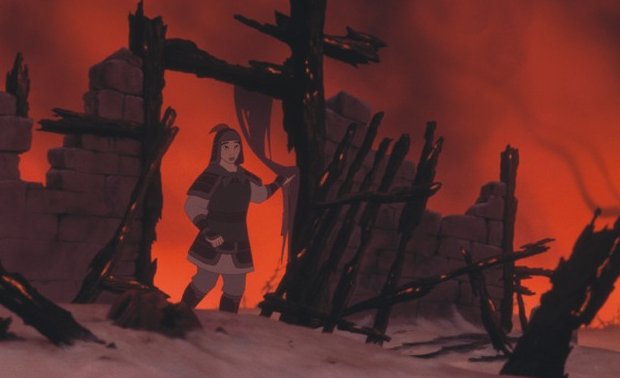
That’s a shame, because the original still has a great deal to offer. Unlike many Disney films, the songs don’t bring proceedings to a grinding halt and are notably absent from the second half of the film. Indeed, the transition is deliberately abrupt: a band of happy, singing warriors is stopped mid-verse when they come across a burnt-out village which the Huns have exterminated (right). It’s a simple, but highly effective moment, where silence says a lot more than any words. [At one point a song for Mulan about the tragedy of war was considered, but this was dropped, along with Mushu’s song, Keep ‘Em Guessing – both decisions which can only be applauded.]

Obviously, in terms of action, it’s hamstrung by the G-certificate (though the British censors insisted on a headbutt being removed to get the equivalent ‘U’-rating), but allowing for this, it’s still got some exciting scenes, and the first encounter between Mulan and the Hun army is fabulous by any measure. It also avoids the pitfall of many a Disney film – making the villains more memorable than the main characters. [Everyone remembers Cruella DeVille from 101 Dalmatians; but can you name the hero?] Here, Shan-Yu is almost a caricature, but does what’s necessary quickly, allowing the other characters to be developed more completely, and compared to other Disney heroines, Mulan may be the most well-rounded human being.

Of course, Eddie Murphy comes close to stealing the show as demoted family guardian, Mushu. Unlike Shrek, where the competition for laughs with Mike Myers was painfully clear, Ming-Na Wen is content to be the straight “man”, and the film benefits as a result. Murphy’s accent is entirely anachronistic, naturally, but that’s half the fun – interestingly, the American DVD offers the option of a Mandarin soundtrack, which is a nice option. We did try it for a bit, but the Chinese Mushu just didn’t have the life and energy of Murphy, and we soon switched back. [HK singer CoCo Lee plays Mulan, while Jackie Chan is the voice of Shang in both this and the Cantonese versions] The tunes are perhaps not quite “classic” Disney, in the sense that they don’t stay in your brain for years after, to explode at the most inappropriate moments. They’re still fairly hummable though, and Jerry Goldsmith’s Eastern-tinged score compliments the similarly Oriental-flavoured animation well. The makers clearly did a lot of research, thought it does have to be said, the film does not exactly portray Chinese culture in a particularly good light; Mulan, the heroine, is shown as rebelling against it in almost every way. One reviewer describes its basic theme as, “a woman with western values overcoming the oppression of a backwards Chinese civilization.” Ouch.
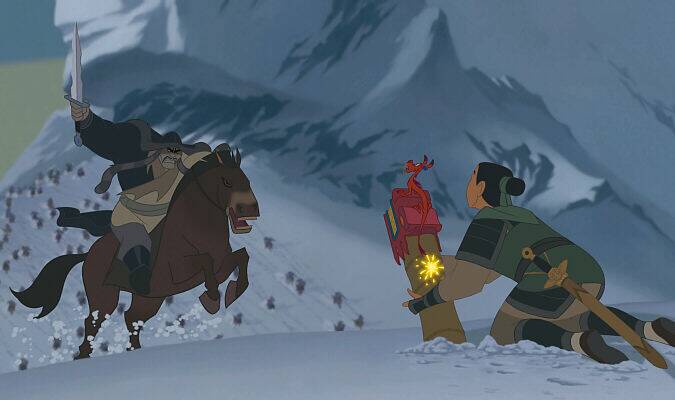
However, personally, I’d say the value of having a clearly non-Caucasian heroine (a first for any Disney film) outweighs relatively minor quibbles about subtext. It may be the last great hand-drawn animated feature from the studio which invented the genre, and all but defined it for sixty years, so I have absolutely no hesitation in recommending this as an empowering and highly entertaining tale for children – of any age, but especially those too young to read subtitles. There aren’t many action heroine films our entire family loves, but Mulan is definitely high on the list.

Dir: Tony Bancroft and Barry Cook
Star: Ming-na Wen, Eddie Murphy, B.D.Wong, Soon-Tek Oh

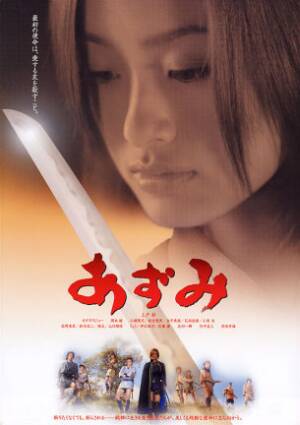
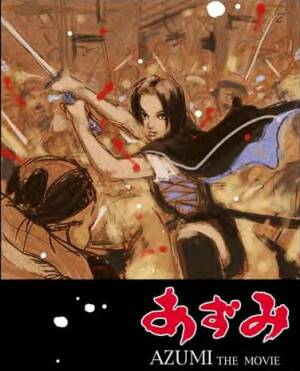
Azumi

★★★★½
“No matter how much I try to escape, I can’t avoid it… I am forced to kill.”

The moment that I heard this female samurai pic was from the director of Versus, I started drooling uncontrollably. [See the Trash City review for why] And if the end product is a slight disappointment, it is only because it doesn’t quite replicate Versus‘ imaginative splatter. Sure, the body-count is massive – it makes The Bride vs. The Crazy 88’s look like Lilo and Stich – but I wanted, and expected, arterial spray. Lots of arterial spray. However, in every other way, this is excellent.

Azumi (Ueto) is one of ten orphans, raised by a warrior (Harada) for a mission to slay the warlords who have thrown Japan into chaos. At the risk of stating the bleedin’ obvious, this won’t be easy. Indeed, at one point, Azumi abandons her samurai ways and tries to be semi-normal, joining the sole survivor of a travelling circus. This doesn’t work out, needless to say, leading to the quote above.

Cutting to the chase; the action is excellent, with several sequences which would be fitting climaxes to any other movie. When you see this one’s finale, you’ll realise why they’re not: Azumi’s master is captured, and an entire town of sword-wielding rogues and assorted scum is in her way, plus villain #1, a rose-wielding psychopath who dresses in white (Odagiri). Settle back, and pass the popcorn. While the swordplay itself is mostly nothing special (save one Very Special decapitation), Kitamura captures it beautifully, the visual highlight being a full circle around two characters – vertically. The sound is also fabulous; you could close your eyes and just listen to the battles.

Especially early on, the pacing is kinda slow (it is a 143-minute movie), but Kitamura’s fabulous sense of style means you’re never bored. The villains, in particular, are all larger-than-life characters and enormous fun to watch – for example the Sajiki Brothers, who attack anyone even faintly resembling their target. Curious to know the budget: I’ve heard both “low” and “high”, without specific figures. Certainly, it looks amazing, every bit the equal of The Last Samurai, though I doubt it cost a fraction of $140m. If any 2004 Hollywood action heroine can match Azumi, I’ll be very, very impressed.

Dir: Ryuhei Kitamura
Stars: Aya Ueto, Yoshio Harada, Joe Odagiri, Masato Ibu