Ink Mage
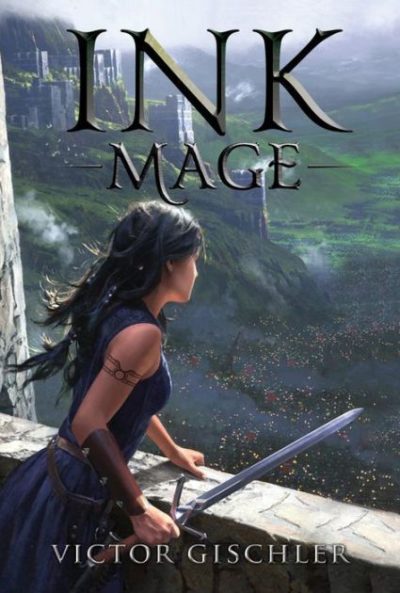 The small duchy of Klaar has been impervious to invasion, due to a secure location offering limited access. But when betrayal from within leads to its fall, to the vanguard of an invading Perranese army, heir apparent Rina Veraiin is forced on the run. She is fortunate to encounter one of a handful of people who know how to create mystic tattoos that will imbue the recipient with magical abilities. With her already significant combat skills radically enhanced, and her body now also blessed with a remarkable talent to heal, Rina can set about trying to recover her domain. It won’t be easy, since the king is not even aware the Perranese have landed. But she has help, albeit in the motley forms of a stable boy – sorry, head stable boy – a gypsy girl and a noble scion, whose charm is exceeded only by his ability to irritate.
Despite the young age of the protagonist, who is still a teenager, this isn’t the Young Adult novel it may seem. It’s rather more Game of Thrones in both style and content, with the point of view switching between a number of different characters. Some of these can be rather graphic, particularly the story of Tosh, an army deserter who ends up working as a cook in a Klaar brothel. But even this thread turns out more action-heroine oriented than you’d expect. For the madam gets Tosh to train the working girls in weaponcraft, so they can become an undercover (literally!) rebel force against the Perranese. Can’t say I saw that, ah, coming…
Gischler seems better known as a hard-boiled crime fiction author – though I must confess to being probably most intrigued by his satirical novel titled, Go-Go Girls of the Apocalypse! The approach here does feel somewhat fragmented, yet is likely necessary, given the amount of time Rina spends galloping around the countryside. It may also be a result of the book’s original format as a serial. However, it translates well enough to a single volume, and I found it became quite a page-turner in the second half. There, Rina readies her forces to return to Klaar, and take on the occupying forces, which have settled in for the winter.
The tattoo magic is a nice idea, effectively providing “superpowers” that can help balance out the obvious limitations of a young, largely untrained heroine. It is somewhat disappointing that, after significant build-up involving the Perranese’s own tattooed warrior, the actual battle between him and Rina seemed to be over in two minutes – and decided through an external gimmick, rather than by her own skill. In terms of thrills, it’s significantly less impressive than a previous battle, pitting her against a really large snake, or even the first use of Rina’s abilities, which takes place against a wintry wilderness backdrop – more GoT-ness, perhaps?
Such comparisons are unlikely to flatter many books, and this is at its best when finding its own voice, as in the tattooing, or the gypsies who become Rina’s allies. He does avoid inflicting any serial cliffhanger ending on us, instead tidying up the majority of loose ends, and giving us a general pointer toward the second in the three-volume series. Overall, I liked the heroine and enjoyed this, to the point where I might even be coaxed into spending the non-discounted price for that next book.
The Tattooed Duchess
A Painted Goddess
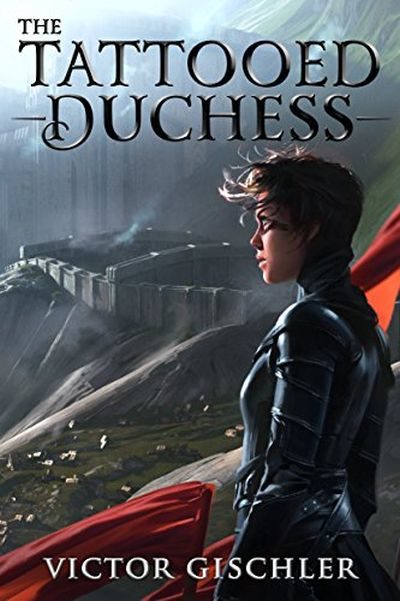 It makes sense to treat the second and third volumes in the series as a single entity. Ink Mage worked on its own as a one-off, with a beginning, middle and reasonably well-defined end, and the eight-month pause between installments was not a problem. Duchess and Goddess, however, really need to be read back-to-back. Mage ended with Rina Veraiin having recovered her family’s territory of Klaar, thanks largely to the magical tattoos covering her skin. But the new duchess is discovering that fighting to get territory is one thing, ruling over it on an everyday basis, quite another. Especially since the Perranese invaders repelled in the first volume, are on their way back with a vengeance. For their Empress Mee Hra’Lito needs a big win to keep control of things on her side of the ocean.
Rumbling in the background, and coming to a head particularly in Goddess, is a changing of the guard in the Kingdom of Helva’s divine pantheon, with the current incumbent as top god being challenged for that position. Disturbingly, the likely replacement is the god of war: never a good thing, especially when he can raise an army of unstoppable dead soldiers and send them after Rina and her allies. Dealing with both those threats, requires Rina to ink up some more. Since she’s otherwise engaged, that means sending expeditions to the furthest corners of the lands and beyond, to retrieve the templates needed for Rina’s power-ups. [Though part of the problem is, these don’t come with instructions, explaining what a tattoo will do…]
In particular, off to the Scattered Isles go stable-boy Alem, who carries a torch for Rina, and gypsy girl Maurizan, who is interested, both in Alem and getting some magic ink of her own. Meanwhile the noble Brasley and a new character, near-immortal female wizard Talbun, are exploring the depths – or, rather, heights – of the Great Library. This is a building so vast, it remains largely unexplored, with its origins and contents lost in the mists of time. Rina, meanwhile, is on a diplomatic mission, aimed at securing support for Klaar, only to be abducted by a group of Perran soldiers and their own mages, left behind when the army withdrew.
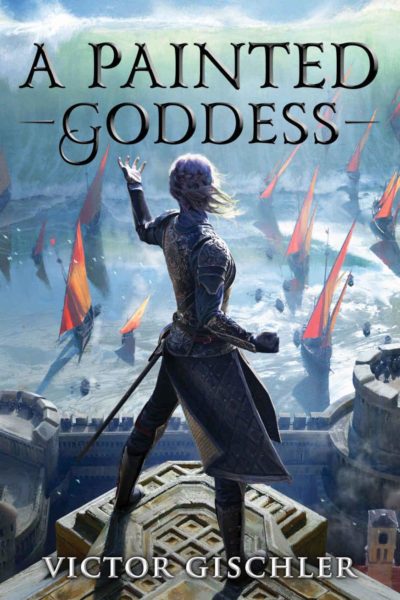 Especially in the second volume, poor Rina is largely relegated to a supporting role. The major threat to her is, not deities or monsters, but the arguably more insidious danger of an arranged marriage, necessary for the defense of Klaar. Maurizan becomes the action heroine focus, supported by members of the “Birds of Prey”, ex-prostitutes who have become the castle guard, as well as Talbun. It’s decent, yet almost inevitably, suffers from the bane of trilogies, “second volume syndrome”, lacking both a beginning an an end [I will say, for understandable reasons, explained by the author on his site]. It was originally published in serial format, so feels a bit episodic too, though I can’t say this impacted my enjoyment particularly much.
Rather than having to wait for the next part, as readers at the time had to do, I was able to head straight on into volume three. And Gischler redeems himself admirably for any flaws, with an excellent final volume. Rina has pretty much completed her set of tats, now possessing superhuman strength, speed and healing, as well as the ability to have anyone believe what she says, plus more. However, there’s a darker side to her talents, which becomes apparent to everyone when the Perranese lay siege to the port of Sherrik. With great power comes… scary responsibility, it appears: Rina has to make some unpleasant decisions about how far she is prepared to go, in order to repel the massive invading fleet. And they aren’t even her toughest adversary.
There are a lot of disparate elements across the series, yet Gischler melds them together into a coherent whole, rather than feeling like he’s simply plugging in fantasy tropes. I was particularly impressed by how even minor characters feel well-developed, such as Mee Hra’Lito. She didn’t need to be in the book at all, being simply the force behind the big bad (or more accurately, the secondary big bad). Yet seeing her motivations, adds depth to proceedings and enhances the epic scope. On the other hand, perhaps the series’s main weakness is lacking a truly central character. Is this Rina’s story? Alem’s? Maurizan’s? The answer is both all of the above, and none of them.
Still, this is the first true series I’ve completed since beginning book reviews on the site, and I’ve certainly enjoyed the experience. Gischler hinted at further volumes in February, saying of his universe, “I feel there’s more there to be mined,” and I wouldn’t mind in the slightest – even if Rina’s role would need… let’s say “serious revision”, based on how this ends, and leave it at that. Or a Peter Jackson trilogy of films based on these: that’d do, just as well.
Author: Victor Gischler
Publisher: 47North, available in both printed and e-book versions, as folllows:




 This slice of British televisual fantasy was offered up on Christmas Day, and provides a pleasant, warm and unchallenging slice of family fare. It takes place in a world where magic has ruled, but is gradually fading from consciousness and being replaced by technology. The magic appears connected to the dragons with which humanity shared the planet, uneasily. After previous battles, a kind of apartheid was set up, with the world divided into dragon and human areas. Overseeing the peace is the Dragonslayer, who is charged with killing any dragons who violate the treaty and attack humans or their territory. But some members of mankind are casting envious eyes on the unspoiled territory of the dragons, and would love an excuse to take it over.
 My name is Alyse Winters. I used to be a
 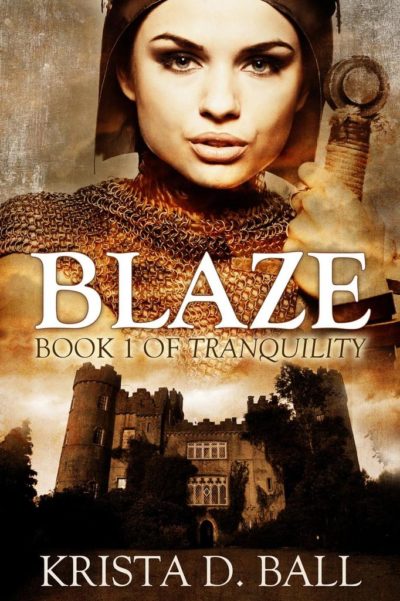 The half-elven Lady Bethany has shattered the glass ceiling for women in the military forces, rising to third in command, a position she has achieved on her own merit. Of course, it probably didn’t hurt that she is daughter of the goddess Apaxia, although her ancestry causes as many problems as it solves. This is due partly to some pesky secret prophecies which outline – in typically vague prophetic ways, with references to the “Diamond” and the “Viper” – Bethany’s very important place in future events, and partly her estranged twin sister, Sarissa. For she has turned to the dark side of magic, insanely jealous of her sister’s success, with the emphasis squarely on “insanely” there…
 I was one of the few who didn’t mind
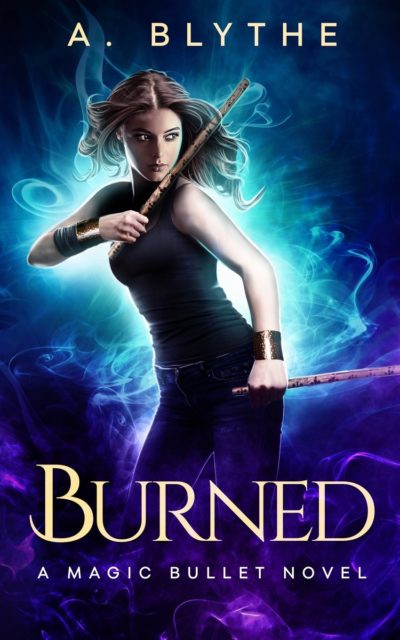
 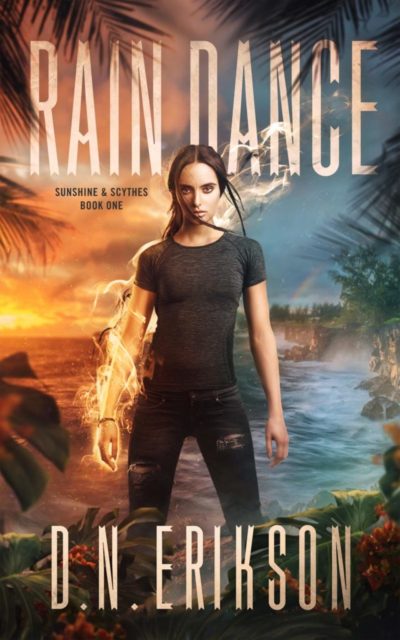 The saying, “You only live twice,” is supposed to be a metaphor, but for Eden Hunter, it ends up being very much a statement of fact. She’s a former con-artist, dragged back from beyond the grave by vampire warlord, Aldric. He puts her to work on a hidden island as his personal soul-harvester, with a strict quota per week. It’s not great work, but it’s steady – at least until Eden’s beach-front house is attacked by a werewolf with murder on its furry mind. She then finds herself seen by the FBI as their prime suspect after an old partner in confidence tricks turns up dead on her doorstep. But, wait! There’s more! She has to deal with the rain goddess – presumably, the source of the title – to whom Eden is also in thrall, and whose rules she just broke. A gang involved in robbing her boss of millions in gold bullion. Her dead sister. A serial-killer politician. Oh, and a talking cat.
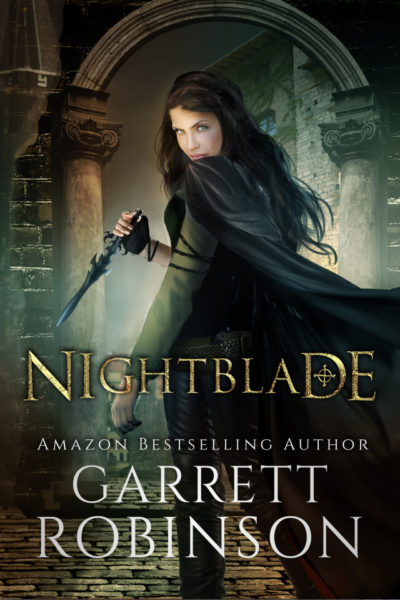 One of the common problems I’ve found with fantasy novels is establishing the universe. It’s clearly going to be very different from the reader’s, and the author needs to get them up to speed on how things work in the book’s setting. If this isn’t done quickly and effectively, the reader can be left floundering in a world they know nothing about. Robinson uses a neat trick to get around this. His heroine, Loren, basically knows nothing about it either, because she has been brought up in a remote rural area. Virtually all she knows about life outside the woods comes from tales told to her by an itinerant tinker, and her dreams of becoming a heroic thief seem no more than fantasies.
 It’s probably worth noting that although this is Volume 1 in the somewhat clunkily-named “Dragon’s Gift: The Protector” series, it follows in the wake of two other Dragon’s Gift threads by the same author, The Huntress and The Seeker. While you don’t need to have read those to enjoy this, it does explain a structure, which could seem somewhat odd. For the volume sets up a trio of treasure-hunting magicians – Cass, Del and Nix – then all but discards the first two and concentrates heavily on Nix. Turns out Cass and Del were the subjects of the Huntress and Seeker sagas respectively, and the Protector gives Nix her turn in the spotlight. This is why some aspects, such as the shop run by the three women, seems more than a bit undeveloped: I presume they were featured in the ten or so previous volumes set in the same world.
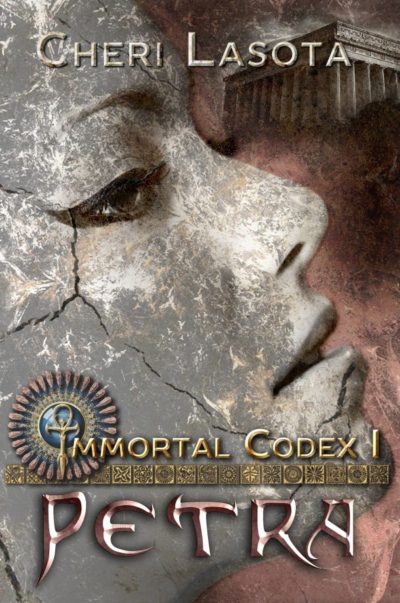 Petra is a teenage Roman slave at around the birth of Christ. She is completely under the thumb of her sadistic master, Clarius, until a strange conjunction of events and a poisonous herb with mystical qualities changes the power dynamic entirely. Both of them, together with her lover, Lucius, attain immortality. But it’s an immortality which requires the two men to drink from Petra annually, or they will degenerate into sub-human monsters. Neither is happy with the arrangement: Clarius is not used to being reliant on anyone, least of all his former property, and Lucius hates the fact Petra agreed to submit to their ex-master, in order to save him. As the centuries stretch into millennia, Petra begins, slowly, to put together a group people who will be capable of defeating Lucius and the immortals he has recruited, allowing her to live in eternal peace with Lucius.