
Princess Mononoke

★★★½
“Princess Die”

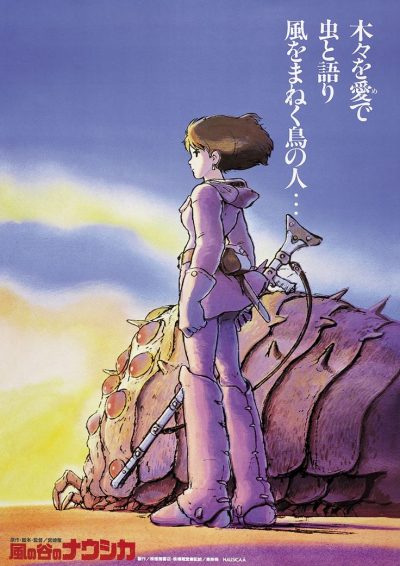
To some extent, this was the film which “broke” Miyazaki in the West, being his first feature to receive an unedited theatrical release in America. It wasn’t a huge commercial success, taking only about $2.4 million in North America. But it was very well-received, Roger Ebert listing it among his top ten films of 1999. It likely opened the door for the success of Spirited Away, which would win Miyazaki the Oscar for Best Animated Feature at the 75th Academy Awards. But if I’m being honest, I don’t like it as much as many of his movies. While there’s no denying the imagination and enormous technical skill here, it doesn’t resonate emotionally with me in the same way. I think it’s probably the central character, who is relatively bland and uninteresting, even compared to other characters in the movie.

Firstly though: no, there’s no-one called “Mononoke” in this. It’s not a name, but a Japanese term describing a supernatural shape-shifting creature. Though even this seems ripe to cause confusion, because there are no shape-shifting princesses to be found either. And despite the title, the protagonist is Ashitaka (Matsuda), a prince of the Emishi tribe in medieval Japan, whose arm becomes infected after an encounter with a demon-possessed wild boar. As happens… Seeking a cure before the rest of his body follows suite, despite the superhuman strength it gives him, Ashitaka heads into the Western lands, and straight into the middle of an ongoing battle.

On one side is Lady Eboshi (Tanaka), the ruler of Irontown, a progressive and industrial settlement, in need of the resources which can be found in and under the nearby forest. On the other is San (Ishida), a young woman raised by wolves, who has vowed to protect the woods and their inhabitants, including the Great Forest Spirit. It’s their conflict which is really the core of the film, with Ashitaka’s quest to get his demonic arm fixed, taking a back-seat for most of the (lengthy, at 133 minutes) running-time here. Probably for the best, since he is, as mentioned, perhaps the least charismatic or engaging protagonist in the entire Miyazaki canon. His arm is easily the most interesting thing about him – and that keeps wanting to strike out on its own. When your own limb wants to go solo, you might be the problem… To quote Lady Eboshi, “I’m getting a little bored of this curse of yours, Ashitaka. Let me just cut the damn thing off.” #ImWithTeamEboshi

But enough of him. Let’s focus on what works here, which would be San and Eboshi. The first time we see San, her face is smeared in blood which she has sucked up and spat out, from a wound in the side of a gigantic white wolf. [This is certainly the most hardcore of Miyazaki’s films, with decapitations and limbs being lost at a rate closer to an entry in the Lone Wolf & Cub franchise.] She’s relentlessly aggressive in attitude, going so far as to stage a one-woman assault on Irontown in an attempt to assassinate her enemy. She tells Ashitaka, “I’m not afraid to die. I’d do anything to get you humans out of my forest.” That said, she’s still considerably less creepy than the forest apes who want to eat him.

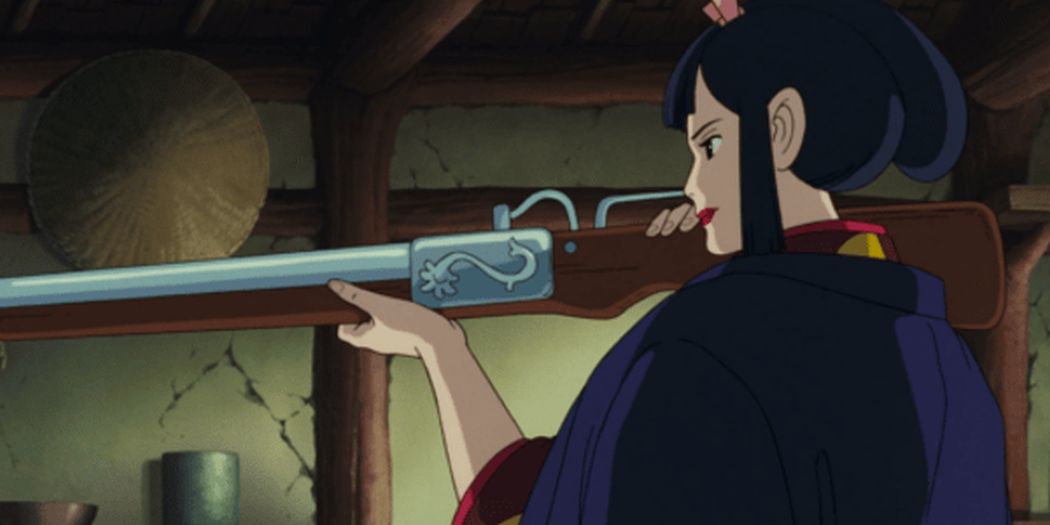
Eboshi, on the other hand, is a complete contrast to the near-feral San, and remarkably progressive, especially considering the era and location. Her town is a haven for the disenfranchised and those society considers “untouchables”, including both lepers and prostitutes, the latter whose contracts she bought out and who now work in her iron mill. Her citizens and their welfare are what she cares about, above all, and she’s completely fearless about who she has to go through for that purpose. “She’s not even afraid of the gods, that woman,” says one of Irontown’s residents about their ruler, admiringly. They aren’t wrong, for she subsquently tells her warriors, “I’m going to show you how to kill a god, a god of life and death. The trick is not to fear him.” It’s remarkably easy to envisage a version where the roles are reversed, and she is the heroine. The fact she’s a gun enthusiast, is just a bonus!

Ashitaka’s role is largely to act as a middleman between the two worlds: somewhat more than human, yet less than divine. That remains the case even at the end, as he agrees to spent part of his time in the forest with San, and part of it working alongside Lady Eboshi in Irontown. It’s potentially an awkward and unsatisfying compromise, storywise, yet Miyazaki makes it work better than you feel it should.  But there are a couple of perplexing missteps too. For one, when the animals of the forest are talking, there’s zero effort to make their lips synch up. It’s bizarre and distracting. And in the Japanese version, the voice of San’s wolf mother, Moro is a man. Someone known in Japan as a drag queen, admittedly – but a man none the less, a weird choice which confused the heck out of me [score one for the dub, at least, which had Gillian Anderson as the character]

The overall result is undeniably beautifully animated, and epic in its scope and invention. As ever, Miyazaki excels at creating a world which is like our own, yet simultaneously completely alien. However, it all gets rather wearing, especially at the length depicted here. My attention simply ran dry during the second half, as the multiple different factions began hacking or gnawing away on each other, with the personal and intense quality of the Eboshi/San conflict getting lost in the bigger picture. It’s in putting over the intensely personal elements of large stories, that Miyazaki is unsurpassed – never mind just in animation, among film-makers as a whole. This isn’t the best demonstration of his talents in that area.

Dir: Hayao Miyazaki
Star: Yōji Matsuda, Yuriko Ishida, Yūko Tanaka, Kaoru Kobayashi

The World of Battle Angel Alita

With the release of Robert Rodriguez’s Alita: Battle Angel scheduled for February next year, I figured now would be a good time to take a look at the origins of the character. Where did she come from? What is the world she inhabits like? And what might we expect from the film?

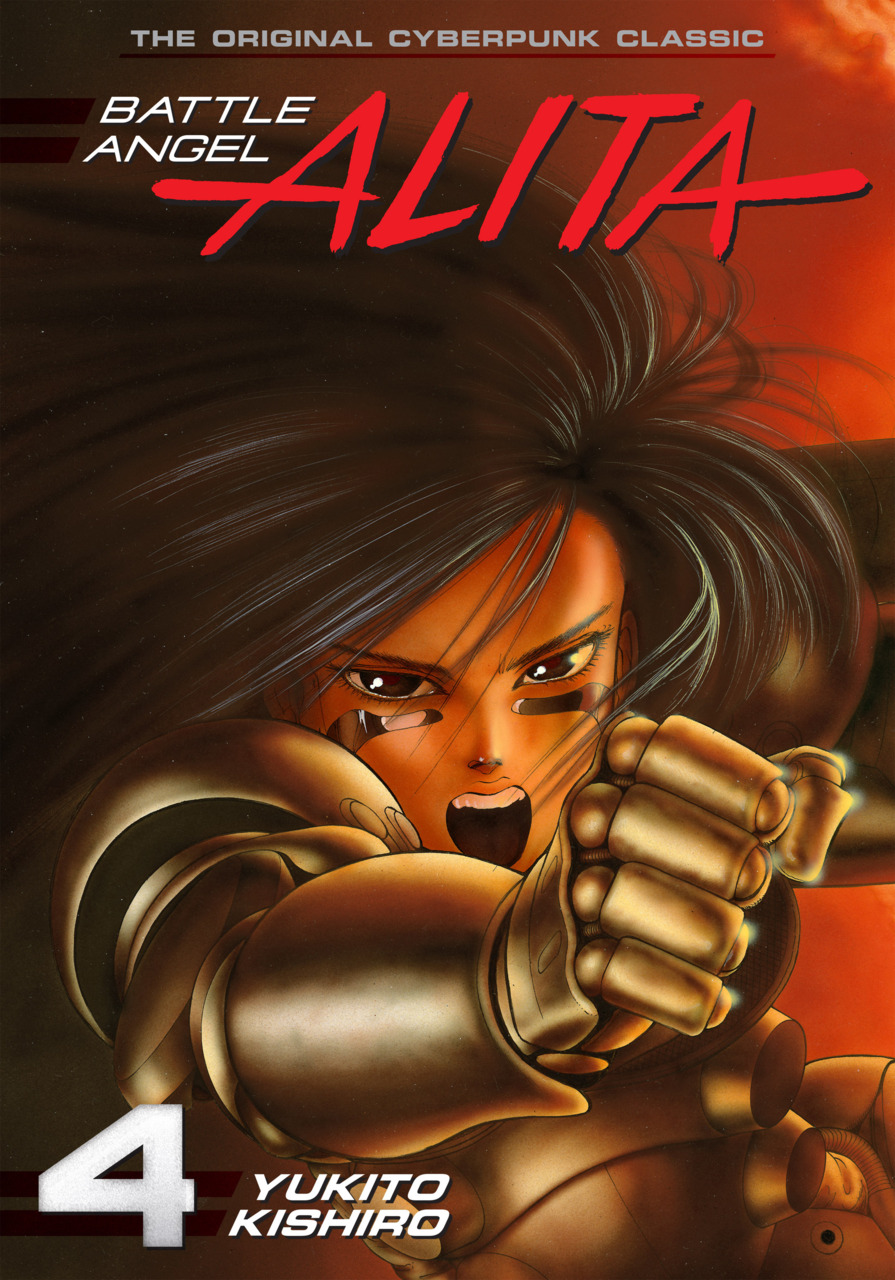
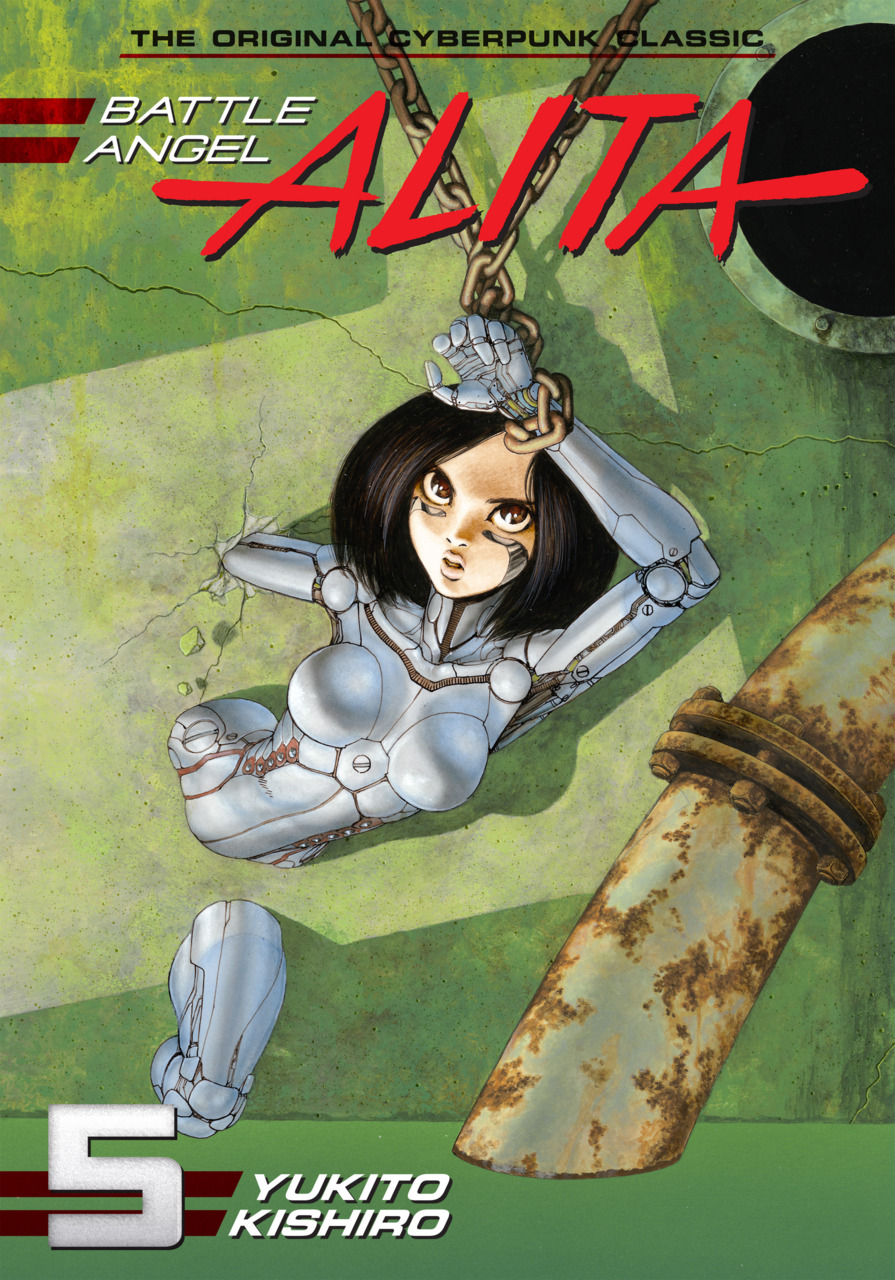
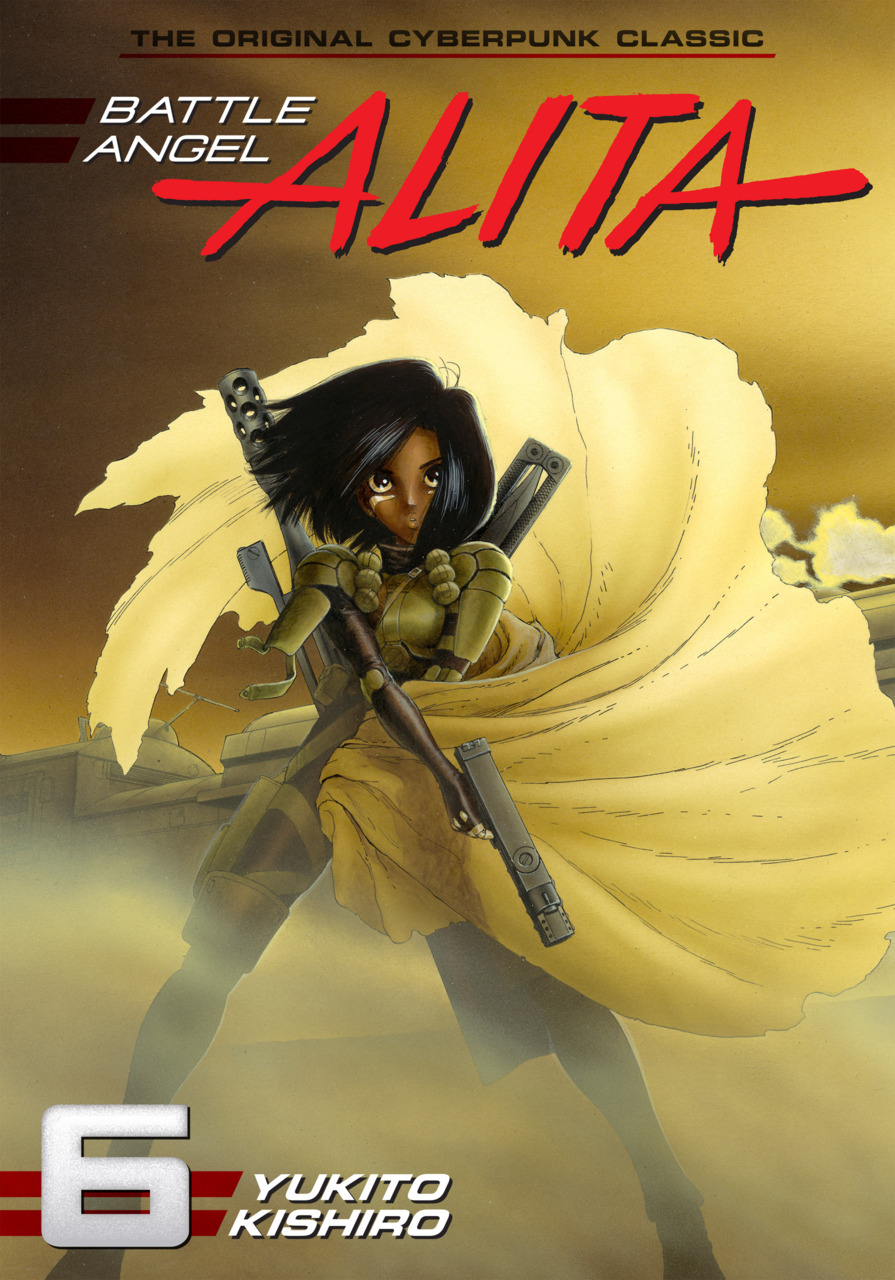
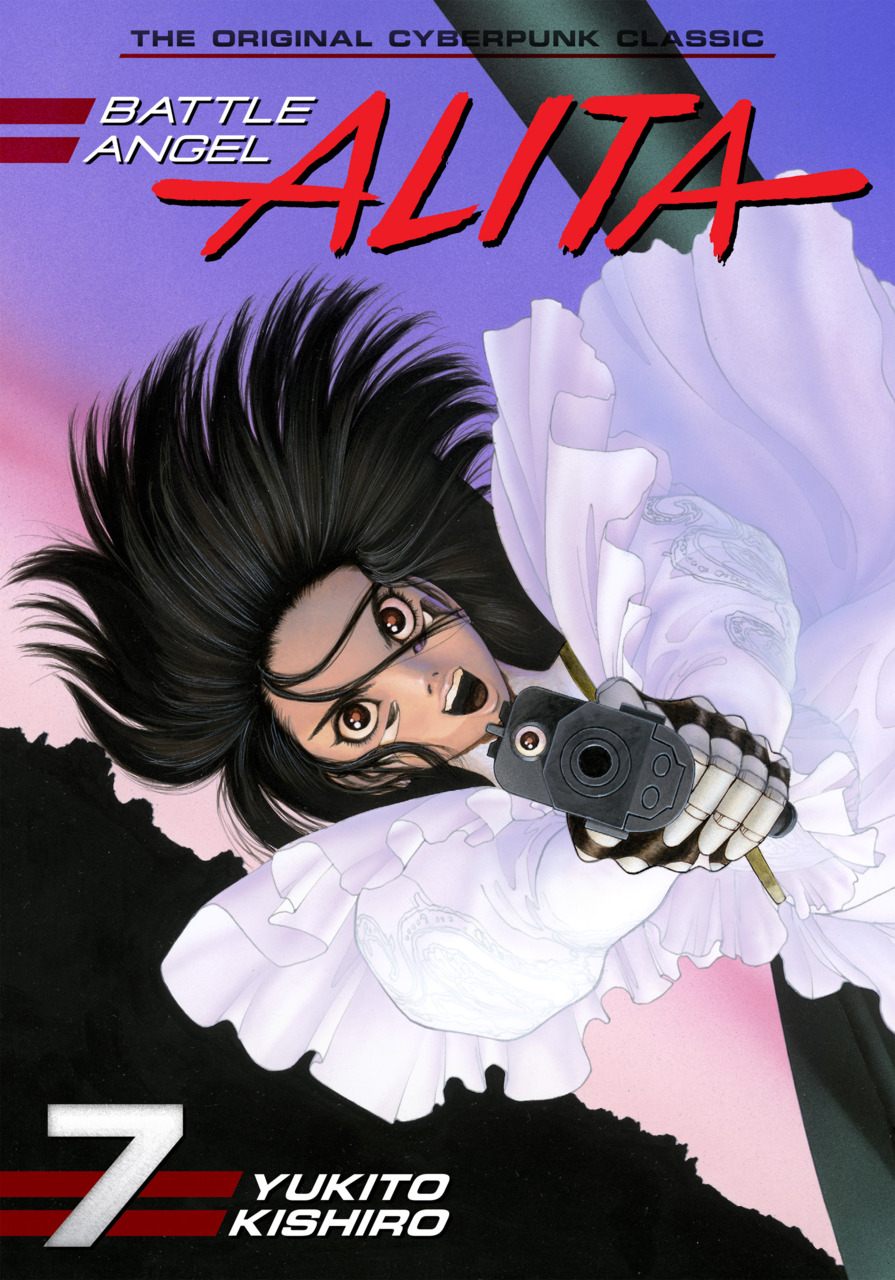
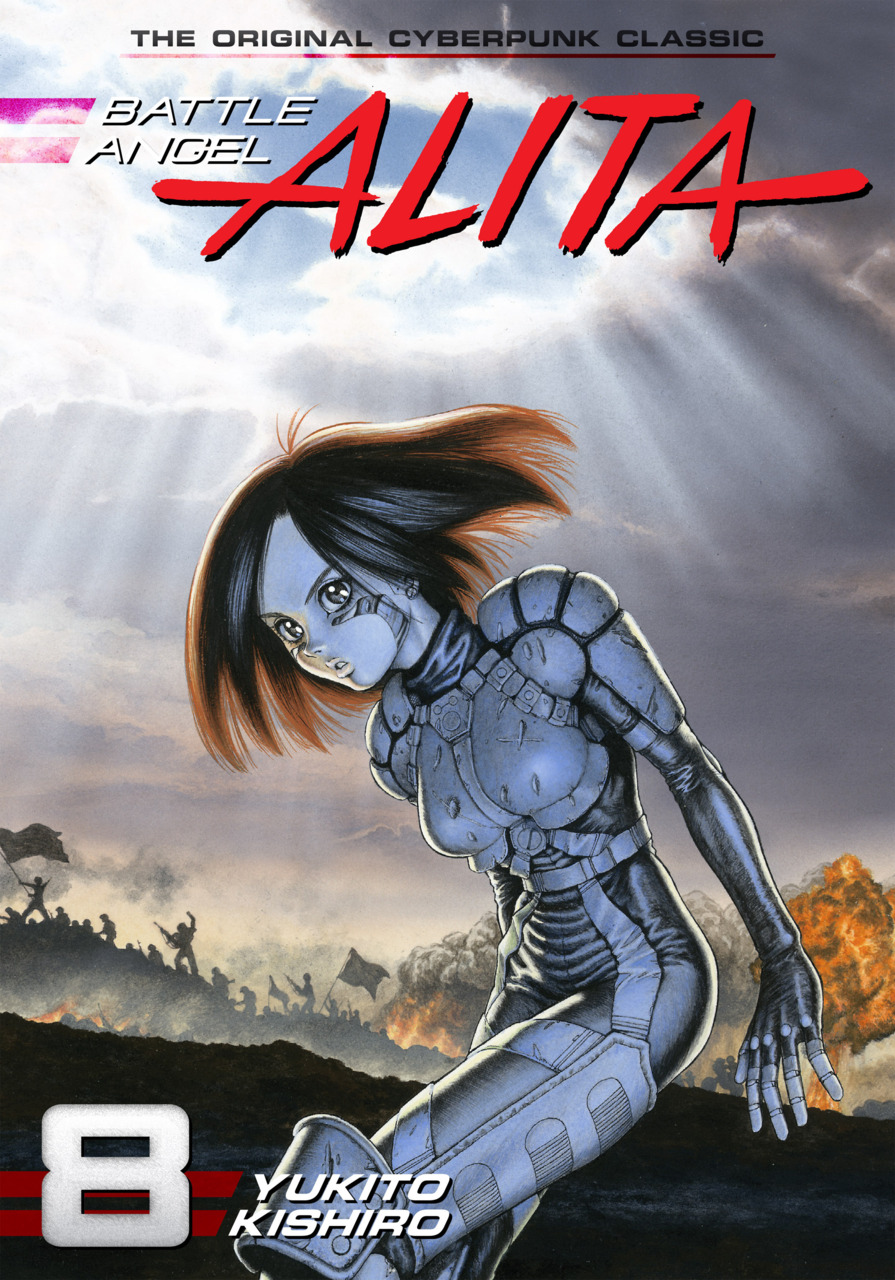
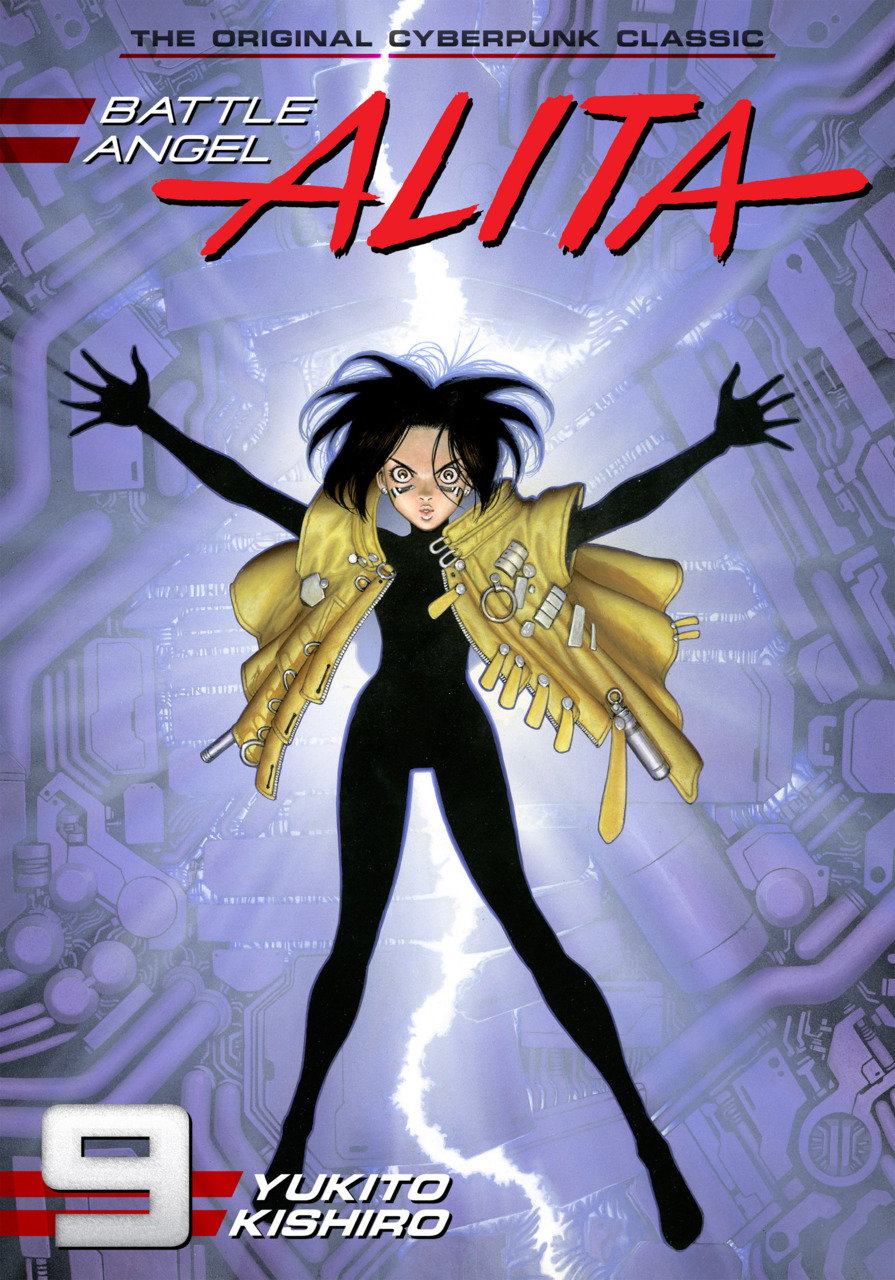
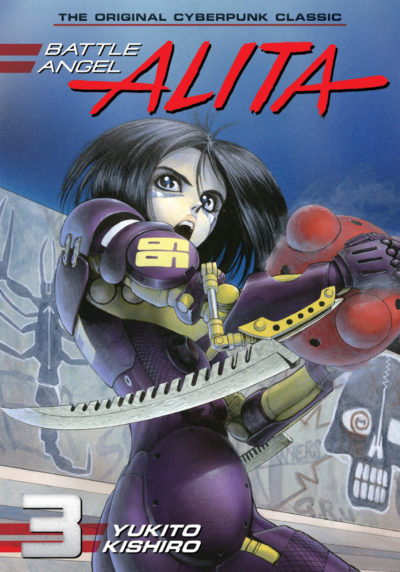
The character was created by Japanese manga artist Yukito Kishiro, with the first installment appearing in Business Jump magazine, late in 1990. The 52 episodes plus an epilogue were then collected into nine volumes, and the story is available in that format, both in Japan and translated into English for a Western audience. There have been some changes made, beginning with the title: in its homeland, the series was known as Gunnm, which translates as “gun dream” [something hinted at by the heroine, who at one point says “I was probably a gun or something in my previous life”]. Alita is known as “Gally” in the original version, and the city hovering over her home town was originally Salem, rather than Tiphares. I’ll be using the English language names.

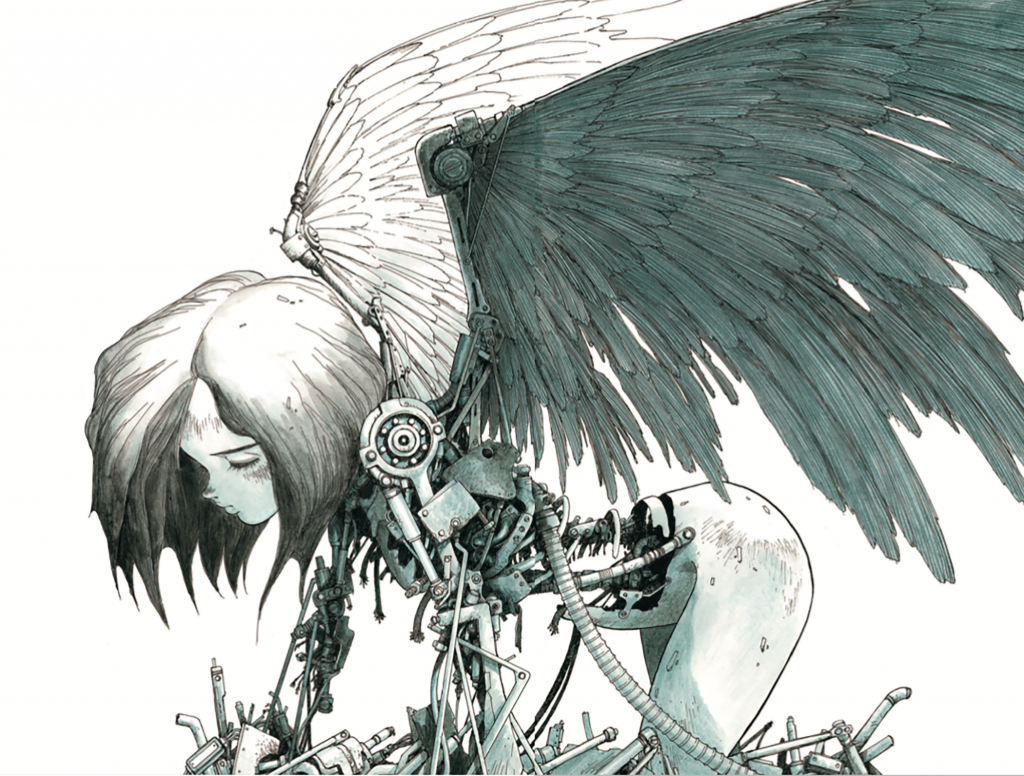
It takes part in a post-apocalyptic version of North America; later installments have said the timeframe is the 26th centure, beginning in the year 2533. The elite have left the surface of the planet, and live in the flying city of Tiphares. Everyone else is still on the ground, supplying the city with all its needs. One of those is Ido, a cyberdoctor exiled from above, who finds a cyborg head in the scrapyard lying beneath Tiphares. He gives it a body, and calls her Alita. Her memories are all but gone; what she does remember, however, is how to fight, being skilled in ‘Panzer Kunst’, a legendary form of martial arts. This stands her in good stead, as she becomes a bounty hunter, tracking down and killing criminals in and around the scrapyard.

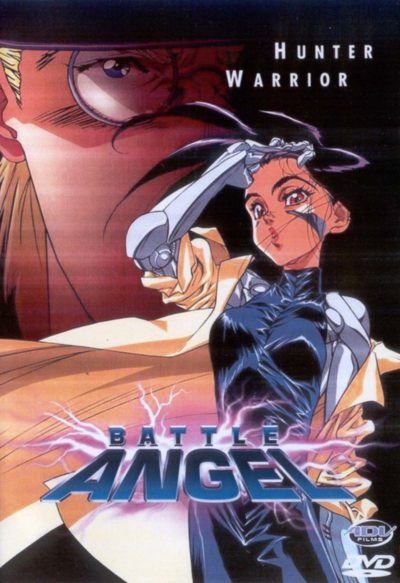
There have been two (or perhaps three) subsequent comic-book incarnations. First was Battle Angel Alita: Last Order, originally published from 2001-14 in Japan. Then came Battle Angel Alita: Holy Night and Other Stories, though this was a collection of four side-stories – hence the “perhaps three”! Most recently, we had Battle Angel Alita: Mars Chronicle (2015-17). Two of the volumes from the first incarnation were adapted into a pair of 30-minute OVAs (Original Video Animation), released in June 1993. Rumblings of a live-action version have been around almost as long, with James Cameron securing the rights to the comic in 1999, having been introduced to the property by Guillermo Del Toro. By the mid-2000’s, a script had been created, but after developing the project in parallel with Avatar, Cameron decided to devote his efforts to that instead, and Alita went on the back-burner.
The massive success of Avatar led to Cameron committing to not one, two or three but four sequels, with releases dates planned out as far ahead as December 2025. Needless to say, that meant he would not be working on Alita any time soon. In 2015, he gave Rodriguez the script to rework, and was reportedly impressed enough by the result, then to hand over directorial control as well. The results are likely to be somewhat different from Rodriguez’s other works, where he typically does the cinematography and editing as well as his directorial duties. Here, those tasks have been delegated, a nod to the scale of the production. At a reported figure of $200 million, it’s not far off the budget of every other Robert Rodriguez movie combined.

It does not appear to have been a trouble-free journey to the big screen. When the first trailer appeared in December 2017, it came under heavy criticism for the enlarged size of the heroine’s eyes. While a standard feature in much of anime, seeing it in a “live-action” production was clearly unsettling to many people. It was notable that, by the time the second trailer arrived in July, adjustments had been made, and the reaction was considerably better. However, by that point the film had already undergone its first change in release date. Originally scheduled to come out on July 20, in February, it was pushed back to December 21.

But in September, Fox moved the release date again, this time to Valentine’s Day, 2019. This seems to have been a decision to back out of a crowded December market, including Aquaman and new movies from the Spiderman and Transformers universes. Moving it lessens the competition, giving it a couple of weeks before Captain Marvel is released. It’ll also become the first foreign movie after Chinese New Year, which may help its prospects there. That’s now almost eight months it has been pushed back, so you can understand some nervousness among fans. Especially given how much is riding on this.

For Alita: Battle Angel will be the most expensive action heroine film of all time, easily surpassing the $160 million cost of The Hunger Games: Mockingjay – Part 2. [I exclude The Force Awakens, as more a Star Wars film with a female lead, than a “true” action heroine film] That, of course, was the final entry in a series which had already proven its worth at the box-office. The market for live-action adaptations of anime out of Hollywood has also been shown to be precariously soft, most recently and obviously by Ghost in the Shell. If Alita reproduced that movie’s performance worldwide, it would not even cover its production costs.

If it flops, this would be a serious setback to future entries: we would potentially be back at the days of Catwoman where received wisdom was that actresses couldn’t carry an action flick. Right now, all we can do is keep our fingers crossed, for to this point, there have apparently been no test screenings of the full movie by which it can be judged. 18 minutes of various scenes was screened at Comic-Con International in July, and reports at that time said “the movie is going to be a combination of the manga and the OVA with elements of the ‘motorball’ storyline.” Let’s take a look at both of those incarnations, and see whether we might be able to learn what the film may contain.

Battle Angel Alita, by Yukito Kishiro

By Jim McLennan

Literary rating: ★★★★
Kick-butt quotient: ☆☆☆☆½

I used to read a lot of comics and graphic novels. But when I moved from London to Arizona in 2000, I all but stopped. There are still boxes in our basement, unopened since then, filled with my comic collection. Rare have been the forays into that culture since, beyond the occasional volume of Dirty Pair, for review purposes. Certainly, nothing as extended as deciding to re-read this in advance of the anticipated release of Robert Rodriguez’s live-action movie. Initially, I feared I had bitten off more than I could chew, when I realized the nine-volume series was a total of over two thousand pages of content. Maybe I should have started reading it before mid-October?

In the end, the release date for the movie got pushed into next year, and I blitzed through the comics at about a volume per day, in virtually my usual reading time. I’d forgotten how pacy comic reading can be: if there’s no dialogue, you scan the panels quickly. It’s not as if you stop and admire them, or worry about what exactly is being portrayed. The intent is almost for the visual aspect to go from the page into your subconscious, so you get a visceral “feel” for what’s happening. That’s especially true for something as heavily action-oriented as this, and Kishiro has an amazing flair for it (not least in the area of sound effects!). If you look at an individual frame, you might not know what’s happening; yet put them together, and almost magically, it becomes a coherent flow.

However, there’s still an amazing amount going on in terms of story-line and universe-building. You can easily see how the feature film will only be able to cover perhaps one-quarter of the series. I presume it will begin with the origin story, in which Ido finds the head of Alita in the scrapyard beneath the floating city of Tiphares, and gives it a cybernetic body. He’s a part-time bounty hunter, only to find out quickly, the combat abilities of his new charge far surpass his own. Unfortunately, she has little or no memory of her prior life; where she got these skills and how she ended up in the scrapyard is only revealed well into the series.
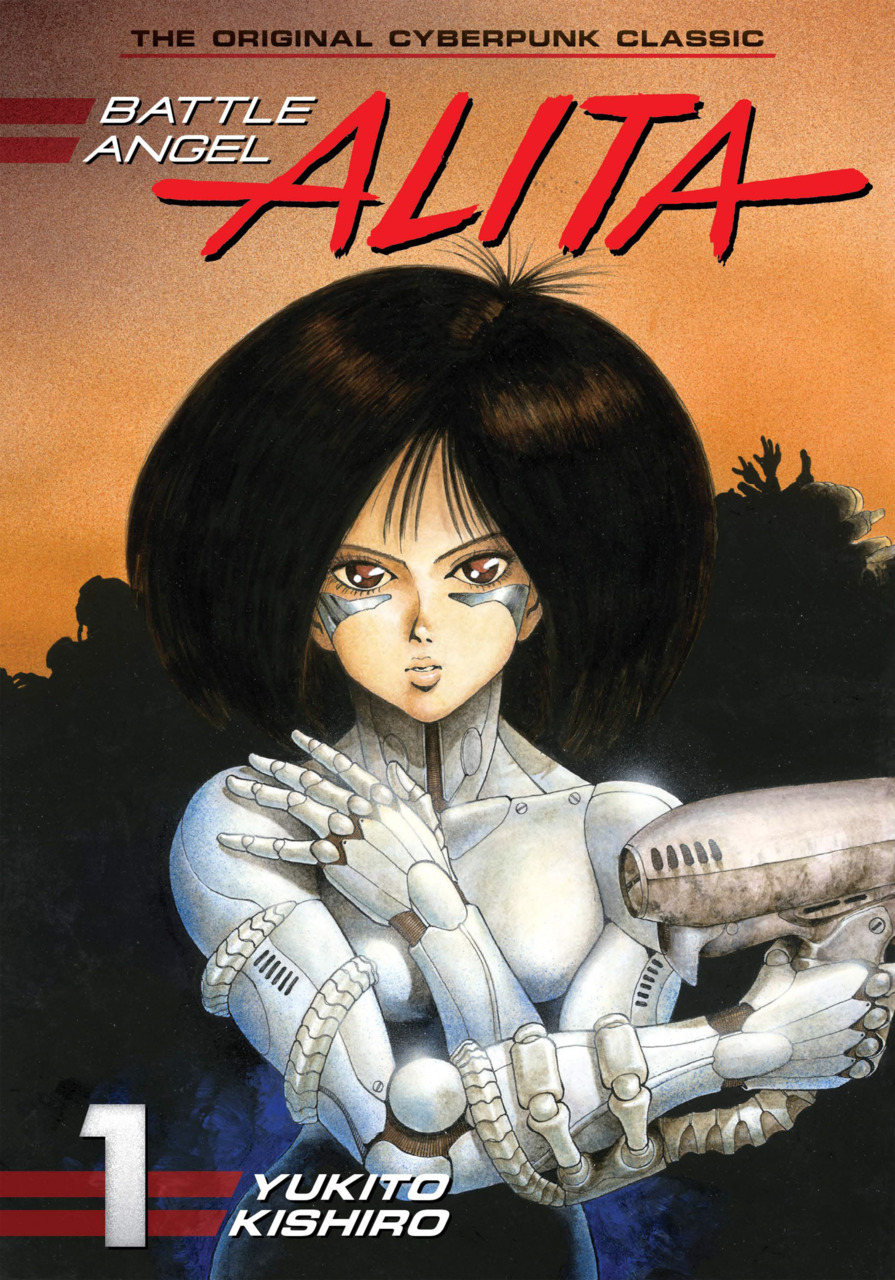
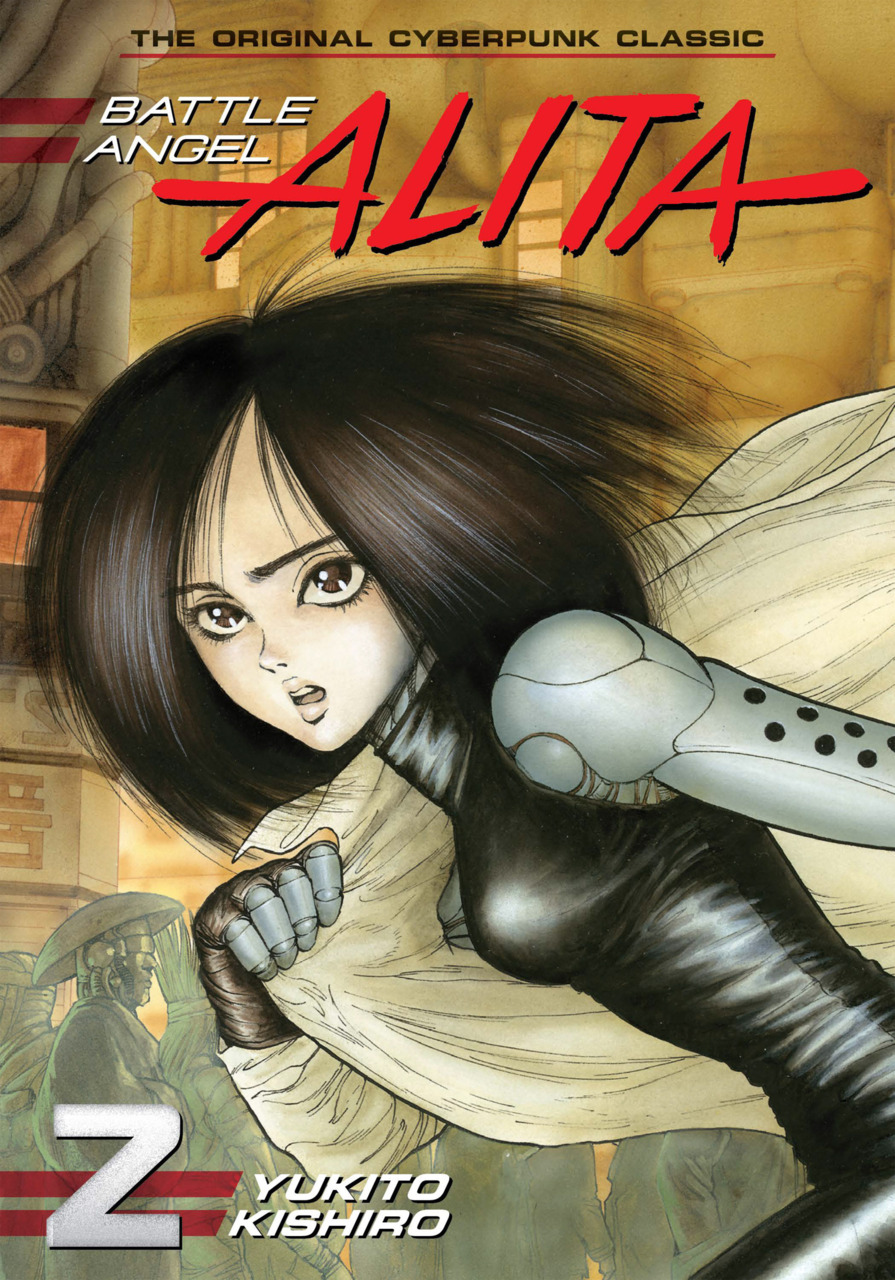
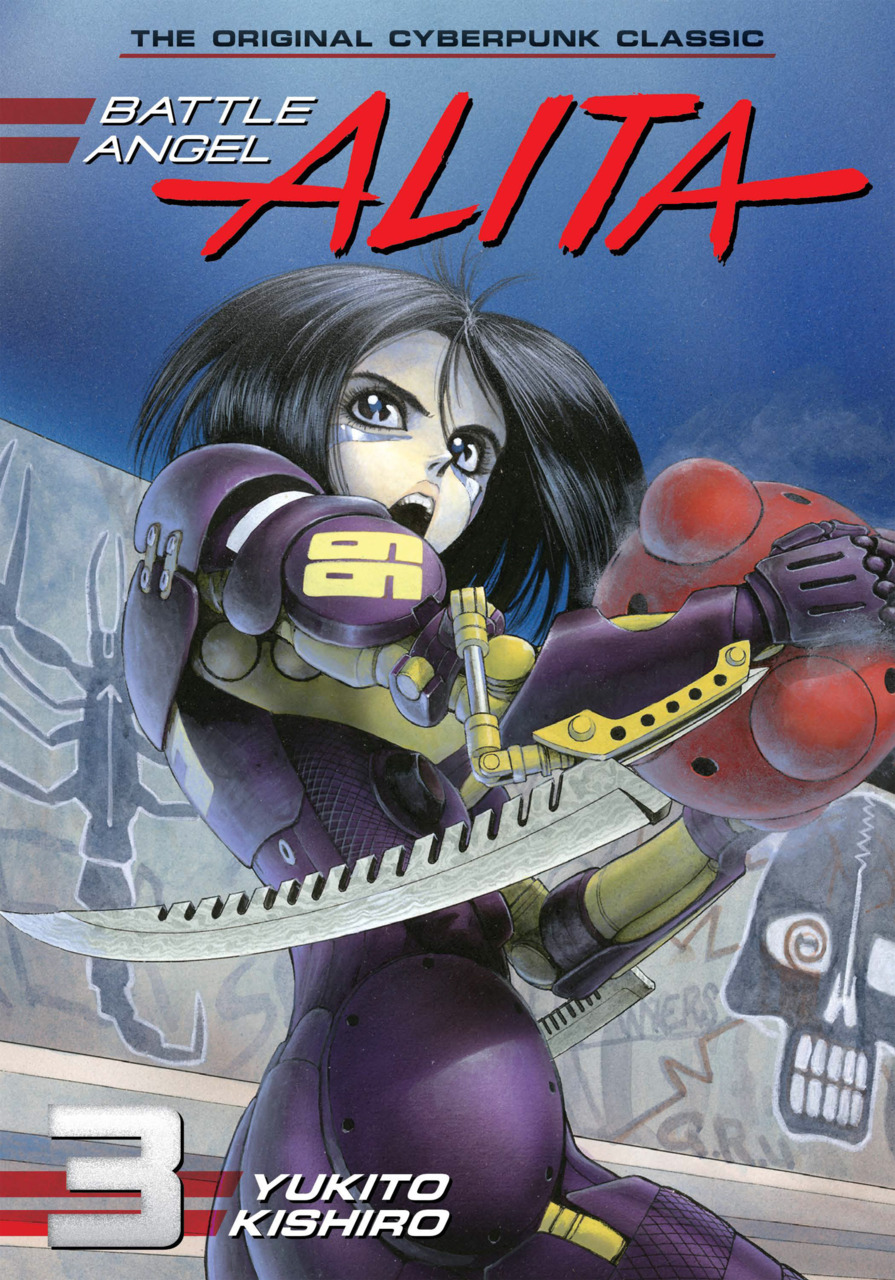
The second volume has her both falling in love, and discovering the pain which love can bring. She is smitten by Hugo, another young orphan of the scrapyard, who is working hard – albeit in some very dubious ways – to raise enough funds to buy a ticket up to Tiphares. When he discovers the truth about his situation, he cracks – and a bounty is placed on his head. The end result is romantic tragedy of a high order, and also drives Alita away from Ido. That brings her into the middle arc: motorball, a superviolent pastime popular among the scrapyard inhabitants. This occupies the third and fourth volumes: Alita climbs the sport’s ladder towards the elite players, and ends up facing off against its brutal champion, Jashugan. It appears this is roughly the arcs which will be covered in the film version, though I’m not sure how far they’ll get into the motorball thread.

The second half sees Alita head into the wastelands, in search of Desty Nova, like Ido another Tipharen exile. She has become an agent working on behalf of the floating city, and against the rebel group of Barjack, which is intent on (literally) taking down Tiphares. While this gives her access to help from above, the flow of data goes both ways: if one Alita is good, wouldn’t a dozen of them be better? Through Nova, she discovers the gruesome truth about the citizens of Tiphares, and her convenient amnesia is also cured, with Alita remembering where she came from, as well as finding out the history which led to the current situation on Earth. She’s left to make the ultimate choice: whether to destroy Tiphares or save it.

It having been more than two decades since I last read this, I’d forgotten almost all the details, so the twists and turns proved highly effective once more. There were several moments where I had to put the book down and just absorb what I’d been told, and Kishiro is good at telling the reader the essential information efficiently. However, it’s the action sequences throughout where he really shines, whether it’s the motorball contests, or the escalating series of battles in which Alita finds herself involved. For no matter how powerful she may become, there’s always someone bigger and badder – likely culminating in Den, leader of the Barjack rebels. Imagine a pissed-off half-horse, half-Transformer. Yeah, he’s like that.

While they certainly would not be cheap, there’s enough material here for a whole franchise of live-action movies, if the first one is a success (fingers crossed, though I’m not optimistic it’ll take in the half-billion or more needed for it to turn a profit). I’m really looking forward to seeing what Robert Rodriguez can do with the adaptation, on the largest cinema screen I can find. Hopefully his vision of Tiphares, the scrapyard and Alita is able to live up to the impressive world created by Kishiro.

Author: Yukito Kishiro
Publisher: VIZ Media LLC, available through Amazon, both as a paperback and an e-book

Battle Angel: The OVAs

By Jim McLennan

★★★½
“Sweet, yet too short.”

Watching this after having read the manga version, it feels like the anime version can do little more than scratch the surface of the world of Tiphares, in the barely fifty minutes it has to work with across its two OVA (Original Video Animation) volumes. The stories here, originally released in 1993, cover the first two section of the manga, and it looks like much of what we see here will also be included in the live-action film next February. Slightly confusing matters, is the way this uses the original Japanese names. So Tiphares becomes Zalem here, and Hugo is Yugo. Most oddly, the heroine is not called Alita – hence the absence of her name from the title – but Gally. To avoid further confusion, I’m going to be consistent with our other articles on the topic, and stick to the translated ones for what follows.
We see Ido (Kariya) discover the head of Alita (Itou), and almost before we can blink, it’s back to being fully functioning. He’s a part-time cyber-doctor, part-time bounty-hunter, and after Alita follows him – suspecting he’s a killer who is stalking the streets of the scrapyard – she ends up rescuing him from the real killer. She also meets and falls for Hugo (Yamaguchi), a young man desperate to get out of the scrapyard, by any means necessary – a fact that proves to be the source of his downfall in the second OAV. Not present in the manga is the character of Chiren (Koyama). Like Ido, she’s a refugee from Tiphares, who resent his cyber-medical skills and wants to prove herself superior. To do so, she rescues gladiator Grewcica and sets him against Ido’s creation, Alita.

For something a quarter-century old, the animation has stood the test of time well. This is notable in the first part, and especially the battles between Alita and Grewcica, which remain more than capable of getting the blood pumping. The look of the scrapyard and Tiphares have been transferred nicely. The colours feel like your imagination told you they should, from the b&w manga, and even the sound design adds to the atmosphere, both in Kaoru Wada’s score and the groans of the pipes connecting Tiphares to the scrap-yard.

The problem, I think, is a script which doesn’t have enough room to develop the characters and their interactions. Especially short-changed is the relationship between Alita and Hugo, which feels like it goes from zero to passionate love (on her side, at least) in no time at all. As a result, you’re left to wonder why she’s prepared to go to such lengths for him, though his eventual fate remains poignant – not least the addition of a little flourish at the end, where Ido and Alita send up a balloon in his honour. I probably would have felt kinder towards these episodes if I’d seen them before reading the original source material; as is, while solid enough, I can’t help feeling there’s something missing.

Dir: Hiroshi Fukutomi
Star (voice): Miki Itou, Shunsuke Kariya, Kappei Yamaguchi, Mami Koyama

Battle Angel: The OVAs

★★★½
“Sweet, yet too short.”

Watching this after having read the manga version, it feels like the anime version can do little more than scratch the surface of the world of Tiphares, in the barely fifty minutes it has to work with across its two OVA (Original Video Animation) volumes. The stories here, originally released in 1993, cover the first two section of the manga, and it looks like much of what we see here will also be included in the live-action film next February. Slightly confusing matters, is the way this uses the original Japanese names. So Tiphares becomes Zalem here, and Hugo is Yugo. Most oddly, the heroine is not called Alita – hence the absence of her name from the title – but Gally. To avoid further confusion, I’m going to be consistent with our other articles on the topic, and stick to the translated ones for what follows.

We see Ido (Kariya) discover the head of Alita (Itou), and almost before we can blink, it’s back to being fully functioning. He’s a part-time cyber-doctor, part-time bounty-hunter, and after Alita follows him – suspecting he’s a killer who is stalking the streets of the scrapyard – she ends up rescuing him from the real killer. She also meets and falls for Hugo (Yamaguchi), a young man desperate to get out of the scrapyard, by any means necessary – a fact that proves to be the source of his downfall in the second OAV. Not present in the manga is the character of Chiren (Koyama). Like Ido, she’s a refugee from Tiphares, who resent his cyber-medical skills and wants to prove herself superior. To do so, she rescues gladiator Grewcica and sets him against Ido’s creation, Alita.

For something a quarter-century old, the animation has stood the test of time well. This is notable in the first part, and especially the battles between Alita and Grewcica, which remain more than capable of getting the blood pumping. The look of the scrapyard and Tiphares have been transferred nicely. The colours feel like your imagination told you they should, from the b&w manga, and even the sound design adds to the atmosphere, both in Kaoru Wada’s score and the groans of the pipes connecting Tiphares to the scrap-yard.

The problem, I think, is a script which doesn’t have enough room to develop the characters and their interactions. Especially short-changed is the relationship between Alita and Hugo, which feels like it goes from zero to passionate love (on her side, at least) in no time at all. As a result, you’re left to wonder why she’s prepared to go to such lengths for him, though his eventual fate remains poignant – not least the addition of a little flourish at the end, where Ido and Alita send up a balloon in his honour. I probably would have felt kinder towards these episodes if I’d seen them before reading the original source material; as is, while solid enough, I can’t help feeling there’s something missing.

Dir: Hiroshi Fukutomi
Star (voice): Miki Itou, Shunsuke Kariya, Kappei Yamaguchi, Mami Koyama

Black Lagoon

★★★½
“Black to basics.”

Thanks to Dieter for pointing me in the direction of this series, whose 24 episodes feel like a bit of a throwback to the days when watching anime felt hard-edged and dangerous, almost a subversive act. Mind you, this actually came out in 2006, so I guess it’s actually something of a throwback, full stop. [Random aside of no relevance to anything much: startled to realize today it’s more than eight years since Salt came out. Would have sworn it was only about three, tops] It’s hyper-violent, clearly for mature viewers only, and its multiple action heroines possess generally poor attitudes. Clearly up my street!

It takes place in what I’m going to assume is a somewhat alternate reality, where the Thai city of Roanapur has become a modern-day equivalent to Tortuga, the 17th-century pirate haven in the Caribbean. It’s a free-fire zone where organized crime operates with impunity, including Japanese, Chinese, Russian, Colombian and Italian groups, along with all the necessary “support services,” from gun-runners to brothels. Lagoon Company are one such, mostly specializing in smuggling goods, people or whatever needs to be moved quietly around. Into this setting falls the unfortunate Rock (Namikawa), a Japanese salaryman on business, whose ship is boarded by Lagoon, and he is taken hostage. After his company abandons him, to conceal the shady business they were doing, he joins Lagoon as an accountant-interpreter-negotiator-factotum. He’s in for a culture shock.

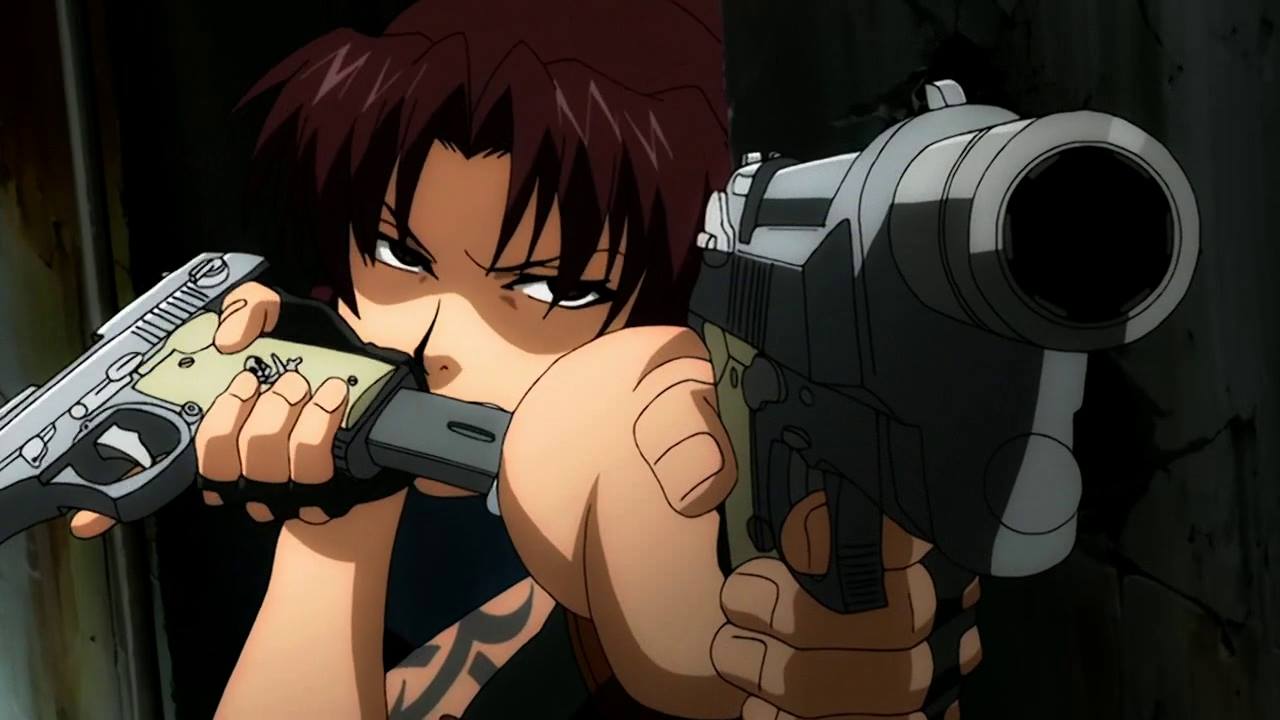
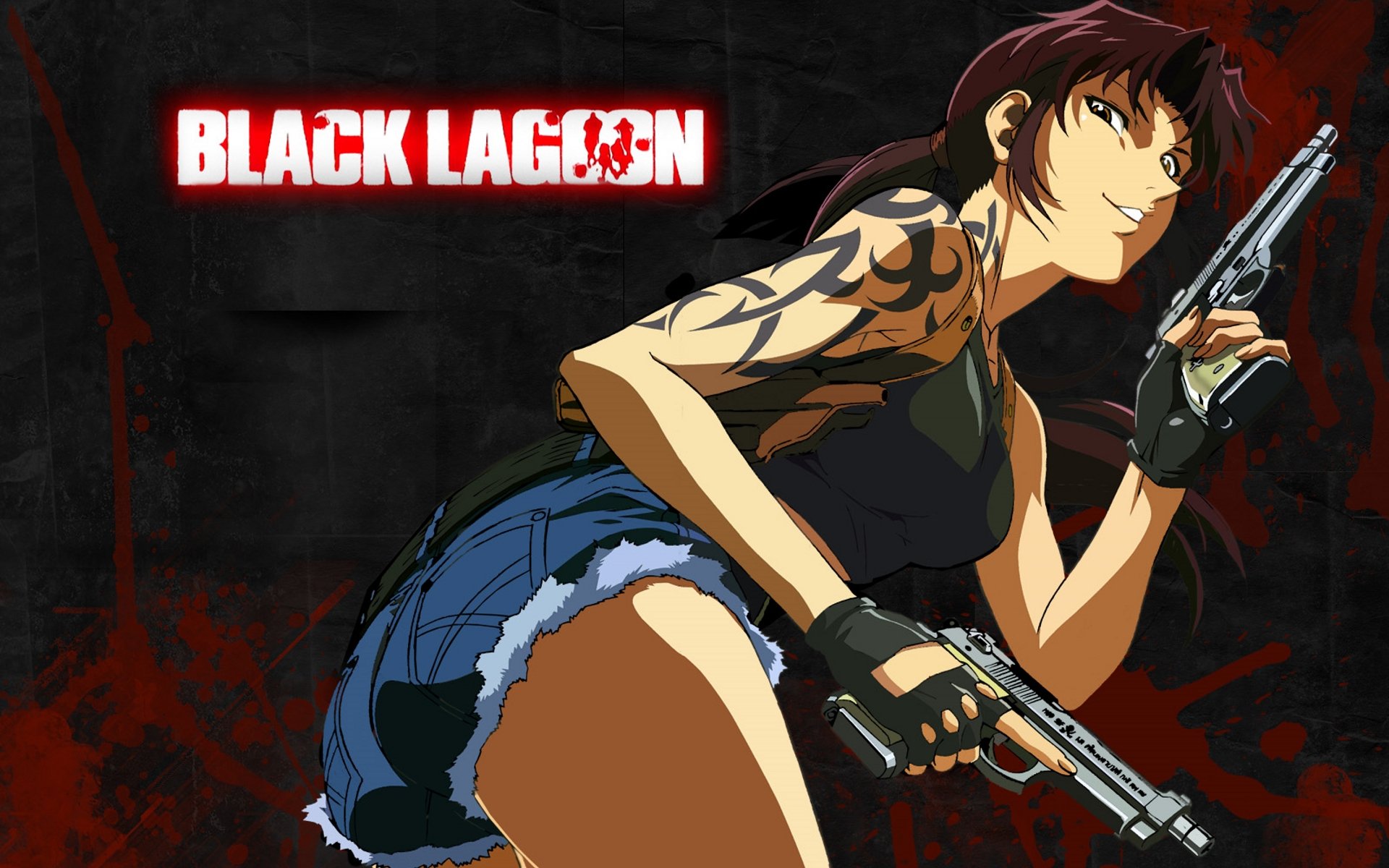
Leading the parade of counter-heroines is the Chinese-American Revy (Toyoguchi), who is Lagoon’s main enforcer, and loves her job, which she carries out enthusiastically, with the slightest provocation. She’s a fascinating character: Revy has absolutely no scruples about blowing away anybody who gets in her way, and in “normal” society would be far beyond the pale. However, in Roanapur, she’s just one among a myriad of similar types – there, scruples are likely to get you killed – and her unswerving loyalty to the rest of Lagoon, and Rock in particular, are a redeeming quality. She prefers to wield, with extreme prejudice and skill, a pair of modified Beretta 92FS’s, and Revy’s ambidextrous skill has earned her the nickname “Two Hand” around town.

If she were the only candidate, this might end up being a bit of a borderline entry, but over the 24 episodes in the two series (there’s another five-episode arc I haven’t seen, Roberta’s Blood Trail, which came out in 2010), Revy is joined by a number of other, morally ambiguous women, all of whom are more than comfortable with firearms:

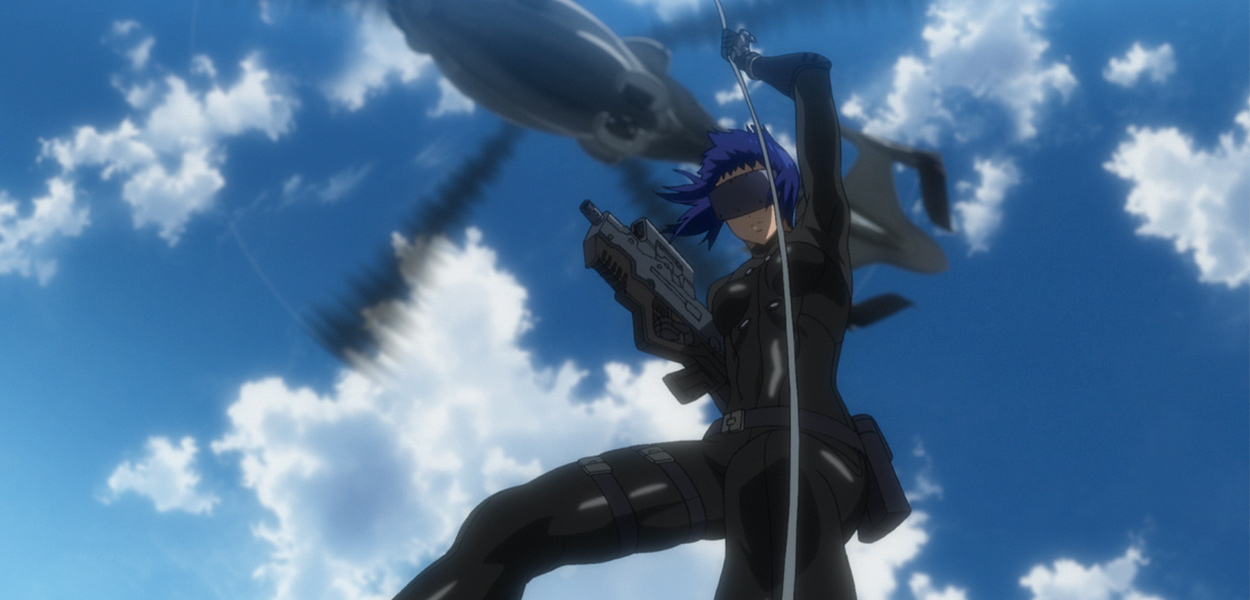
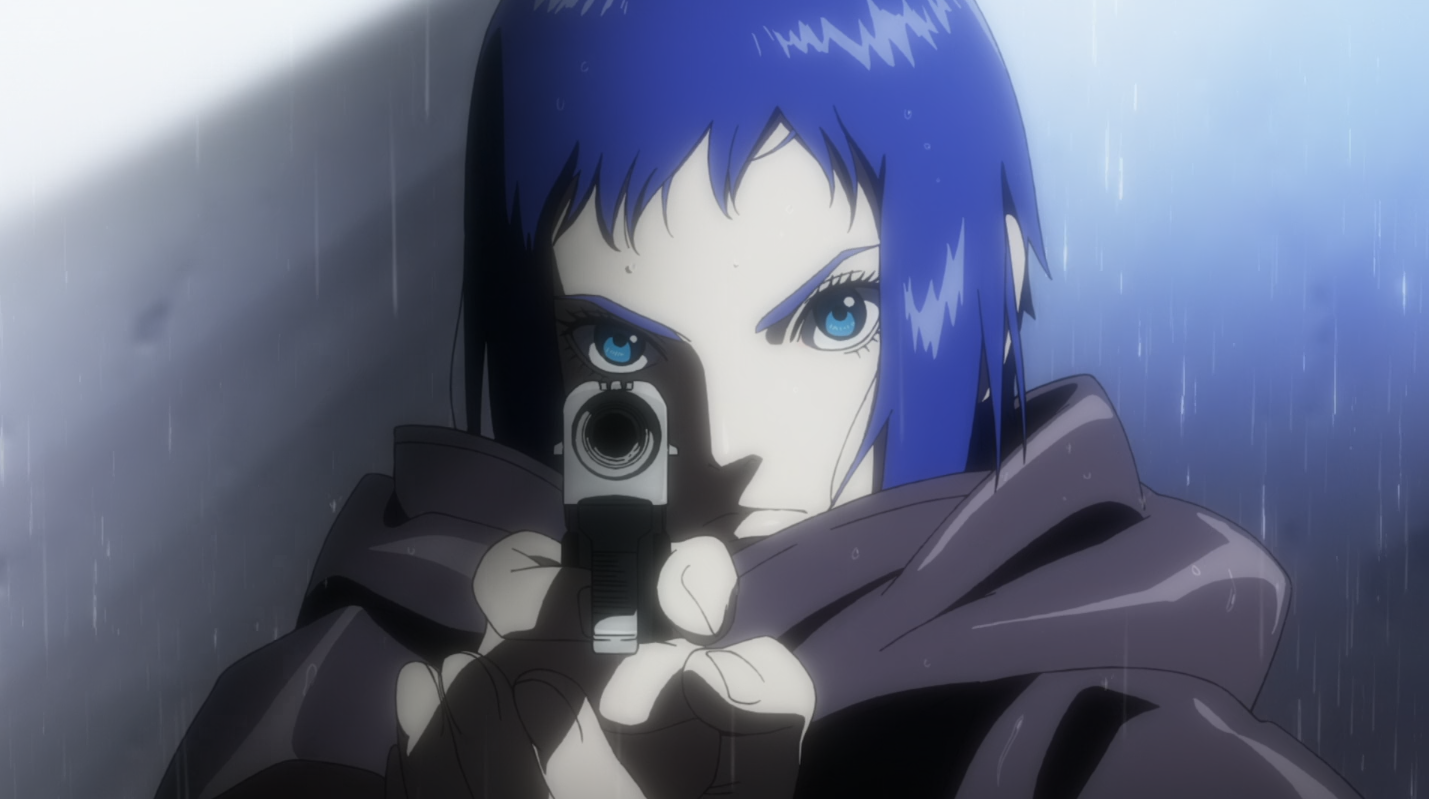
  • “Balalaika” – the pseudonymous head of Hotel Moscow, the Russian crime group under whom Lagoon frequently operate. She’s a veteran of the Soviet occupation of Afghanistan, which left her with serious burns. She got her name from the sniper rifle which was her weapon of choice, and often calls upon her ex-Army colleagues when reinforcements are needed.
  • Eda – a drinking buddy of Revy, she’s a nun in the Church of Violence a.k.a. the Rip-off Church. They are perhaps the premier gun-running outfit in Roanapur, who count Lagoon among their customers, and you interfere with the Church or its leader Yolanda, at your own peril.
  • Roberta – the maid of the Lovelace family, one of the leading South American cartels. When its scion, Garcia, is kidnapped, Roberta goes on the hunt. Turns out she’s actually a former FARC guerrilla, who had been trained as an assassin in Cuba, and proves capable of fighting Revy to a time-limit draw.
  • Gretel – one of two Romanian orphans, who may be the most screwed-up characters in the whole show, due to their background in child porn and worse. [‘Snuff said, shall we say…] While life is generally cheap in this series, she and her brother Gretel take sadistic and visceral pleasure in torturing their victims, extreme even for this show.
  • Yukio Washimine – daughter of a yakuza boss. She takes over the group after the incumbent is killed by Balalaika, despite Rock’s efforts to prevent this.

There are all, in their own way, interesting (if largely damaged, in some cases severely) characters, who have enough potential that they could each merit their own series. Add them to Revy, and its an impressive line-up, even if some only appear for a couple of parts. The structure of the series generally has each arc occupying two episodes, though the Washimine storyline occupies the final six. It’s a good approach, allowing for a bit more expansion than the 25-minute format usually permits. My main gripe is the near-total lack of character development over the two seasons. Revy, Dutch and just about everyone else are the same at the end of the show as at the beginning. There’s no sense they’ve learned anything from their experiences, and even Rock has simply settled into his new life with barely a ripple. The show seems more interested in their past, than their future.

It is still a lot of fun to watch – admittedly, you need to suspend your disbelief in the way gun battles work. But if, like me, you’re a fan of John Woo films like A Better Tomorrow (an obvious and admitted influence), then the remarkable invulnerability to bullets shown by Revy, etc. will not be an issue. Having cut my anime fandom teeth on the likes of Wicked City and Vampire Hunter D, this plays like the organized crime equivalent, and provides an enjoyable blast from the past.

Dir: Sunao Katabuchi
Star (voice): Megumi Toyoguchi, Daisuke Namikawa, Tsutomu Isobe, Mami Koyama

Ghost in the Shell: The New Movie

★★★
“Not be confused with the old movie.”

Really, that was the best name they could come up with? Oh, well. “A rose by any other name…” Released in Japan in June 2015, more or less on the 20th anniversary of the “not-so-new movie”, I guess, it’s the most recent incarnation of the animated universe. This is more or less a direct follow-on from the Arise series, following up on the “Firestarter” arc, the name for both a wizard-class hacker and the virus they have created. As such, you’d definitely fare better if you’ve seen that series first, since (as we’ll see) it has enough issues with new plot elements, and doesn’t bother with much explanation about any pre-existing ones.  This feature is also using the same redesigned character designs, and with the Major (Sakamoto) operating in conjunction with Section 9 and Aramaki (Juku), rather than under his direct control.

The main incident under investigation is the assassination of the Japanese Prime Minister, blown up with a briefcase bomb, during a meeting. That’s the simple synopsis. The more accurate one would involve a complex and tangled web of government departments and their intersection with elements of the military-industrial complex. It’s a alphabet soup blitzkrieg of acronyms: MOD, MOC, DFA. Or was it MFA? Either way, it becomes awfully hard to keep track of who is doing what to whom, for the sake of which alliance. Perhaps it makes more sense if you have a pre-existing awareness of the intricacies of the Japanese federal bureaucracy. Otherwise, you’ll be left scratching your head and/or yawning for significant chunks of this.

Which is a shame, as there are some aspects which are still enjoyable. I particularly liked the idea that the head villainess actually uses the same make and model of prosthetic body as Major Kusanagi, so in effect she is hunting her own doppelganger. This ties together with more information on her childhood, in a cybernetic orphanage, which is being run for purposes that are very far from charitable. There is more of a sense of team here. The Major refers to her colleagues as “parts,” something they take to mean they’re expendable – or it could actually be high praise, given the nature of her existence. It’s symptomatic of the ambivalence about technology that has been present throughout, over a period now spanning two decades.

The action is as impressive as it was in Arise, with a number of show-stopping set-pieces, pitting Kusanagi and her team against a range of opponents, from near-human to entirely artificial. There are also surprisingly poignant moments, such as their questioning of a former active-duty soldier whose job is now to receive the last words of his colleagues. This renewed his purpose in life, after he had been left behind to wallow in his obsolete prosthetic body. But these elements just make the murky plotting all the more frustrating, and I can’t help suspecting the writers confused obscurity with depth.

Dir: Kazuchika Kise
Star: Maaya Sakamoto, Ikkyuu Juku, Kenichirou Matsuda, Tarusuke Shingaki

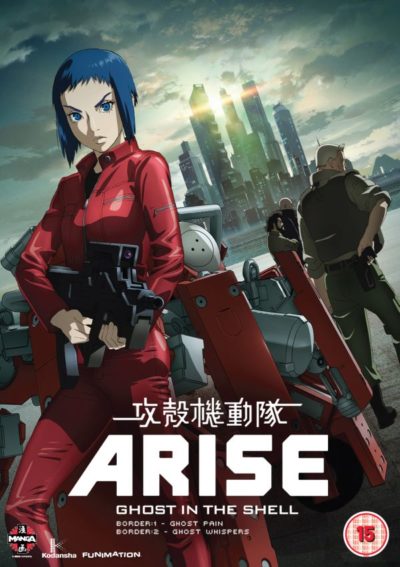
Ghost in the Shell: Arise

★★★★
“Brains and brawn.”

Much more a reboot, complete with a redesigned lead, than any kind of sequel, this four-part series of hour-long episodes received a theatrical release in Japan, before being released on DVD. In a typically confusing GitS universe approach, it was then broadcast on TV in 10 episodes, with extra material added. I mention this only because it’s the four-part version which will be reviewed here. It starts before Major Kusanagi (Maxwell) joins up with her boss, Aramaki (Swasey): initially, she’s part of the 501st, a counter-cyberterrorism group which owns her cyborg body. However, Aramaki offers her the opportunity to go freelance under him, doing similar work, and assemble a team who will largely be free from bureaucratic oversight.

Over the course of the four episodes, she recruits others whose names will be familiar. For example, ex-Ranger Batou (Sabat), comes aboard after initially being part of a team working against Kusanagi, who are trying to prove government complicity in war crimes. This is an interesting change, compared to the previous versions, which always seemed to join Section 9 “in progress,” and provides some intriguing insight into what makes – literally, to some extent – the Major the way she is. For, in this incarnation, we discover that she has been in her prosthetic body since birth, and has never known any other way of life.
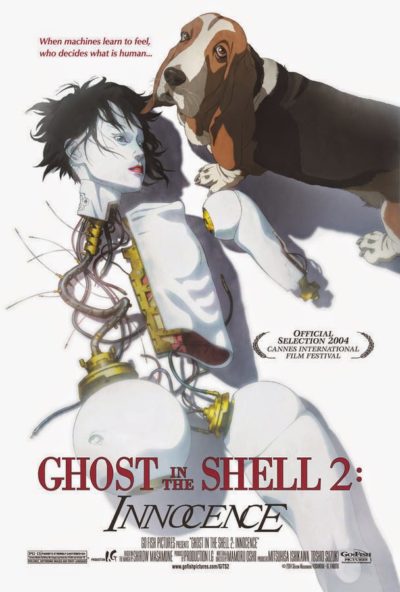
The other main focus is the dangers of a society which is totally reliant on technology, because of the horrible opportunities for exploitation it presents to terrorists. Even the heroine is not immune to being hacked, and one of the themes is the implications of a world in which you can’t trust your own memories, when these could be false implants. This makes police work incredibly hard, because as is pointed out, even if someone admits to committing a crime, they could actually be entirely innocent. This illustrates the nicely cynical streak here, concentrating heavily on the potential downsides of scientific advancement.

I found the main strength to be the much better balance struck between the intellectual and action elements. If you’ve read the previous reviews, you’ll know I’ve rolled my eyes at the uber-dense lumps of philosophy, shoehorned in for no reason more necessary than, apparently, to prove how well-read the script-writer was at college. Here, those are refreshingly absent, although you still need to be paying damn good attention to the plot: I made the mistake of drifting away in episode 2 for a bit, and finally had to admit defeat, cranking things back to re-watch what I’d missed.

The battle sequences are awesome. Whether it’s the Major going up against another enhanced human, or taking on a massive battle-tank which has been hijacked by a pair of “ghosts,” these are slickly animated and edited with precision, in a way from which many live-action films could learn. They’re also incredibly violent, both on a personal level and in terms of the material carnage caused by them. But such is the joy of cyborgs, they can take a lickin’ and keep right on tickin’… The result is a rare combination of action and intelligence, that offers something for both the lizard portions of the brain, and the more highly-developed parts.

Dir: Kazuchika Kise
Star (voice): Elizabeth Maxwell, John Swasey, John Swasey, Jason Douglas

Ghost in the Shell 2: Innocence

★★½
“Shellfishly indulgent.”

This is largely included purely for completeness: if this had been a stand-alone film, it likely wouldn’t have qualified, not reaching the mandatory minimum quota of action heroineness. For in this sequel, Major Kusanagi (Tanaka) has abandoned even her artificial physical form, for life entirely inside the Internet. Her presence in this is therefore more spiritual, with Batou (Yamadera) referring to her as his “guardian angel”, and her impact is more felt than seen – particularly in its ramification for Batou, whose degree of cybernetic enhancement is not much lower than hers. She only returns to a tangible persona in the final scene, where Batou has to take on a near-endless stream of combat-reprogrammed sex robots. My, that’s a phrase I never thought I’d be writing…

So this is much more Batou’s story, as he and the much-less enhanced Togusa (Ōki) investigate Section 9’s latest case. In it, the “gynoid” sex robots created by tech company LOCUS SOLUS, are involved in a series of their owners’ deaths, which have been covered up and settled quietly, out of court. Section 9 are brought in, over concerns the incidents are a prelude to a cyber-attack by terrorists. Instead, they discover human “ghosts” are being implanted into the gynoids, to make them more realistic. It eventually turns out LOCUS SOLUS, from their floating headquarters (conveniently in international water) have been kidnapping young girls, in order to repeatedly copy the victim’s personality into their robots – a process which eventually drives the source insane.

It’s quite a trip for Batou and Togusa to get there, however. They have to handle a very pissed-off Yakuza gang, whose boss was one of the gynoid victims – they don’t respond well to Batou’s style of investigation, shall we say. Then there’s Kim, an ex-military hacker who can hack the pair’s cyber-brain, and twist the reality they experience into a pretzel. This is where the mix of animation styles is perhaps at its best: Oshii opts neither for pure CGI nor traditional hand-drawn, instead combining them in a way that uses the strengths of each to good effect.

But it probably is too damn cerebral for its own good. Per Wikipedia, “quotations in the film come from Buddha, Confucius, Descartes, the Old Testament, Meiji-era critic Saitō Ryokuu, Richard Dawkins, Max Weber, Jacob Grimm, Plato, John Milton, 14th century playwright Zeami Motokiyo, the Tridentine Mass, and Julien Offray de La Mettrie, French Enlightenment philosopher and author of Man a Machine.” This is a common problem for Oshii: see Avalon or Garm Wars, for other examples of his work which also struggle to hold up under the philosophical weight he throws onto genre fare.

Look, I’m not averse to intellectual concepts in film. But when it comes to action film, they need to be a garnish rather than the main ingredient – something to tickle the higher parts of the brain, while the lizard areas enjoy the spectacle and gratuitous violence. While those latter aspects are present, it comes with indigestible lumps of philosophy, that I would rather had been present in lesser quantity, if not left out of the dish entirely.

Dir: Mamoru Oshii
Star: Akio Ōtsuka, Kōichi Yamadera, Tamio Ōki, Atsuko Tanaka

Ghost in the Shell: Stand-Alone Complex

★★★½
“We need to go deeper…”

Despite the critical and commercial success of the original film, it took a while for anything further to emerge from the GitS universe. Over the seven years after the movie, the only adapted media to be released was a 1997 video-game. This hiatus came to an end in October 2002 when Stand Alone Complex took the air on Japanese satellite station  SKY PerfecTV!. This was a 26-part series, each episode lasting 25 minutes, and was followed in 2004 by S.A.C. 2nd GIG, which had the same format. In turn, the first season was adapted into both a feature-length version, The Laughing Man, and two manga volumes, while the second was also edited down into a feature-length edition, Individual Eleven.
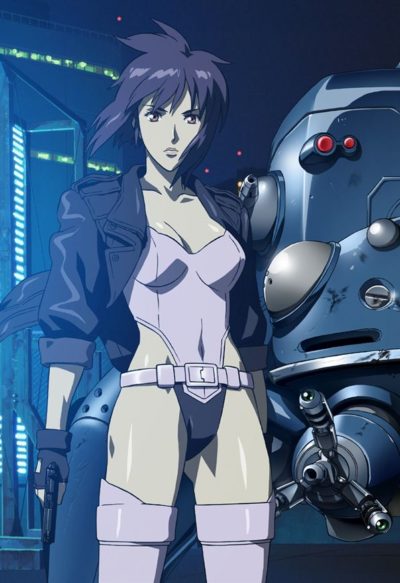
The main advantage the TV series offers over the movie should be apparent: it has much greater scope at which to explore the world of cyberbrain networks, information warfare, and their resulting impact on society and humanity. This is particularly apparent early on in the first series. There does eventually develop an ongoing story arc, focusing on the search for an elite hacker (the “Laughing Man”, who takes inspiration from a J.D. Salinger short story) who is trying to expose a conspiracy between the government and cyber-medical companies. But the series also has episodes that don’t advance this at all, exploring other aspects of life in the technologically advanced society which is 2030’s Japan.

It can also be pretty damn cerebral at times. Even the titlular concept, the “Stand Alone Complex”, is not easy for the viewer to wrap their head around. It’s a little bit like the notion of copycat incidents – except, in the case of the Stand Alone Complex, the original didn’t take place, or at least not in the way perceived by those who copy it. It’s probably easiest to provide an example: “Slender Man”. This was a supposed supernatural creature, belief in which reportedly caused two 12-year-old girls to stab another, a ritual designed to impress Slender Man. But the urban legend in question was actually a piece of fiction, created wholesale by a Internet forum user. This idea informs both seasons, with reality and perceived reality both triggering subsequent actions. It’s sometimes way above my head, that’s for sure.

Another result of the extra room is an approach which occasionally becomes meandering to the point of irritation. On the other hand, you can only admire a show which is confident enough in its own abilities, to have an episode which takes place, almost in its entirety, in an Internet chat room. Another ongoing thread is the growing self-awareness of the Tachikomas, independent AI tanks employed by Section 9. These feature in little vignettes at the end of every episode in the first season. To be honest, I initially found their squeaky little voices fairly irritating and fast-forwarded as soon as the final credits rolled. However, they did redeem themselves with a surprising bit of altruism at the end of the series, and were considerably more tolerable in the second season.

Compared to the movie, the animation is a little less fluid – as you’d expect, given the constraints of cost and time. The budget was reportedly $300,000 per episode, compared to $10 million for the film: so the entire first season, running nine hours or so (excluding credits), still cost less than the 80-minute movie, even allowing for seven years of inflation. The style is also a little different, with the character designs more closely resembling the original manga. This is perhaps most apparent in the look of Major Kusanagi. For the TV version seems quite enthusiastic in the area of fan service, with some of her costumes looking as if she’d just rolled out of a Victoria’s Secret catalogue, rather than those typically worn by a public servant – see below for an example!

While the feature focused directly on the Major and her quest for identity, the series also uses its greater freedom to become more of an ensemble piece. The Major is clearly still the leader and boss, with skills that surpass everyone else – they defer to her, and it’s entirely understandable. But over the course of these 52 episodes, the spotlight turns at one point onto just about everyone else, from her hulking second-in-command, former Army Ranger Batou, through to Togusa, the member of Section 9 who has undergone the least amount of cybernetic enhancement. This allows it to explore their history. For example, the (somewhat notorious, due to its graphic violence) “Jungle Cruise” episode, had Batou hunting down an ex-military colleague who has become a serial killer.
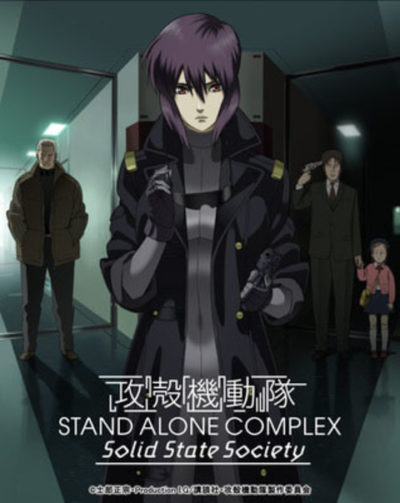
The second season, while still having some individual episodes, has an interesting main thread which has become particularly relevant in the light of subsequent geo-political events. A refugee crisis has broken out, leading to a large influx of displaced people to Japan, causing tension between them and the locals. A charismatic refugee leader, Kuze, has sprung up, leading a movement demanding autonomy for the island where they are being housed. A right-wing group within the government, led by creepy intelligence officer Goda, seeks to exploit the tension by “false flagging” a nuclear incident as a refugee terrorist act, allowing the group to stage effectively a military coup. While originally inspired by the Japanese reaction to 9/11, it’s easy to see parallels to the current world situation here.

Partly due to this, I’m curious to see how much of the series ends up present in the live-action film. The very first episode includes a hostage situation involving android geisha, which is a part of the trailers we’ve seen. As mentioned, each series was edited down into a feature-length compilation, so could be the basis for the 2017 story – though as I haven’t bothered with those, I can’t comment on how coherent the results ended up. But other aspects of the trailers appear to come from the original movie, so I suspect we’ll be looking at a combination, drawing from multiple elements of the GitS universe. It’ll probably be based more on “what looks cool?” rather than narrative sense!

Dir: Kenji Kamiyama
Star (voice): Mary Elizabeth McGlynn, Richard Epcar, Crispin Freeman, William Frederick Knight

Ghost in the Shell: Stand Alone Complex – Solid State Society
★★½
“Solid State Survivors.”

A rather clunky title for an OAV (original animation video), which came out in September 2006, about 18 months after the end of season two. It’s also two years after the events depicted, with Major Kusanagi (Tanaka) having quit her job as Section 9, and largely dropped off the grid. Batou (Ōtsuka) has taken over her position as S9’s top field operative, with Togusa (Yamadera) the. After a series of suicides exposes a plot for a bioterror attack, the group is on the hunt for a hacker called the Puppeteer, apparently behind it. But the investigation finds the apparent attack was almost a diversion, and uncovers a massive child abduction ring that may be responsible for as many as 20,000 kidnappings.
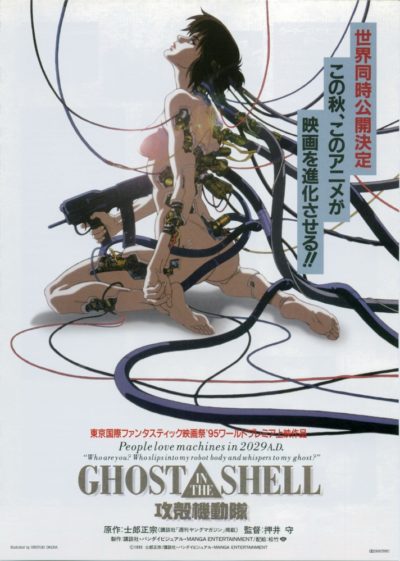
Even by the standards of a series which has always waxed philosophical, this has some pretty deep constructs. For example, the Puppeteer is described by the Major as a “rhizome”. Wikipedia tells me this is a concept developed by Gilles Deleuze and Félix Guattari in their Capitalism and Schizophrenia (1972–1980) project. It is what Deleuze calls an “image of thought,” based on the botanical rhizome, that apprehends multiplicities. Well, glad we’ve cleared that up, then. Fortunately, you don’t really need to understand any of this: basically just think of of it as an example of a computer network becoming self-aware, and acting on its own behalf. Everything beyond that, feels a bit like extracts from a paper by a college student who wants you to know how deep they are.

It’s somewhat better when not vanishing up its own philosophical backside. Probably the best sequence has Togusa becoming the victim of a brain-hack and compelled to make a terrible choice: hand his own daughter over to the Puppeteer, to become one of the abductees (with his memory then wiped) or kill himself. It’s a chilling sequence, and also marks the return of the Major to work with Section 9. She has been carrying out her own investigation, free from the restrictions inevitably resulting out of her official role. It turns out to be connected to the aging of Japanese society – a major problem now, and likely to be worse by the late 2030’s when this is set.

It looks pretty slick, with a budget definitely on the high-end for video animation, and there’s no need to have seen the TV series, for this to make sense. But it’s largely forgettable stuff, and the significant absence of the Major, particularly in the first half, weakens proceedings considerably, robbing it of the universe’s most memorable character.

Dir: Kenji Kamiyama
Star (voice): Atsuko Tanaka, Akio Ōtsuka, Koichi Yamadera, Osamu Saka

Ghost in the Shell (1995)

★★★½
“The ghostess with the mostest.”

ghostintheshell1985Renowned for its influence on just about every subsequent cyberpunk entity, from The Matrix to Westworld, this also remains one of the classic anime movies, more than two decades after its release. The main problem though, is the translation of a densely-packed and heavily notated manga series by Masamune Shirow, into an 82-minute action feature. You’re left with something forced to cram the philosophical aspects into a couple of indigestible lumps – an approach certainly also adopted by the Wachowski Brothers.

It’s set in a future Japan where cyborg enhancements have become the norm, to the point where some people are beginning to question what’s left of their own humanity (the “ghosts” in the hardened artificial “shells”). Among them is Major Motoko Kusanagi (Tanaka), an assault-team leader in Section 9, a federal public security agency. They are attempting to track down the Puppet Master, a notorious hacker, who uses an automated facility to create an entirely artificial body. Section 9 discover that the truth about the Puppet Master’s origins is closer than is comfortable, stemming from the actions of another government department and “Project 2501”. But what, if anything, does this say about the Puppet Master’s goals?

It’s a rather uneven mix of high-paced action sequences and more leisurely scenes. Each work well on their own (helped immeasurably by Kenji Kawai’s score), yet fall short of combining into a thoroughly cohesive whole. The Major might be rather over-fond of waxing philosophical, as shown in the following monologue, during a down-time conversation with her less-enhanced colleague, Batou (Ōtsuka), which feels more like the sort of thing I heard out of my fellow students – typically, the damn philosophy ones – at university, late on Saturday nights after the bar had closed.

Just as there are many parts needed to make a human a human, there’s a remarkable number of things needed to make an individual what they are. A face to distinguish yourself from others. A voice you aren’t aware of yourself. The hand you see when you awaken. The memories of childhood, the feelings for the future. That’s not all. There’s the expanse of the data net my cyberbrain can access. All of that goes into making me what I am. Giving rise to a consciousness that I call ‘me’. And simultaneously confining “me” within set limits.

While certainly a good summary of the movie’s main theme, it’s the kind of thing best explored in a longer, more leisurely format such as the TV series which were to follow. Here, this kind of rumination seems a bit forced. More effective than the chat is the action. Kusanagi’s talents and ability to take damage make for some glorious set pieces, such as her fight with one of the Puppet Master’s host bodies, and a battle against a tank, possessing vastly superior fire-power. The look of the film is just glorious as well, combing traditional cel animation and computer graphics to an effect rarely, if ever, matched. There was an “enhanced” version which came out in 2008, with upgraded CGI; yet after two minutes, I switched back to the original, where the combination feels more seamless. It’s certainly preferable to much modern anime – I’d rather have something try too hard to be smart, as here, than not try hard enough.

Dir: Mamoru Oshii
Star (voice): Atsuko Tanaka, Akio Ōtsuka, Iemasa Kayumi, Kōichi Yamadera

Gunslinger Girl

★★★½
“Young and heavily-armed.”

gunslingergirlIf you want something more cerebral and family friendly than Kite – if a story about underage assassins can ever be family friendly! – then Gunslinger Girl is perhaps for you. Set in Italy, a shadowy government organization, the Social Welfare Agency, has a prototype project which takes young women from hospital beds, augments their strength, speed and agility with cybernetic accessories, and unleashes them as state-sponsored special agents, with a wide-ranging license to kill. Each has a handler, to maintain and direct their conditioning and act as backup. But these trained assassins are still little girls at heart, with a fondness for teddy bears and ice-cream, as well as forming disturbing attachments to their handlers, who become their only family.

Though probably the most disturbing thing here, is that these are the forces of good: this is your tax dollars (well, tax lira) at work, fighting against radical terrorists and organized crime. Does the end justify the means, in terms of both the physical and emotional costs paid by those who take part, especially those too young to offer any kind of informed consent? Perhaps wisely, the thirteen 22-minutes episodes don’t delve too far down that rabbit-hole, preferring to concentrate more on the relationships between the five girls who are the subjects of the project. There’s something of Ghost in the Shell here, with the heroines’ awareness of their own (now, largely mechanical) nature leading them to ponder what it is to be human, and whether they can even consider themselves as qualifying any more.

The action here is perhaps less frequent than you’d expect, each episode typically having one or two brief bursts of intense activity. This doesn’t soft-pedal the violence in any way, even if it doesn’t seem to have the emotional impact on its young subjects that you feel it might; this could well be the point, and may also be a side-effect of the amnesia which is induced in them. The technical aspects are solid, in particular the music which prefers a classical tone to the (over-used, to be honest) standard large helping of J-Pop tunes, and the show has been complimented for its attention to detail, particularly in the details of the weapons it depicts.

My main issue is the lack of any real story arc or escalation. You reach the end of the 13th episode and, while not ineffective (most of the girls sit out in a meadow, watching a meteor shower and singing Beethoven’s Ode To Joy, while one lies in a hospital bed), it would hardly pass for a satisfactory conclusion. This may well result from it being an adaptation of just the first two volumes, in a series actually running to fifteen. Given this, it might have been wise to cut down the characters; rather than splitting stories and characterization relatively evenly across the five, focusing on one or two in greater depth would potentially have been more successful. That said, I still appreciated its more thoughtful and leisurely pacing, and will certainly cover the sequel series in due course.

Dir: Hiroshi Ishidori
Star (voice): Eri Sendai, Yuuka Nanri, Kanako Mitsuhashi, Ami Koshimizu