




★★★½
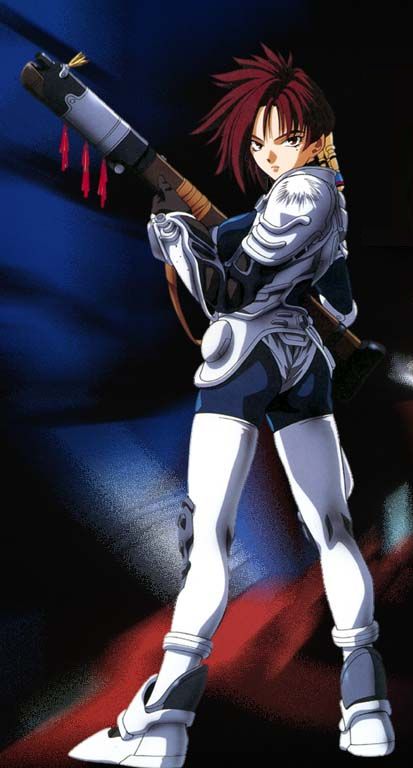 Though released several years later, this is a prequel to the two Zeiram movies, telling the story of the first encounter between Iria (Hisakawa, who was also Sailor Mercury) and Zeiram. At the time, she was an apprentice bounty-hunter, working alongside her brother Gren. They take a mission to rescue a VIP and recover the cargo from a stranded space-ship. However, once there, they discover the “cargo” is actually the alien Zeiram, which a corporation is interested in using as a weapon. The result leaves her brother apparently dead, and Iria now the target for the corporation, who want to hush up their thoroughly-dubious plan, by any means necessary. Fortunately, as well as her own skills, our heroine has the assistance of former rival bounty-hunter, Fujikuro (Chiva), endearing urchin Kei (Kanai), and Bob (Ikeda), a colleague whose consciousness has been turned into an AI.
The six-episode (about 25 mins per part, by the time you skip the opening and closing credits) series worked, for me, a little better than the live-action, simply because of the nature of animation: there’s no need for restraint. There were times in the movies where you could see where Amamiya wanted to, but has to restrain his imagination for budgetary reasons. Here, there’s close to a fully-fledged universe, with content which would likely be well beyond the budget of anyone not named James Cameron. There’s also a nice character arc for Iria: initially, she is probably too big for her boots, with an over-inflated sense of her own skills. When she meets Zeiran, she soon discovers she isn’t quite the cat’s whiskers, at least, not to the extent she thinks.
As with most animation of the time, it’s not going to be confused with Miyazaki, and it would be silly to expect otherwise. However, there remain weaknesses. Most obviously, and surprisingly – because it’s the same issue as in the live-action version – is the diversion of time to secondary characters, in particular Kei and sidekick, the latter of whom is there for one purpose only (too spoilerific to discuss in detail; I’d say it falls into the category of “surprising, but almost entirely pointless”). That’s true for much of the plot, which feels over-similar to the Aliens series, and at times, the conspiracy angles just seem to be there to fill in time, before we get to the inevitable final battle between Iria and Zeiram. It did generally keep my interest, overall; but I can see why it hasn’t exactly been remembered as a classic of the medium.
Dir: Tetsuro Amino
Star: (voice) Aya Hisakawa, Shigeru Chiba, Mika Kanai, Masaru Ikeda
 Ayane tries out for the All-Japan Women’s pro-wrestling federation, but is rejected. However, on the way home, she meets a mysterious trainer, who recruits her for his indie group, promising that if she does well, AJW will likely pick her up. What Ayane doesn’t know, is that her trainer has no interest in pro-wrestling, but wants to use our heroine’s lethal leg skills to make her a kick-boxing champion. Ayane eventually discovers the truth, literally in the ring at her first bout; after the inevitable struggles, she wins, in spectacular style, but vows to quit the sport. However, her victory grabbing the headlines infuriates a rival, who turns up at Ayane’s school to issue a challenge. Which is not good, since the vice-principal is just looking for an excuse to expel her.
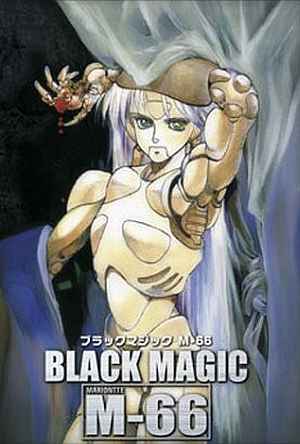 Shirow has certainly done his fair share of anime works that are regarded as classics – his best-known creation is probably Appleseed. This is from relatively early in his career; indeed, coming out in 1991 made it one of the first anime to be ‘properly’ distributed in the West [and, by that, I mean subtitled and not cut down for a child audience]. It centers on the titular pair of military androids, who are released after their transport craft goes down in the middle of a forest. The army cordon off the area, which draws the attention of Sybel (Sakakibara), a reporter, unwilling to let anything stand in the way of her story. She witnesses a hellacious fire-fight in which one ‘droid is destroyed, while the other escapes, and discovers the goal for the android is to kill the inventor’s young grand-daughter, Ferris. As the only person who knows the current location of the daughter, it’s up to her to save the child.
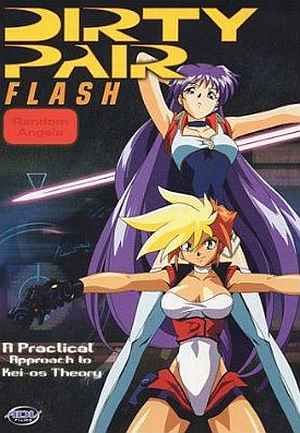 The final – to date – installment of Dirty Pair adventures on the screen, is a bit of a mixed bag. Of the five episodes here, two are pretty good, one mediocre, and two are more than a tad creepy, thanks to the level of, from what I recall of my days in anime, used to be called ‘fan service’. There is an entire episode centered around beach volleyball, which is nothing more than a flimsy excuse to see Kei and Yuri in a variety of miniscule costumes, bordering on the fetishistic. Now, I just don’t find cartoons sexy – no, not even Jessica Rabbit – and given both of them are technically under-age, it all gets a tad sleazy. Things get worse in the fourth episode, when an even younger boy, rich and clever, but very weird, builds a mechanical replica of Yuri and falls in love with it.
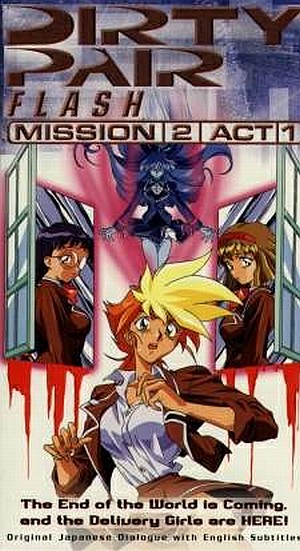 Where are Kei and Yuri, and what have you done with them? That might be the anguished cry of the Dirty Pair fan after watching these five episodes, most of which eschew any efforts at high-octane action, in favour of generally unamusing comedy and tedium. All five parts are set on World’s World, a theme-planet that recreates 20th-century life for tourists. Our heroines are sent there because the computer is virus-infected, to bodyguard the network engineer Touma (Ono) who is going to fix it. Their presence becomes necessary, as it’s soon clear someone is out to stop Touma from doing his job. That only occupies the bookend episodes: the middle three are, while still set on the same planet, largely unconnected. In them, Kei and Yuri must look into ghostly goings-on at a girls’ school, help Touma with his love-life and bring a con-artist to justice.
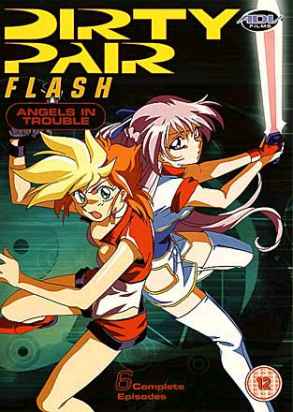 The surprising thing about this, is that the six episodes, basically, form a single plot, a radically different approach to the first phase anime, where the individual OAVs stood on their own, with little or no ongoing story arc. Here, the parts mesh, starting with the pair, off-duty, coming into possession of an encrypted card, which they must get back to 3WA headquarters, in the face of significant opposition. From this develops the uncovering of a galaxy-wide conspiracy involving the malevolent Lucifer group, which must be foiled, since they have control of galactic communications. However, a significant subplot involves Lady Flair, a sniper who humiliates Kei in the second episode, provoking her into a fury which leads, later on, to our redheaded spitfire quitting the 3WA in order to pursue Flair on her own terms.
 The Peach Twisters baseball team suck. This may be because the owner kills his pitcher with a baseball bat in the car-park, after losing a game? And he’s the model of restraint and sanity compared to his daughter, Momomi. The Danger Service Agency, a trio of troubleshooters, are hired to kidnap the owner (obviously, legality is a minor concern), but things go wrong, and he dies in the process. How can they escape this tricky situation? The core of the DSA is Mikura, who is a combat specialist, and easily the best thing in the group, as the other two are largely forgettable. But when Mikura goes into action, the film accelerates from 0-60 in about two seconds, which a cheerful, splattery approach that’s endearing. And she’s an upbeat character, which is a notable contrast to Umetsu’s other genre entry, Kite [Sawa, that show’s heroine, makes a cameo here].
 Why let Kei and Yuri blow up one case, when you can save time by giving them two at once? That’s what happens at the start of this, as the WWWA computer assigns them two, apparently unrelated, assignments in the same galactic sector: one is to investigate a spaceship which blew up, and the other involves the disappearance of a scientist and his family. You will not be surprised to hear that these two cases are interconnected, though it does appear to come as a shock to the participants here. Once they reach their destination, it soon becomes clear that someone is out to stop Kei and Yuri – “someone serious,” to steal a line from Leon. Can they uncover the conspiracy before it uncovers them?

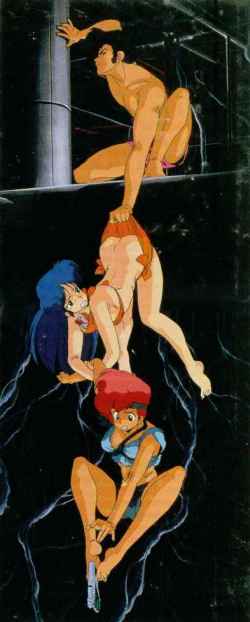 If you’re going to start with Kei and Yuri, this is as good a spot as any; it may not be the first entry in the series, but requires no prior knowledge at all. Even complete novices will be up to speed by the pre-credit sequence, which sees them – oops! – destroying an entire space-station after they decide to pursue the bad guy, rather than handling the explosive suitcase with which he has tried to distract them. They’re then sent to investigate some strange happenings on a mining planet, which is being plagued by attacks from monsters. They discover that the creatures are the results of failed experiments by Dr. Wattsman, who has plans to force nature’s hand, by making the next evolutionary step beyond mankind. Meanwhile, gentlemen thief Carson D. Carson is there, for his own reasons.