 The history of action heroines can’t be told without a chapter on China and Hong Kong. When we watched Michelle Yeoh kick butt in Yes, Madam, did we ever think she’d be an Oscar winner? She’s just the best-known product of a system which also gave us the likes of Moon Lee, Cynthia Khan and Maggie Q. The golden era for Hong Kong Girls With Guns films, was arguably the late eighties, but it’s never died away entirely. In the past few years, I’ve been finding a rich vein of recent Chinese GWG movies on YouTube. Streaming films took off there during COVID, with makers churning out a high-volume of films, in the action, horror and SF genre. Naturally, some fall under our remit.
Though researching them has been a bit problematic. Certain… “unofficial” channels, shall we say, will post the films with titles which are largely useless in terms of finding cast, crew, or even the film’s name. For instance, I discovered this franchise via a post titled, and I quote, “【FULL MOVIE】The beautiful police officers compete with criminal gangs in a battle of wits and courag”. In the comments, someone revealed it was called Angels of Vengeance 2. I thought I’d found part one on YT… But despite having the title Angels of Vengeance, none of the synopsis or cast info matched up. It turned out to be a mis-titled copy of Angel Warriors.
This issue actually feels like a throwback to the eighties, when the In the Line of Duty series, for example, had almost different titles in every country. Similarly, you’re sometimes dealing with subtitles that are less than optimal, and as we’ll see, audio is a sadly common problem too. However, after some further research, I eventually hit the mother lode, finding all three movies with English subs on Youku’s YouTube channel. The Chinese title of the franchise is 辣警狂花, which according to Google translates as “Hot policeman crazy flower.” I guess Angels of Vengeance will do under the circumstances.
Information on the franchise, director or actresses involved is hard to come by. In fact, at the time of writing in late 2024, this would appear to be the first English-language coverage the trilogy will have ever received. I love that: discovering obscurities is, to me, one of the joys of the site, especially when they end up being generally more entertaining than many a better-known production. But to quote the lyrics to the song which close out the third installment.
The resounding song is the sword of justice
Police badges shine with firm faith
Fear no flying bullets, guns in my hands, shield on my shoulder
I’m fearless to any dangers.
We undertake missions, we maintain the faith
Proceeding with firm steps, we keep going
We’re thunderbolts, charging forward
We safeguard the peace by fighting crime.
Can’t say more than that, really. Here are reviews of each film in the series, and a YouTube playlist of the trilogy.
Angels of Vengeance: Blood Trails
★★★½
This introduces us to the main protagonist, Tang Shi-Yu (Yan), a member of a Chinese SWAT team. She is recruited to infiltrate the drug-running gang belonging to Zhao Wen-jiu (Bai), doing so by rescuing Jiu’s younger sister, Ya-Ya (Mu), who is oblivious to her sibling’s criminal activities, from an attack in a nightclub. Tang’s undercover identity is someone in debt to loan sharks, and Jiu offers to take care of this, if she comes to work for him. After proving her loyalty, and also rescuing Jiu from an assassination attempt, she’s successfully embedded in the organization. But things are complicated, due to the reason behind the hit. Jiu killed someone close to his rival, Chen Jia-hua (Zheng), and Chen is out for revenge.
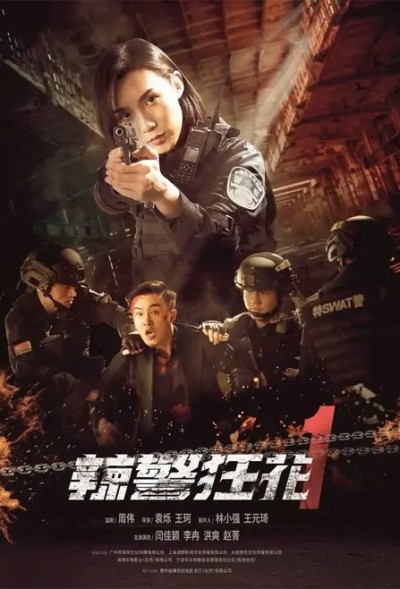 The obvious target for that is Ya-Ya, who is kidnapped, luring Jiu into a confrontation. Eventually, an uneasy peace between producer and distributoris brokered, setting the scene for a major drug deal going down at the docks. Tang informs her colleagues, and plans are put in place for a raid which will sweep up both sets of traffickers. This does a fair amount right, in particular the lead performances of Yan and Bai, which are thoughtful and well-considered. Both come over as smart individuals, and there is a complexity to the gangster which is a little surprising. Indeed, you could argue that, with his relationship to Ya-Ya, and their history, Wen-Jiu is given depth which is largely missing from Shi-yu. She is almost entirely defined by her career.
Tang does an excellent job of maintaining her undercover status, even when drenched in gasoline and threatened with immolation, and takes care of business on the action front when necessary too. I’d like to have seen more from the female members of her support team; outside of a little at the beginning, and a raid on Jiu’s offices, they don’t particularly get to show off their skills much. The ending feels a little underwhelming too, though that may partly be a result of the severely muffled audio during almost the entire sequence [It’s something you sadly need to live with on a lot of Chinese YouTube channels, even the legitimate ones like Youku]
I appreciate the practical effects: especially during the rescue attempt on Ya-Ya, there are real explosions rather than CGI. It feel like there was good effort put into the script as well, which always keeps moving forward, and Chen’s presence adds an extra twist or two. There’s a great scene when the two gangsters have a meeting in a restaurant; the intensity and tension here is off the charts, and you can sense Tang’s nervousness as she can do nothing except standby and watch. This feels like the kind of film which could easily be remade for a Western audience, and I’d be happy to watch it again. A pretty solid and promising start, delivering a better story and performances than I expected.
Dir: Yuan Shuo
Star: Jessie Yan Jia-ying, Bai Yun-Feng, Mu Lan, Zheng He-Cheng
Angels of Vengeance 2: Top Fugitive
★★★
This is based around “P2P lending” which was a major thing in China during the mid-2010’s, before the government cracked down on the various dubious pyramid schemes operating under it. A significant number of people lost a lot of money, but going by this relatively contemporary film, it’s still happening, and still problematic. In this case, young women are lured into running up large debts, and when they’re unable to pay, are abducted and sold into sex slavery, to cover the amount owed. I have some questions about exactly how this would operate, but I’m just going to presume the basic scenario makes sense in context for the local audience.
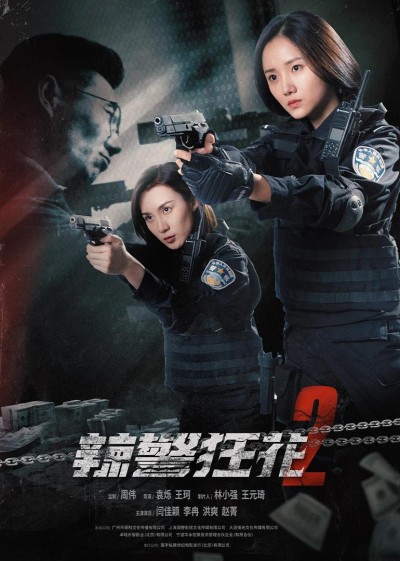 It’s a bit more of an ensemble piece here, with Tang’s SWAT group in Hanjiang City becoming involved after being called in to resolve a hostage situation at a petrol station. Turns out, the two women were victims in the scheme, but as the investigation proceeds, the criminals involved are covering their traces in no uncertain i.e. murderous fashion. Things become rather personal, since SWAT member Hao Miaomiao (Zhao) has lent money to her cousin, Zhang Le-Le (@@@), supposed for education purposes. Turns out Lele’s boyfriend is part of the gang, but when it comes time to kidnap the victim, an administrative mix-up leads to Miaomaio being snatched off the street, rather than Le-Le.
This pushes Shi-Yu’s investigation into overdrive, because they need to find their colleague before she gets shipped permanently out of the country. After Miaomiao is able to get her hands on a phone, she contacts Shi-Yu and is able to send her location. This allows the SWAT team to tool up, and head to the rescue of their colleague. To be honest, the resulting battle represents a clear majority of the action in this installment. Up until that point, there’s a good urban chase sequence, as the team tries to stop a witness from being offed, but this is probably more of a thriller than an action movie. Although it’s still interesting, because of the cultural differences, there are points where it teeters on the edge of TVM territory.
As noted, there is a better sense of team here, and you get a feeling for the camaraderie between the various members. Witness the affectionate hazing at the end, when Miaomiao tries to skimp on the “thank you” meal for her rescuers. It’s novel to see SWAT people like Ting actively involved in a criminal investigation. This is presumably how things work in China, rather than the sharp demarcation of responsibility with detectives they have in the West. It could have use additional intensity, for example, a greater sense of threat to the victims, as it’s rather too vague on the specifics to present any real peril. The lack of a well-defined antagonist also keeps this one below the bar set by the first installment. It remains a pleasant enough way to pass 85 minutes.
Dir: Yuan Shuo
Star: Jessie Yan Jia-ying, Zhao Jing, Zhang Zi-Yue, Li Ran
Angels of Vengeance 3: Shadow Repose
★★★½
This gets off to an excellent start, depicting the kidnapping and subsequent ransom attempt of Ni-ni, the daughter of industrialist Yang Shi-ke (Bin). He’s getting instructions from the kidnapper, Li Zi-Xiong (Zhou), by phone in order to shake the tail on him, before the drop. As well as following Yang, Tang and her colleagues try to locate the victim, but neither side of this goes perfectly: while they don’t lose the ransom, there’s a trap which leaves Miaomiao badly injured in hospital, and the team with egg on their face. However, SWAT member An Qi (Zhang) suspects there’s more going on than meets the eye, with elements of Yang’s behaviour seeming suspicious.
 As seems common throughout the series, we get more time than I expected spent on the villains. In this case, one of them is killed in the first pick-up attempt, which causes his friend to want to kill Ni-Ni. When Li refuses to allow that, the friend swears vengeance against the cops he considers responsible. No prizes for guessing who that is. This adds an additional wrinkle to what might otherwise be a fairly straightforward (though effective enough) kidnapping plot. Between that and Yang’s murky actions, the story is pretty interesting. We’re kept uncertain whether what Yang is doing, is simply to get Ni-ni back safely. Especially after we learn that Li has a long track record of kidnaps – and that the victims there have not come back alive.
In effect, we have tension between Yang, who is prepared to do anything to recover his daughter, and the authorities, whose main interest seems to be in arresting the criminals, with the hostage’s health falling under the “optional” category. To what extent this reflects the reality of Chinese policy, I can’t say. It makes for an interesting point of consideration. The action has its moments too: there’s a particularly good brawl in a hotel kitchen. The finale is, at least initially, more stealth-oriented than the second part. The team capture one of the kidnappers during another attempt to collect the ransom, and successfully turn him, reminding him of the death penalty he could face – China does not mess about with punishing criminals!
He then returns to the lair, carrying the ransom, and with Tang, An and third member of the team,Yang Fan (Hong Shuang), hidden in the bag. They’re just able to free Ni-Ni before the deception is discovered, leading to an enjoysble and hard-hitting battle against Li and his henchmen (albeit with an ending which merits an “I’m so sure…” comment from this viewer!). Annoyingly, this film suffers from even worse audio problems than the first two entries, in the version provided by Youku. The sound completely vanishes at points, and when it goes, it takes the subtitles with it. The film is strong enough to survive the issue with most of the entertainment value intact. I can’t help thinking, if there had been a better presentation, this one might well have merited our Seal of Approval. Hopefully, there will be more entries to come.
Dir: Yuan Shuo, Wang Ke
Star: Jessie Yan Jia-ying, Zhou Yan, Zhang Lin, Xue Bin




 From what I can tell, Arisen is a massive zombie apocalypse saga, with a heavy military focus, by Fuchs and Glyn James. There are fourteen books in the main series, but Fuchs has also spun off related sets to tell other stores set in the same universe, such as Arisen: Raiders. The Operators series appears to be another. It looks to be intended as a trilogy: at the time of writing (March), part one is out, with part two next month and the finale in 2026. It feels like subsequent installments might be more team-oriented, but part one? Hoo-boy.
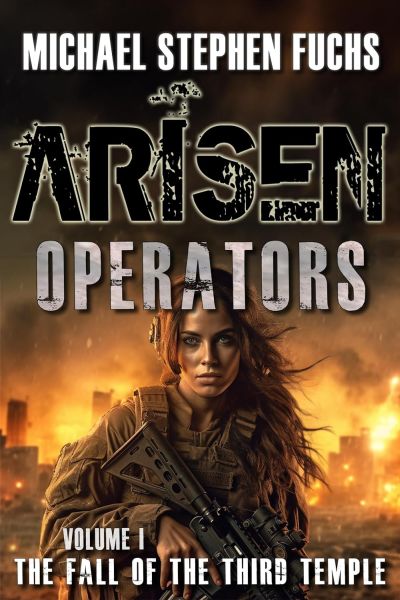 Yeah, this is the first book to ever get a five-star action rating from me. It just doesn’t stop. There’s a sub-genre called “hard SF,” which according to Wikipedia, is “characterized by concern for scientific accuracy and logic.” I suggest this could be labelled as hard action, with a great deal of information about hardware, like guns and vehicles. Here’s a sample paragraph: “The boat itself is a low-observable, reconfigurable, multi-mission surface tactical mobility craft with a primary role to insert and extract SOF in high-threat environments, but can also be used for fire support, maritime interdiction, and VBSS missions, as well as CT and FID ops.” I’m not sure what much of that means. Though I suddenly have a strong urge for a glass of whisky and a cigar.
 What’s unusual here is that, allow this is an American production, the cast and crew are almost entirely of South Asian origin. Which is fine, except that writer/director Gil has an imperfect grasp of English. Witness the opening voice-over, which I present verbatim: “There are three wants which can never be satisfied. That of the mastermind who want more, that of the peddler who pray for more, and that of the whistle stopper who don’t know when to say enough.” Um, yes? Fortunately, it’s not too dialogue-heavy, and the plot is mercifully basic, albeit needlessly cluttered up with jumps around in time of weeks, months or days, which a more skilled creator would have avoided.
 ★★½
★★½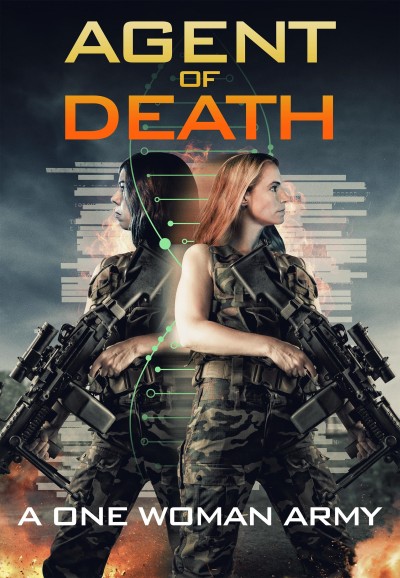 I quite liked the idea here, but the execution just wasn’t quite good enough to do justice to the concept. It feels like a matter of resources to some degree. But I also feel that a few tweaks to things would have paid significant dividends. The heroine is Tara Croydon (Fox), a CIA agent who experiences a crisis after an operation means she’s not around when her father passes away. In her depression, she signs up for a cutting-edge but rather dubious experimental project under the oversight of Hype (Medina). This involves her being given the ability to transform, physically, into one of fifteen different personas which have been implanted into her.
 The first volume is free on Amazon at time of writing, but all four are available for 99 cents, so you certainly can’t complain about value. It’s an interesting concept, too. Axira is a “spacer”, a member of an alien race feared to such an extent that they are almost legends. For centuries, she has been mentally chained up by a member of the Kore sects known only as “Master”, and compelled to do his bidding. Which usually involves copious amounts of violence, directed toward his enemies. Finally, Axira is able to break free and regain her independence, and vows to take revenge on Master.
 For the first hour and forty minutes, you may well be wondering why this is here. You will need to be patient: it gets there… eventually. However, to start with, it’s the story of the battle between crime boss Nikka Shaitan (Grover) and dogged cop Inspector Sidhu (Kumar). After members of the former’s gang are caught attempting a bullion robbery, Sidhu seeks to leverage them to reach their boss. But Shaitan uses all the power – both legal and illegal – at his disposal, to avoid justice. Initially, a state of martial law (the title translates as “emergency”) gives the cops the edge, but after that is declared over, the balance shifts, culminating in Shaitan’s gang invading Sidhu’s wedding and gunning everybody down.
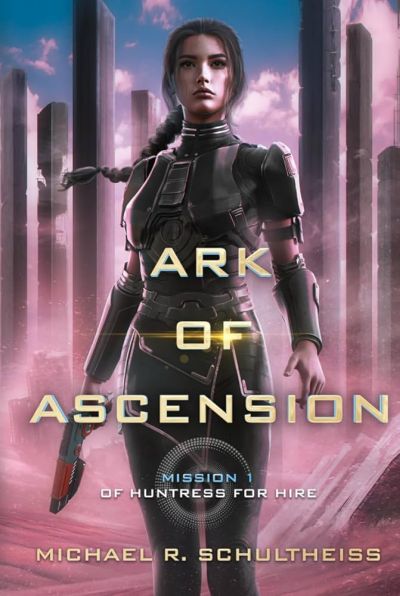 I don’t necessarily expect to understand a literary universe from the first page. These things take time: I get that. But I do expect that, as I go through the chapters, things will become clear. If I reach the end, and am still vague on a number of significant plot points, then something has gone wrong. Sadly, it’s the case here, and that largely hampered the effectiveness of the narrative. In this case, it had a cascading effect. Because I didn’t understand one situation, that rendered a character’s purpose uncertain, and this then meant the heroine’s motivation wasn’t clear.
 This is now the third film with the same title to be reviewed on the site: no
 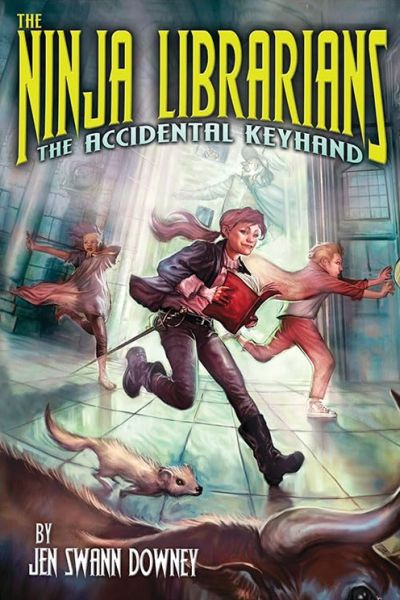 (That quote also answers the question of whether this is fantasy or science fiction; that would depend on whether the author intended us to view the speculative elements as enabled by magic –which, as noted above, she did!– or by natural phenomena/technology unknown to present science.) 12-year-old protagonist Dorothea “Dorrie” Barnes is a library-loving kid growing up in Passaic, New Jersey (I suspect this might be Downey’s hometown, but can’t confirm that), in a chaotic household with her inventor father, college instructor mom, 14-year-old brother Marcus, and three-year-old sister Miranda. (The family shares the house with her great-aunt Alice, who’s an anthropologist.) Dorrie’s a pretty ordinary tween, albeit one with a sense of justice and a liking for the idea of sword-fighting against villains; she’s got a blunt practice sword and takes a library-sponsored fencing and stage combat class. But when the book opens on the day of the library’s annual Pen and Sword Festival (a sort of low-budget Renaissance Faire), a succession of freak events will very soon suck Dorrie and Marcus into a most un-ordinary experience….