 ★★★½
★★★½
“Alien vs. Firefly”
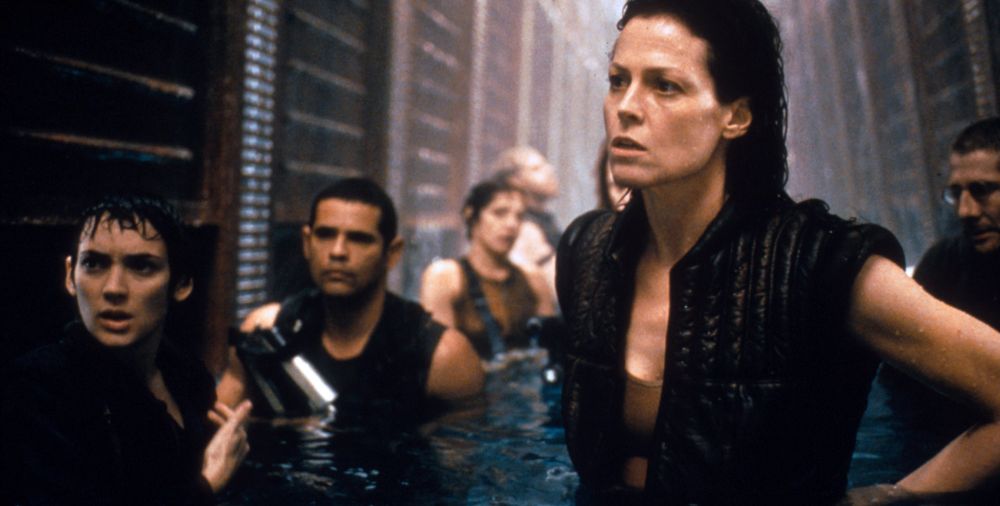
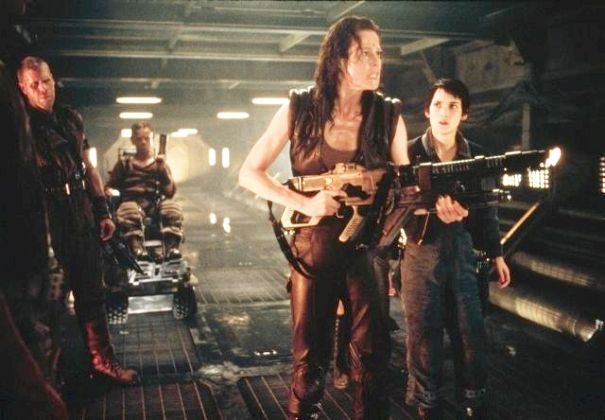
It’s not often that a film series manages to recover from – or even, survive – such a disastrous mis-step. But the Alien franchise managed it, though it took five years to come to fruition, and a Really Big Cheque to Sigourney Weaver [reportedly, $11 million, as well as a producer’s credit. The results, while short of the original two movies, are an awful lot better than its predecessor, managing to progress the story, re-invent Ripley and be generally entertaining. However, from a 2012 perspective, it’s painfully obvious that writer Joss Whedon recycled large chunks of the supporting characters, and turned them into Firefly. We’ll get to that a bit later.
It is set 200 years into the future, and begins with scientists on a space-station creating a clone of Ripley, using DNA from blood samples. They also remove the alien queen embryo which she was carrying, growing that, but keep her around for further study, intrigued by her apparent mix of human and alien DNA that’s giving her unusual powers [not unlike the way Alice fuses with the T-virus in the middle Resident Evil movies]. Docking with them is the Betty, a ahip operating on the fringes, which is bringing the scientists some meat popsicles in which they can incubate more aliens. Annalee Call (Ryder) appears to recognize the threat Ripley poses, and tries to kill her – but it’s too late, as the aliens have escaped their containment facility. Ripley and the crew have to team up, to try and fight their way back through the station to the Betty, which is the only means of escape left.
That’s an improvement in terms of a storyline over 3, simply because it is one, and provides a skeleton upon which a good amount of interesting ideas and fun sequences can be built. Jeunet came to the movie from some visually-striking French films, such as The City of Lost Children, and there’s a much better sense of cinematography apparent here – it’s a striking contrast to Fincher’s approach, where it appears his main direction to the DP was “Darker. Make it darker.” Here, you can see what’s happening: particular standouts include the first confrontation between Ripley and the Betty crew, in the basketball court, where Ripley sinks a long-range shot behind her back [legitimately done by Weaver], and a lengthy underwater sequence, where you’ll probably find yourself trying – and likely, failing – to hold your breath.
 But the central idea is the one of Ripley now being something more than human, and Weaver has a great deal of fun with that, playing as if she’s half a beat ahead of everyone else, and completes her transition by no longer being scared of the aliens. It’s them who need to be scared of her, and again, I’m reminded of Milla Jovovich in the RE series: more than human, and yet, less than human at the same time. There’s even a creature with the proportions the other way round – monster with a touch of human – like Nemesis from RE: Apocalypse, and it was no surprise to read that Paul W.S. Anderson was one of the many directors considered for this (Danny Boyle, Peter Jackson, Bryan Singer and David Croneberg beinh among the others). I briefly drifted off to speculate on the possibility of an Alien vs. Resident Evil cross-over; would probably have been a lot more fun than anything involving Predators.
As noted, what’s startling are the parallels between the Betty and the Serenity, from Whedon’s show Firefly, which came out in 2002. Both operate on the edge of legality, with a small crew of oddballs: Capt. Frank Elgyn (Michael Wincott) is somwhat less sympathetic than Mal Reynolds, but in both you have a captain/first-mate/pilot trio of two men and a woman, two of whom are in a relationship, plus a mechanic from an unexpected minority (there, a woman; here, disabled). If Perlman’s lumbering mercenary Johner isn’t a blatant dry run for Jayne Cobb, I don’t know what is, and there’s more than a touch of mechanic Kaylee Frye to be seen in Annalee. Writing as someone who found Firefly no more than a passable timewaster, it’s amusing to see Whedon was stealing from himself. Still, if you’re going to plagiarize, best use your own work, I suppose.
Oddly, Whedon hated this finished product almost as much as Fincher did the third, saying, “It was mostly a matter of doing everything wrong. They said the lines…mostly…but they said them all wrong. And they cast it wrong. And they designed it wrong. And they scored it wrong. They did everything wrong that they could possibly do. There’s actually a fascinating lesson in filmmaking, because everything that they did reflects back to the script or looks like something from the script, and people assume that, if I hated it, then they’d changed the script…but it wasn’t so much that they’d changed the script; it’s that they just executed it in such a ghastly fashion as to render it almost unwatchable.” It seems likely that’s why he recycled so many of his characters for Firefly.
It’s far from perfect, however. The biggest flaw is Ryder, who is completely unconvincing, and not a patch on her predecessors [if you’re thinking, “What predecessors?”, there’s a clue in the initial letter of her character’s surname…]. I wasn’t too fond of the way the film went in the final act, and the human-alien hybrid is neither convincing nor scary. It’s damn hard to believe that Whedon came up with five endings, and this was the one Jeunet picked as the best. But, really: after the dismal failure which was part three, it was a major relief to see something even semi-competent, which managed to sustain my interest (okay: consciousness) much better, and be generally entertaining.
Dir: Jean-Pierre Jeunet
Star: Sigourney Weaver, Winona Ryder, Ron Perlman, Dominique Pinon




 Another review compared this to Savage Streets and Vigilante, from the same era, and I can certainly see the similarities. Black belt Billie Clark (Mani) finds herself hamstrung by the ineffectual legal system, after she stops a rape – and, indeed, ends up going to jail, which is more than can be said for the attackers. With the help of a sympathetic cop (Torti), who’s also her boyfriend, she works her way up the chain to the sleazeball at the top, Krug (Wayne), presumably named after the villain of another grindhouse classic, The Last House on the Left. But it’s a climb not without its personal cost.
 Tian Si Si (Yim) is a spoiled rich girl, whose doting daddy pays kung fu fighters to give the illusion that she can beat them up. Despite his desire to wed her off in an arranged marriage to Yang Fan (Tak), Si Si runs off to meet her idol, Qing Ge (Chen), a true master of the martial arts, whom she knows only through the fictional tales of derring-do, told by her maid. Susequently, Si Si becomes the target first of con-men, then is sold to a brother, and when they realize who she is, becomes the centre of a scheme to force her into marriage, so her husband can inherit her father’s fortune. Throughout it all, Yang is about the only loyal friend, though when she meets her idol, she discovers that, while if he isn’t as depicted, he still has a courageous streak of his own.
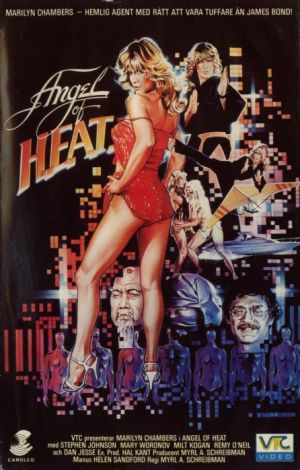 After some hi-tech computer chips go missing, government agents Samantha (Woronov) and Mark (Johnson) are assigned to go undercover at the electronics plant. But also investigating is Angel Harmony (porn star Chambers), with whom Samatha has crossed swords before, and #1 agent one of a group called The Protectors, “international vigilantes, outlaws in the service of peace and freedom” as the introductory title card calls them. Eventually teaming up, they discover the missing chips were only the tip of an iceberg created by a thoroughly-mad scientist (Jesse), who is planning to use high-pitched sound and his army of androids (which have, charitably, been given sex drives!) to take over the world and… Oh, y’know: the usual mad scientist stuff, I guess.
 This made for TV movie first aired in January 1984, and was likely fairly topical at the time, with Geraldine Ferraro then on her way to becoming the VP behind Walter Mondale. It’s still just her and Sarah Palin as far as major party tickets in American history go. Her candidacy is foreshadowed by this piece of masculine paranoia. Stowe plays Dr. Sharon Fields, a doctor who is sued for malpractice after her hospital patient, a leading Congressman, had an unexpected psychotic episode, which leads to him playing in traffic. She finds a series of similar deaths linked by trace elements found in autopsies, all of men, whose deaths benefit women, in general or specifically. Turns out they are assassinations, carried out to the orders of an ancient, matriarchal cult: they now have their eye set on the leading presidential candidate – who just happens to have picked a woman as his running mate.
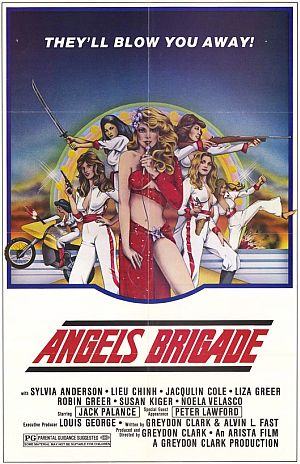 After her brother is severely beaten by a drug dealer, Las Vegas lounge singer (!) Michelle Wilson (Kiger, Miss January 1977) is visited by his teacher (Cole), who knows the location of the cartel’s drug warehouse. Wilson puts together a team of women who have reason to want to take the dealers down, including a stuntwoman (Anderson) and an undercover cop (Grant). There’s also a martial-arts instructress, a model and, tagging along, one of the teacher’s pupils. They build a heavily-armed van, train in the ways of war, and rip off a bunch of militia types for weaponry, before staging a successful raid that destroys the warehouse. However, the mob (led by veteran actors Peter Lawford and Jack Palance) are not prepared to let them get away with it.
 ★½
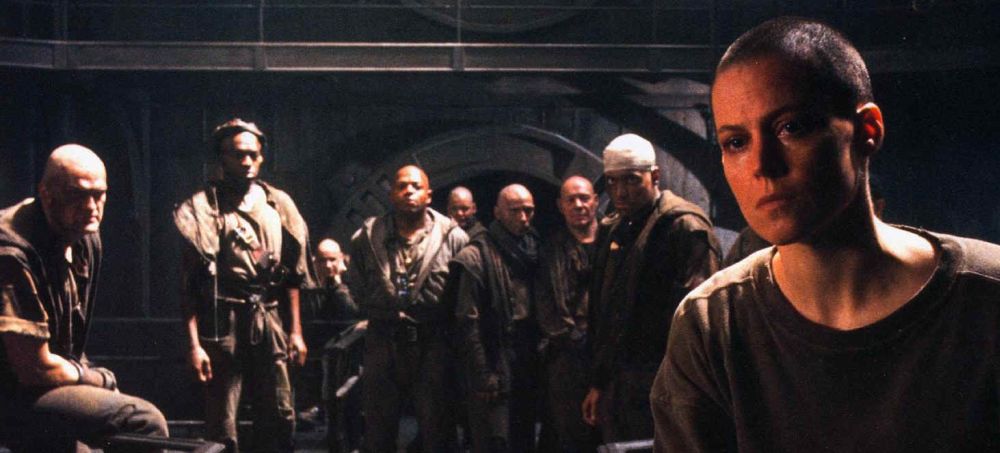
★½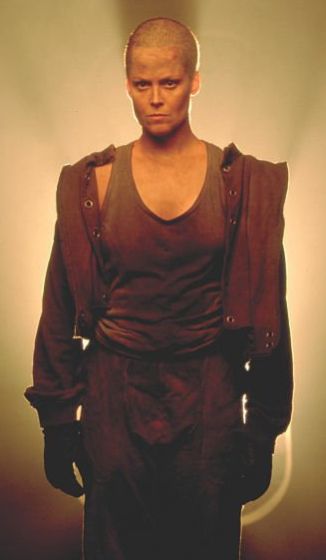 Right from the get-go, the script basically junks its predecessor. An emergency on the spacecraft bringing Ripley, Newt, Hicks and Bishop home causes it crash-land, with Ripley apparently the only survivor. It’s a near-derelict former prison planet, which was about to be decommissioned, but the inhabitants, under spiritual leader Dillon (Dutton), opted to stick around, under minimal supervision. They’re none too happy to have a woman dropped into the middle of their society, and a message is sent to request Ripley be removed as soon as possible. Needless to say the Weyland-Yutari Corporation are more than happy to oblige. However, it soon becomes clear that Ripley was not the only living thing to escape the crash, as local residents start turning up “diced.” When it’s confirmed, through Ripley re-activating Bishop, that there was indeed an alien present: destroying it is necessary, not only to survive, but also to stop it from falling into the hands of Weyland-Yutari.
 Galia is a sex-slave, kept in captivity in an Israeli brothel. After a failed escape-bid, she is told she has one chance to get back to Russia and be reunited with her daughter: kill an enemy of the man holding her hostage. This she does, but one murder becomes another, with the lure of getting her passport returned and freedom being used to keep her working, just as when she was a prostitute. But at least she has some freedom, and moves into an apartment opposite Elinor (Tayeb), who has problems of her own, in the shape of an abusive husband. The two women bond, both sharing dreams of escaping their violence-plagued lives. However, acting on those dreams is unlikely to be easy, with the men in their lives unlikely just to let them walk.
 This and Yes, Madam were basically the Genesis and Exodus of the genre as we know it. Sure, there had been action heroines before, but never with quite the heft of their male counterparts. Madam showed they could kick ass with the best of them; Angel took this, and added about a billion bullets to the mix. Sure, it’s rough around the edges, with scenes that appear randomly inserted and characters so shallow they resemble a puddle. But its influence was massive, and if you can watch the final battle without wincing, as Lee and Oshima kick the utter crap out of each other, you’re made of tougher stuff than I [It’s the December 2011 video of the month].
 A loosely-related sequel to Oshii’s last live-action film, Avalon, this is similarly set in a VR world, and muses on the relationship between real life and game life. This one is a lot less populated; there are only four people in it, roaming a desert landscape, with the targets being giant sandworms (think Dune) and the “boss” Madara, the mother of all sandworms, whom the game helpfully informs contestants, cannot be killed single-handed. The four get together to launch an attack on it, having agreed to split the game reward equally. Is that quite how things are going to turn out?