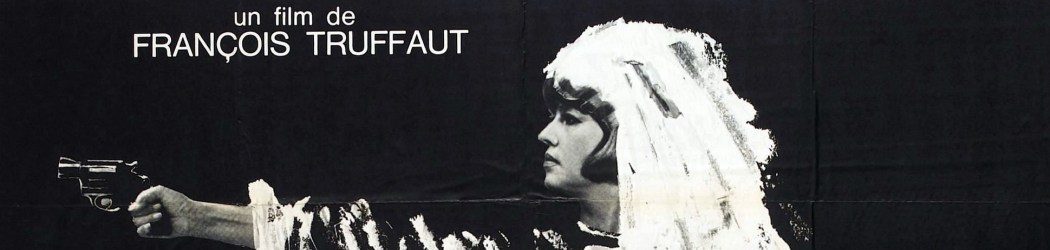

Blow a Kiss

★★½
“Too little, too late.”

You could skip the first 30-45 minutes of this, and it really would not affect your enjoyment level significantly. It seems to be one of those cases where the director is far more in love with the dialogue and characters than they deserves, and so we have to sit through far too much flapping of jaws by the latter, delivering the former in inane and uninteresting conversation, before we get to the meat of the story. Which is, as follows.

Homeless, failed ballerina Joy Malone (Berkshire), who just lost custody of her child, is drowning her sorrows in a dive bar, when she encounters local meth dealer, Samantha (Tutor), who offers her a way out of her dire straits. For Sam is in a war with another dealer, Marcus Mitchell (Martinez), and needs a replacement killer after having recently discovered – in the bar’s bathroom – that one of her gang was actually working for the opposition. Sam offers to pay Joy all the money she needs to get her kid back. All she has to do is kill Mitchell. Of course, it’s never as easy as that.

I’ve not heard of Mauser, but turns out he’s a prolific film-maker, whose site lists Kiss as his 37th (!) feature. That’s impressive, almost regardless of quality. And it’s possible this might have appealed more if I’d seen the previous 36. For instance, I suspect the presence of a psychotic killer in a giant bunny costume here, is a nod to his Serial Rabbit franchise, which has reached five movies. [Who knew?] On its own, though, there wasn’t enough to sustain my interest. For example, while I’m always down for an all-girl gang, we first meet the one here in an extended interrogation sequence, trying to extract Mitchell’s location from one of his henchmen. I suspect this is trying to be Tarantino-esque. It is – only in that it’s incredibly annoying and self-indulgent.

Just when I was close to giving up on this entirely as a flick which didn’t require a microscope to detect any entertainment value… Joy and Sam connect, and the rest of the film is actually not too bad, for a low-budget romp. There are a couple of ways I thought this might go: the striking red hair of both Sam and Joy seemed so consciously similar, I expected some kind of impersonation twist. Instead, it’s just Joy having to make her way up against Mitchell – at least until the truth is revealed.

Avoiding spoilers for that last section, means I can’t say too much about the finale, which is probably the best, and certainly the most energetic (read: least chatty), part of proceedings. I did also like the way what appears to be a police interview of Joy in the wake of everything, turns out to be… not quite that. However, you need just too much patience to get to the decent stuff, and I certainly wouldn’t blame anyone who cut and ran after the first half-hour.

Dir: Brett William Mauser
Star: Dane Berkshire, Cassandra Tutor, Karen Roberge, Ernest Martinez
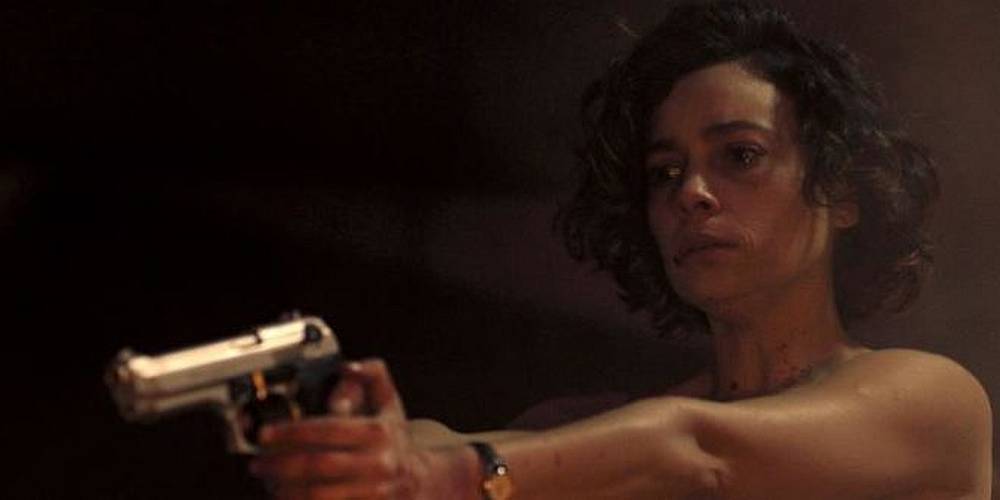
Trauma

★★★½
“Parental advisory, to put it mildly.”

This is not an easy film to watch. The easily-offended should stay away. Indeed, even the hard to offend, which include myself, may find it rough going. To give you some idea, the opening scene is set in a 1978 Chilean torture chamber where a political dissident is being interrogated. When she won’t talk, her son is drugged and forced to rape his own mother. It actually goes on to get worse still, but that’ll give you some idea. In terms of disturbing opening scenes, I can’t think of many equivalents.
Fast forward to 2011, and four young women are on their way for a quiet weekend in a country house owned by one’s uncle. An unfortunate stop for directions in a local dive-bar puts them on the radar of Juan (Antivilo) and his son, Mario (Ríos). The former was the teenage boy of the opening sequence, and was clearly broken beyond repair by those and other events. He has passed that damage on to Mario, and the pair now form a father-son duo of staggering repugnance. When they subsequently show up on the doorstep, our four heroines are in for a very, very unpleasant night. But when they learn Juan has turned his attentions to pre-pubescent local girl, Yoya, they decide something must be done, and take the fight to Juan and Mario.

It’s brutally unpleasant stuff, with some (literally) mind-blowingly gory effects. But it’s acted and assembled well enough that it can’t be written off as mere torture porn, and some radical switches in tone actually work in its favour. For example, after the opening scene, we cut to some intense lesbian canoodling, provoking cinematic cognitive dissonance which is disturbing yet effective. And importantly, it’s not without a point. In that area, it’s like A Serbian Film, which used its cinematic atrocities as a parable about the break-up of Yugoslavia. I’d actually say this was rather more successful in terms of getting its message over, about the impact of the tyrannical Allende regime of the seventies and its impact over the decades.

The carnage likely reaches its peak near the middle when everyone returns to the bar, for a fight of disturbing savagery, even by this movie’s standards, which also affirms Juan’s status as completely above the law in the local community. The final battle, I have to say, did come across as rather confused in comparison, likely hindered by lighting which barely reached the level of murky. As a result, on more than one occasion, I went “Hang on, aren’t they dead already?” Considering how coolly clinical Rojas’s camera was in capturing the previous unpleasantness, this was disappointing.

If there’s a message here, it’s the one written by Edward Burke: “The only thing necessary for the triumph of evil is for good men to do nothing.” Or women, in this case, with Andrea (Martin) taking the lead. She’s an interesting character, with a certain standard of morality: for instance, she doesn’t like her sister’s girlfriend, though it’s unclear whether this is because of gender or personality. It’s Andrea who increasingly occupies centre-stage as events unfold, and occupies the film’s final frame. Though let’s just say, it’s not exactly what you would call a happy ending, even if there is some degree of catharsis to be found. It’s probably even harder to forget than to watch.

Dir: Lucio A. Rojas.
Star: Catalina Martin, Daniel Antivilo, Macarena Carrere, Felipe Ríos

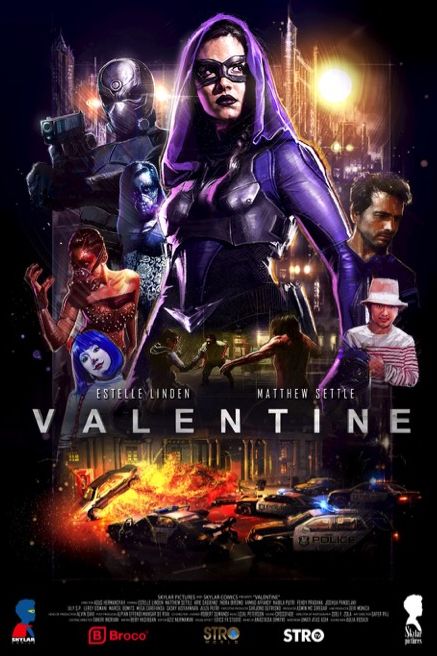
Valentine: The Dark Avenger

★★★½
“An unexpected Valentine’s gift.”

It’s always nice when a film manages to surpass expectations. Coming in, I was thinking this was going to be nothing but a low-rent, dubbed, caped crusader flick. And, to be honest, that is exactly what it is: a low-rent dubbed, caped crusader flick. But it proved considerably more entertaining than, say, Terminator: Dark Fate, which I saw the same weekend, and which cost roughly a thousand times as much to make.

It has an interesting hook. Waitress Srimaya (Linden) is recruited by a film-maker, Bono (Settle, the only American in the cast), who wants to make a superhero movie that will be a positive role-model for the citizens of crime-riddled Batavia City. With no producer willing to back him, Bono opts to go the viral route. When he sees Srimaya’s martial arts skills in action, he brings her on board to star in videos where she goes up against and beats robbers, muggers and other street punks, clad in a fetching little mask and cape designed by stylist friend Wawan (Dagienks). But her actions bring her to the attention of crime lord, Shadow, who is carrying out a vendetta against the local police.

There’s a nice sense of progression through the film, with the heroine’s gear and costume improving from the pretty basic to the impressively nifty, as she and Wawan learn from her experiences, e.g. add more padding. It also is willing to kill off people you didn’t expect, and if the true identity of Shadow is something you might well figure out before the end, the reasons behind it are unexpected and well-considered. Even the dubbing didn’t irritate me, in the way it usually does – though this may partly have been been because I still put English subtitles on!

The main appeal is the action, however. Indonesian films have a reputation of late for being remarkably impressive, and if this isn’t quite The Raid or The Night Comes For Us, choreographer Robert Suwandi delivers the goods. Linden in particular, is better than expected, and I also liked the Suicide Squad-like trio of female henchmen used by Shadow. The directorial style does tend a little too much to the hyper in terms of movement and cutting, yet it also does a good job of meshing practical and CGI – better, indeed, than Terminator: Dark Fate. For the CGI is used to enhance, rather than replace the physical effects, in particular during a car-chase following a bank robbery.

My interest in the Marvel Cinematic Universe has steadily waned as it has become an unstoppable behemoth. Films like this, however, I find considerably more interesting.  Not necessarily because the stories they tell are particularly novel, just that they seem created out of a desire to tell those stories, rather than as cold, calculated commercial entities. I’d rather see a film with rough edges here and there, made with passion, than one which is clearly just a job for those involved. This movie is a good indication of why.

Dir: Ubay Fox, Agus Pestol
Star: Estelle Linden, Matthew Settle, Arie Dagienkz, Fendy Pradana

High-Rise Rescue

★★½
“All fired up.”

Architect Beth Davis (Bell) is just about to leave Chicago for a business meeting in Miami, when she hears there has been an explosion at the high-rise apartment building downtown, where she lives with husband Jack (Davis) and son Charlie (Arnold). Rushing back home, she finds the situation increasingly perilous, and the fire department unwilling to enter the unstable structure. Having been the person who designed the building, Beth is able to sneak in, with the aid of a sympathetic fireman, Ray Steele (Holmes, looking like a low-rent Tony Todd) on the outside, and begin the perilous climb to the 55th floor where Jack and Charlie are trapped in the bathroom.
When this sticks to the basic, Towering Inferno-like concept of Davis vs. fire, and the heroine making her way up through the burning building, this isn’t bad. There is some decent practical effects work, and although CGI is also used, it’s clear that someone is getting quite close to the flames – even if it’s unlikely to be Bell. The film switches focus frequently between her and her family, as the latter find themselves in increasing peril, despite the helpful advice offered over the phone by Ray. This is quite educational, and if ever I find myself trapped, six hundred feet above the ground and awaiting rescue, I feel I will be reasonably well-informed as to the best tactics for survival.

The problems are much more when the film attempts to build character through the backstory and dialogue, such as the subplot involving Beth and Jack’s shaky marriage, or their differences of opinion as to whether or not to have a second child (though in an admirable shift from what you’d expect, it’s Beth who is less than enthusiastic about the prospect). Watching them swapping dialogue which is so soapy, you could wash the floor with it, is painful – though likely still less cringeworthy than the scene where Ray reveals the personal life experience which resulted in him becoming a fireman. It’s ironic, since an early scene deliberately establishes that, “Fire doesn’t care who or what you are.” The same can probably be said for this viewer.

It’s all rather too implausible, from the moment live TV has a report on the explosion, within literally ten seconds of it taking place. I’m not sure the actions of the fire-brigade quite stand up to scrutiny either: the chief seems far too unconcerned about the civilians that are still present in the conflagration. I’d like to have seen them make more use of Beth’s position as the building’s architect, putting her specialist knowledge to good use, instead of all but forgetting about it, as soon as she enters the basement. The results just about skate by as a way to pass 90 minutes, mostly thanks to a decent performance from Bell. But it’s a long way short of being even disaster soft-porn, and will barely leave even a scorch mark on most surfaces.

Dir: Robert Vaughn
Star: Catherine Bell, Adrian Holmes, Greg Bryk, Sam Ashe Arnold

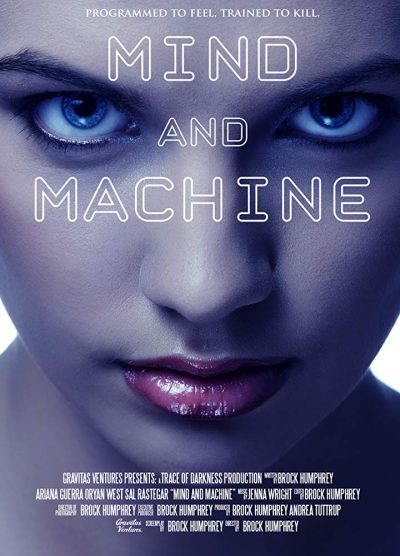
Mind and Machine

★½
“Circuit bored.”

Intelligence without morality to govern it, is psychopathy. So what happens when you create an intelligent machine, but deliberately avoid installing any kind of moral compass? It’s an interesting idea for a film. Not that you’d know it from this unconvincing effort, which sucks the potential out of it. In this near-future – it’s set in 2024, close enough to now, no actual work is required on the part of the makers – androids have become part of everyday society in many roles. Crime boss Isaac Lynch (Restegar) orders technician Leo Cameron (West) to make one without a conscience, so that it can be used as an assassin, saving those pesky hitman fees. Only Leo crafts the robot, Maya (Guerra), in the image of his late wife. On the plus side: he gets to see his wife again. On the other hand: she’s an amoral killer. Didn’t think that through too well, did he?

And that’s the problem here: not much of this makes sense. Not Leo’s actions. Not the way nobody else came up with the idea first; most obviously, the military would be all over this in reality. Not how Isaac’s entire criminal organization consists of about three people, yet is still capable of pushing technological innovation into uncharted territory (and he also kills a customer, rather than letting him pay their debt). Not even the way Maya – and this is so obvious, it’s not a spoiler – eventually rebels against Isaac’s orders. It seems like writer/director Humphrey decided where he wanted the film to end up, but couldn’t be bothered to figure out how it could logically reach that point.

I’ll give Guerra credit for her portrayal of Maya, which is credibly lacking in emotion. Though again. there’s no consistency there, nor any explanation for her decision to revolt, after being made to torture an undercover agent. Why is killing unproblematic for this machine, yet torture represents a breaking point? And the lead actress’s reluctance to disrobe does lead to one of the most embarrassingly unconvincing body doubles I’ve ever seen: Guerra’s hair is black and straight, while that of the woman standing in for her, is brown and wavy. If you can’t do it well, Humphrey should have written it out of his script, since it’s not as if it was necessary to the plot.

Maybe he needed it for running-time purposes. Because this barely qualifies as a feature, lasting a mere 70 minutes, and that includes a slow, slow end credit crawl. It certainly feels considerably longer, and my interest steadily waned, as it failed to provide any interesting answers, or ask any interesting questions. A slowly-developing self awareness and independence, and more focus on Maya, rather than (the thoroughly uninteresting) Leo and Isaac, might have been the way to go. But then, that was Ex Machina, wasn’t it? This is a poor imitation thereof, and one which sporadic bursts of low-rent violence can do nothing to rescue.

Dir: Brock Humphrey
Star: Ariana Guerra, Oryan West, Sal Rastegar, Bobby Hernandez

Prime Suspect: Tennison

★★★½
“Before she was famous…”

Origin stories are all the rage, it appears. Though it’s probably just coincidence we watched this prequel to Prime Suspect the same week that Joker came out. It’s not quite as successful in terms of reinventing an iconic character, or shedding light on how they became who they are. This is largely because lead actress Martini is not Helen Mirren. Though it would unfair to hold that against her – because, let’s face it, who is? While I found it interesting to see some of the early influences which turned Jane Tennison into who she is, what she became is more notable than how she got there. It’s probably more enjoyable if you can separate them, and just enjoy this on its own terms, as a period police procedural.
It’s 1973, and we join the 22-year-old WPC 517, Jane Tennison (Martini), as she tries to find a footing in her first posting, to Hackney Police Station in East London. There, she has to cope with a time where women police officers were largely sidelined to making tea and taking messages. However, one of the detectives there, D.C.I. Len Bradfield (Reid) takes her under his wing, as the investigation begins into the murder of a prostitute, found strangled with her own bra. Meanwhile, long-term criminal Clifford Bentley – against whom Bradfield has a grudge – has barely got out of jail, before he and his family are planning a new robbery. But Jane is about to discover that things are not always as cut and dried as she’d like, and that the law and justice can be different, too.

It’s when the heroine is forced to confront these dilemmas that the show is at its most interesting. For example, when Tennison witnesses a colleague roughing up a suspect in the murder, actions which could allow them to go free. Should she speak up or keep silent? There are no easy answers, and depicting the dramatic tension is where Martini is at her most effective, along with trying to deal with her “helicopter mother”, who doesn’t appreciate her little girl is all grown up. [As an aside, there’s no denying the actress does bear more than a slight resemblance to a young Helen Mirren. Compare the pic on the right to this one of Mirren, from 1972, a year before this takes place]

Of course, if you’ve seen the episodes with Tennison all grown up, you’ll not be surprised by much here. There’s no way, for example, that Jane and Len are ever going to end up happily ever after. That said, the double-whammy in which this is accomplished was undeniably effective. It goes some way to explaining her aloofness in middle-age, as the scars of her early experiences. Being able to hang more personality trains on FutureJane, in a similar way, would have helped link this to what was to come. Instead, it’s just a little too disconnected, though on its own merits, we still were solidly entertained.

Dir: David Caffrey
Star: Stefanie Martini, Sam Reid, Blake Harrison, Alun Armstrong
a.k.a. Prime Suspect 1973

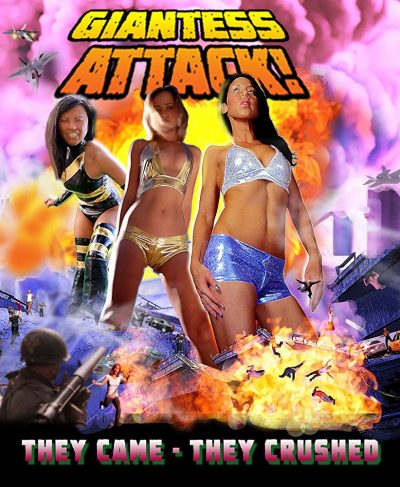
Giantess Attack!

★★★
“Large and in charge.”

Diedre (Tacosa) and Frida (Riley) are the fractious stars of low-rent superhero show, Battle Babe and Combat Queen. When the series is canceled, they go on a bit of a binge, ended only by the appearance of two tiny aliens from Metaluna (Nguyen), who give the pair of very drunk Earth women devices that will turn them into Team Giantess Attack. These are intended to be used to rid the planet of evil. Needless to say, things don’t quite work out that way. The military, under Gen. Smedley Pittsburgh (Rowen), want to get their hands on this alien technology. But D+F won’t give it up and, instead, use it to go on the rampage and take revenge on those who previously wronged them.

When a film goes out of its way to be deliberately crap, this largely makes it flame-proof, since a legitimate defense against any highlighting of its shortcomings becomes. “Well, it’s supposed to be bad.” There’s no doubt this is a parody of.. well, everything from Japanese sentai shows through B movies such as Attack of the 50-Ft Woman and on to TV series like The Bionic Man. As such, there are chunks which work remarkably well: Nguyen’s dual performance as both Metalunans (a name itself taken from This Island Earth) is delightful, especially if you’re familiar with the Mothra movies which inspired the twins. It just needed a little song-and-dance number to make it perfect.

However, there’s a weird inconsistency of tone, and as the above should suggest, a lot of potential left on the table. At times it seems almost like this is aimed at kids, Then you get a lengthy sequence about Team Giantess Attack sticking the General into various orifices, which seems to have strayed in from some creepy fetish movie (I’m not Googling it, but… Rule 34). There’s also a funny spoof commercial for cereal… and just the one. That they failed to go full Amazon Women on the Moon there, peppering the film with fake adverts, trailers, etc. seems like a lost opportunity. The whole thing runs only 61 minutes, so it’s hardly as if they were strapped for time. And there’s still padding: we’re 22 minutes in before the Metalunans show up.

Yet all told, it remains a good-humoured and generally entertaining piece of work. The effects are all over the place, throwing stock footage, model work and green screens together in a thoroughly low-budget mess – which is, of course, the point, just as much as the women’s clothes conveniently expanding to keep them covered. If you don’t smile at the thought of two bikini-clad behemoths wrecking Hollywood landmarks like the Capitol Records building, then it’s probably safe to say this isn’t the movie for you. However, I have seen more than my fair share of the content which this is lampooning. So I must admit, I probably have more anticipation than I expected, for the impending sequel, Giantess Attack vs Mecha-Fembot, whose trailer is below.

Dir: Jeff Leroy
Star: Tasha Tacosa, Rachel Riley, Jed Rowen, Christine Nguyen

The Archer

★★
“An arrowing experience.”

Lauren Pierce (Noble) is an expert archer, leading her high-school team. However, after she rescues a friend from sexual harassment, she finds herself on the wrong side of justice, and is sent to “Paradise Trails”, an incongruously-named juvenile detention facility, where harsh discipline and indefinitely extended sentences are the order of the day. And wouldn’t you know it, the place is run by a former Olympic archer – Bob Patrice (Sage) and his creepy son, Michael (Terry). It’s not long before Lauren is plotting an unofficial departure, along with new friend Becky (Mason), who knows the truth about what’s going on behind the scenes. When they get evidence proving it during their exit, they become the hunted as Bob and Michael will go to any lengths to stop the truth from getting out.

Opening with a claim about being “inspired by true events,” apparently that means the “kids for cash” scandal from Pennsylvania. While there’s nothing wrong with that as inspiration, it’s probably a mistake for the makers, apparently to want to make a serious statement, while adopting the tropes of the juvenile delinquent and women in prison genres. Brutal wardens; sadistic guards; lesbian subtexts… This all makes it kinda tough to take seriously, whatever statement they’re trying to make. And even that’s kinda muddied, beyond “sending kids to jail for bribes is bad.” Not much to argue with there. Probably more questionable, is the way every man here is an utter bastard. It gets kinda tiresome.

The main problem, however, is simply taking too long to get anywhere. The final 20 minutes or so, have Lauren and Becky trying to get through the wilderness around the facility, with Bob and Michael in pursuit. It’s well-crafted and tense, even if it builds to the inevitable final, bow-powered confrontation between Lauren and Bob, which you can see coming from a long way off. Unfortunately… it’s the final 20 minutes. The first hour are a real slog to get through, particularly the chunk after Lauren’s arrival at Paradise Trails. The script doesn’t have any real idea about where it needs to go or what it wants to do, once the basic concepts are established. As a result, it and the characters simply rotate gently in the wind, as interest evaporates gently.

There’s not even any real logic in the concept. Lauren is supposedly a “straight A’s” student with no previous record. Could have fooled me, going by the hyper-aggressive way she beats up on her pal’s boyfriend. That shows experience in the kicking of ass. Been nice if her ability to defend herself had come into play in the facility a bit more. Except, acknowledging women’s ability to be violent might have gone against the narrative apparently being peddled here. In that light, even the heroine’s use of a bow seems like some kind of liberal cop-out to avoid giving her the far more effective force multiplier of a fire-arm.

Dir: Valerie Weiss
Star: Bailey Noble, Bill Sage, Jeanine Mason, Michael Grant Terry

Shuddhi

★★★
“Social justice vs. warrior.”

I should probably start by providing some background the film omits – likely because the intended Indian audience were well aware of it. In 2012, a notorious gang-rape took place in Delhi, the victim subsequently dying. Of the six attackers, four were sentenced to death and one committed suicide in prison – but the sixth, being a juvenile, could only receive a maximum sentence of three years. This loophole appalled many, including two journalists depicted in this film, Jyothi (Nivedhitha) and Divya (Karagada), who begin a campaign to revise the law.
At the same time, American photographer Karlyn Smith (Spartano) returns to India, with a very different but even more personal mission: taking revenge on the men who raped her. This is a highly-risky job, beginning when her attempt to buy a gun turns into a mugging. Matters aren’t helped when another attempted robbery leads to her attacker’s death, and a subsequent police investigation by Rakesh Patil (Purushotham). Nevertheless, she persists, tracking down and eliminating the gang responsible like a female Charles Bronson; initially, one by one, then finding the remainder as they crash a house party.

It really feels like two different movies edited together. You have Jyothi and Divya, touring the country putting on little stage plays, offering an interpretive dance version of gang-rape in a bid to raise awareness. Then there’s Karlyn, opting for a considerably more direct form of protest: shooting rapists. The threads only overlap at the end, in an extended coda where Karlyn may or may not have drowned. It’s all rather confusing, and the film’s insistence on jiggling the time-line for dramatic effect is also more irritating than enlightening. For instance, it opens with an off-camera shooting, that turns out – for no good reason – to be the second robbery attempt on our vengeful heroine.

The good news is Spartano – who has almost no previous feature work to her name – does an excellent job with her part of the film, and it’s that which held my interest. Interesting decision by the makers, to create and cast an American character for this role, rather than using an Indian actress. [The director know the actress from his time at the New York Film Academy, and also brought on board an American music director and cinematographer] Yet it still manages to weave in to its narrative strands from Indian mythology: the title is an alternate name for the goddess Durga, the Hindu warrior goddess. Wikipedia tells me her “mythology centres around combating evils and demonic forces that threaten peace, prosperity and dharma of the good. She is the fierce form of the protective mother goddess, willing to unleash her anger against wrong, violence for liberation and destruction to empower creation.”

Hard to argue with that: at one point, Karlyn says, “When you get used to it – killing – it’s as easy as breathing.” And there’s one particularly memorable shot at the party where Karlyn just stalks past an opening, and it suddenly feels like a wildlife documentary about tigers hunting. Just a shame they film didn’t go full-bore into this aspect, rather than diluting it with Jyothi and Divya’s ineffectual social campaigning.

Dir: Adarsh Eshwarappa
Star: Lauren Spartano, Nivedhitha, Amrutha Karagada, Shashank Purushotham

Hostile

★★★
“We are the monsters.”

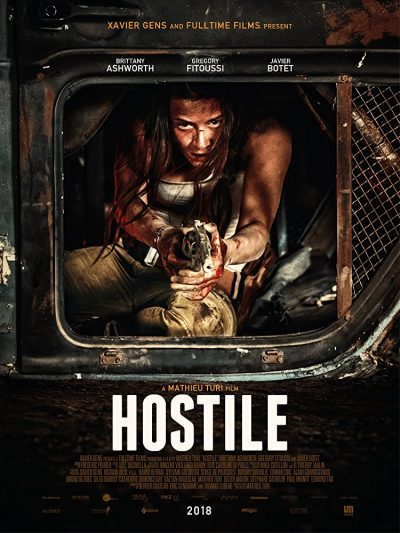
After an un-specified global apocalypse, humanity is reduced to small bands of scattered survivors, who have to try and scratch out survival, while avoiding the attacks of “reapers”, mutated creatures which stalk the landscape, especially after dark. One of those survivors is Juliette (Ashworth), who is on a foraging mission in the desert when an accident throws her off the road, and leaves her with a badly-broken leg. She has to wait for help to arrive, fending off the reaper (Botet) which is prowling the area, with whatever she can find to hand. As she does so, she thinks about life before the apocalypse, where she escaped drug addiction with the help of her boyfriend, gallery owner Jack (Fitoussi) – only for happiness to be fleeting, and taken away from her when multiple tragedies strike.

Initially, the structure bugged the hell out of me. Just when tension was being ramped up, with Juliette in peril and having to cope with a host of issues, simply to survive, we’d suddenly flash back to mundane reality, and thoroughly unconvincing chat between her and Jack. This happened on multiple occasions, and I was left wondering what the relevance of it all was. Beyond her apparent issues with reading, there seemed to be little or no connection. Finally, at the end, you suddenly get the point. While it’s quite a touching revelation, and the ending in undeniably poignant, I’m not sure it was enough to counter all the irritation the approach generated earlier.

The other problem, is that Turi is considerably better at the action/horror aspects, than at relationship drama. It’s a while before we see the first reaper. Juliette’s first encounter with one takes place inside a caravan where she foraging; the camera remains outside and, brilliantly, we only see the impact of her battle with the creature on the caravan, as well as hearing it, of course. When we finally see one, it lives up to what our imagination has crafted, and is creepy as hell. That’s thanks mostly to Botet’s fine work as a “body actor,” along the lines of Doug Jones. In contrast, there’s little or no wallop packed by the scenes involving Juliette and Jack, which are closer to bad soap-opera.

As noted, you eventually understand why, yet I can’t help thinking there were better ways to handle it. While necessary exposition, front-loading all the set-up, rather than spreading it out through the film, and doing so more efficiently, would perhaps have helped. I’d rather have seen how we got there from here (“there” being the post-apoc world, in case it’s not clear), than rehash every detail of what’s clearly a doomed relationship. If we’d had the reaper stalking her over an extended period, that might also have helped credibility in terms of the final revelation, and a bit more likeability for the heroine would have been welcome. As is, the good here is really good; it’s unfortunately countered by a number of significant issues.

Dir: Mathieu Turi
Star: Brittany Ashworth, Gregory Fitoussi, Javier Botet