




★★½
“I’m the trouble starter, punkin’ instigator…”
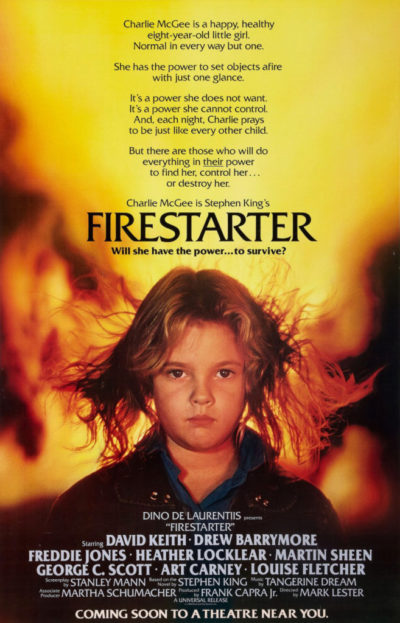 It’s somewhat ironic that John Carpenter was originally supposed to direct this. However, after The Thing tanked at the box-office, he was let go from the project, and replaced by the more commercially “safe” Lester. The irony being that The Thing is now regarded (rightfully) as one of the greatest scifi/horror films of all time, while this is… not. It’s very much a mid-tier Stephen King adaptation, far less well remembered than the similarly themed The Dead Zone, from around the same time. I can understand why: it’s lumbering when it needs to be taut, needlessly coming in a little shy of two hours, and only comes to life at the end, when a pissed-off Drew gets enough XP to learn her Level 3 Fireball spell.
She plays Charlie McGee, daughter of Andrew (Keith) and Vicky (Heather Locklear), who met during a fringe scientific experiment, carried out by a dodgy arm of the government. Dosed with a substance called Lot 6, she can read minds, and he can compel people to act in accordance with his will. Charlie, meanwhile… Oh, see the title. Or the poster. Figure it out for yourself. Though the stiff breeze which springs up out of nowhere, each time she furrows her little brow and gets toasty, is a nice touch. Naturally, the government under Captain Hollister (Sheen) are very keen to get their hands on her, with psycho Indian hitman John Rainbird (Scott) eventually sent out to bring in Charlie.
There’s quite a lot here which has not stood the test of time, and/or wasn’t very good to begin with. Top of the list is likely Keith’s performance, which feels like a poorly conceived effort to channel Patrick Swayze. Scott is creepy, for all the wrong reasons. Rainbird’s relationship with Charlie feels inappropriate from a 2020’s angle, and few people are likely less appropriate to play a native American than Gen. Patton. The film’s main strength is Barrymore, who alternates between adorability and frankly being damn scary. Every other minute, you want to hug her… while wrapped safely in a fireproof suit. At the age of eight, I guess she was still a couple of years from going into rehab.
While the structure largely mirrors the book, doing so probably doesn’t help, beginning when Charlie and her father are already on the run. This then requires a series of clunky flashbacks to get us caught up, and there is too much sitting around the lab, getting father and daughter to demonstrate their talents. Charlie probably isn’t the only one to issue a derisive snort when she is presented with a pile of wood chips. When things do eventually get going though, this is deliciously well-done (in the steak sense, at least), a throwback to the days in Hollywood when wanting to blow stuff up, required actually blowing stuff up. I would nod in acceptance if you told me the finale was responsible for starting off global warming. It just doesn’t quite make up for the 105 minutes which preceded it.
Dir: Mark L. Lester
Star: David Keith, Drew Barrymore, George C. Scott, Martin Sheen
A version of this review previously appeared on Film Blitz
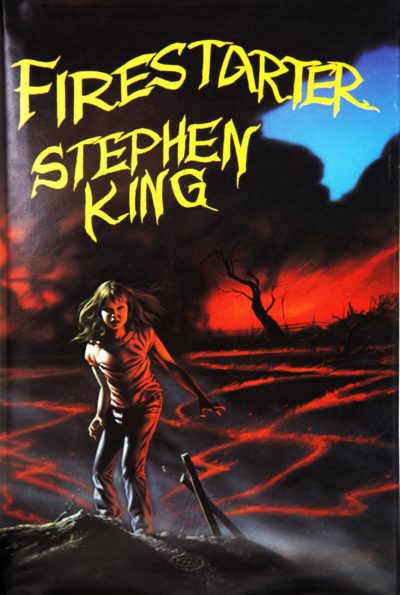 Having watched both versions of the film, I followed up by reading the book on which they were based. Despite my general fondness for horror, I haven’t read very much Stephen King: this is only the second novel of his, after Salem’s Lot. First thought: at 576 pages in the mass paperback edition, it’s quite a door-stopper, and you can see the problems in adapting a work of that size into a movie. Inevitably, a lot of the detail and nuance is going to be excised. There’s no doubt, the 1984 version is more faithful; the 2022 adaptation takes the basic concept of a young girl with pyrokinetic powers, on the run from the government with her father, and does its own thing, more or less.
 Despite generally terrible reviews, this is definitely not, by any means, a terrible movie. It is, admittedly, a fairly generic sword-and-sorcery flick, in which a hero must rise from a common background to save the world from a terrible magical threat. But it looks spiffy – the hundred million dollar budget is on the screen. If the central performance has its issues, there’s enough around the fringes to make both for an adequately entertaining experience, and also merit the existence of a review here. In particular, the main antagonist is the evil witch Mother Malkin (Moore). She escapes from the prison to which she had been confined years ago by Gregory (Bridges), now the last survivor of his order of witch-hunters.
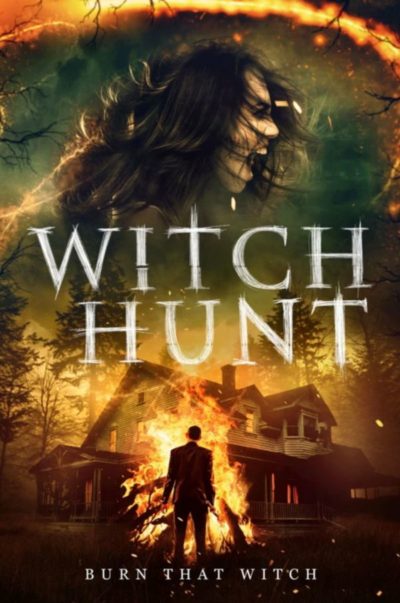 This is set in the everyday world – but with one major tweak. Witchcraft exists, and has been outlawed in the United States by the 11th amendment. Now, government agents from the BWI seek out witches, using tried and true methods from the middle ages (the “sink test” is exactly what it sounds like), and punish those found or suspected to be practicing witchcraft. But those opposed to this have set up an “underground railroad” to smuggle the targets over the boarder to Mexico. Teenage girl Claire (Adlon) is part of one such family, courtesy of her mom Martha (Elizabeth Mitchell); Dad is out of the picture. Claire is rather ambivalent about their activism, since she just wants to fit in at school. But the arrival of Fiona (Cowen) and her little sister, siblings whose mother was burned at the stake, forces Claire out of her professed neutrality,. Especially as the investigation of the unrelenting BWI Agent Hawthorne (Camargo) gets closer to home.
 Seeing this described as “an experimental thriller,” set my alarm bells ringing. I’ve seen enough “experimental” film in my time, to realize it’s typically a code-word meaning “incoherent rubbish.” The above rating is thus partially a reflection of my relief that this did not fall into that category. You still, very definitely, have to manage your expectations here. If you go in expecting a slick, Jason Bourne style adventure, you will be sorely disappointed. For this is a no-budget entity, largely guerilla filmed by a one-man crew, and with a lead actress who has no real experience. It has already significantly surpassed all my expectations, simply through not being a total disaster.
 This is likely an admirable effort in terms of its budget. The IMDb estimates it costs $100,000 and it looks like Price squeezed every cent – or, since it’s British, penny – out of that. To give you some idea, also per the IMDb, “Sections of the film were shot during the Covid-19 United Kingdom lockdown with just the occupants of the director’s flat. The director’s girlfriend doubled for any actors and WhatsApp voice notes from cast members were used for any extra lines of dialogue.” This is the kind of thing that can only be respected. Which is why I feel a little bad about having to give this an underwhelming review, because… truth be told, it’s kinda boring.
 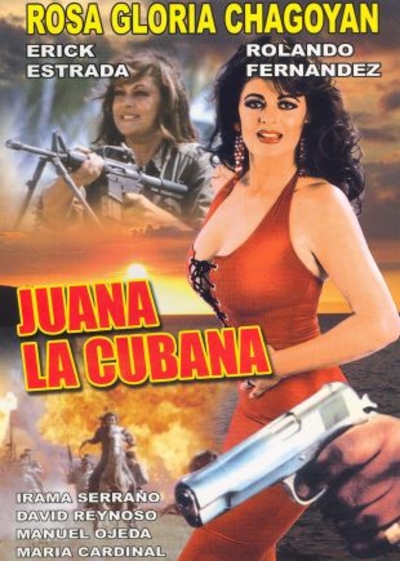 A long time ago – 17 years or thereabouts! – we reviewed another Chagoyan/Fernandez production,
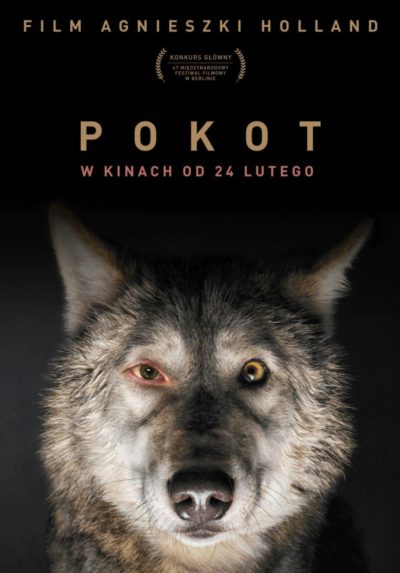 Janina Duszejko (Mandat) is a former engineer, who now lives in a small rural Polish town. She has a deep love of nature and animals. This is a belief not shared by many of the local population, who treat animals as a resource, put there for their benefit – an attitude which brings them into conflict with Duszejko. After her two dogs disappear, she goes to the authorities, but they blow her off. However, the man she suspects most, turns up dead – just the first in a series of mysterious deaths, that may be related to Jaroslav Wnetzak, a local businessman with a finger in a number of shady pies. Subsequent corpses include the police chief, who owes Wnetzak money.
 To my surprise, when I begin researching this film, it appears actually to be based – at least, somewhat – in reality. I give you