Stalked

★★
“Lacking in military intelligence”

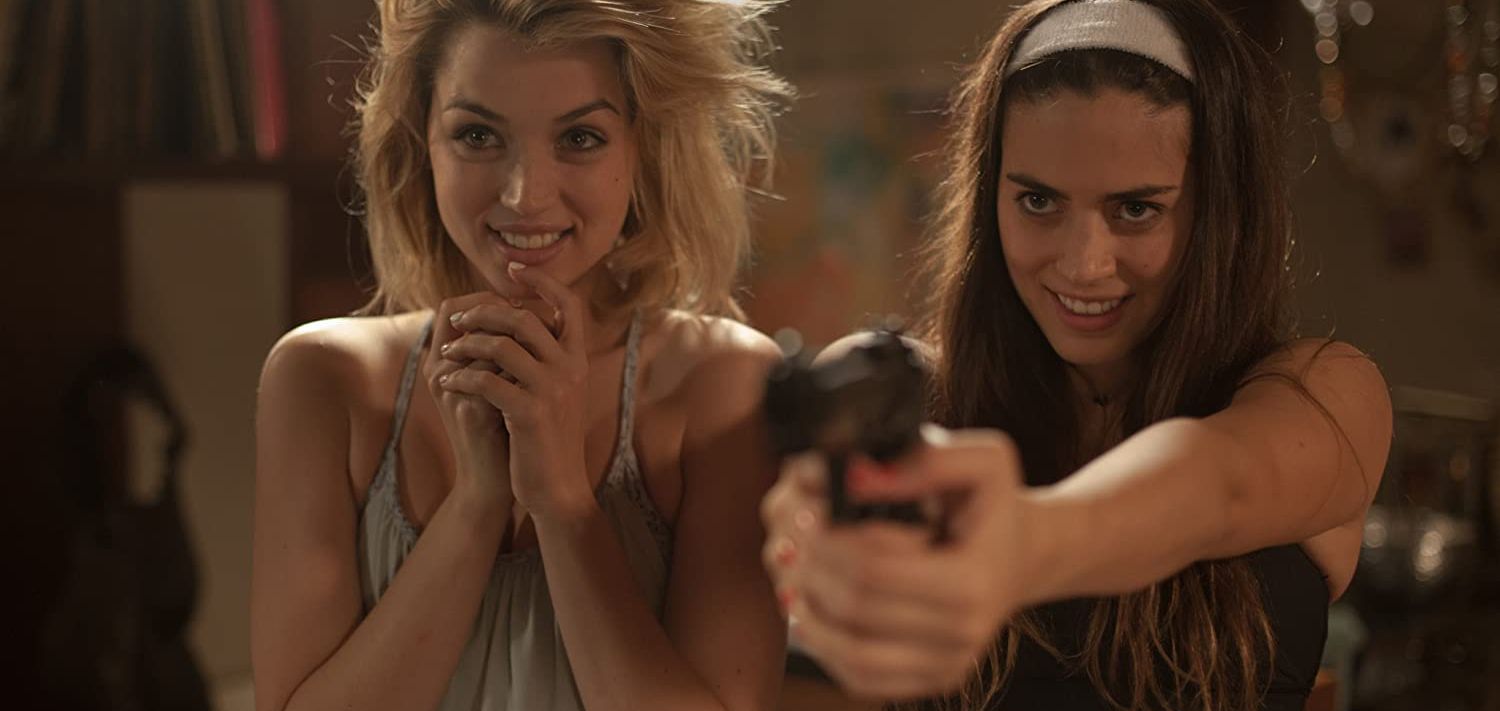
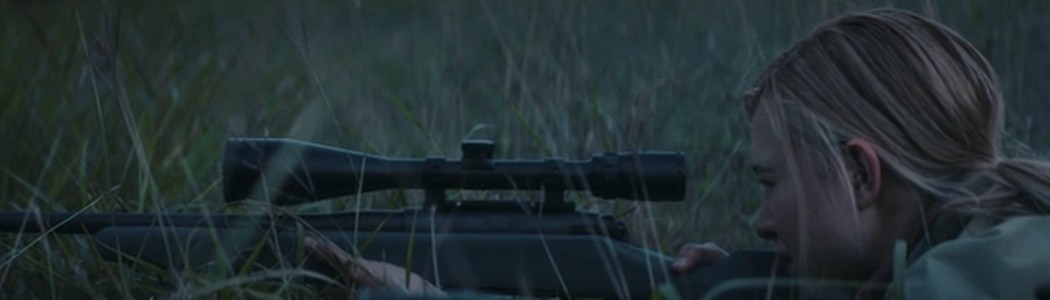
A promising idea has its concept snuffed out by shaky execution and even worse writing. Sam (Rogers) is a former solder and now single mother. When her child falls sick, Sam heads for the chemist’s for medicine. She never gets there, being abducted in a van and rendered unconscious. She wakes in a large warehouse-like facility in the middle of nowhere, which turns out to be a military production facility. She’s not the only woman there, and finds that an invisible adversary, using advanced tech to cloak his presence, is taking advantage of the weekend to turn the place into a stalker’s amusement park. However, Sam’s background perhaps gives her a very particular set of skills, unavailable to the other victims.

I’m generally fairly oblivious to script-holes: Chris is considerably better at spotting them. But here, even I could see the glaring flaws. This is supposedly a cutting-edge military facility, yet the security is so bad, a child can literally get in. The motivation for the villain is poorly drawn, and it’s never explained how the lowly caretaker – for that’s what he is – manages to get to use all of his wonderful toys. Do the army also let soldiers take tanks off to drive around on the weekend? But it’s not as if the film has any confidence in him as a bad guy, for even after Sam has managed to avoid his threat, she then has to handle a military drone. Just one – for like I say, security is pretty bad. And it can easily be taken out with a conveniently to hand brick. If we ever go to war, I swear, we are screwed

If the film had made much of Sam’s background, supposedly in the engineers’ corps, that might have helped. Watching her MacGyver her way against her opponent, using the plentiful material at hand could have been fun. But that would have required thought, something largely absent from the script. There are few points at which we are ever convinced of her military background, and the scenes where she is “fighting” her invisible opponent, all too often reminded me of the Monty Python sketch about self-wrestling. It’s a shame, as Rogers is by no means terrible otherwise, and is quite empathetic.

The same cannot be said for the ending, however. It’s understandable that the writer-director felt the need to tack something on, after the considerably underwhelming confrontation with the drone. What he delivers is the ultra-cliched finale where someone isn’t who they seem to be, but turns out to be the killer. No, those are not a pair of fidget spinners, they are my eyes rolling at this “twist”. At least he has the good grace not to stretch this out, bringing things to a ending that is brisk to the extreme. It’s clear the budget on this was limited, and I forgive it that. The lazy plotting is considerably harder to forgive.

Dir: Justin Edgar
Star: Rebecca Rogers, Nathalie Buscombe, Ian Sharp, Laurence Saunders

Hellcat’s Revenge II: Deadman’s Hand

★★★
“Hello Catty!”

We reviewed Hellcat’s Revenge last year, and I’m pleased to report this is a small but palpable improvement from Kabasinski. Most of the players from its predecessor return, notably biker queen Cat (Neeld), who quickly finds herself framed and locked up in prison. There’s a target on Cat’s back, courtesy of rival gang leader, Rosie (Hamblin), who has formed an unholy alliance with the warden, and slips easily in and out of jail to manage her business, through a basement tunnel. She has driven both Cat’s gang, the Hellcats, and that of her lover, Snake (Kabasinski) off the streets, with the latter supposedly killed. That’s not the case – cue “I thought you were dead” comments to Snake, which I feel have to be an Escape From New York homage – and we soon learn, down is not out. For the tunnel out of jail goes both ways, and can also be Cat’s escape route, allowing her and Snake to take on Rosie and her crew.

It’s nice this largely addressed the issues I had with the first one. For instance, the lack of motorcycles isn’t a problem here, since this time round, it’s more a women-in-prison film – not many bikes in the slammer. And when pursuing the WiP path, it’s a good slice of fun, even if not much more than the usual tropes from the genre e.g. evil warden, sadistic guards, laundry-room brawls, etc. I particularly liked the turn of Dutch (who was in part one, playing a different character) as long-term inmate Vegas. Also: approaching seventy, if the IMDb is to be believed, and still doing a shower scene? Mad props. Hamblin, too, simply looks like a scary prison inmate, all piercings and face tattoos. In a film like this, that’s half the battle, and there’s no shortage of the requisite attitude and jailbird posturing to be found across the female characters.

The film is less impressive on the outside, not least because in the middle, Cat ends up becoming a supporting character in her own film, with Snake taking over. This isn’t as much fun, coming off as more like a low-rent episode of a Sons of Anarchy wannabe [and I speak as a fan of that show], with Snake carving a lone furrow there. I couldn’t help wishing they’d just stuck within the closed confines of those prison walls, where things appeared to be moving along quite nicely, thank you for asking. Things do perk up again once Cat is busted out of jail, and we get the expected face-off between Cat, Snake and their allies against Rosie and her minions. As in the first film, the limited resources do limit the scope of the action, though there’s a “bullet through the head” effect which was a good effort. It’s all slightly more polished this time, and that progression is what you want to see from any low-budget film-maker. Here’s to the next film being Cat III… :)

Dir: Len Kabasinski
Star: Lisa Neeld, Donna Hamblin, Deborah Dutch, Len Kabasinski

The Doorman

★★
“It’s like Die Hard, in a… building?”

Kitamura is one of the few people to have made two films given our seal of approval: Azumi and Sky High. Throw in the amazing (just not heroine oriented) Versus, plus Godzilla: Final Wars, and there’s a case that in the first half of the 2000’s, he was the best director working in the action genre. But since moving to America, his star has largely faded. This may be the most lacklustre to date, a shameless Die Hard knock-off, which adds nothing except a series of cliches, courtesy of the godawful screenplay by Lior Chefetz and Joe Swanson.

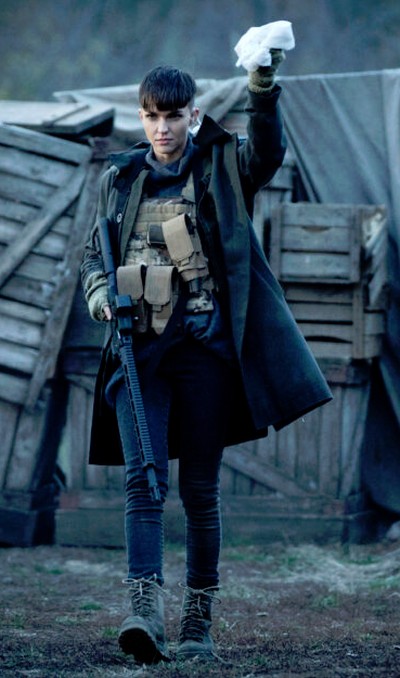
These begin with its heroine, Ali Gorsky (Rose), a Troubled Ex-soldierTM, suffering from PTSD. She has returned to New York, and through a relative, gets a job as a doorman at an apartment building undergoing renovation. It turns out the husband (Evans) of her late sister lives in the building: cue the Family DramaTM. Over Easter weekend, the place is taken over by the villains, under the leadership of Cultured EurovillainTM, Victor Dubois (Reno). He’s after hundreds of millions of dollars of paintings, hidden inside the walls of an apartment, because… Best not ask. And what are the odds? It’s her brother-in-law’s apartment. Fortunately, she’s out getting mint sauce (no, really) when the bad guys come to call. So Ali can spend the next hour, scurrying round the building, picking off the thieves and trying to rescue her family, while exchanging not very witty banter, about zodiac signs and the like.

The problems with the script here are multiple, such as its blatant foreshadowing. Things like the building’s secret passages are dumped in there so blatantly, they might as well be preceded with an intertitle, “THIS WILL BE IMPORTANT LATER.” What’s good, isn’t original – and what’s original isn’t any good. The use of PTSD here is simply a crutch, for no real purpose: we never believe it’s a genuine malady. Meanwhile, there’s Rose, who has done supporting work in other action franchises e.g. John Wick and Resident Evil, but proves incapable of carrying a movie herself. Firstly, she makes for an extremely unconvincing soldier, looking as if she might blow away in a moderate breeze. More damningly, she seems to have just the one expression, a combination of concern and annoyance. While not inappropriate, given the circumstances, it certainly outstays its welcome.

All of which would have tolerable, had the action been up to snuff. By and large, it isn’t, with only very occasional moments of the inventiveness which made Versus such a joy. It doesn’t help that most of the film takes place in half-darkness, leaving the viewer to peer into the gloom and try to figure out what’s going on. I guess this is just about watchable, if you’re in an entirely undemanding mood. However, I keep watching Kitamura movies in the hopes of him recapturing his former glories, and I keep being severely disappointed.

Dir: Ryuhei Kitamura
Star: Ruby Rose, Jean Reno, Rupert Evans, Aksel Hennie

Destiny Lost, by M.D. Cooper

Literary rating: ★★★
Kick-butt quotient: ☆☆☆

This is the second book from Cooper here, after Outsystem, and has some of the same characters. Initially, it seemed to have a shot at being considerably better, with a first half which was impressive. Unfortunately, it couldn’t sustain this, and ended up dropping back to a similar level and for similar reasons. If you’re interested in SF which is so hard, you could use it to cut glass, this is for you. But I’m not typically a fan of books which need to include a twenty-page appendix of “Terms and Technology” at the back. Especially when half of them don’t help much, e.g. “A CriEn module is a device which taps into the base energy of the universe, also known as zero-point, or vacuum energy” – glad that’s cleared up. And some of the rest are superfluous: any fan of SF won’t need to be told what “FTL” travel is.

In this world, that faster-than-light breakthrough allowed humanity to occupy a swathe of the galaxy, but the resulting wars triggered a dark age from which we are now only just recovering, in the ninth millennium. Sera is a transporter-for-hire, who’ll move anything, anywhere for the right price. But when one commission brings down unexpected heat, she cracks open the package, and is startled to find it contains Tanis Richards. She was a colonist from Earth, whose ship set off over five thousand years ago and is only now reaching its destination. While events overtook them,  her ship, the Intrepid – its construction was the subject of Outsystem – carries long-lost technology, on which everyone, from pirates to stellar alliances, wants to get their hands.

One such pirate, Rebecca, kidnaps Sera, seeking to swap her for Tanis and access to her tech. But both Sera and her crew, helped by the colonist, are made of sterner stuff. Through this section is when the book is at its best, combining interesting characters with a conflict which is taking place on a personal level. All seems lost for Sera and her trusty AI, when she’s secreted away in Rebecca’s headquarters, hidden in the depths of dark space, outside our normal universe. Yet, through grit and determination, she manages to return to her allies, then prepares to take the fight to Rebecca, as well as reunite Tanis with her crew. It’s a very good, gripping read. Unfortunately, after that is where things go a bit pear-shaped.

For once everyone arrives at the star-system of Bollam’s World, the hard SF elements really kick in, as if Cooper wanted to make up for the time lost earlier. It becomes more like watching a gigantic game of three-dimensional chess, with vessels of various kinds moving around and firing weapons at each other, for lengthy sections. Rather than technology enhancing the human elements in the story, it threatens to overwhelm the characters entirely, and even a (not exactly surprising) revelation about Sera’s origins couldn’t stop this from becoming laborious by the end. Quite a few typos, such as a reference to a “grizzly task” when no actual bears were involved, don’t help matters. I’ll not be going further in this series.

Author: M.D. Cooper
Publisher: The Wooden Pen Press, available through Amazon, both as a paperback and an e-book
Book 1 of 13 in the Orion War series.

Saand Ki Aankh

★★★
“Grannies with guns”

It’s interesting to compare this with the recently reviewed Ride Like a Girl. Both are sports movies based on real events, and neither really do much story-wise, except trot out the standard tropes for the genre about overcoming obstacles on the way to triumph. Yet this succeeds somewhat better, likely because of the unusual central concept. Two Indian grandmothers, unable even to read, take up competitive shooting in their sixties, and end up becoming national heroines as a result. Tell me you’re not intrigued by that.

Chandro and Prakashi Tomar (Pednekar and Pannu) are part of a large extended family in Uttar Pradash. In this world, women do much of the work, while the men lounge around. If the film is to be believed, smoking hookah pipes and demanding snacks are their main occupations, viewing the woman as machines for pumping out babies. But things change when a local doctor (Singh) opens a shooting range. One of their grand-daughters goes along for a lesson, and the grannies – who initially attend for moral support – discover a natural talent for the sport. However, the family’s patriarch, Rattan Singh Tomar (Jha), would never permit them to travel to competitions, so deception needs to be carried out. But as the contests get bigger, so do the lies.

While the story does span several decades, it concentrates mostly on the characters in their later years, which makes it a little odd that the producers cast a pair of thirty-something actresses for the lead roles. Presumably the idea was that it was easier to make them up to be older, rather than making sixty-five year olds look thirty. I can’t say it always works. Indeed, there are points where they look closer to the Beatdown Biddies from GLOW than genuine senior citizens. At 146 minutes, it goes on too long as well. The makers could have significantly reined in the montage sequences, and the likely inevitable musical numbers add nothing to proceedings either, at least to this Westerner’s eyes. [I will admit, I’m not the intended audience there]

Despite this, is still manages to work, and the running time isn’t as much of a problem as I feared it would be when I started. It is one heck of an eye-opener to see what life in rural India is like, especially for women, and quite puts all our #FirstWorldProblems in perspective.  There’s a calm dignity about the two heroines which is effective, and it’s easy to see how that temperament transfers to their sport, even in the face of initial heckling by unconvinced audience members and opponents. It’s also about the first GWG film I’ve seen which looks at the purely sporting aspects of firearms – one of the few fields in which men and women can compete on an equal footing. The Indian title translates as “Bull’s-eye”; while I’d not claim the film scores to that degree, it hits its targets at least as often as it misses.

Dir: Tushar Hiranandani
Star: Taapsee Pannu, Bhumi Pednekar, Prakash Jha, Vineet Kumar Singh

Becky

★★★½
“Dear diary: my teen angst bullshit has a body count.”

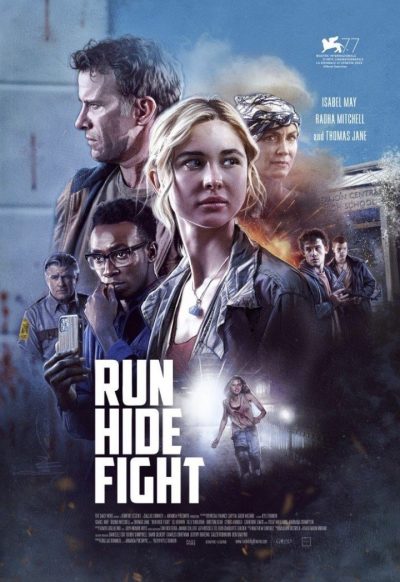
Becky (Wilson) is the quintessential troubled teenager. Since her mother died, she has become increasingly estranged from her father, Jeff (McHale, replacing the original choice, Simon Pegg, who had to drop out due to scheduling conflicts), not least because of his new girlfriend, Kayla. Dad arranges a weekend away for everyone at the family cabin to try and repair things. However, relationship problems rapidly become the least of everyone’s concerns. For a quartet of escaped Aryan Brotherhood convicts, led by Dominick (James, going completely and effectively against type), have turned up, seeking a key they had hid on the property. Not too happy to find an inter-racial family, they capture everyone except Becky, who had stormed off in one of her huffs.

But hell hath no fury like a pissed-off teenage girl. Especially once Dominick starts torturing her father, the one person about whom Becky truly cares. Naturally, you do need to be able to accept that a 13-year-old – even one as unquestionably highly-motivated and vindictive as Becky – can take out hardened criminals, especially largely without the equalizer of a firearm. Yet the script does a fairly good job of overcoming this, setting up scenarios that allow her to use the tools at hand to her advantage. It helps some of her adversaries aren’t exactly the sharpest tools in the box, stupidity being a significant factor in their deaths by impalement and outboard motor.

The script also does a good job with villains Dominick and the 7-foot tall Apex (former WWE wrestler Maillet), who are respectively smarter and given greater depth than the bad guys usually receive in this kind of film. The latter, in particular, gets more of a character arc than anyone else bar Becky, becoming a surprisingly sympathetic character for a neo-Nazi. This development definitely helps the movie, when Becky is not extracting her furious, bloody vengeance [For instance, we could have done without the flashbacks to Becky playing the ukulele for her terminally ill mother. No, really]. Though it’s Dominick who provides the film’s most insanely hardcore moment, involving a scissors and an eyeball.

However, there is a fatal mis-step by having the movie’s climax take place after dark. This leaves the audience peering into the gloom, trying to figure out what’s going on. I’m still not sure what was being pulled behind the ATV on which Becky rides into her final battle. Going by its effect, I’m guessing at some kind of industrial strength earth-tilling equipment… This shadowy coyness is at odds with the in-your-face energy the film had shown up to that point, and which had it contending for a spot in Top 10, of any genre, for 2020. In the end, it probably falls just short, yet is still an enjoyable slice of brutal, hormonal savagery. As the end credits rolled, my mind drifted off to visions of a Hanna vs. Becky crossover story. Hey, we can all dream, can’t we?

Dir: Jonathan Milott, Cary Murnion
Star: Lulu Wilson, Kevin James, Joel McHale, Robert Maillet

The Legend of Tomiris

★★★
“Steppes up.”

Not quite the first film from Kazakhstan I’ve ever seen. That would be Diamond Cartel, though hard to think of a film more different from this sweeping historical epic. It tells the story of Tomiris (Tursyn), the princess of a tribe living on the Scythian plains to the East of the Caspian Sea, in the sixth century BC. She was orphaned as a young child, after her father was betrayed, and had to flee into exile. But she never forgot her origins, and as an adult, returned to claim her inheritance and take vengeance on the traitors. However a bigger threat loomed in the shape of Persian emperor Cyrus, who was casting envious eyes at the territory of Tomiris and the other tribes. After further treachery, she rallies the population under her banner, and prepares for an all or nothing battle against Cyrus’s numerically superior forces.

It looks very nice. The cinematography is excellent, and there’s no arguing that the landscapes in question are perfect for this kind of thing. Though it feels as if the film-makers fell in love with the scenery more than the characters. It seems that half the running time involves shots of characters moving from Place A to Place B, and considering the film is 156 minutes long, that’s a lot of galloping back and forth. There are even some (CGI, presumably) high-altitude aerial shots, which reduce the players to literal specks on the ground, and this is indicative of the approach being taken here.

I’d have rather seen a more personal portrait of Tomiris, and her relationships with husband Argun (Akhmetov) or best friend and fellow warrioress, Sardana (Lighg). For the movie is best at provoking emotions in the viewer, when the characters are experiencing them. Perhaps the best example is when word of Cyrus’s betrayal reached Tomiris; she knows the truth, yet suppresses herself and lets his ambassador dig his own grave with his lies. [Sidenote: as I waited for the inevitable “This is SPARTA!” moment, for a while, I was wondering why Cyrus looked and behaved so differently from his portrayal in 300. Turns out that was a different Persian emperor, Xerxes, from about fifty years later. Not that I’d take 300 exactly as gospel!] The intensity of her feelings internally is obvious, and more of this passion would have been welcome.

The version of history told here is mostly based on the writings of Herodotus. He may or may not be the most reliable source; as Chris pointed out, political spin was apparently being applied to events, even in those days. But his version is likely more entertaining than other accounts, in which Cyrus died in his sleep. While I’m sure events from 2,500+ years ago fall outside the statute of limitations for spoilers, let’s just say, that doesn’t quite happen here. Though I was a little disappointed in the “hands-off” approach, historical accuracy be damned; Tomiris largely sits back and watches her troops go into battle. The action scenes are well-staged though, and help enliven a film which does occasionally need a shot of adrenaline.

For I definitely found myself checking my watch, and it’s a case where this would be a better 100-minute movie than a 156-minute one. The finer details of negotiations between the tribes really didn’t add much; on the other hand, the “warrior woman” culture of the Massagetae feels almost glossed over. Though it’s being taken as routine, rather than depicted as some kind of aberration, was a pleasant surprise. Tursyn, appearing in her first film, manages to overcome her lack of screen experience well, and without her, this could potentially have ended up being little more than a lengthy promo video for Central Asian tourism. While definitely worth a watch – not least as a more down-to-earth contrast to Mulan – I wouldn’t say it was worth a rewatch.

Dir: Akan Satayev
Star: Almira Tursyn, Adil Akhmetov, Erkebulan Dairov, Aizhan Lighg
a.k.a. Tomiris

Warrior Queen of Jhansi

★★½
“Talks rather than walks.”

This version of the story of Rani Laxmibai, Queen of Jhansi, falls unfortunately between two stools. As a result, it seems likely to leave no-one satisfied, so its critical (3.5 on IMDb, 24% on Rotten Tomatoes) and commercial (less than $180K in North America) failure doesn’t come as much of a surprise. Western audiences were perhaps put off by the stereotypical portrayal of the colonialists – matters may not have been helped by a surprising, and I’d say quite harsh, R-rating. But, conversely, Indian audiences may well have been unimpressed by the Westernization of their beloved historical heroine. Most obviously – apart from the star being born in Manhattan – would be the hinted-at relationship between the Jhansi and good Briton, Major Robert Ellis (Lamb). This element seems to have been taken from Rani, a book by London-based author Jaishree Misra, whose publication triggered protests in her native land in 2008.

I can see both points. On multiple occasions, as the evil Brits of the East India Company did something else unpleasant, I leaned across to Chris to whisper, “I can only apologize.” Now, this would be tolerable in an adaptation aimed at a local audience e.g. Jhansi ki Rani. But if you’re aiming for an international audience, you need rather less of a sledgehammer approach. And while Ellis’s presence does balance things out a bit, this isn’t a story which needs any kind of romantic angle. Laxmibai is often considered as being India’s Joan of Arc; this feels a bit as if a movie decided to give Joan a boyfriend.

The rest of the film is not inaccurate, and hits the main points of her life. Her husband dies, the East India Company try to take over, and Laxmibai ends up being one leader of a rebellion against the British. Though here, the focus on her is diluted in a couple of ways. We have, as noted, the evil Brits seeking to dethrone her, led by Sir Hugh Rose (Everett). But there’s also a number of superfluous scenes, back at Balmoral Castle, in which Queen Victoria (Jodhi May) argues with Prime Minister Palmerston (Derek Jacobi). I’m guessing it’s trying to draw a parallel between the female rulers; beyond that, there really doesn’t seem much point to them.

I’d prefer to have seen more of Laxmibai becoming the warrior queen. She seems to spring, almost fully-formed, slicing and dicing the British forces, as they storm the fortified city of Jhansi. That, and a later scene where she wields a metal whip to great effect, are effective enough, and the production values are generally fine. But it’s altogether talky, on too many occasions preferring to tell the audience, instead of showing them. It fails to demonstrate quite why she was capable of becoming such a leader, with only occasional flashes showing the charisma, intelligence and diplomatic skills the real Laxmibai appears to have possessed. I appreciate the intent here; it’s a shame so much appears to have been lost in the execution.

Dir: Swati Bhise
Star: Devika Bhise, Ben Lamb, Rupert Everett, Nathaniel Parker

Crossfire, by Andrea Domanski

Literary rating: ★★
Kick-butt quotient: ☆☆½

This is less a book than a hodge-podge of elements cobbled together from other sources. Buffy the Vampire Slayer and Wonder Woman are the most obvious influences, but you can also throw in some X Men and Greek mythology. Hell, the bad guy even uses the Force choke, as popularized by Mr. D. Vader. What’s missing is mostly originality. Though that’s not all.

Mirissa Colson has always been unusual, blessed with remarkable physical abilities – her “respiratory and vascular systems are extraordinarily efficient.” Even though her mother left their family over a decade ago, she has been lovingly nurtured by her ex-military father, Steve, and trained in martial arts, shooting, and other skills On her eighteenth birthday, a package arrives from her mother and Mirissa discovers her true legacy and destiny. She’s an Amazon, who are the usual bunch of warrior women from history. However, an ancient victory over worshippers of Ares peeved the god. He got the ruler of the underworld, Hades, to create the Kakodaemons as enemies who’d fight the Amazons. They’re basically vampires, and the two sides have been at war ever since. It’s time for Mirissa to join her ancestors in that fight, under the tutelage of her watcher, Giles – sorry: I mean guardian, Greco.

But, wait! There’s more! Specifically, a demigod named Daedric, who has brought all the creatures of darkness together and is preparing to unleash his final solution against humanity. Meanwhile, the “Omega Group” has been formed to rally all those on the side of light. And unfortunately for Daedric, there’s a prophecy: “The Queen of the Amazons has a daughter that is destined to disrupt your plan. Her powers will be great, and if you don’t stop her, she will stop you.” No prizes for guessing who that is, and it’s why Mom vanished, to stop Mirissa from being discovered. Now, everything is coming into place, and it’s up to Mirissa to master her almost endless list of powers (including but not limited to: telekinesis, sensory expansion, the ability to control the elements and, by the end, teleportation) in order to take on Daedric.

Except, she never really does. She’s supposed to have all these talents, yet spends most of the story wrapped in bubble-wrap, being protected from danger. It’s an awkward contradiction to her being the all-powerful child of prophecy, and to be frank, Daedric comes over as more than a bit crap. He’s capable of being held and rendered harmless by a force-field projected by one of the Omega Group’s minions – the same force-field Marissa can tear through like it was tissue paper. The structure is also needlessly confusing. For example, the first seven chapters take place at three different points in time, beginning by bouncing between Marissa’s 19th birthday and a year previously, and then goes back to 12 years previously, when her mother was still around.

The main problem though, is a complete failure to establish Mirissa as a character. I finished the book less than 24 hours ago, and I’m damned if I can remember a single defining aspect of her personality. She feels less like a person, than a piece that gets moved around the board between various plot points. There’s little or nothing here, in story or persona, to make me want to go any further.

Author: Andrea Domanski
Publisher: Amazon Digital Services, available through Amazon, both as a paperback and an e-book
1 of 6 in the Omega Group series.

By Night’s End

★★★
“Bad decisions = poor consequences.”

There are lessons to be learned here. In particular: should you gun down a home invader in the middle of the night… just call the cops. Even if they have offered you ten thousand dollars to let them walk away, immediately before their untimely demise… just call the cops. Of course, Heather (Rose) and Kurt (Yue) have issues, which make their decision to do otherwise understandable, if not wise. They’re teetering on the edge of financial carnage, and figure that if the intruder was willing to pay them that much, whatever he was after in their house has got to be worth a lot more. Therefore, they postpone alerting the authorities for a bit, choosing to look for the target of the search.

Have these people never seen Shallow Grave? Do they not know that when valuable property falls into your lap in shady circumstances, its real owner inevitably comes looking for it. And that’s exactly what happens here. Polite, hat-wearing villain Moody (Milligan) soon shows up to establish his property rights, and when the couple finally get round to calling the police, the poor officer who turns up simply doubles the quantity of corpses with which Heather and Kurt have to deal. There’s only one way to get through the night, and that path goes through Moody. Fortunately, there is some good news: it turns out Heather used to be in the military, and still has the skills. Bad news: she’s on shaky emotional turf, due to her PTSD, among other things.

This is on most solid turf when it’s in motion. Rose is a stunt-woman, and gets a number of opportunities to put those skills into good use. There’s one particularly good brawl through the house, where she leaves a literal dent in the wall when her body crashes into it, and it’ll make a similarly lasting impression on the viewer. The film is less successful when it’s digging for emotional depth. For example, knowing they recently lost a young child is probably enough. We don’t really need to see the husband wife and staring at one of their drawings, or clutching a toy, respectively: it’s way too obvious. Similarly, the details of precisely why Heather has PTSD are superfluous, and add little or nothing.

Indeed, they may be counter-productive, as they slow the film down, at just the point when it probably needs to be accelerating towards a final confrontation. It does get there, and proves adequately satisfying; it just feels like some opportunities were left on the table to do more. The movie does a decent job of reversing the obvious roles in the marriage, and also of making its single location work for it, rather than seeming a limitation. The film even takes place at Christmas, which could even be considered a small-scale homage to Die Hard, especially when Rose is roaming the house, trying to stay out of the reach of Moody and his men. It’s nowhere near as good, of course. Then again, very few movies are – so no blame should be attached for that!

Dir: Walker Whited
Star: Michelle Rose, Kurt Yue, Michael Aaron Milligan, Carlos Aviles