




★★★★
“X-Men, as directed by Peter Jackson. And not LotR Peter Jackson. Brain Dead Peter Jackson.”

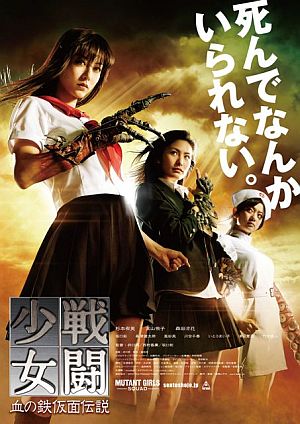 It makes sense that this stems from a drunken agreement between the three co-directors at a film festival, because this is the sort of film you would only make under inebriated terms, and it’s probably true to say that drunk is the best way to watch this. That’s not a bad thing per se, just that its loopy sensibilities and over-the-top antics would seem to go particularly well with a few beers. Rin (Sugimoto) hits her sixteenth birthday not too happy, being bullied at school. However, the bullies have a surprise in store, as it turns out Rin is half-human, half-Hiiko, with her father being from a mutant race with extraordinary powers. They have largely been hiding from humanity, but are now fed up of being persecuted, and under the leadership of Kisaragi (Sakaguch), are about to declare total war on us. Rin, along with Yoshie (Morita) and Rei (Takayama), are to lead the strikeforce, though Rin is less convinced over the need to target all of mankind.
This is right up there with Brain Dead in terms of the goriest movie ever, with fountains of blood, real and digital painting the entire screen, including the lens, though rarely affecting our heroine’s sailor-suit school uniform. Which, one assumes, is part of the joke, for everything about this is so amazingly excessive, it’s impossible to take any of it seriously, even as it is played completely straight-faced. The talents, for instance, include a waitress whose breasts each sprout a sword and a cheerleader, concealing a chainsaw in a place power-tools are not normally located. No explanation for any of this is ever given. It just is, and you either buy into it or you don’t. Yet there’s also a moment or two of poignancy, as Rin struggles to decide whether to align herself with a human race which has largely rejected her, or her new “family,” weird and incredibly ultraviolent as they may be.
While the gore is certainly present in buckets, as we’ve seen, that isn’t enough by itself to make for entertainment, and the insane imagination on view here is equally impressive. This is particularly true at the end, when Kisaragi reveals his final form. Let’s just say, breasts that squirt acid milk is one of the lesser of his talents. This kind of lunatic invention makes the film work, and while you undeniably need a large tolerance for arterial spray, and some of the FX are rubbery, to say the least, it is thoroughly fun schlock, unlike anything produced by even the most warped Western company.
Dir: Noboru Iguchi, Yoshihiro Nishimura, and Tak Sakaguchi
Star: Yumi Sugimoto, Suzuka Morita, Yuko Takayama, Tak Sakaguchi
 Ok, “dull” is perhaps not quite the word, but Chris voted on this one with her closed eyelids and heavy breathing, and I was struggling to avoid joining her, despite some impressive ideas. It’s set in the Forest of Infinity, a strange locale where past, present and future all seem to merge. Hence, you’ve got renegades with samurai swords and Buddhist nuns and a party of a dozen young women whose paths cross with the former, resulting in the rape and death of 11. The un-named survivor (Kishi) is rescued by a scientist who creates mecha – cyborgs – and he uses the organs of her friends as a core to rebuild her, with the nun adding their 11 souls. The new super-powered samurai princess goes after the killers, and then Red Dragon and Butterfly, who instigated the murders in the name of what they call “art.”
 Ji-Won (Lee Yo-Won) and her friend So-Hyun (Kim) make a trip to the seaside, borrowing a car from a friend. However, the auto turns out to have a couple of guns in it, lost by a gangster and cop in a poker game. The weapons come in handy when the girls need to escape from some assailants, but when they are joined by a manic waitress with no sense of gun-control, the now-trio find themselves on the run from police. A clothing-store owner with a grudge, completes the quartet, as they try to make their way back to Seoul – and they are pursued not only by the cops, also by the previous owners of the guns, who need to get them back to prevent issues of their own. Conversely, their exploits and subsequent media attention are getting them fans of their own, with the titular website (it stands for Adoring Four Revolutionary Idols Korea Association) extolling their virtues and provoking copycat crimes.
 ★★★½
★★★½ Angelina Jolie is the undisputed US box-office queen of action heroines. With
  Still, it’s entertaining and keeps moving. Credit for clocking in at a brisk 100 minutes, rather than stretching things out beyong what’s necessary: there’s isn’t much unnecessary fat on its scriptual bones, and a refreshing lack of romantic chit-chat. There are a couple of solid action set-pieces, most notably an early, frenetic chase through the streets, and Salt overall has an ability to withstand falls that Wile E. Coyote would envy. Towards the end, she descends a lift-shaft leading to the presidential bunker, without bothering to wait for the elevator, and can also turn a few common cleaning supplies into an impromptu rocket-launcher. These are talents I’m sure we all could use occasionally.
 Bliss Cavendar (Page) is stuck in the hickville of Bodeen, Texas: her mother (Harden) coerces her into small-town beauty pagents, but Bliss’s heart isn’t in it. On a shopping trip to Austin, she picks up a roller-derby flyer, and on attending the event with her friend Pash (Shawkat), falls in love with the sport and decides to try out. She has to lie about her age to do so, and also keep her attendance a secret from her parents. Bliss has a natural talent, and helps her team, the Hurl Scouts, previously the doormats of the league, to the championship game against the Holy Rollers, under Iron Maven (Lewis). The confidence Bliss gains is not without its issues however, bringing her in to conflict with her boyfriend and Pash, as well as her parents…
 Lili is a devotee of Sayama Hashinryu, a deadly form of swordsmanship passed down from woman to woman. She goes through the initiation rite, which involves being blindfolded and given a drink which knocks her unconscious. She comes to, about three hundred years in the past, in feudal Japan, naked. When she gathers her senses, she rescues a local village-girl from some ninjas, but to cut a long story short, discovers in the process that when Lili exposes her breasts, they emit a pinkish glow, and she becomes far better at swordplay. Turns out the poor villagers are suffering extortion from the evil Lady Okini (Asa), so Lili turns into the Magnificent One [or Magnificent Two, if you know what I mean, and I think you do], while also falling for Hikoichi (Matsuda), the brother of the girl she rescued. However, it turns out that Lili is not the only one in possession of a supernatural bosom; Lady Okini is also so equipped. Battle cleavages are thus drawn…
 I can certainly appreciate where the makers are trying to go with this one. Two Catholic schoolgirls, selling Bible door-to-door to raise funds for their educational establishment. Unfortunately, they knock on the wrong door: this is actually a whorehouse, run by the psychotic Lobo (Tahoe), who has just killed one of his hookers. The two are kidnapped: one is killed, while the other (Lyone) is left for dead, naked, in the nearby woods. She is taken to hospital, but has only a single thought in her head: revenge. Stealing a nurse’s uniform, she checks out, intent on taking our her wrath on Lobo and his no-less depraved sidekicks.
 Ok, that brief is a little harsh, but it is true to say by the end, I had opted to double-task, and was watching this while I stood over the sink in the kitchen. It wasn’t as good as I expected: I was hoping for something along the lines of Faster, Pussycat, and instead got a turgid, over-extended crime drama. While it has all the right aspirations, the yawning chasm between that and its execution would require several days’ trip by mule to cross. Alice Wynn (Sondrup) is part of an armored-truck robbery, only to find herself double-crossed and left for dead by corrupt cop Jill Robbe (Beisner). Alice vows to recover the loot and take revenge on Robbe, and won’t let anyone – examples include her late mother’s boyfriend, psychotic pimp Ramrod or his Swedish assassin – stand in her way.
 The animated version was one of the first reviews I wrote for the site, and I didn’t like it much – the fifty-minute running time allowed for hardly any development of scenario or characters at all. The feature fares a good bit better in these departments, though suffers from some horrendous editing styles and a couple of monsters which appear to have strayed in from a Playstation game (and I am not talking Playstation 3 here, either). The basic plot is retained. Saya (Gianna) is a half-demon with a grudge, intent on taking out Onigen (Koyuki), the one responsible for the death of her father. Working under the loose guidance of The Council, she is inserted into a school on an American air-force base in 1970 Japan. American girl Alice (Miller) has been added; Saya rescues her, and the two end up on the run, pursued both by Onigen and more regular forces.