



★★★
“Blue is the color; extortion, theft and other anti-social activities is the game.”
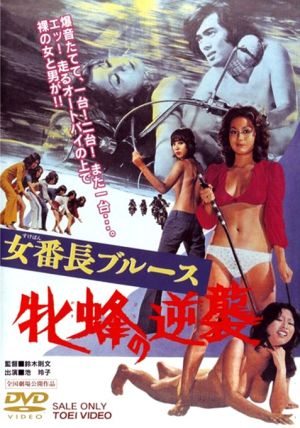 Reiko (Ike) is leader of the Athens Gang, a low-level all-girl gang, who specialize in car thefts and rolling naive salarymen with the lure of hot sex. They’re part of a hierarchy, which includes a male gang under whom they loosely operate, who are in turn on the fringes of a Yakuza group. There’s also a motor-cycle gang and its leader (Taki) who don’t obey anyone, and that independence is really what Reiko wants, even though her group is obliged to follow certain rules, such as not getting attached to any man. Things are disrupted by the return of former leader Jun (Kagawa) from reform school: will Reiko be able to hold on to her position? It’s just one of a large number of plot threads here: you also get the blackmail of a pop star; a hitman agreeing to one last mission; a gangster estranged from his wife and daughter; sex on motorcycles for no apparent reason; a journalist with a nose for scandal; and, of course Reiko failing to follow her own rule about no attachments.
That’s more of a problem than a benefit here, as the threads are of significantly varying interest. Obviously, I’m not averse to see Jun and Reiko brawl for control, and the heroic muck-raking writer is actually an interesting figure, cheerfully admitting to what he does, but also believing he genuinely makes a difference by exposing sordid sex scandals. While I didn’t realize how hierachical Japanese crime was, there are too many moments of earnest drama, that slow down what needs to be a fast-paced romped through the seedy underbelly of criminal life, and a couple of moments that are just laugh-out loud bad, such as when Jun asks for a farewell song from another gang member. What I want to know is, was the full orchestra she gets, hiding in a closet?
Despite the titles, which imply some kind of sequel, this was the first in a seven-film series, four directed by Suzuki. At this point, he still seems a little uncomfortable with the style, and there isn’t the necessary consistency of tone to provide a smooth ride. Ike and Kagawa are both good in their roles, however. Right from the first encounter, and the traditional girl-gang greeting, their interactions are a nicely-crafted mix of tension and politeness, and you know it’s only a matter of time until things finally kick off. When it does, this is indeed memorable. Otherwise, there’s just a bit too much filling, at the expense of the meat.
Dir: Norifumi Suzuki
Star: Reiko Ike, Yukie Kagawa, Keiko Yumi, Shinsuke Taki
a.k.a. Queen Bee Strikes Again
 You can almost imagine the trailer for this anime series being done by The Trailer Guy [y’know, who does all the voice-overs for Hollywood action flicks]: “In a world where demons stalked the land… One woman… Was humanity’s final hope…” The particular focus here is Clare (Kuwashima), one of 47 Claymores, an all-female sect of nomadic warriors who travel a fictional country, battling the flesh-eating Yoma, with combat abilities that border on the magical. But doing so requires them to unleash their own Yoma power, an act which runs the risk of them becoming what they hunt if they lose control. Clare rescues Raki (Takagi), who becomes her companion and cook, but out heroine has a mission of her own: hunting down and killing the Yoma who, years previously, killed her own mentor, Teresa of the Faint Smile.
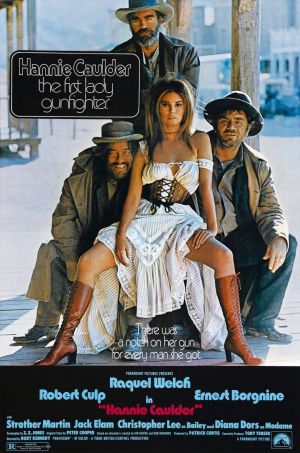 If genre entries produced in Italy are “spaghetti Westerns”, what does that make those produced in Britain? “Fish and chip Westerns?” “Roast beef Westerns?” Shot in Spain, but made by Tigon Film, and including such quintessential Brits as Christopher Lee and Diana Dors in supporting roles, this is nicely-photographed and hits all the right notes. But as the titular character, who seeks revenge after her husband is gunned down, and she herself raped, by the Clemens brothers, Welch perhaps has too much cinematic baggage. While responsible for one of the all-time absolute
  Like most civil wars, the Spanish one was a nasty, brutal affair that split families as well as the nation. Not that you’d know it from this, which suggests the citizens were entirely behind the anarchist forces: odd how the opposing Fascist forces not only prevailed, but then held power for close to 40 years. You don’t do that without significant popular support. Putting that aside (for the moment), this is the story of Maria (Gil), a young nun ‘liberated’ from her convent as the Civil War gets under way, amid a wave of anti-religious fervour. Initially just trying to get home to Zaragosa, she’s escorted by militant militia woman Pilar (Belen), and eventually decides to join their female fighting force and take up arms against the Fascists. That puts them at odds not just with the men in charge, but many of their own sex, who would rather see them doing laundry and providing ancilliary support, rather than in the front lines.
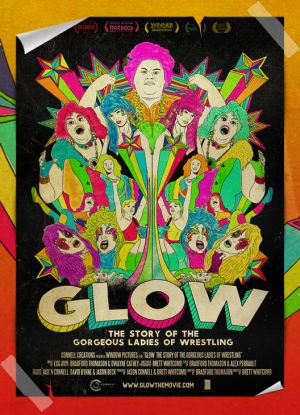 It has now been almost a quarter-century since GLOW was cancelled in 1990, and there still hasn’t been anything quite like it on television in the Western world: a pro wrestling federation entirely populated by women wrestlers. The brainchild of David McLane, and funded by Pia Zadora’s husband, the owner of the Riviera casino in Las Vegas, GLOW was a marvel of eighties low-budget television, mixing self-effacing comedy (it depicted McLane as having his office in a phone booth) with larger-than-life characters such as Matilda the Hun, and of course, wrestling matches. This documentary tells the story of the federation’s rise and fall – largely through the eyes of the women, as McLane and Matt Cimber, the show’s director, both declined to be formally interviewed (which is a shame, as it would definitely have provided another dimension for the film).
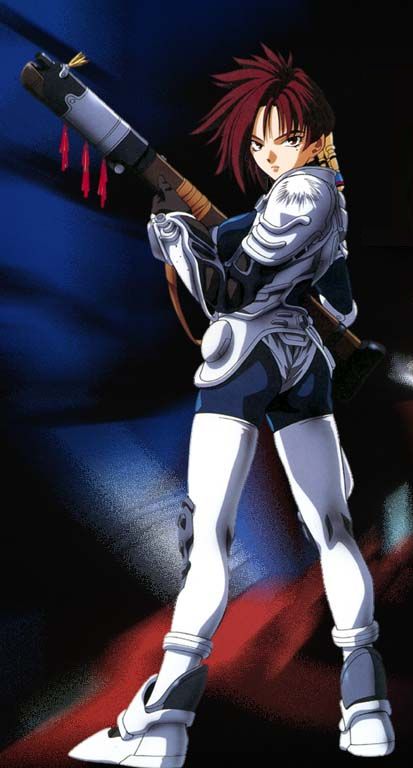 Though released several years later, this is a prequel to the two Zeiram movies, telling the story of the first encounter between Iria (Hisakawa, who was also Sailor Mercury) and Zeiram. At the time, she was an apprentice bounty-hunter, working alongside her brother Gren. They take a mission to rescue a VIP and recover the cargo from a stranded space-ship. However, once there, they discover the “cargo” is actually the alien Zeiram, which a corporation is interested in using as a weapon. The result leaves her brother apparently dead, and Iria now the target for the corporation, who want to hush up their thoroughly-dubious plan, by any means necessary. Fortunately, as well as her own skills, our heroine has the assistance of former rival bounty-hunter, Fujikuro (Chiva), endearing urchin Kei (Kanai), and Bob (Ikeda), a colleague whose consciousness has been turned into an AI.
 In the late seventies, British television was notable for series which generally kicked ass on the performance front, but suffered from woefully inadequate production values. The most well-known example is Doctor Who, but that was just the tip of a dramatic iceberg which included the likes of Blake’s 7 and this series: in some cases, you can look past or ignore the deficiencies, because the acting is good enough to counteract them. That, sadly, isn’t the case here, with Phillips (a compatriot of Diana Rigg and Glenda Jackson at RADA) sadly adrift as Boudicca, the queen of the Iceni who takes on the occupying Roman forces after her daughters are assaulted. Having enjoyed the 2003 version, with Alex Kingston in the title role, I thought I’d give this one a chance, but when a supposed army of 6,000 is represented by four chariots and, maybe, ten guys in animal skins, it’s hard not to notice.
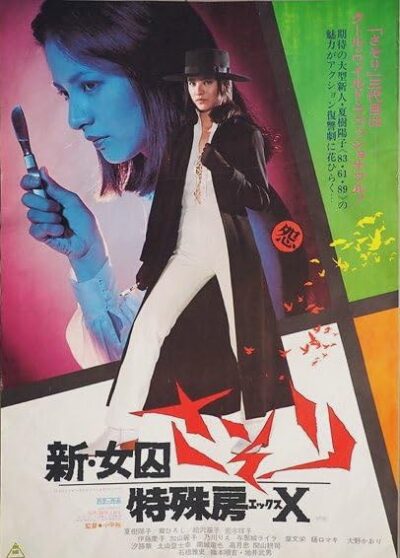 The comparisons of Takigawa to Lazenby above proved appropriate in another way, both being canned after one entry playing the iconic title character, which is probably just as symptomatic of something. The replacement here as Nami Matsushima is Natsuki, who seems to go back toward a more taciturn heroine, closer to the original. But it’s, effectively, another reboot, with not even a nod to the previous entry. In this case, the heroine is a nurse, framed for her involvement in the hospital murder of a politician who was threatening to expose corrupt practices.
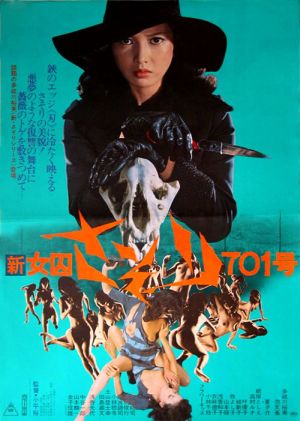 Just goes to show that the “cinematic reboot” is not a 21st-century invention, e.g. Batman or James Bond. For a mere three years after Meiko Kaji showed her sting as Nami, the studio reset the series, giving it a new director, new (and much more talkative) lead actress, and returning Nami Matsushima to a happy, criminal record-free young women, with a loving boyfriend. Except, of course, he turns out not to love her quite as much. Things start to collapse after her sister uncovers evidence of major government corruption, and passes it to Nami, shortly before being kidnapped. After Nami uncovers the truth – her sister is killed and she is framed for the murder, with the help of her boyfriend, and sentenced to 15 years in prison. Initially an easy mark for the tough girls in her cell, Nami soon develops her mean streak. And she’s going to need it, because the politician behind it all is looking to tidy up the loose end she represents, by killing her and making the death look like a suicide. Name turns the tables, in incendiary fashion, and it’s clear that she’s one loose end that won’t be quietly disposed of.