




★★★★
“Hammer time!”

 2020’s first seal of approval goes to this uber-gritty Irish film, starring Sarah Bolger, whose most familiar to us from Into the Badlands. While her GWG creds there are overshadowed by the likes oE Emily Beecham, safe to say Bolger makes up for lost time here. She plays single mother Sarah Collins, who is struggling to come to terms with the recent, unsolved murder of her husband. Barely managing to make ends meet, her life is upended when entry-level criminal Tito (Simpson) breaks in, seeking sanctuary. He has stolen some drugs belonging to top boss Leo (Hogg), and offers Sarah a cut of the proceeds if she’ll act as his safe-house. Very reluctantly, she agrees. Needless to say, it doesn’t go as they plan.
And that’s putting it very mildly. I won’t spoiler it, but there’s a reason she ends up visiting a hardware store, and weighing up whether an axe or a hack-saw is better suited for her “project” [the correct answer, it appears, is both…]. Yet, the character arc from mild-mannered mother who basically won’t say “Boo!” to a goose, into someone capable of going about with a bowling-bag of highly unpleasant content, is remarkably plausible. Because it’s almost all driven by fierce maternal love for her two children, one of whom has been traumatized into muteness by witnessing his father’s murder. Sarah will do anything to protect and provide for them, and as motivation for taking up a criminal lifestyle, it’s a far sight better than we got in the similarly themed Widows or The Kitchen.
It also does not soft-pedal its violence. The extended sequence where Sarah goes over the edge and becomes a killer for the first time, at one point almost teeters into farce with her first choice of weapon. But the further it goes on – to the point of death and beyond, the grimmer it gets. I was reminded of the line spoken by Macbeth: “I am in blood stepped in so far that should I wade no more, Returning were as tedious as go o’er.” This is made clear from the opening scene, which sees a gore-drenched heroine taking to the shower, setting the scene for its subsequent savage tone. We only find out the source of the blood later, and it won’t be the last time it gets spilled.
It’s a spectacular performance from Bolger, portraying a woman who is ground down to almost nothing, before finding fate presenting her with an opportunity – albeit one which comes with a frightening cost in terms of her humanity. Yet her portrayal manages to take the audience along with the character on that journey. The rest of the cast pales in comparison, though it probably doesn’t help that non-British audiences may need subtitles for some of the dialogue; even I was going “What?” at some points, particularly for Tito’s lines. Still, neither that nor some suspiciously convenient skill with a firearm (likely a necessary contrivance) are sufficient to derail a thoroughly successful slab of Irish noir.
Dir: Abner Pastoll
Star: Sarah Bolger, Edward Hogg, Andrew Simpson, Jane Brennan
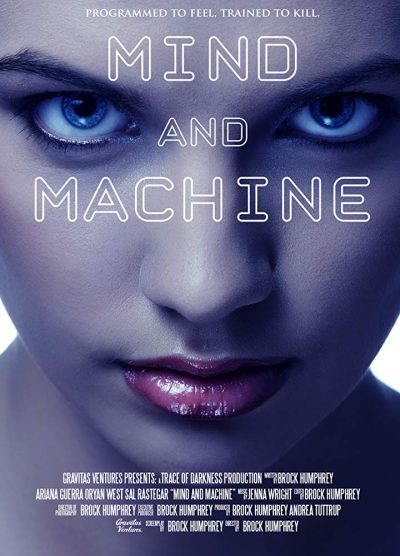 Intelligence without morality to govern it, is psychopathy. So what happens when you create an intelligent machine, but deliberately avoid installing any kind of moral compass? It’s an interesting idea for a film. Not that you’d know it from this unconvincing effort, which sucks the potential out of it. In this near-future – it’s set in 2024, close enough to now, no actual work is required on the part of the makers – androids have become part of everyday society in many roles. Crime boss Isaac Lynch (Restegar) orders technician Leo Cameron (West) to make one without a conscience, so that it can be used as an assassin, saving those pesky hitman fees. Only Leo crafts the robot, Maya (Guerra), in the image of his late wife. On the plus side: he gets to see his wife again. On the other hand: she’s an amoral killer. Didn’t think that through too well, did he?
 Origin stories are all the rage, it appears. Though it’s probably just coincidence we watched this prequel to
  Coming in on a wave of hype, e.g. “The Best Indie Science Fiction Movie Since Moon“, I guess I should have listened – because I didn’t think Moon was
  Though just called “Brian Cox” on the book, it’s probably wise to begin by distinguishing the author here from his more famous namesakes, both the actor and the “rock-star physicist.” That said, this is a brisk if not particularly memorable spy novel. The main outstanding feature is that the heroine is neither American nor British, but Chinese. Rather odd to be reading this very positive portrayal of Communist state security personnel, during the protests in Hong Kong.
 Ninjas were famed for their mystical powers, but Tsubame (Asami), the heroine here, has… well, let’s just say, a rather different talent. And I quote her brother, Hayabusa: “The ability to store a man’s seed inside your womb for seven days after intercourse.” This raises a number of questions, not least: how did this get discovered, considering Tsubame is a virgin at this point? Anyway, this skill is needed because of… Ah, to heck with it. Hayabusa explains it as well as I could:
 Diedre (Tacosa) and Frida (Riley) are the fractious stars of low-rent superhero show, Battle Babe and Combat Queen. When the series is canceled, they go on a bit of a binge, ended only by the appearance of two tiny aliens from Metaluna (Nguyen), who give the pair of very drunk Earth women devices that will turn them into Team Giantess Attack. These are intended to be used to rid the planet of evil. Needless to say, things don’t quite work out that way. The military, under Gen. Smedley Pittsburgh (Rowen), want to get their hands on this alien technology. But D+F won’t give it up and, instead, use it to go on the rampage and take revenge on those who previously wronged them.
 It’s one of those weird coincidences. I watched two action heroine flicks last weekend and both, while American, starred actresses who were born in Greece. Really, what are the odds?
 I was genuinely stoked when I got to the end of this one, which details the derring-do of 19th-century pioneers James Glaisher (Redmayne) and Amelia Wren (Jones). The former is a scientist in the fledgling field of meteorology, who wants to obtain data from the upper atmosphere. The latter is a balloon pilot, carrying on despite the death of her husband on a previous flight. Together, they team up, to fly higher than any person had ever gone before. Indeed, further than even they wanted to go, as a frozen valve prevents them from descending when they need to do so. With Glaisher out of commission through oxygen deprivation, it’s up to Wren to climb, by herself, up the outside of the balloon, in order to reach the top and clear the valve.