




★★★
“Cecily, Warrior Princess”
 This is one I’ve been aware of since as far back as 2010, but it seemed to have been lost in post-production hell, so I was surprised to see this had finally got a release, coming out on DVD in its home territory of the UK last May. It’s one of those films where you need to know, going in, that this is not a slick Hollywood blockbuster with massive production values, and instead is clearly a work of love for those involved, doing their best with limited resources. In fact, I can’t really do better in setting those expectations than another review, which said the film was, “Best described as ‘Xena filmed on a Doctor Who-circa-1980 budget by way of a Robin of Sherwood LARPing weekend'”. I can’t really improve much on that, though would perhaps add, “Set on Steampunk Sunday at your local Renaissance Festival.”
The story is triggered by a prophecy, which sees Boudiccu (Fey) first win custody of a pair of legendary weapons, then journey through a post-apocalyptic landscape, where humanity has largely reverted to tribal savagery. However, the crypto-fascist Falonex clan still appear to have a handle on some old-school technology and appear to be massing to establish their dominance. On the way to the prophesied location, where she will face another warrioress in a battle which will hopefully lead to a champion rising who can defeat the Falonex, Boudiccu is joined by White Arrow (Simpson), who is seeking revenge on those who killed her family. Or something. They have to fend off attacks, share flashback sequences and, eventually, have a twist revealed in their relationship that should come as absolutely no surprise to anyone paying attention.
What works? Simple: the action, led by Fay. She’s a tiny thing – 4’9″! – yet it’s entirely convincing, because the style of her fights don’t show her using strength and power to beat her opponents (which would be implausible), they instead emphasize skill, quickness and agility, which she has in spades. Credit, too, for Boyask, who consciously avoids the rapid-fire style of editing, knowing that the best thing he can do with a talent like Fay, is point the camera in her direction, then let her get on with it. [Sometimes, knowing not to do anything is more important than trying to do it] There’s a battle, not long after Boudiccu leaves her village, in which she takes on half-a-dozen other women, which is just glorious: it’s probably the best action heroine sequence ever to come out of the UK. But therein lies a problem, in that nothing during the hour thereafter is as great: good, sure, sometimes very good, but the final battle in particular feels like a letdown.
What doesn’t work? Sadly, way too much of the stuff between the fights, which feels like a slapdash grabbing of elements lifted from elsewhere, lobbed into a storyline which might just about have passed muster on a wet Sunday at my college D&D society. The efforts at generating any kind of broad, post-apocalyptic landscape are feeble, particularly the Falonex, who are represented by a ropey CGI backdrop and the interior of a single tent, which does not succeed in making them the kind of global threat they are supposed to be, especially since their scenes are play largely for laughs. But what’s really missing from the dialogue and performances, is any sense of intensity. They’re purely functional, intended to get the story from A to B (where A and B are almost certainly fight scenes). It’s clear from the action scenes, everyone involved had a passion for what they were doing there. Unfortunately, that passion is absent from everywhere else, and weakens the overall product to an extent that many will be unable to look past the flaws, and appreciate the positive attributes to be found here.
Dir: Ross Boyask
Star: Cecily Fay, Joelle Simpson, Christian Howard, Merrilees Fay Harris

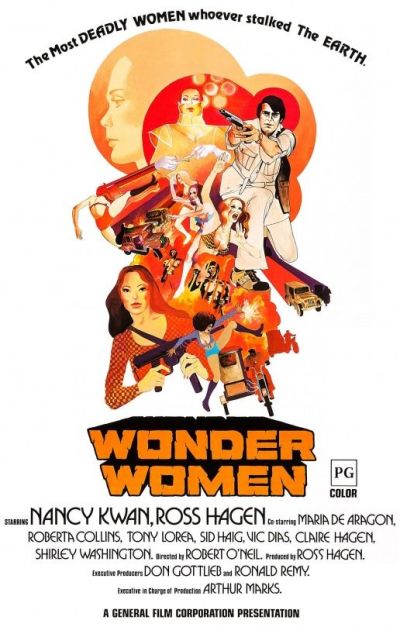 Roger Corman’s New World Pictures weren’t the only ones using the Philippines as a factory to churn out B-movies in the seventies, as this 1973 entry, from Arthur Marks’ General Film Corproration shows. Dr. Tsu (Kwan) and her posse of henchwomen are kidnapping athletes, the not-so-good doctor having perfected the ability to do brain transplants. She’s now selling this as a service to rich, old people, who can become young again. However, after kidnapping a jai-alai star, the insurance company on the hook for the half million dollar policy hires Mike Harber (Hagen) to investigate. As he starts nosing around and making waves, first the local gangster boss, then Dr. Tsu, send their minions out to stop him. Needless to say, this is of limited success, and he is soon on his way to the remote island where Tsu operates, to take down her operation.
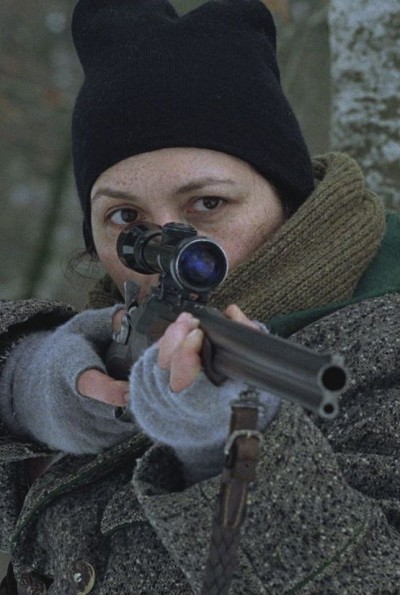 This is a very different kind of GWG film: indeed, it could almost be called an inaction heroine movie. It starts from a very simple presence. A woman (Gedeck) wakes up in a cabin in the Austrian Alps. When she tried to head to a nearby village, the path is blocked by an unseen, impenetrable barrier that has sprung up overnight, and now defines the boundary of her world. Everyone outside is dead. What do you do? How do you survive, both short- and long-term? Could you handle the loneliness? Can you retain your humanity, when you are, apparently, the only human being left?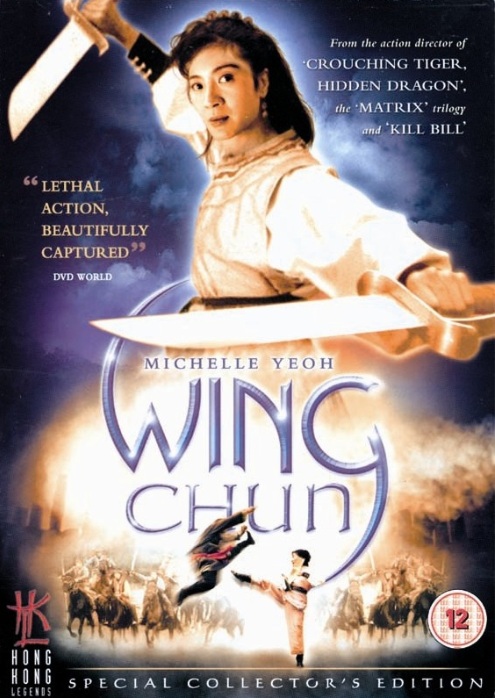
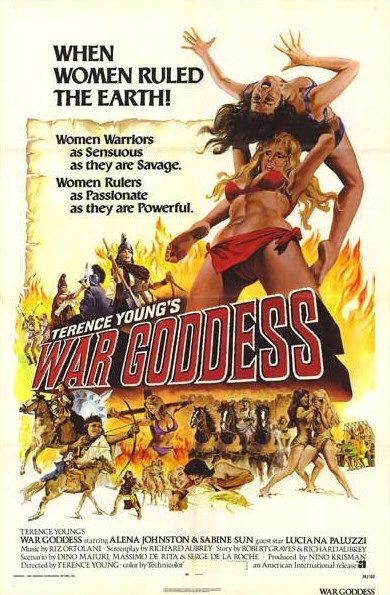
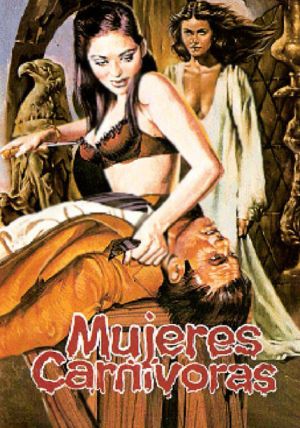 This German 1970’s film is well ahead of its time in some ways, but is postively Neanderthal in others, being basically a scream of fear about women’s liberation. It feels like a far-less subtle version of Neil LaBute’s re-make of The Wicker Man, taking place in a matriarchal town, where women are in charge, with the exception of a couple of incompetent men, to lift heavy things and provide a facade of normality (the police commissioner is an alcoholic, who knows little and cares less about what’s going on). Into this scenario comes Eve (Glas), a stressed-out secretary who has been booked in for a six-week course of treatment at the local spa. It’s not long before she stumbles across the body of a man with a knife embedded in his back, only to discover that no-one believes her, with the clinic’s doctor telling people Eve is suffering from post-tramautic hallicinations. Is that the case, or is there something genuinely unpleasant going on? And what’s this on the dinner menu?
 This was also released in a hardcore version as Black Lolita, but I’m not sure if that was 3D or not. Certainly, the DVD delivers about the worst such attempt I’ve ever seen. It’s in color, but also attempts the red/green method (glasses very early, and the only thing to be said for them is, they stop you seeing the film, which on the whole, is probably no bad thing. Lolita (Love) decides to team up with an air-stewardess and a yoga instructress to take down the local Mr. Big, who goes by the name Buddha – even though about all he shares with the Enlightened One is being Asian, since he’s neither fat nor pacifist.
 In the late seventies, British television was notable for series which generally kicked ass on the performance front, but suffered from woefully inadequate production values. The most well-known example is Doctor Who, but that was just the tip of a dramatic iceberg which included the likes of Blake’s 7 and this series: in some cases, you can look past or ignore the deficiencies, because the acting is good enough to counteract them. That, sadly, isn’t the case here, with Phillips (a compatriot of Diana Rigg and Glenda Jackson at RADA) sadly adrift as Boudicca, the queen of the Iceni who takes on the occupying Roman forces after her daughters are assaulted. Having enjoyed the 2003 version, with Alex Kingston in the title role, I thought I’d give this one a chance, but when a supposed army of 6,000 is represented by four chariots and, maybe, ten guys in animal skins, it’s hard not to notice.
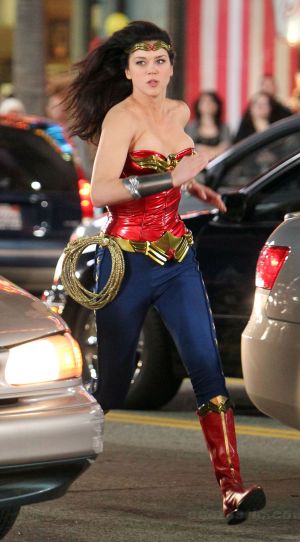 Allowing for the fact this was more or less a rough-cut – you can still see the wires as the heroine throws villains around – this actually is far from the atrocity you expect, going from the pre-production fan loathing. The story avoid the whole “origins” thing, hitting the ground running by having Wonder Woman/Diana Prince (Palicki) already fully-active, and busting crime around Los Angeles. Her extra-legal activities, with the local cops’ complicity, bring her to the attention of the federal authorities. Meanwhile, she’s tussling with the board of her company over the merchandise that funds her crime-fighting, objecting to the size of the tits on her action-figure – and, yes, they actually say “tits”, to my surprise. Finally, the villainess (Hurley) is performing illegal medical experiments with steroids and such, to create super-soldiers, and it’s up to Wonder Woman, her plane (wisely, no longer invisible), bullet-deflecting bracelets and lasso which may or may not be of truth (it’s unclear from this episode) to stop her.