 ★★★½
★★★½
“See Salt?”
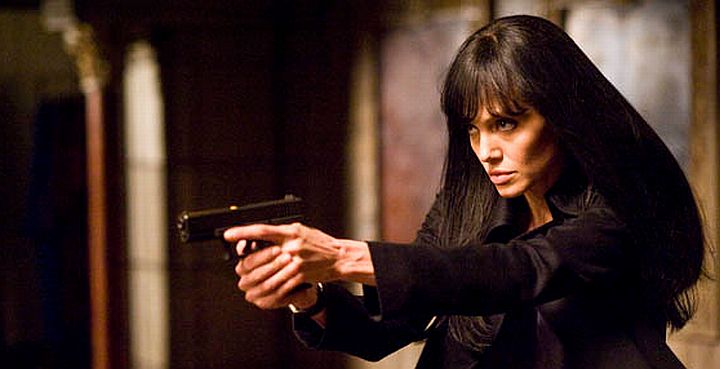
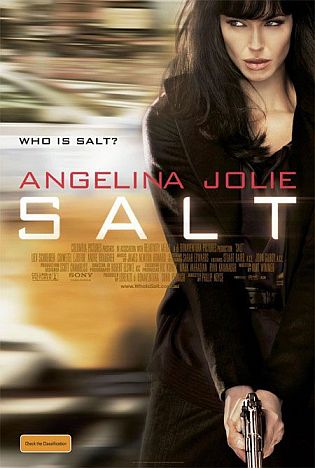 Angelina Jolie is the undisputed US box-office queen of action heroines. With Lara Croft: Tomb Raider‘s $131 million, and the $117 million this had earned to date, she owns two of the top four all-time genre entries (the other two being Crouching Tiger and Charlie’s Angels). While that’s not adjusted for inflation – Aliens would likely come out on top there – it’s still an impressive feat, and there probably isn’t any other actress in Hollywood capable of opening a large-budget action movie on this scale. Even in a supporting role, e.g. Wanted, she has credibility as an action heroine few can match.
Here, she plays Evelyn Salt, a CIA operative who returns from time in captivity in North Korea, and resumes her cover as a company executive. She and her colleague Ted Winter (Schreiber) are called in to interview a Russian defector, and decide if he is telling the truth. He spins a tale of a long-running project, dating back to the Cold War era. Young children were groomed from a very early age to become sleeper agents abroad, leading normal lives without suspicion until the time comes to activate them. That time has now come, with one agent tasked with killing the Russian President, currently on a state visit to the US. Oh, yeah – and that agent’s cover name is… Evelyn Salt.
When Salt can’t contact her husband (Diehl) and the defector escapes from custody too, Salt bolts from the impending custody closing around her and goes on the run. Is it because she wants to rescue her husband and prevent the assassination, to clear her name? Or is she the double-agent claimed? The film doesn’t hold out too long in this regard before committing itself. However, that isn’t the main focus, as the script then swerves in a different direction, and it also turns out that the assassination attempt is not an end in itself, only the start of a more far-reaching, and disturbing, plan to incite Armageddon.
I confess to being somewhat disappointed, especially after I realized this was written by Kurt Wimmer, who gave us Equilibrium and Ultraviolet [the former was a lot more warmly-received, but I’ll defend the latter to my dying breath as pure adrenalin/popcorn nonsense]. This is rather more restrained, which likely explains why it took nine figures at the box office, yet is also rather less memorable as a result. Not to say it’s “bad”, or anything like that; just that it’s very easy to see it, as originally envisaged, starring Tom Cruise. Pretty much run a global search and replace on the script, changing the lead character’s name [to, oh, I dunno: “Jason Bourne”?] and you’d be there. It’s too generic to be a true classic of the action heroine genre.
 Still, it’s entertaining and keeps moving. Credit for clocking in at a brisk 100 minutes, rather than stretching things out beyong what’s necessary: there’s isn’t much unnecessary fat on its scriptual bones, and a refreshing lack of romantic chit-chat. There are a couple of solid action set-pieces, most notably an early, frenetic chase through the streets, and Salt overall has an ability to withstand falls that Wile E. Coyote would envy. Towards the end, she descends a lift-shaft leading to the presidential bunker, without bothering to wait for the elevator, and can also turn a few common cleaning supplies into an impromptu rocket-launcher. These are talents I’m sure we all could use occasionally.
Despite this, and Jolie’s undeniable screen presence, it lacks any truly memorable moments, and has little you won’t have seen before, assuming a passing knowledge with action franchises like Bourne, 007, Jack Ryan, etc. [Worth noting that two entries in the last-named series were directed by Noyce] We sniggered more than once at the way Salt always seems to have a new outfit, even as she runs from the entire weight of federal law-enforcement, and Salt’s husband is never developed enough to justify the pivotal role he plays. However, the ending is left wide-open for a sequel, pointing in a definite direction, presumably in the hope of a franchise emerging. The $162 million this has taken overseas, in addition to the US earnings, make that a distinct possibility, and I would certainly not be averse to the prospect of another helping of Salt.
Director: Phillip Noyce
Stars: Angelina Jolie, Liev Schreiber, Chiwetel Ejiofor, August Diehl


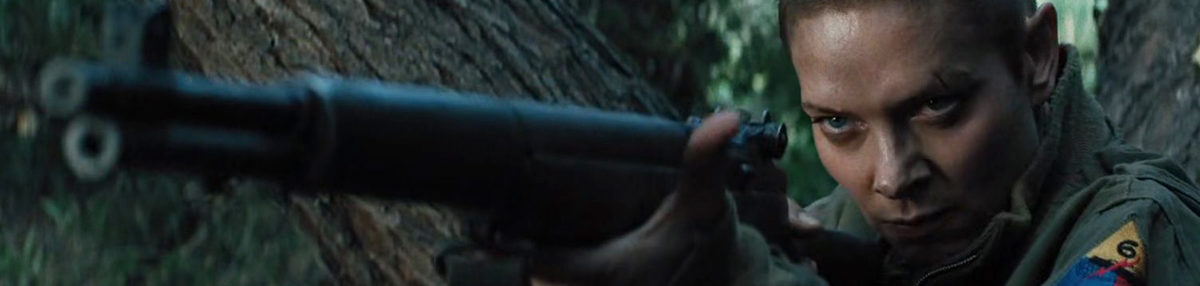

 Thailand appears to have become a hot-bed of action-heroines in the past couple of years. Jeeja Chocolate Yanin is obviously a key component, but others appear to be leaping on the bandwagon: this one plays like an entry in the Angel series, a Hong Kong classic in its day. Unfortunately, so little effort is put into explaining what is going on, or who is doing what to whom, that the copious action feels like a showreel for participants. Both Chris and I nodded off for a bit in the middle, which is about the worst condemnation any action film can receive. Hence, I turn to Amazon.com for a synopsis.
 “What did your mother die of?”
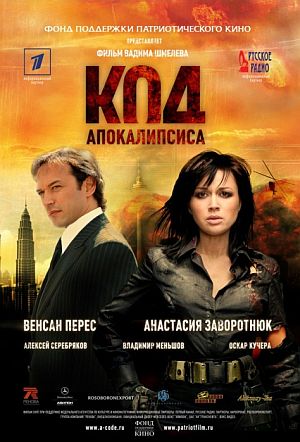 About ten minutes into this, as another large explosion filled the screen, Chris turned to me and said, “Is this a Michael Bay movie?” While it isn’t, confusion is understandable: this is just the kind of dumb action film for which he is renowned, featuring basic plotting and large-scale mayhem. Terrorist Jaffad is just about to sell four nuclear warheads he has hidden in major cities worldwide back to the Americans, when his entire compound is taken out, at the command of a mysterious figure known as “The Butcher.” FSB Agent Marie (Zavorotnyuk), who had previously been working undercover to get to Jaffad, just manages to escape the slaughter, and is now assigned to track down the Butcher, by getting close to his financial advisor, Louis (Perez). Jaffad gave parts of the eleven-digit code that can be used to detonate the devices, to trusted colleagues in Italy, Norway and Malaysia, and Marie needs to find the code before the Butcher.
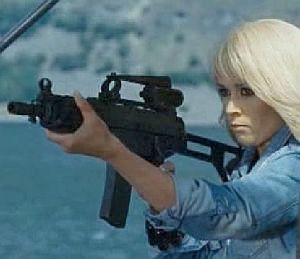 However, the plot is not novel at all, the efforts to give Marie backstory are near-laughable, and once the novelty of the Russian heroes wears off, the script has little to offer: significant fragments don’t make much sense, and other scenes seem to be there, just to prove the makers actually went to the locations. Action-wise, it’s somewhat of a mixed bag; it seems pretty clear the lead actress isn’t doing much of the action herself, but there’s a nice fight at the end between Marie and the villain, in front of the console which can be used to detonate the bombs, as a self-destruct timer counts down. You can also enjoy a gun-battle on a boat, and Marie stocking the corridors of a hotel [you’ll understand why I spelled it like that, hohoho].
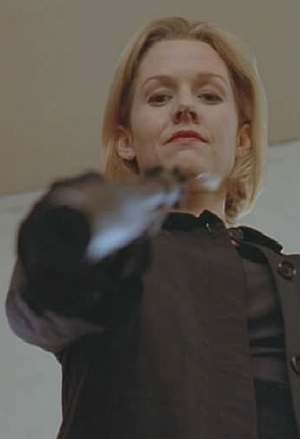 Ward (whom we’ll watch in anything, as payment for the enjoyment Tremors has given us) plays John McWhirter, a hard-bitten journalist with a fondness for the bottle, who is still trying to put behind him an incident when he was a young radical, that led to his friends being sent to jail for long terms, while John escaped doing time. He’s looking into the murder of an industrialist by Palestinian terrorists, when said friends show up, asking him to hide a woman (Ticotin) from the authorities for a few days, describing her as an activist in Shining Path, a Peruvian rebel group. Turns out she’s not who she seems, and it also turns out John had more to do with his friends’ arrests, thirty years ago, than it initially appeared. With enemies in the FBI, led by Robert Lecker (Plummer), an ally in the CIA, and a female assassin (Miller, right) out to tidy up all the loose ends, McWhirter has to decide whether to do what’s right, what’s easy, or what’s best for himself – and those might be three mutually exclusive options.
 This feels more like a mid-season episode of Alias than anything else, and not much more than a filler episode at that. I say this, because so little effort is put into developing the characters, it’s as if the makers reckon everything had already been established in the previous seven installments. And since there
  Film-makers really need to let the sixties go, especially when it comes to mining TV schedules and turning them into movies. The Mod Squad, Thunderbirds, Wild Wild West: the remainder bins in Walmart are littered with the DVD corpses of failed attempts. While it’d be a massive stretch to call this incoherent mess anything like a success, it does have some merits, not least in the casting of Fiennes and Thurman as John Steed and Emma Peel. If undeniably different to Patrick McNee and , it still works, despite the unfortunate efforts to shoehorn in a romantic relationship between the pair; one of the things that made the original series work was the
 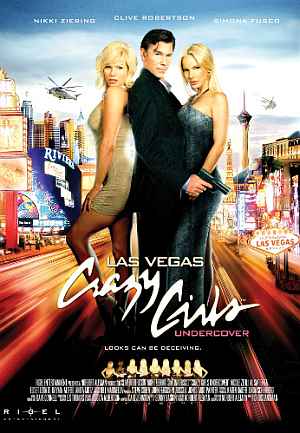 Written and produced by the man behind the ‘Crazy Girls’ topless revue at the Riviera in Las Vegas. Really, that’s about all you need to know: much like most Vegas shows, it’s quite shiny and glossy, but if you look behind the surface, it doesn’t have any real heart and possesses no brain at all. It centres on Damon Archer (Robertson), a freelance CIA operative whose day-job is running said revue – I dunno, but I always thought these shows consisted of more than five women [mind you, all I know about such things was learned from Paul Verhoeven’s epic]. They are investigating shady arms-dealer Hamid Marzook, a man with terrorist links who, it turns out, was previously responsible for the death of Archer’s wife and child. So, it’s personal as well as national security being at risk, with the terrorists seeking to detonate a bomb on Las Vegas Strip [though let’s not get involved in why Archer calls it a “chemical bomb”. Merely containing chemicals – half a ton of nitrates – does
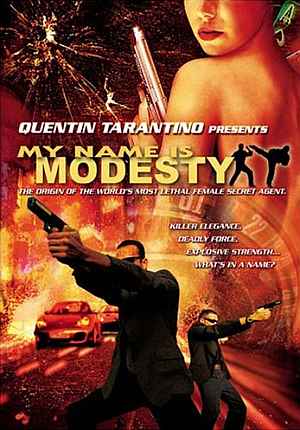 The word is, Miramax made this in order to keep their rights to the Modesty Blaise series active: I imagine a clause reverted them back to creator Peter O’Donnell, if unused within X years. Tarantino wanted to direct it, but couldn’t find the time, hence this stop-gap directed by journeyman Spiegel, who’s familiar with Quentin cast-offs, having also directed From Dusk Till Dawn 2. Shot in 18 Romanian days, the limitations of time and budget are clear [save admittedly copious flashbacks, the movie is almost all set in one location], but given them, it’s by no means a disaster. The main failing is the lack of action; we don’t see alleged jet-setting, goddess of kick-butt Blaise do much at all until the last few minutes. This may be because Staden looks as if she’d struggle to move forward in a stiff breeze; seeing her trading blows is unconvincing, and the fight choreographer should have focused on speed and/or agility instead. Though in terms of presence and steely gaze, she does fit the part well.
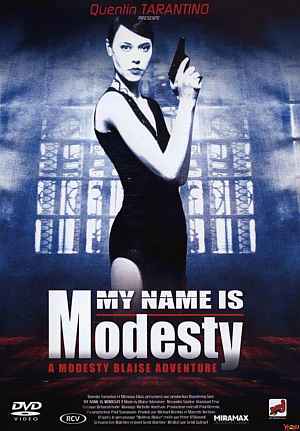 I remember the books from my youth, and the huge disappointment I felt when I saw the 1966 camp abortion starring Monica Vitti [there was also an 1982 TV pilot, with Ann Turkel, which I haven’t found]. This “origin” story is an improvement, at least taking the characters seriously. Blaise is trapped in a casino by a robber with a grudge against the owner (Waldau), and as they wait for the guy with the safe combination to arrive, she trades stories of her past for the freedom of the other hostages, Arabian Nights style, almost. I’d be somewhat curious to see the original cut, which apparently ran nearly two hours. Now, it’s barely 70 minutes between Bond-esque opening and closing credits, yet is still pretty talky, Blaise and her mentor (Pearson) meandering between the Balkans and Morocco.