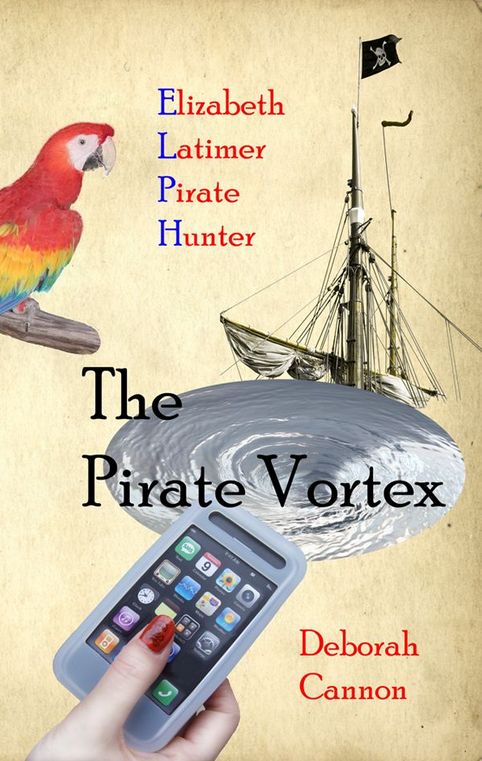
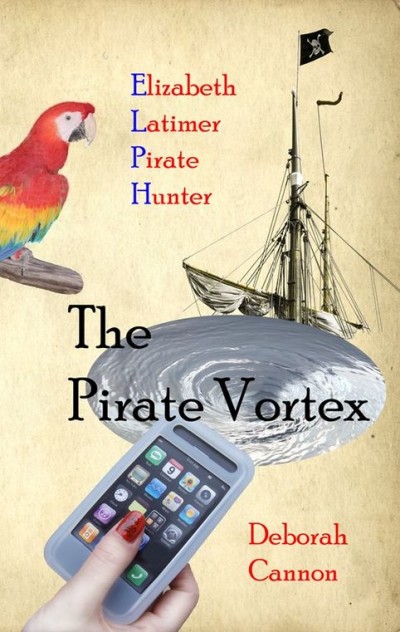
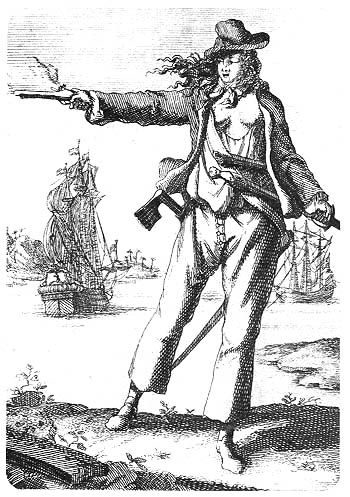
 “Calico Jack” Rackham, a Caribbean pirate hanged soon after his capture in 1720, his lover and fellow pirate Anne Bonny (b. ca. 1700) and a few other characters in this series-opening novel were real-life people, who left behind an historical record in A General History of the Robberies and Murders of the Most Notorious Pyrates (1724), by one Capt. Charles Johnson. (Johnson is otherwise unknown; many scholars surmise, as Cannon assumes in her novel, that this was a pen name used by Daniel Defoe.) That book forms our main historical source for piracy in that era, and Cannon’s portrayal here seems to be basically very faithful to the historical data as far as it goes, including the fact that we know nothing of Bonny’s ultimate fate (so we’re free to speculate about any descendants she may have had…) –but that data is very embellished here, with time-traveling SF elements.
The author and I are Goodreads friends, but I checked a copy of the book out from the library where I work (so, it wasn’t a review copy). My rating correctly indicates that I liked the read. For me personally, a few factors kept it from a higher rating; but it’s quite possible that other readers wouldn’t weigh those as much, and would rate it higher. (In fact, several already have!)
Our heroine, Elizabeth Latimer, is an 18-year-old college student at the Univ. of Victoria near Vancouver in British Columbia, Cannon’s own stamping grounds. We’re not told her exact age until a few chapters in, and many American readers wouldn’t know there’s a Victoria, Canada; I confused it with the Australian state of Victoria for the first couple of chapters. Liz’s mom, Tess Rackham kept her maiden name and formerly taught an Archaeology of Piracy class at the university; but when her husband John Latimer was lost at sea in a sailing accident four years earlier, she quit that job and went into marine salvage with her business partner, Cal Sorensen. Though her dad taught her to sail proficiently, Liz hasn’t since that day.
She has some issues from her dad’s death and her mother’s not very hands-on parenting of herself and her 14-year-old sister, and mixed feelings about her parents’ obsession with pirate history: she aspires to go into business and make a prosaic career on dry land –but she’s the self-styled “queen” of her school’s competitive fencing program, and taking the same class her mother once taught. Then on a spring morning, two things happen: she meets mystery youth Daniel Corker, and learns that her mom is presumed lost at sea, in the Bermuda Triangle area. This sets us up for a time-traveling adventure.
Cannon handles language capably, without the poor grammar and diction that bedevil so many self-published authors; she’s also written novels before, so this is no freshman effort. Her prose style isn’t of a sort that calls attention to itself; it’s straightforward, with a focus on the story. The pace is fast, and the plot exciting and eventful, with an emphasis on events, action, and snappy dialogue. Young Adult readers affluent enough to be tech-savvy are the main target audience, and there’s a fair amount of tech-talk, texting jargon, and pop culture references that this group would be more at home with than some other demographics; but older readers wouldn’t be lost with these either, since the context usually furnishes clues for any meaning that’s essential to get, and the same goes for nautical terms, though there’s aren’t a lot of those.
 Liz herself is a well-drawn, likeable but not perfect character, with some depth and complexity to her. As an action heroine, her fencing skills don’t match those of seasoned pirates, she’s not a good shot, and she’s an inexperienced horsewoman; and more often than not, she needs male rescue when in jeopardy. (Considering the situations here, the violence in the book is restrained, and almost never lethal.) Given her background and situation, though, this is only realistic. She’s also got enough guts to fight when necessary, thinks quickly and resourcefully, and is a strong swimmer. Other characters, like Lu, Stevie, Cal and Jerrit Wang, are also quite lifelike.
Time-travel writers divide over the question of how they handle time paradoxes. Some take the position that you can’t change the past – whatever you did there, you’ve already done. Cannon and others treat the past as malleable – you can change it, and you’d better not, or you might erase yourself and your whole bloodline! Personally, I prefer the former approach; but it wasn’t a problem to accept the latter as a literary conceit. I did have some issues with the plotting. In several cases, IMO, characters make decisions that aren’t well explained, or that it doesn’t seem like they would have made in real life, although they’re necessary to move the plot the way the author wants; and some difficult operations/problems are solved too easily or coincidentally. At one point, we’re apparently barely off shore from Nassau, traveling by sail –but are in very short order in swimming distance of Jamaica on the far side of Cuba, a journey that would take days at least.
Liz has unexplained telepathic connections with animals, and sometimes with people: we’re told at one point that she can tell if someone is lying, and Tess can psychically tell if Liz is in danger. In a plot that already demands some suspension of disbelief, this for me was an element that stretched credibility a bit too much. And while CJ the parrot is cute, he and the horse Fancy display a lot more intelligence than parrots and horses really have. (Parrots imitate the sounds of human speech, but in real life they don’t know what they’re saying.)
Romance isn’t really a stressed theme; Liz has always been too focused on her studies and her fencing to have much time for boys and dating (her sister Lu, at 14, is the more boy-crazy of the two). That said, she is a healthy 18-year old who’s aware of attractive unattached males and appreciates their awareness of her, and who wants to someday be married. There’s a triangle of speculative interest here, and there will be a kiss before the book ends; so very romance-phobic readers will want to avoid it. This novel completes its story arc, but it leaves a lot of unanswered questions for the sequel(s). Readers who liked this first book will probably want to continue the series; and I definitely plan to set sail with The Jade Pirate myself sometime!
Note: There are a couple of instances of implied sex here, but nothing explicit. There’s some use of d- and h-word language and vulgarisms, but no obscenity and little profanity.
Author: Deborah Cannon
Publisher: Self-published, available through Amazon, both for Kindle and as a printed book.
A version of this review previously appeared on Goodreads.




 This is another book I got for my wife, because I felt the pistol-packing cowgirl on the cover would appeal to her, and then read on her recommendation. It’s even more of a departure from my usual reading fare, since it isn’t only a Western, but a paperback romance as well. Set mainly in Texas in 1877, the title refers to the heroine’s penchant for using disguise and deception in her work; she’s a bounty hunter with a reputation for bringing in her quarry alive. The leading male character is an ex-gunfighter recently turned rancher, who’s mistakenly accused of complicity in a bank robbery; she’s hired to bring him in alive.