




Ink Mage
Literary rating: ★★★½
Kick-butt quotient: ☆☆☆
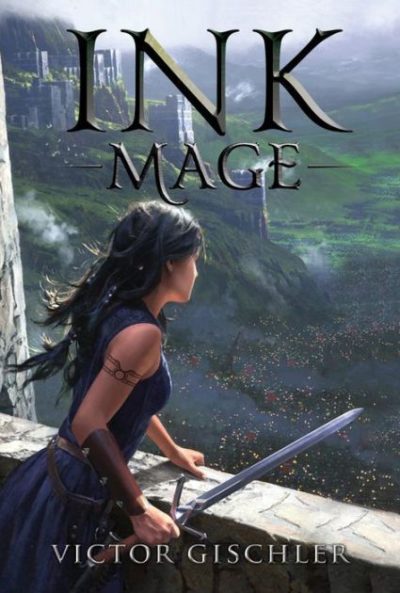 The small duchy of Klaar has been impervious to invasion, due to a secure location offering limited access. But when betrayal from within leads to its fall, to the vanguard of an invading Perranese army, heir apparent Rina Veraiin is forced on the run. She is fortunate to encounter one of a handful of people who know how to create mystic tattoos that will imbue the recipient with magical abilities. With her already significant combat skills radically enhanced, and her body now also blessed with a remarkable talent to heal, Rina can set about trying to recover her domain. It won’t be easy, since the king is not even aware the Perranese have landed. But she has help, albeit in the motley forms of a stable boy – sorry, head stable boy – a gypsy girl and a noble scion, whose charm is exceeded only by his ability to irritate.
Despite the young age of the protagonist, who is still a teenager, this isn’t the Young Adult novel it may seem. It’s rather more Game of Thrones in both style and content, with the point of view switching between a number of different characters. Some of these can be rather graphic, particularly the story of Tosh, an army deserter who ends up working as a cook in a Klaar brothel. But even this thread turns out more action-heroine oriented than you’d expect. For the madam gets Tosh to train the working girls in weaponcraft, so they can become an undercover (literally!) rebel force against the Perranese. Can’t say I saw that, ah, coming…
Gischler seems better known as a hard-boiled crime fiction author – though I must confess to being probably most intrigued by his satirical novel titled, Go-Go Girls of the Apocalypse! The approach here does feel somewhat fragmented, yet is likely necessary, given the amount of time Rina spends galloping around the countryside. It may also be a result of the book’s original format as a serial. However, it translates well enough to a single volume, and I found it became quite a page-turner in the second half. There, Rina readies her forces to return to Klaar, and take on the occupying forces, which have settled in for the winter.
The tattoo magic is a nice idea, effectively providing “superpowers” that can help balance out the obvious limitations of a young, largely untrained heroine. It is somewhat disappointing that, after significant build-up involving the Perranese’s own tattooed warrior, the actual battle between him and Rina seemed to be over in two minutes – and decided through an external gimmick, rather than by her own skill. In terms of thrills, it’s significantly less impressive than a previous battle, pitting her against a really large snake, or even the first use of Rina’s abilities, which takes place against a wintry wilderness backdrop – more GoT-ness, perhaps?
Such comparisons are unlikely to flatter many books, and this is at its best when finding its own voice, as in the tattooing, or the gypsies who become Rina’s allies. He does avoid inflicting any serial cliffhanger ending on us, instead tidying up the majority of loose ends, and giving us a general pointer toward the second in the three-volume series. Overall, I liked the heroine and enjoyed this, to the point where I might even be coaxed into spending the non-discounted price for that next book.
The Tattooed Duchess
A Painted Goddess
Literary rating: ★★★★
Kick-butt quotient: ☆☆☆
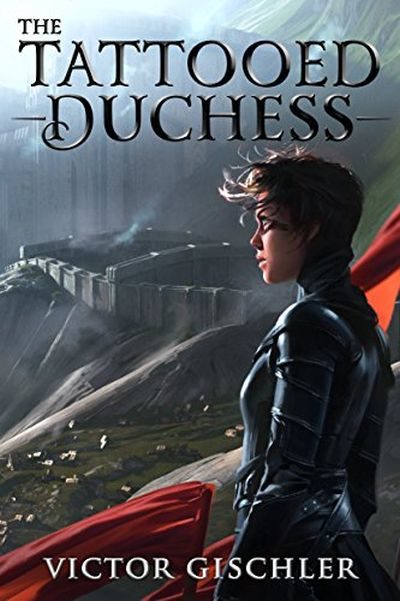 It makes sense to treat the second and third volumes in the series as a single entity. Ink Mage worked on its own as a one-off, with a beginning, middle and reasonably well-defined end, and the eight-month pause between installments was not a problem. Duchess and Goddess, however, really need to be read back-to-back. Mage ended with Rina Veraiin having recovered her family’s territory of Klaar, thanks largely to the magical tattoos covering her skin. But the new duchess is discovering that fighting to get territory is one thing, ruling over it on an everyday basis, quite another. Especially since the Perranese invaders repelled in the first volume, are on their way back with a vengeance. For their Empress Mee Hra’Lito needs a big win to keep control of things on her side of the ocean.
Rumbling in the background, and coming to a head particularly in Goddess, is a changing of the guard in the Kingdom of Helva’s divine pantheon, with the current incumbent as top god being challenged for that position. Disturbingly, the likely replacement is the god of war: never a good thing, especially when he can raise an army of unstoppable dead soldiers and send them after Rina and her allies. Dealing with both those threats, requires Rina to ink up some more. Since she’s otherwise engaged, that means sending expeditions to the furthest corners of the lands and beyond, to retrieve the templates needed for Rina’s power-ups. [Though part of the problem is, these don’t come with instructions, explaining what a tattoo will do…]
In particular, off to the Scattered Isles go stable-boy Alem, who carries a torch for Rina, and gypsy girl Maurizan, who is interested, both in Alem and getting some magic ink of her own. Meanwhile the noble Brasley and a new character, near-immortal female wizard Talbun, are exploring the depths – or, rather, heights – of the Great Library. This is a building so vast, it remains largely unexplored, with its origins and contents lost in the mists of time. Rina, meanwhile, is on a diplomatic mission, aimed at securing support for Klaar, only to be abducted by a group of Perran soldiers and their own mages, left behind when the army withdrew.
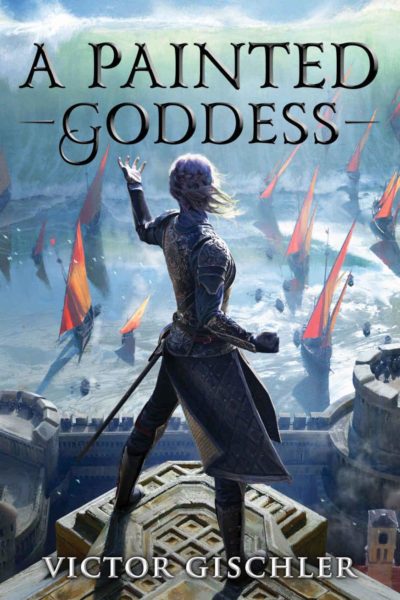 Especially in the second volume, poor Rina is largely relegated to a supporting role. The major threat to her is, not deities or monsters, but the arguably more insidious danger of an arranged marriage, necessary for the defense of Klaar. Maurizan becomes the action heroine focus, supported by members of the “Birds of Prey”, ex-prostitutes who have become the castle guard, as well as Talbun. It’s decent, yet almost inevitably, suffers from the bane of trilogies, “second volume syndrome”, lacking both a beginning an an end [I will say, for understandable reasons, explained by the author on his site]. It was originally published in serial format, so feels a bit episodic too, though I can’t say this impacted my enjoyment particularly much.
Rather than having to wait for the next part, as readers at the time had to do, I was able to head straight on into volume three. And Gischler redeems himself admirably for any flaws, with an excellent final volume. Rina has pretty much completed her set of tats, now possessing superhuman strength, speed and healing, as well as the ability to have anyone believe what she says, plus more. However, there’s a darker side to her talents, which becomes apparent to everyone when the Perranese lay siege to the port of Sherrik. With great power comes… scary responsibility, it appears: Rina has to make some unpleasant decisions about how far she is prepared to go, in order to repel the massive invading fleet. And they aren’t even her toughest adversary.
There are a lot of disparate elements across the series, yet Gischler melds them together into a coherent whole, rather than feeling like he’s simply plugging in fantasy tropes. I was particularly impressed by how even minor characters feel well-developed, such as Mee Hra’Lito. She didn’t need to be in the book at all, being simply the force behind the big bad (or more accurately, the secondary big bad). Yet seeing her motivations, adds depth to proceedings and enhances the epic scope. On the other hand, perhaps the series’s main weakness is lacking a truly central character. Is this Rina’s story? Alem’s? Maurizan’s? The answer is both all of the above, and none of them.
Still, this is the first true series I’ve completed since beginning book reviews on the site, and I’ve certainly enjoyed the experience. Gischler hinted at further volumes in February, saying of his universe, “I feel there’s more there to be mined,” and I wouldn’t mind in the slightest – even if Rina’s role would need… let’s say “serious revision”, based on how this ends, and leave it at that. Or a Peter Jackson trilogy of films based on these: that’d do, just as well.
Author: Victor Gischler
Publisher: 47North, available in both printed and e-book versions, as folllows:
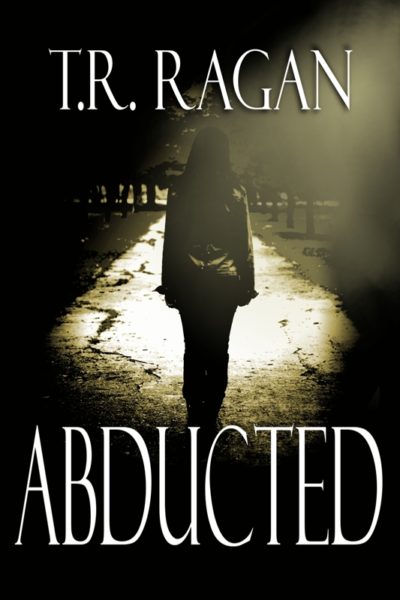 A largely uninteresting and occasionally tedious read, this begins when the 17-year-old Lizzy Gardner is abducted by a serial killer known as “Spiderman”, for his habit of using insects to terrorize his victims. Lizzy manages to escape, but Spiderman isn’t captured, until almost a decade and a half later, when someone confesses to the crimes. By then, Lizzy has become a private eye, and also giving lectures to young girls, on how to avoid falling victim as she did. She’s not convinced the right person has been caught, and she’s right: the real Spiderman is by no means happy that someone else has taken “credit” for his crimes. So he starts up again, with the eventual aim of recapturing Lizzy, the one who got away…
 Although I didn’t set out to, in roughly the past year, I’ve read no less than three novels, and one short e-story, that feature female cops as protagonists: this one, “The Academy” (the short e-story that’s the teaser for Robert Dugoni’s Tracy Crosswhite series), Tami Hoag’s A Thin Dark Line, and Justin W. M. Roberts’ The Policewoman. It occurred to me that an instructive way to open this review might be to compare and contrast the four works.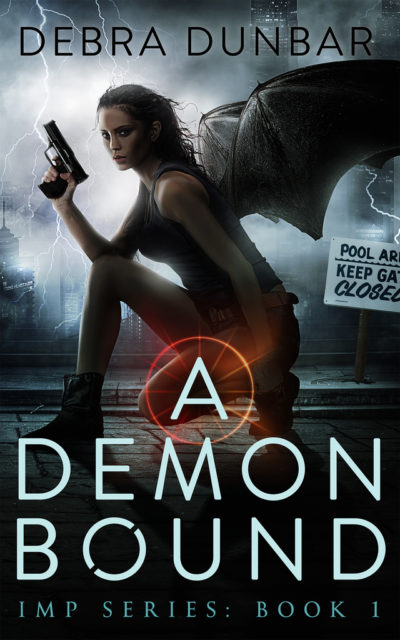
 While the cover image is certainly striking, I should mention that it is inaccurate in one significant point. At no point do I recall the heroine ever wielding a gun. While such false advertising would normally be a sore point, in this particular case, we’ll give them a pass – since the reason she doesn’t, is because she is simply too bad-ass to need one. For
 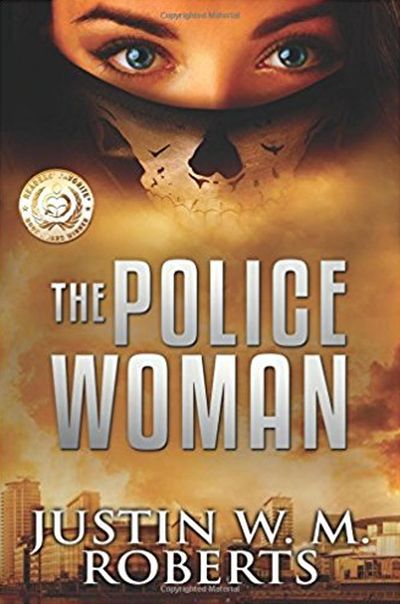 He also appears to have a background in police and/or military counter-terrorist services. His knowledge of S.W.A.T. (special weapons and tactics) terms and procedures, firearms specs, and both British and Indonesian police and military organization and organizational culture and traditions is extensive, to put it mildly, and he puts this to use in spades throughout the book. It’s noted at the beginning of the book that almost all of these tactics are “intentionally disguised” to protect police and military officers (so that baddies can’t use the book as a text to learn what to expect!), but it still has a very realistic feel. We’re in the hands of a writer who knows his stuff here; readers who need and want technical accuracy won’t be disappointed. For other readers like me, who don’t know one brand of firearm from another and have little technical knowledge of covert operations, much of this information will go over our heads, but it will still give a feeling of verisimilitude, and maybe impart some knowledge that will stick! (Seven and a half pages of glossaries of organizational “alphabet soup” and British, Indonesian and Irish military/police slang and terms and Gaelic –here spelled “Gaeilge”– phrases are provided; and if you’re anything like me, you’ll refer to them frequently.)
 Let’s start with a grumble. Perhaps I’ve been spoiled by the number of full books – or even collections of multiple books – I’ve picked up for $2.99 or less. Maybe that’s why I can’t help feeling gypped when a book lasts only about an hour. The official page count on Amazon says 182 pages. But this figure doesn’t take into account that a significant chunk is actually the first few chapters of Kill Order, the first “full” novel about British government agent, Maggie Black – available separately for another $4.99! If I’d realized this was only 133 pages of actual story, I’d probably not have fast-tracked this. I was then further disgruntled to discover that the “
 The blurb for this one reads, “Terra Cross is just your typical paranormal princess. She plays poker with goblins and leprechauns. She savors her morning muffin from the Pacific Sunrise Bakery in suburban California. She solves galactic crime cases. And on a particularly wild day, she can even see into the future.” It is somewhat inaccurate, at least as far as this novel goes. I don’t recall any poker at all, muffins appear once, and as for the crime-solving… Well, sorta but not really. There is, however, likely good reason, since the novel is a prequel to Summers’s “Sorcery and Science” series, in which I presume Terra does more of the above.
 I guess there is at least something logical about this, in how its heroine, Maggie Lee, becomes the assassin of the title. She takes on her first contract to pay the medical bills of her niece, left in a coma after a car accident which killed her parents and injured Maggie. That’s the kind of motivation which I can see, causing a person to take desperate steps. Unfortunately, it’s a rare island in a sea of largely implausible plotting and uninteresting characters.
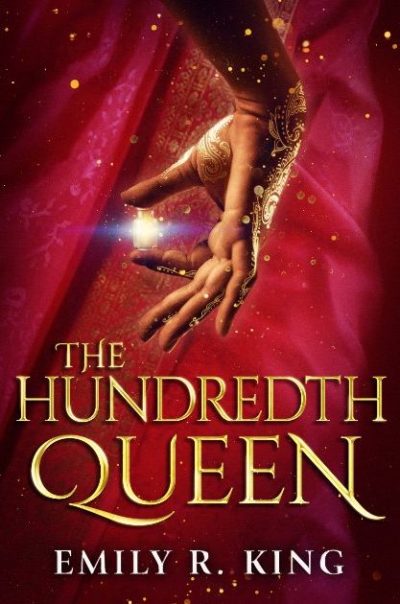 An interesting premise gets wasted, buried under a muddied writing style which sets up in one direction, then abandons it for another. Orphan Kalinda has been brought up by The Sisterhood in their remote temple in the mountains (kinda Indian, kinda Sumerian, annoyingly non-specific), training in the ways of a warrior – though others have far more talent in the era. Her life is upended when the local monarch, Tarek, visits the temple and selects Kalinda to be his next wife. Next, as in he already has 99, not to mention his additional courtesans. The problem for Kalinda is, this sets up a tournament in which she can be challenged by the other women, who seek to supplant her.
 Manchester Detective Sergeant Jan Pearce is part of an investigation into local crime lord, Connelly, whose family has managed to evade the reach of the law for decades. Indeed, this is the second recent investigation, the previous effort having collapsed, apparently due to procedural blunders. But the boss isn’t taking it lying down, beginning a campaign of intimidation against those investigating him. This hits DS Pearce, with the disappearance of her teenage son, Aiden: she’s convinced this is retribution from Connelly. But neither her colleagues on the force, nor her ex-husband, Sal, agree – they think Aiden simply ran off.