★★★
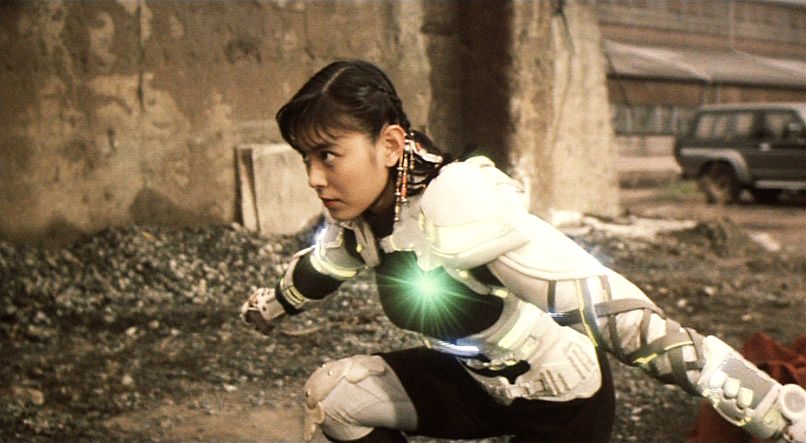
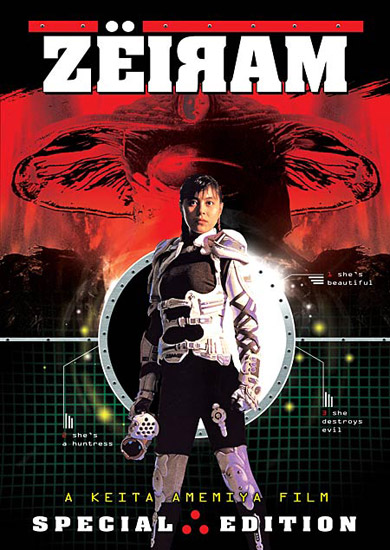 Zeiram and its sequel, Zeiram 2, both concern a creature which combines all the most unpleasant and lethal features of The Thing with The Terminator. It’s humanoid, at least in the number of functioning limbs, but its head appears almost mushroom shaped – though it’s hard to tell where Zeiram ends and its hat begins, for there’s a second face, embedded in the hat. This is capable of extending on a tentacle, to attack victims, taking in nourishment, and there’s evidence to suggest that it can absorb their DNA and use it to create monsters. Oh, and the rest of it is almost impossible to destroy.
However, trying to do exactly that is Iria (Moriyama), an interstellar bounty hunter, who has laid a trap to take Zeiram into an alternate, uninhabited dimension, in order to deal with him in a way that will pose no threat to the local population. However, she reckons without the arrival of electrical techs Kamiya (Hotaru) and Teppei (Ida), who have been dispatched by the power company to investigate the power-drain resulting from Iria’s tech. Through an unfortunate series of events, they end up in the alternate dimension with Zeiram, while Iria is largely stuck in our world, trying to keep them alive until she can fix her portal and get in there to help them.
The problems here are largely two-fold. Kamiya. And Teppei, There are few things less appealing than comic relief characters whose antics and mugging are supposed to be endearing or amusing, but fail miserably on both fronts. They bring very little to proceedings except for running time, and that’s a shame, because there is no shortage of bizarre inventiveness on view. And when the pair stop trying to be characters, shut the hell up, and simply team up with Iria to kick alien arse, it’s a lot better, because whatever they do to Zeiram, he/she/it just keeps mutating into another form and fighting back. You get the sense being fed through a wood-chipper would only be a minor inconvenience.
This also helps cover up Moriyama’s somewhat limited set of fighting skills. Admittedly, it’s possible she had to slow things down in order to fight a giant mushroom, but the hand-to-hand combat here is choreographed at about the speed of a Strauss waltz. She does have screen presence, however, and looks decent enough firing a gun. To a casual eye – that’d be my wife’s, wandering through the living-room – this could look like an episode of Amemiya’s Power Rangers, and it’s not surprising he would go on to direct some Kamen Rider films. But it’s too uneven to succeed: for every moment where you go, “Cool!”, there’s another where you’ll roll your eyes, or just go “Eh?”. For instance, the section where Zeiram squeeze out goo onto the ground, which grows into a half-man that has a burbling conversation with Zeiram, before getting its head stomped on. Altogether, now: eh?
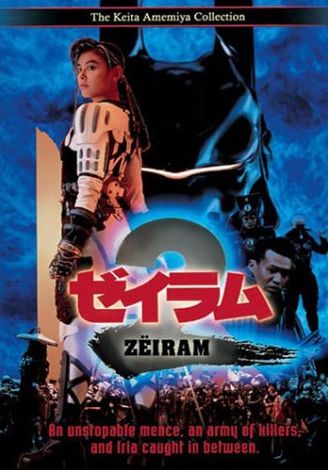 The sequel, which came out three years later, restores the “i” in the title, which was inexplicably removed from the original for it US release by Fox Lorber. This installment starts off as if it’s going to go in some radically different directions, even if all the main players are back. Iria is seeking an ancient artifact called the Carmarite, and additionally, has a new assistant, but he turns out to be untrustworthy. Meanwhile, a shadowy group has succeeded in regenerating Zeiram as a cyborg warrior (which makes a lot more sense if you’ve seen the anime, and know its origins), bending its will to their needs and turning it into a weapon. While initially successfully, this works about as well as most plans usually do, and it’s not longer before Zeiram is much more a menace than an ally.
However, just when you think the film is going into new and interesting territory… Well, I’m not quite show how it happened, but before long we were back in more or less the same situation as the original. Blah blah irritating comic relief blah another dimension blak Iria unable to help (this time because she gets herself locked in a room), etc. You’re looking at something which borders on being a remake of the original, and unlike something like Terminator 2, which upped the ante significantly, while telling a largely similar story, there isn’t any real sense of progression or development. Much as before, things do get better when things move into action, and Zeiram is again, a shape-shifting nightmare that won’t stay dead. And this time, not even a cute dog which strays into proceedings is off the menu.
It also helps that, this time around, Moriyama has a better handle on the action angle. Previously, it was very much a case of kick, pause, punch, pause, move, but she is a good deal more fluid here, and makes for a more credible heroine as a result. However, her strength is still more in the “looking cool with a gun” department, because her punches still look like they might be troubled by a damp paper-bag. On balance, the sequel’s lack of invention is approximately balanced by the overall improvement in Iria’s character and the slightly better overall production values – it still looks like you could fund it from your bedside table change – and it’s as worth watching as the first part. Which would be “somewhat”: call both of them a rent (or more likely these days, a download), rather than a buy.
Dir: Keita Amemiya
Star: Yûko Moriyama, Mizuho Yoshida, Kunihiro Ida, Yukijirô Hotaru



 Nami (Kaji) is about to get married, but her wedding day is rudely interrupted by the arrival of the cops, who arrest her. On the way to prison (and, unsurprisingly, death row, given the body count left behind in the previous three movies), she takes out the driver, causing a crash. The injured Scorpion staggers away, and is rescued by Kudo (Tamura), a former political radical who was brutalized by the police for his actions, and so has a massive load of resentment against them. After being informed of Kudo’s harbouring of Nami by a worked at the sex-club where he works, the cops take him in: and use both physical and psychological torture to try and make him give up her location. Eventually arrested, Nami is sentenced to death, but the cops intend to make sure the time leading up to her execution is as unpleasant and possible, and the detective in charge, Hirose (Tsukata), is intent on making even Nami’s death as lonely an experience as possible.
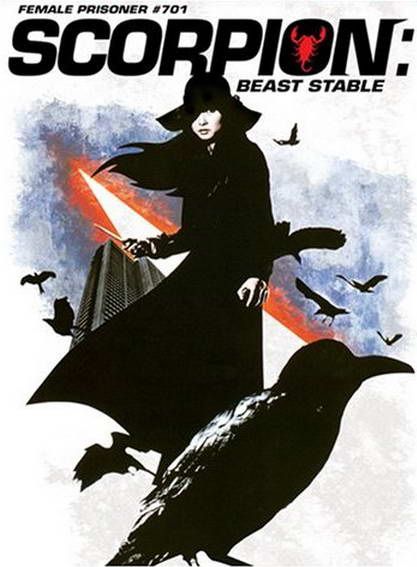 When this begins, Nami (Kaji) is on the run, and slices the arm off Detective Kondo (Narita) after he handcuffs himself to her. She befriends street hooker Yuki (Watanabe), who runs foul of the locak Yakuza gang by turning tricks on their turn, while trying to care for her brain-damaged brother, whom she also services sexually, to stop him from raping women(!). After Nami is involved in the death of a gang member who was blackmailing her, the gang’s madam Katsu (Lee), who knew the Scorpion from her own prison days, captures her, locking our heroine up in a literal big bird-cage. But after the true horror of the Yakuza’s treatment of their women is revealed (it starts with a golf-club going where no golf-club should ever go), Nami escapes and carves a bloody path of revenge on those responsible. When Katsu realizes what’s going on, she turns herself in to the police, figuring jail will be safe from Sasori’s wrath. Take a wild stab in the dark… Which, by coincidence is exactly what Katsu deserves.
 Right from the start, Nami (Kaji) established her utterly hardcore credentials, as she’s trying to dig her way out of the dungeon where she has been for the past year. With a spoon. Held in her teeth. She’s let out for the day because a bigwig is visiting, but takes the opportunity to attack warden Goda (Watanabe), almost depriving him of the sight of his other eye. As punishment for the resulting riot, Goda sends four guards to gang-rape Nami, and all the inmates are sent to a hard-labour camp. On the way back, they beat Nami as punishment, leaving her near-dead but it turns out that was just her ruse to get the guards to open the back of the van and escape. She leads the women across a blasted landscape, revenge once more on her mind, with Goda’s men in hot pursuit.
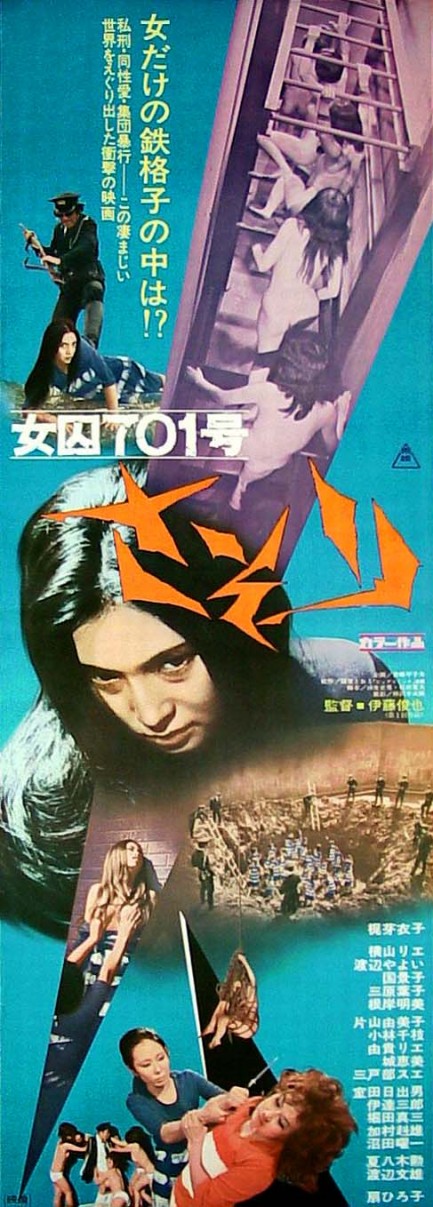
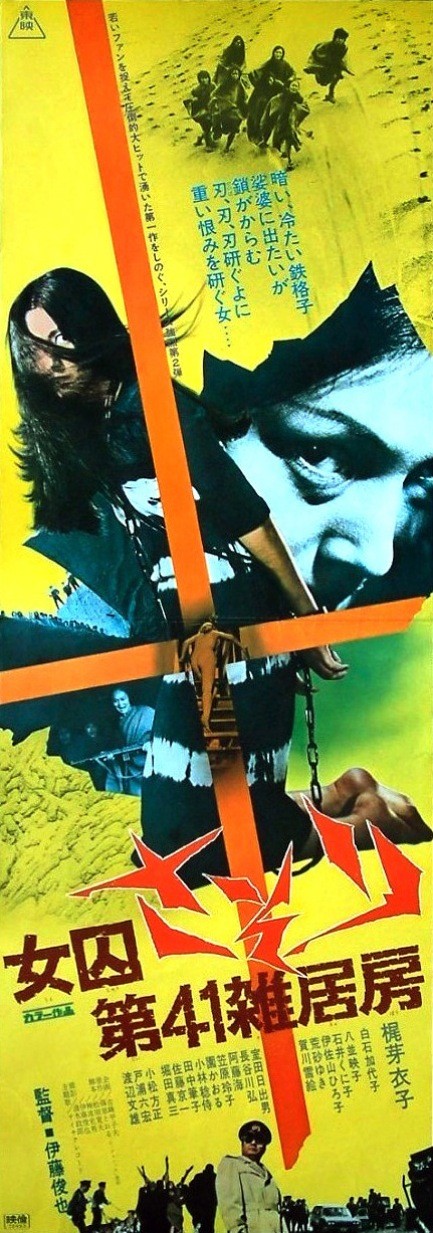
 This archetypal “women in prison” film is lifted above its colleagues in the genre, most of which are little more than crude exploitation, by being pretty damn sophisticated exploitation. The two main factors are Ito’s great sense of visual style, and Kaji’s almost-silent performance as Nami Matsushima. She ends up in jail after being betrayed by her cop boyfriend Sugimi (Isao), who turns out to be in league with the Yakuza he was investigating. Nami vows to escape, and the film starts with her doing so, but she is quickly recaptured, thrown back into jail, and her fellow inmates are punished for her actions, causing them to turn against her. While not her fault, she’s involved in an incident which costs the warden (Watanabe) his eye, and he vows to break her at any cost. That’s an awful lot easier said then done, and what happens as a result might be what Nami wanted all along. Meanwhile, Sugimi, seeking to tie up the loose end she represents, promises another inmate, Katagiri (Yokoyama) parole, if she takes care of Nami.
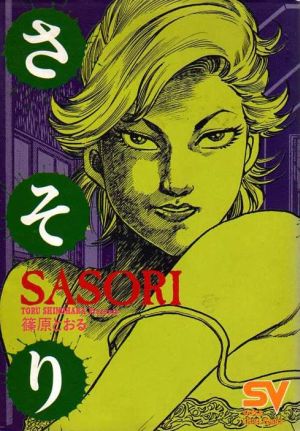 In the first half of the 1970’s, Meiko Kaji was to the slightly-disreputable end of Japanese cinema, much what Pam Grier was to the same end of Hollywood movies. Both made a career out of playing strong female characters, often operating on or beyond the boundaries of the law, and with no compunction about using violence to achieve their ends – which often involved taking revenge on those (almost alwayx men) who had wronged them. The Sasori [Japanese for “scorpion”] was not Kaji’s first foray into the genre, having cut her teeth on the Noraneko Rokku [Straycat or Alleycat Rock] films, a couple of years previously.
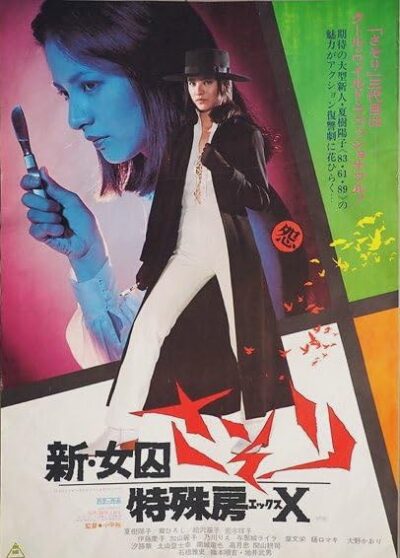
 Just goes to show that the “cinematic reboot” is not a 21st-century invention, e.g. Batman or James Bond. For a mere three years after Meiko Kaji showed her sting as Nami, the studio reset the series, giving it a new director, new (and much more talkative) lead actress, and returning Nami Matsushima to a happy, criminal record-free young women, with a loving boyfriend. Except, of course, he turns out not to love her quite as much. Things start to collapse after her sister uncovers evidence of major government corruption, and passes it to Nami, shortly before being kidnapped. After Nami uncovers the truth – her sister is killed and she is framed for the murder, with the help of her boyfriend, and sentenced to 15 years in prison. Initially an easy mark for the tough girls in her cell, Nami soon develops her mean streak. And she’s going to need it, because the politician behind it all is looking to tidy up the loose end she represents, by killing her and making the death look like a suicide. Name turns the tables, in incendiary fashion, and it’s clear that she’s one loose end that won’t be quietly disposed of.
 The comparisons of Takigawa to Lazenby above proved appropriate in another way, both being canned after one entry playing the iconic title character, which is probably just as symptomatic of something. The replacement here as Nami Matsushima is Natsuki, who seems to go back toward a more taciturn heroine, closer to the original. But it’s, effectively, another reboot, with not even a nod to the previous entry. In this case, the heroine is a nurse, framed for her involvement in the hospital murder of a politician who was threatening to expose corrupt practices.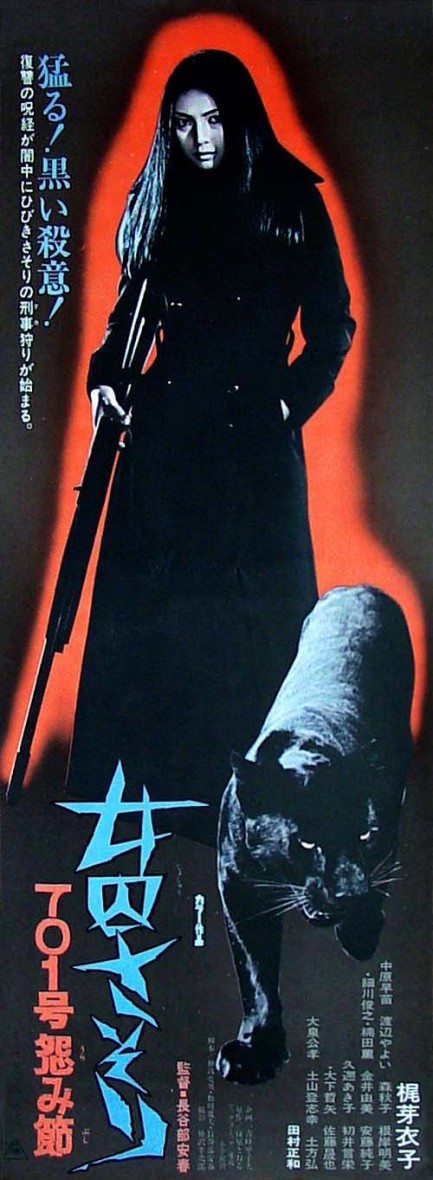

 “Z is for Zeiram”
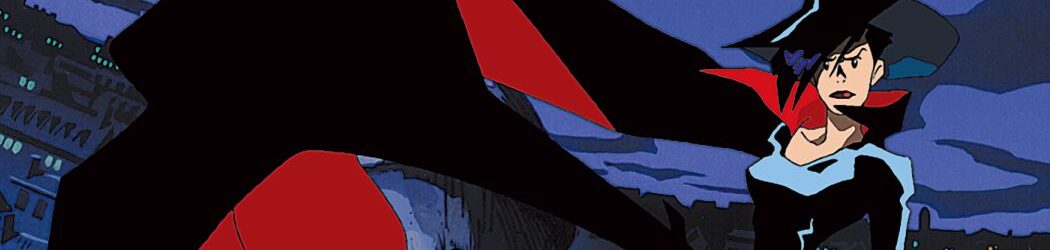
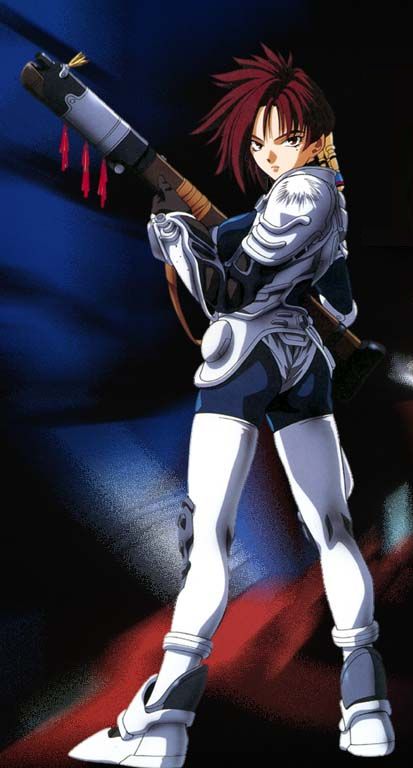 Though released several years later, this is a prequel to the two Zeiram movies, telling the story of the first encounter between Iria (Hisakawa, who was also Sailor Mercury) and Zeiram. At the time, she was an apprentice bounty-hunter, working alongside her brother Gren. They take a mission to rescue a VIP and recover the cargo from a stranded space-ship. However, once there, they discover the “cargo” is actually the alien Zeiram, which a corporation is interested in using as a weapon. The result leaves her brother apparently dead, and Iria now the target for the corporation, who want to hush up their thoroughly-dubious plan, by any means necessary. Fortunately, as well as her own skills, our heroine has the assistance of former rival bounty-hunter, Fujikuro (Chiva), endearing urchin Kei (Kanai), and Bob (Ikeda), a colleague whose consciousness has been turned into an AI.
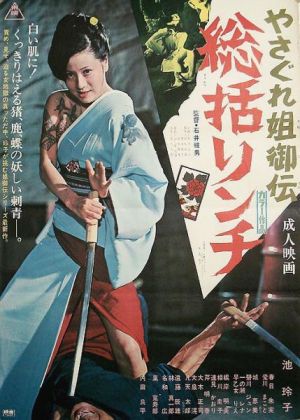 This starts with a memorable sequence in which Inoshika Ocho (Ike) fights off a number of attackers, armed only with her umbrella; albeit, an umbrella that is rather more heavily-armed than most. While she succeeds, she ends up losing all of her clothes in the process, leading to some artful staging in which the discarded umbrella is used to hide her naughties bits. Unfortunately, the rest of the film, while occasionally reaching the same levels of unsanity is largely crude and unpleasant. Even the central concept – a gang smuggling drugs in the vaginas of junkies – falls firmly into that category.
 Rika (Kudo) and her schoolgirl pal ditch education for a day and head off to a remote village to check up on her grandfather, who hasn’t been heard from for a while. But as soon as they arrive, the pair come under attack by zombies, initially spawned as the result of a euthanasia drug being tried out by the Japanese government to address the whole “inverse pyramid” thing. They do reach Grandpa’s house, but find him in the stages of advanced Alzheimer’s – at least, until Rika is bitten. Gramps removes the limb, and replaces it with one conveniently lying around, which happens to belong to a master zombie hunter. Who cares if it’s the wrong colour and incredibly muscular? With America preparing a Return of the Living Dead style cleansing operation on the area, Rika and her allies have to locate the King Zombie and kill him, before being reduced to their constituent atoms.
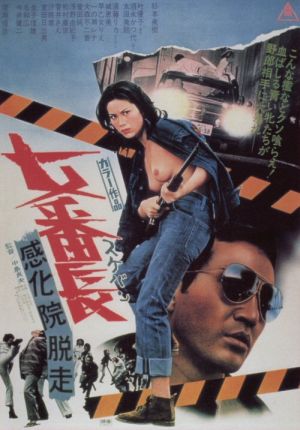 Serial escaper Ruriko (Sugimoto) is more persistent than good, and is dragged back to reform school after her seventh escape attempt ends the same way as her previous six. After whizzing through most of the standards of the women-in-prison genre in about 30 minutes or so e.g. corrupt staff, gratuitous nudity, solitary confinement, etc. she and a few of her colleagues (supposedly teenagers, but that clearly ain’t the case) break out as a group. Splitting up to avoid detection, they arrange a rendezvous at a deserted building by the sea, from where they plan to hijack a ship and escape Japan for good. Truth be told, a sense of urgency isn’t exactly top of the their skill-set, and as they meander their way there, various escapades happen, of which the only significant one is Ruriko meeting, by chance, a male criminal (Watase), who is also trying to out-run the law. But the police are also keen to ensure that they run their record in terms of Ruriko to a perfect 8-for-8…