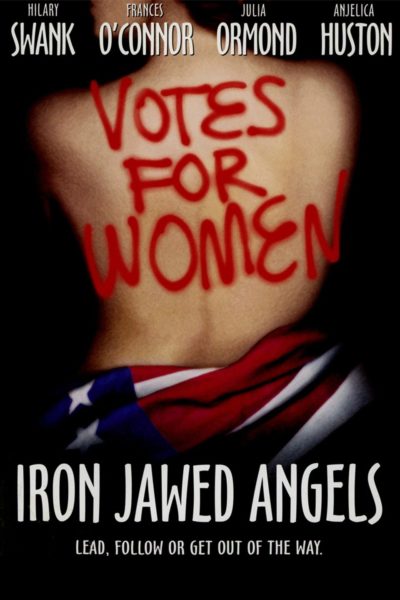

Iron Jawed Angels

★★
“Largely unable to get out the vote.”

There’s a fascinating story to be told about the struggle by American women to get the vote. Unfortunately, this isn’t it. Rather than being content to tell the story of the battle and those who fought in it, von Garnier (a German director who gave us Bandits)  seems to want to force these women from the 1910’s into modern feminist configurations. This position is set out particularly clearly in a deliberately anachronistic soundtrack, which at times makes the story feel more like Hamilton. And to be clear, that’s not a good thing. The focus is campaigner Alice Paul (Swank), beginning in 1912 when she returns from England, her passions set on fire by the work there of Emmeline Pankhurst, as documented in the rather better Suffragette.

Alice initially seeks to work with the leading American group, the National American Woman’s Suffrage Association, led by Carrie Chapman Catt (Huston), only to find their methods not radical enough for her tastes. This eventually causes her to form her own group, and begin protesting against President Woodrow Wilson, including a daily picket of the White House. Matters come to a head after the United States enters World War I, with such protests being seen as unpatriotic. This leads to Paul and other women being arrested on dubious charges, and after beginning a hunger strike in protest, the women are force-fed. Eventually, Wilson is convinced to support their cause, with the 19th Amendment, giving women the right to vote, being passed in 1920.

My main problem is that Paul never feels an authentic character. She comes over more like a 21st century woman transplanted to the time, which as result, makes her story feel almost like a bad episode from the current incarnation of Doctor Who. It chooses to manipulate history purely for dramatic purposes, such as shoehorning in a romantic relationship with a newspaper cartoonist. Yet for all the obviously liberal credentials inherent in the story, according to the film, only one black woman supported the suffrage movement – and just for a minute or two, before exiting the film. Awkward, that.

Despite the above, and the film in general being a stylistic mess, you’d have to try particularly hard to screw up the underlying story, which is generally an empowering and rousing one. You’d have to be a colder heart than I, not to feel aggrieved by the treatment Paul and the other women suffer in pursuit of their cause, and the film does manage to do these elements justice, simply by reining back in the attempts to jazz things up. I was amused (and slightly pleased) by the disdain of NAWSA towards their bomb-flinging sisters across the Atlantic, who were rather keener on direct action. Though the main moment which amazed me was the scene where President Wilson walked out of the front gate of the White House, tipping his hat to the protestors as he passed them. Truly a different era.

Dir: Katja von Garnier
Star: Hilary Swank, Frances O’Connor, Julia Ormond, Anjelica Huston

Injun

★½
“I Spit on Your Movie.”

I never thought I’d find a film which would leave me yearning for the subtle and understated pleasures of the original I Spit on Your Grave, but here we are. 35 years on, and this cringeworthy copy was made, transplanting events to the old West. A further decade later: with a couple of re-titlings which jostle each other for inappropriateness, it’s out on a number of free movie streaming platforms. I’m here to tell you, not to bother. Even in the low-rent neighbourhood which is rape-revenge movies, you could close your eyes, pick a random entry, and be almost guaranteed to find something with a better script and general execution.
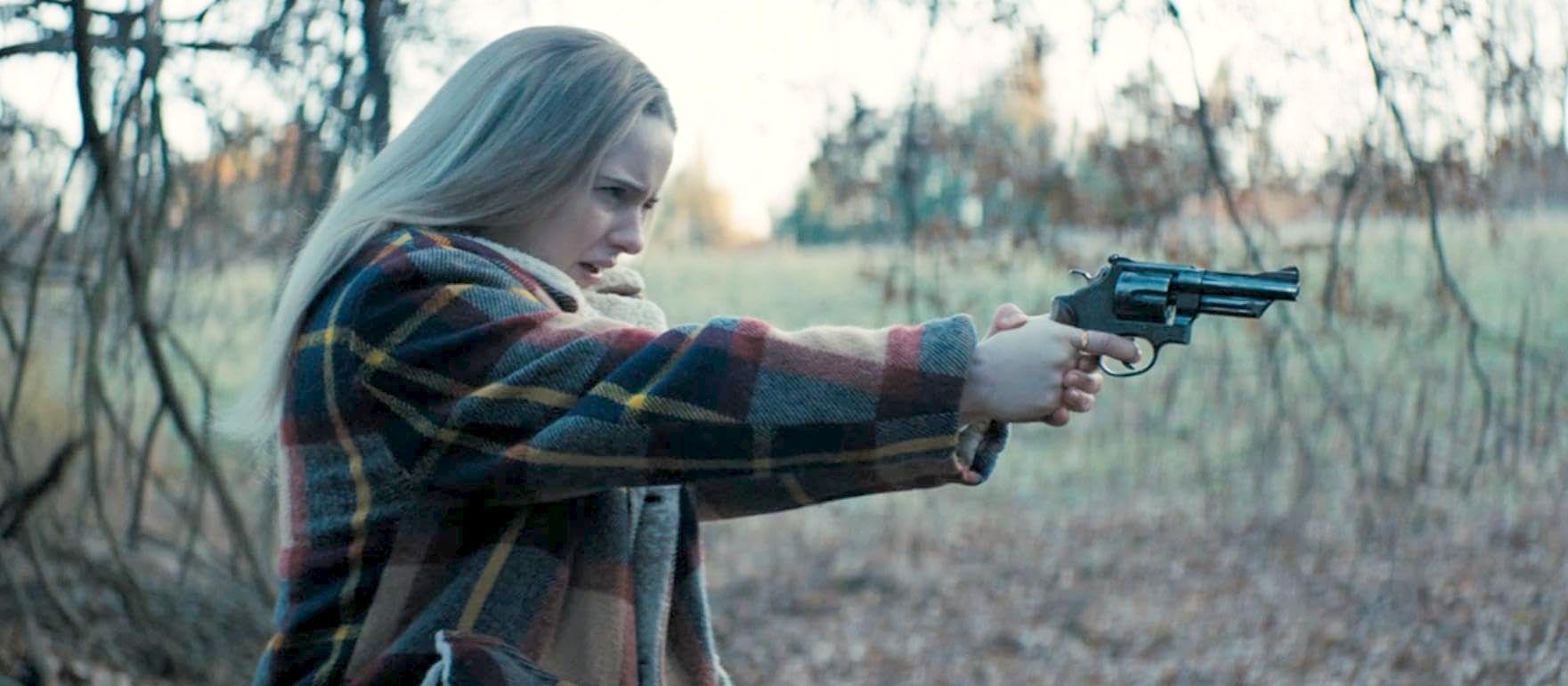
It begins on a bizarrely integrated farm, I’m guessing at some point after the end of the Civil War. Comanche adopted white girl Ana (Sawyer) lives there with her native American husband and their son, plus a Hispanic woman, a black guy and a geezer in glasses. Their names are not important. For onto the ranch ride six escaped convicts, led by former Confederate officer Jeb (Herrick). After some ominous banter with geezer in glasses, they kill everyone – told you their names weren’t important – except for Ana who is merely gang-raped, staked out and left for dead. Fortunately for her, she’s rescued by a conveniently passing man called Barfly (Neff). Nursed back to health over what must be a period of several hours, she sets out for revenge against the six escapees, who inexplicably decided to hang around the ranch.

You know me: I’m not exactly one to complain about questionable stereotypes. But even I had to wince on a number of occasions. It might have been Jeb’s Mexican sidekick, Chico (Venture), who sports an F-sized sombrero and droopy mustache. It might have been Ana’s squaw cosplay and whooping war-dance. It might have been the original title, with its even more dubious poster and tagline: “Payback’s an Indian bitch!” I’m all in favour of political incorrectness in order to make a point, or even simply to trigger certain folk. I get the feeling though, that everything here was done out of sheer ignorance. As such, this is no fun at all.

If you’re going to knock off I Spit on Your Grave so blatantly (down to there being a mentally-challenged member among the rapists), then you really need to put more effort into it. The rape here is a scoop of vanilla ice-cream compared to the intensity of the original. The revenge has almost no impact either, with third-rate special effects: the “scalping” is particularly unimpressive. Oh, hey: rather than cutting someone’s genitals off, she sets fire to them. That’s what passes for imagination and innovation here. The performances just about pass muster: indeed, there’s likely too much of them, especially with the gang sitting around the farmhouse and jawing, as their numbers steadily shrink. Your interest and attention will likely suffer a similar fate.

Dir: Bob Cook
Star: Amanda Elizabeth Sawyer, Robert Herrick, Tony Venture, Greg Neff
a.k.a. Scalped! or I Spit on Your Tombstone

I’m Your Woman

★★★★
“Taking action”

Hearing that James Gunn, new head of the DC movie department at Warners, just recently announced David Corenswet and Rachel Brosnahan as the new actors to play Superman and Lois Lane in the next “Superman”-movie, I felt the need to find out more about these new actors. For Brosnahan I chose the movie I’m Your Woman, an Amazon Prime production from 2020. For one thing, she played the main role, and secondly a two-hour movie is much quicker to watch than a series like The Marvellous Mrs. Maisel. Sure, for that series she got two Golden Globes, one Emmy and two Screen Actors Guild Awards – but my time is a bit limited. Also, I prefer gangster movies over a dramedy show.

I’m Your Woman takes place in the 1970s. Although a year is never specifically mentioned, the dresses, suits, hair styles and the ugly interior design speak for themselves. Jean (Brosnahan) plays the wife of gangster Eddie (Bill Heck). She knows that he’s a gangster but not what he exactly does. In material terms, while there is everything that she could wish for, she is obviously unfulfilled, as she would have liked to have a child – but it didn’t work out. A big change in her life happens when Eddie one day brings home a baby, declaring that it is now theirs. Jean is more than a little over-burdened with the new task, for taking care of anything or anyone, least of all a baby, is something she never had to do.

Very soon her life changes even more dramatically, when one night Eddie doesn’t come home. Instead, she is given a large amount of money and told to go with Cal (Kene), a friend of Eddie’s. She is not told what has happened, so her subsequent escape and isolation in a foreign house remains a mystery to her for quite some time.  As one can probably already guess from the above, the movie is not excessively an action movie with a whole lot of bang-bang. That said, it nevertheless earns its place in the “girls with guns” category, even if this element shows up quite late in the game. For most of the movie, the heroine (and by extensions we, the audience) are left in the dark concerning the why, what and how. Only slowly are we given that information, with light eventually being shed on the background of what happened and the fate of Eddie.

I think this makes it quite an unusual movie as – in contrast to many other movies – we are not immediately brought up to speed with an info-dump, so that we tie ourselves emotionally to Jean. As a result, the fear and tension she experiences are really palpable to us, too. We don’t know who Cal is and why he is helping her, or why people are after Jean. In my opinion, the movie is particularly successful in showing a female perspective, as part of something that would otherwise potentially have been just an ordinary gangster story. In the beginning, Jean does whatever she is told, while at the same time also trying her best to be a good mother to the little baby, even if her knowledge in this respect is also just rudimentary.
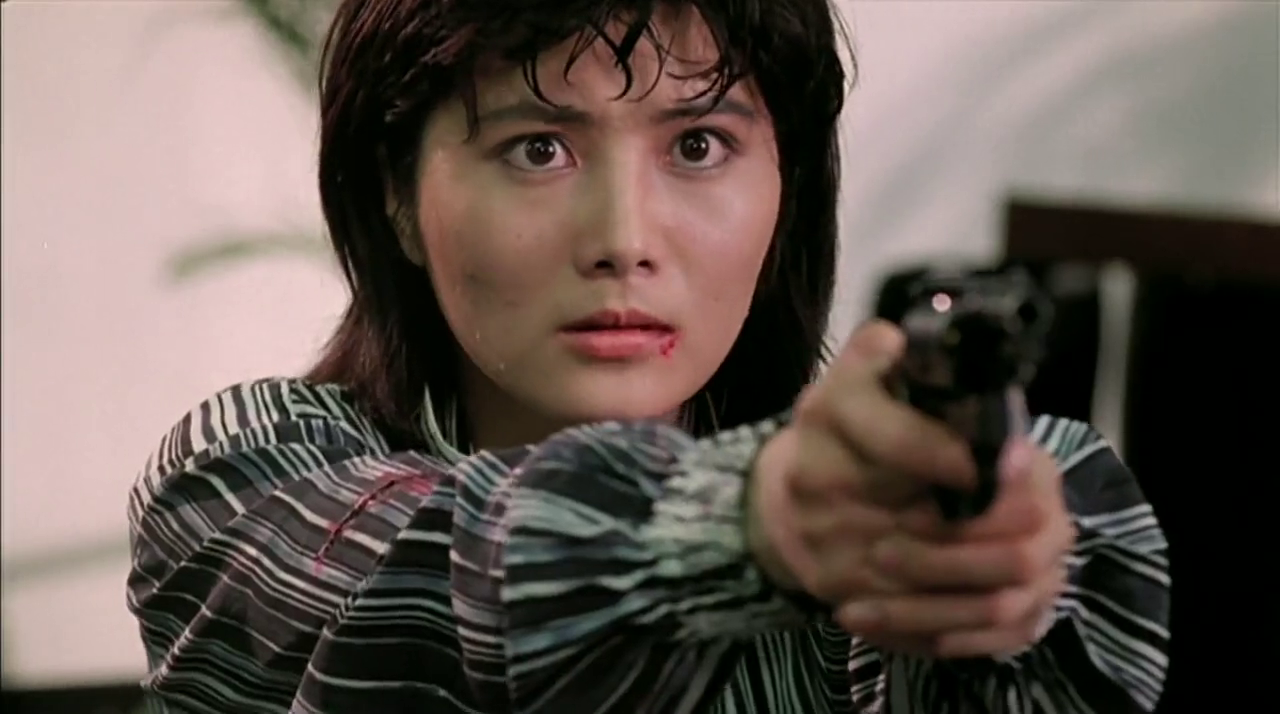
It’s only when she realizes that, unless she leaves behind the passive role that she has occupied for such a long time and becomes active, the hunt for her will never end. After that, she is able to change her life and save her new found friends, including Cal and his family. In that respect – and I know how this sounds – this movie can actually be called an emancipation drama. For once this is real, in contrast to the kind of what many modern movies understand under that expression. Also, the story can be seen as offering a historical comment on 1970s paranoia, and in particular how everything seemed to be chaotic at this time. Jean has to come to terms with the notion that those people who try their best to protect her, might have just as little a clue as she has.

I liked this movie, filmed in Pittsburgh, very much. The inherent tension can be felt for the entirety of the movie and it always feels and sounds like the 1970s. Wikipedia tells me the movie was only in theatres very briefly before Amazon Prime released it online. Rachel Brosnahan gives a first-class performance here though the whole production is top-notch. I regret that, too often, quality content like this flies under the radar, while we are distracted with yet another of these big dumb blockbusters Hollywood is constantly pouring over us. I feel Brosnahan is an actress of whom I would like to see more. That appears not to be problem, with plenty more of her work apparently available on Prime.

Dir: Julia Hart
Star: Rachel Brosnahan, Marsha Stephanie Blake, Arinzé Kene, Jameson Charles

In the Line of Duty IV

★★★★½
“A thinly connected series of action set-pieces…but what set-pieces!”

Back in the early nineties, I saw a double-bill of this and Jackie Chan’s Police Story at the late, lamented Scala Cinema in London, and it blew my mind. I had literally never seen anything like them before. The only martial arts movies I’d watched previously were crappy American ones, which made little or no impression. That afternoon changed my life, and awakened a love of the genre that persists to this day. But would In the Line of Duty 4 stand the test of time? There are certainly movies I loved from the same era, which are now a bit cringe, to put it mildly. So it was with some trepidation that I hit play…
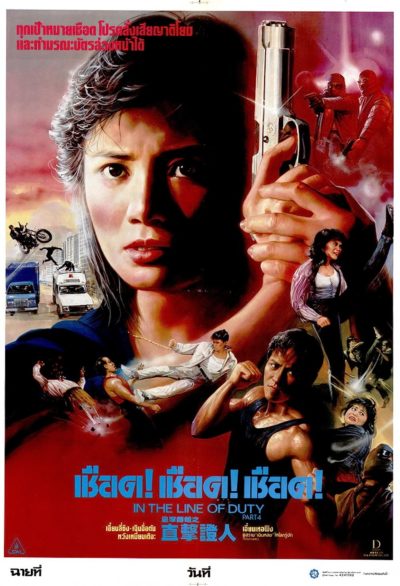
Nope, it’s still goddamn awesome. Sure, it’s a bit rough around the edges, and both the plot and performances are little more than means to an end. But the end justifies the means, 100%. I can’t remember the last time a film provoked so many exclamations from me. It felt like every other scene, there’d be another terrific feat of physical prowess, agility or simply endurance. It’s amazing to see Donnie Yen, then a young, skinny and rough-edged twentysomething, but clearly with raw talent in spades. It took almost thirty-five years for him to get the recognition he deserved, with his co-starring role in John Wick 4.

According to another review, 42 of the film’s 93 minutes are action. Reading this, my immediate reaction was, “That little?” Because it feels like it’s almost a non-stop procession of set-pieces, a highlight reel in feature form. It’s not just hand-to-hand combat either. There are some great vehicular stunts, such as a motorcycle chase, or a fabulous battle in, on and around an ambulance. It’s clear that we really have Cynthia Khan dangling off the front of the vehicle, in a way that looks genuinely dangerous, and quite probably was [the eighties in Hong Kong cinema wasn’t exactly a poster-child for health and safety!] I do wish they hadn’t undercranked some sequences; they’re impressive enough they don’t need to be sped-up.

For when all is said and done, the fights are flat-out awesome. It’s not just Khan and Yen, though they obviously get most to do. Everyone here is well up to the task, both showing off their own stuff and letting the stars look good by selling for them. On the female front, I want to give special praise to Farlie Ruth Kordica, who fights Cynthia around a lift-shaft in another sequence which feels disturbingly life-threatening. She only appeared in a couple of other films, which feels like a real shame, based on her performance here. It’s a wonderfully inventive scene (bottom), taking full advantage of the potential in the environment. 
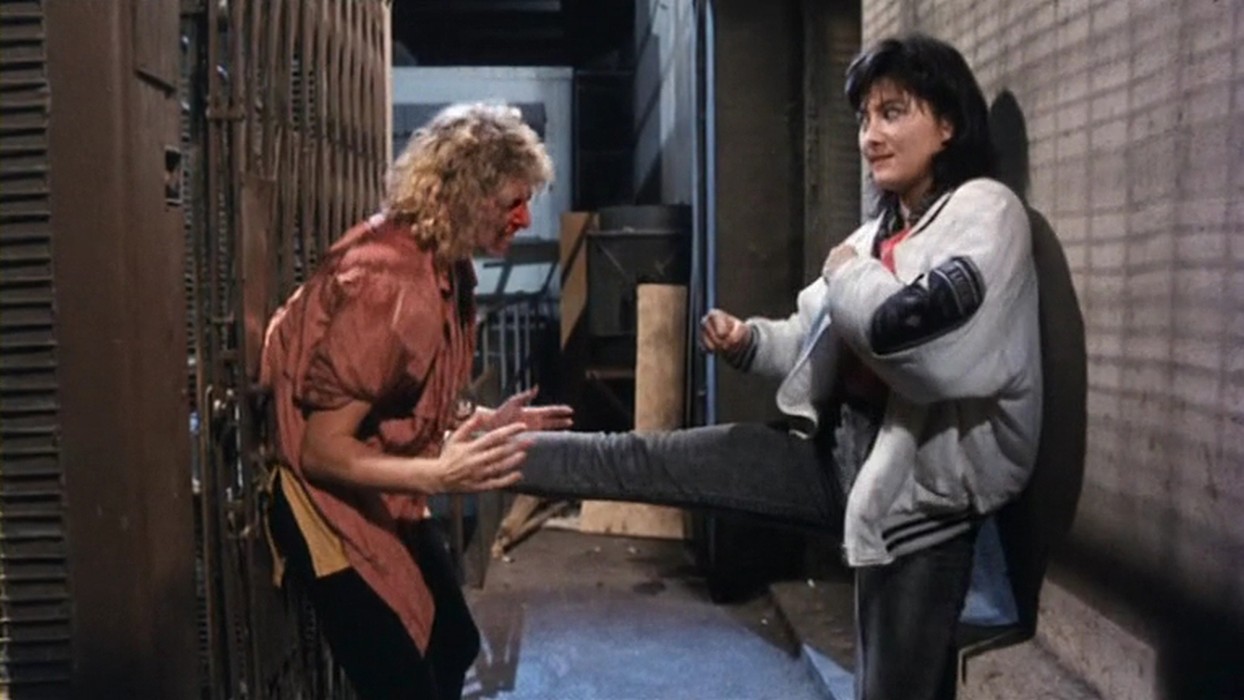
There is a case to be made that Yen is the star here, above Khan. The end caption doesn’t even mention her character, Insp. Yeung Lai-Ching, though Khan definitely is not outclassed. But Lai-Ching is the film’s emotional heart, always intent on doing the morally ‘right’ thing, even if it’s not in line with the law. She is the Jiminy Cricket, trying to keep Donnie’s loose cannon in check, while also trying to figure out who’s the mole in her department. The story, incidentally, has aged well: the CIA openly dealing drugs in order to fund Latin American rebels? That’s not something you would expect to see in an American film from that time, the whole Iran-Contra thing being seen as a bit of an embarrassment. Fittingly, it is Khan’s character who delivers the final blow to this Yankee scheme, falling to its doom and taking the American flag with it.

I will admit that the soundtrack is underwhelming: despite two credited composers, it feels like stock tracks pulled at random from the library. There are also times when the plot logic is less than logical, with bad guys and good guys popping up in convenient places for the next showdown, with little or no explanation. Yet this hardly dampens things, because: yep, means to an end. The eighties was an amazing decade for action cinema, from The Empire Strikes Back, through The TerminatorAliens and Die Hard. I can honestly say that In the Line of Duty 4 deserves to be ranked among those, and remains one of the best examples of Hong Kong cinema, doing what it does best.


[Original review] I don’t think I’ve ever seen a HK film with more action; it seems that every five minutes, along comes another breathtaking fight or stunt sequence. Of course, when you have a master at the helm (Yuen did the fights for The Matrix), you expect a little more, but this is fabulous, even by his standards.

Donnie Yen is perhaps the most under-rated martial artist of our generation, and watching him here, it’s hard to see why he hasn’t become a major star, rather than lurking in (effective) supporting roles in Blade 2 and Highlander: Endgame. For speed, agility and skill, his fights are almost without equal, and most female co-stars would be overshadowed. Fortunately, Cynthia Khan, though occasionally clearly doubled, does more than enough to keep on the same lap – the fight atop, alongside, and dangling from the front of, a speeding ambulance is eyepoppingly extreme, while her aerial battle around a lift shaft is also worthy of mention.

The story is clearly secondary to all this, but for the record, Khan and Yen are cops, one from Hong Kong, one from America, who team up to find a witness to a murder. Double-dealing and twists abound, though most are so obvious, you suspect they were just waiting for cast members to get out of hospital. :-) Interesting to see a foreign view of American cops – even Yen is a barely-controlled psychonaut. Khan is more sympathetic, but characterisation never goes beyond the most basic. However, this is an action movie, and as such, it’s near-perfect, with invention, energy and hardcore guts to spare from all concerned.

Dir: Yuen Wo-Ping
Star: Cynthia Khan, Donnie Yen, Michael Wong, Yuen Yat Choh

Infierno Grande

★★
“Moral: never try and take a pregnant woman’s gun.”

This begins, literally, with a bang. We first meet the heavily pregnant Maria (Docampo), carrying a rifle and preparing to leave her house. A man rises from the floor, and after a struggle for the gun, it goes off, and he drops back down. She hits the road in their pick-up truck, fearful of what she had done, and intending to head back to Naicó, the town where she was born. However, it’s not long before the people she meets on the road, seek to dissuade her from going there. It seems like everyone has a weird story about why her destination  is not a good idea, from mysterious lights that abduct you, to a cult of blond people with possible Nazi connections.
Meanwhile, in flashback, we also see that what happened was she had been escaping from her abusive husband, Lionel (Ajaka) whose treatment of her had become too much. Despite her fears, it turns out she had not killed him, just grazed his head with the bullet. He’s now coming after her, and is not happy about her leaving with their unborn child. It’s all a very slight story-line, and feels more like an Argentinian take on that quintessentially American genre, the road movie. In particular, it’s not so much about the destination, as the journey, the people you encounter along the way, and the way in which you interact with them.

For example, Maria and Lionel both meet the same man at different points. She ends up buying him a meal in a roadside restaurant, despite being strapped for cash, and in turn, he marks the location of Naicó on her map (its absence being another element of weirdness about the place). He, on the other hand, points a gun in his face and harshly interrogates him, as soon as he realizes that his victim had met Maria. It’s an obvious contrast – though like so much about the film, I’m not very sure what point Romero is attempting to make. Even at 75 minutes long, it all feels quite impenetrable, not least due to the lack of resolution. Oh, the Maria/Lionel situation is resolved. It’s just everything else that’s left open to your own interpretation.

The movie includes narration, apparently in hindsight, by her then unborn son, though again: I’m uncertain what is the point of lines like “This story somehow resembles a hunting.” Well, yes? There’s no doubt Maria is certainly attached to her weapon, even if most people she meets, stop seeing her as a threat after they recognize her condition. The film is at its (rather underwhelming) best when she is interacting with others. Her family seems well-known and her late father, who died with her mother in murky circumstances, was the former mayor of Naicó; the resulting dialogue has a relaxed and conversational approach that’s easy to listen to. But once the end credits rolled, I was left largely unsure about the purpose of the whole endeavour.

Dir: Alberto Romero
Star: Guadalupe Docampo, Alberto Ajaka, Héctor Bordoni. Mario Alarcón
a.k.a. Hell and Back

Infinite Storm

★★
“An uphill slog.”

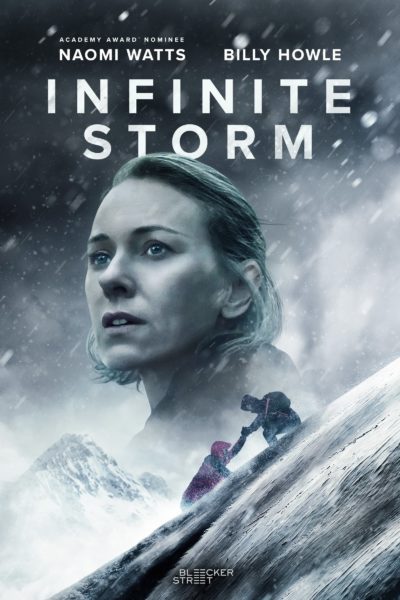
The “based on a true story” label covers a broad range of cinematic outcomes. However, a general rule of thumb is, the closer a movie stays to the facts, the less interesting the result will be. On that basis, I suspect this is a true and accurate deduction of the life of Pam Bales, and one particular incident therein. Because it’s largely lacking in excitement, and worse, seems to know it. Unless you have a fondness for watching someone trudge uphill for 30 minutes, then downhill for another sixty, I’d recommend giving this a pass. Despite some attractive scenery (Slovenia standing in for New Hampshire), there’s not enough to generate the necessary amount of drama or tension.
Pam (Watts) heads out on a solo hike of Mt. Washington. While she’s an experienced hiker, and a member of the local volunteer search and rescue team, she is still not prepared for the sudden change in weather conditions that descends, engulfing her in a blizzard. Managing to extricate herself from a crevasse into which she falls, she then stumbles across another hiker (Howle), ill-outfitted for the storm, just sitting in the middle of the trail. She has to try and negotiate a way down and off the mountain for both of them, a task made harder by her new charge’s odd aversion to being rescued. He won’t tell her his actual name, forcing her to call him John by default, and at one point deliberately plunges off a precipice.

There does turn out to be a reason for this suicidal behavior, which is fair enough. Less satisfactory, is the script’s decision to give us a back-story about Pam and her children. It feels as if they think simple heroism is not something a person – in particular a woman – can simply have; there has to be some more or less buried trauma in their past, to justify their bravery. I didn’t feel this added anything of real significance to her character – and worse, I didn’t care and, to be honest, found it kinda dull. It’s as if the makers didn’t have faith in the ability of their core story to hold the viewer’s attention. Sadly, I can’t argue with them on that point.

In particular, it doesn’t offer any particular progression. This is just Pam stumbling her way about, against the environment and the elements for an hour and a half. At the end, there’s a particularly “Eh?” moment, where a caption informs us that it only takes one person to change a life, not long after Pam has declared that the universe is an infinite storm of beauty. I’m not sure how the film got there from what it depicted over the previous ninety minutes. I always say that the vastly overrated 2001, is the only journey to the outer planets, which feels like it was filmed in real-time. Along the same lines, Infinite Storm is the only mountain climbing movie I’ve seem, which feels like it was filmed in real-time 

Dir: Malgorzata Szumowska
Star: Naomi Watts, Billy Howle, Denis O’Hare, Parker Sawyers

In the Forest

★★
“Once more: why we don’t camp.”

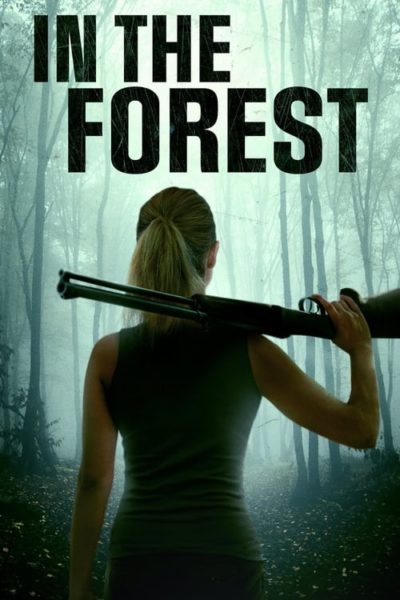
Three generations of a family take a trip into the woods in their mobile home. There’s grandfather Stan (Ward), his somewhat neurotic daughter Helen (Ayer), whose life has been falling apart around her, and Helen’s teenage daughter, Emily (Spruell), for whom a weekend in a forest with old people is just how she wants to spend her time. After finding a spot, they’re ordered off by a surly local with a shotgun. Except, mechanical and medical misadventures get them stuck. Helen heads off to find help, only to stumble across the home of the surly local, who is apparently involved in keeping teenage boy Andrew (Odette) locked up in a room. Andrew begs Helen for help, saying his sister is in the basement. Then his Mom shows up.

It’s not a terrible idea, pitting an urban family against a rural one, with the former being forced out of their comfort zone for the sake of raw survival. The problems here are all in the execution. Part of it is the split focus, with the film’s attention divided between the various plights of Helen and Emily. The former, in particular, seems to spend half the film chained to a crate, and the other half running frantically around the forest. The latter, meanwhile, is mostly in and around the motor-home, where she is paid visits by more or less threatening members of the local clan, and has to fend them off.

This could also have been fun had there been a little more ambivalence over who, exactly, are the psychos. That’s especially the case since Andrew definitely seems to have fallen not far from his tree, yet both mother and daughter seem remarkably willing to take everything he says at face value. Instead, there’s precious little subtlety here: for just about everyone, what you see in the first couple of moments defines their character the rest of the way. Some of the plotting could definitely have been improved, such as when the captive Helen breaks a pole out of closet and starts attacking the wall to the next room. While this does eventually lead to her escape, it seems more by chance than a plan.

Matters do improve somewhat when the family (or the surviving members, anyway) are re-united, and have to take on the matriarch, who is none too pleased at the chaos and dysfunction they have brought to her home. Things get distinctly down and dirty, the three women going at each other with weapons both conventional (gun), improvised (shovel) and downright unconventional (the stake from a garden fence). Yet, if this is when the movie is at its most fun and is also the level of no-holds barred insanity I was hoping it would deliver, it’s a climax which feels wildly out of character compared to what had gone before. This film spent time with the family as they baited hooks and went fishing. The jump to them shanking people, prison-style, is too far a gap to bridge.

Dir: Hector Barron
Star: Debbon Ayer, Cristina Spruell, Lyman Ward, Matthew Thomas Odette

Interceptor

★½
“Why Netflix is a joke.”

Two minutes in, Chris turned to me and said, “Is this an Asylum movie?” Oh, that she had been right, for the net results might have been more entertaining. This is truly the dumbest film I have seen in a very long time. It feels like a throwback in content to about thirty years ago, except with a script that makes your average Cannon product look like Citizen Kane. It’s set on a missile interceptor station in the middle of the Pacific, to which Captain J. J. Collins (Pataky) has just been assigned again. Barely has she dropped her bags off in her cabin, when word comes that their sister base in Alaska has gone dark, and terrorists have stolen 16 Russian ICBMs. Before you can say “shitty Die Hard knockoff”, trust-fund kid Alexander Kessel (Bracey) shows up, intent on removing America’s last line of defense. It’s up to J.J. and plucky SigInt guy Rahul Shah (Mehta) to prevent them – or the terrorists will have won, literally. 

Writer-director Reilly is, I believe, a popular author of thrillers. I say that, because there’s no evidence here he could write his way out of a paper-bag, with so many, painfully obvious plot-holes. The way the terrorists pointlessly go public with their theft. Kessel and his minions kill everyone on the platform except J.J. and Shahul, keeping them alive for no reason. The villain has codes which will sink the base, yet doesn’t use them until only 30 minutes are left. I could go on. It’s a parade of eye-rolling inanity, made worse by cringeworthy dialogue, such as the line shoehorned in to explain the lead actress’s heavy Spanish accent. The final nail is the irrelevant wokeness, from J.J’s sexual harassment past, through the redneck henchmen and her Muslim sidekick, to the female US President (who is completely useless, incidentally). If only Reilly had put as much thought into his script, as his virtue signalling. 

To be fair, I didn’t mind Pataky as a heroine, and the action is occasionally up to what I wanted. There’s a decent brawl with the female terrorist (played by stuntwoman Ingrid Kleinig), and a couple of imaginative deaths, including the novel use of a firearm. However, the rest of the performances are almost uniformly terrible, and the story had lost me entirely, well before the ridiculous finale. While Netflix Originals come in for a lot of criticism, I’ve enjoyed my fair share: The Old Guard was decent, and Extraction (starring Mr. Elsa Pataky, Chris Hemsworth, who cameos here) was as good as any action movie of 2020. Hell, I even enjoyed 6 Underground. So I’m no snob. This, however, was bad enough to have us reconsidering our subscription to the streaming service, once we polish off watching Stranger Things. With the price also increasing sharply, the reality is that you can find considerably better movies than this for free. Certainly, I’ve better things to do with my time and money. 

Dir: Matthew Reilly
Star: Elsa Pataky, Luke Bracey, Aaron Glenane, Mayen Mehta

Inn of the Gruesome Dolls

★★★
“Edgar Wallace meets Russ Meyer”

I’m usually not a too big fan of trash movies, because a lot of them are not so much trashy, as they are boring. Nevertheless, I’m always in for a good, entertaining bit of trash, as long as I don’t find it too excessive. There is no doubt that German movie history is full of it: just think of all those Schoolgirl- and Housewife-Report films of the 1970’s. Though most of these movies can be ignored, since very often, they are just no fun at all.

Not so this jewel, stumbled upon when going through the extensive selection of German Amazon Prime. Made during a time when German movie entertainment found itself at a crossroads, with “Papas Kino” (Dad’s cinema) still running in cinemas, but the new German cinema not having arrived yet, some strange movies found their way on the big screen. 1967 was a year when German Edgar Wallace movies (having been made in colour for about two years) were still finding audiences before the students’ revolts, yet movies in general outside the countrt, became kind of “wilder”. A little bit more erotic titillation found its way in, but the wave of German softcore comedies hadn’t started yet. This movie therefore falls in this very narrow time frame between “older” and “newer” German film styles, which makes it very difficult to define. Though, let me have a try!

The story: Bob (Schumann) and Betty (Persson) try to break into a jewelry store. Unfortunately, the robbery goes wrong, and when trying to escape, Bob kills a policeman with his car. He escapes, leaving the unconscious Betty to pay the price, and she is sent to prison. There, terrible conditions rule. Girls are mistreated in order to keep them in line. Some girls have turned – you’ll be shocked! – to lesbianism. And the female chief warden, with the remarkable name of Francis Nipple (!!), wants to force Betty to have sex with her. Betty instead takes her chance, killing Nipple and breaking out with 4 other girls.

They flee into the Scottish Highlands (though this was filmed in Trieste, Italy), where Bob now works as a waiter in an inn. Betty’s idea is to kidnap the psychologically deranged wife (Trooger) of rich factory owner Oland, blackmail him, get to the coast with the money, and head abroad for a happy life with Bob. Unfortunately, Bob has a taste for one of Betty’s pals. Meanwhile, the factory owner has an affair with his female assistant and is already figuring out how to get rid of his wife. You can probably imagine, things don’t go as planned and… well, go a bit haywire!

Inn is one of the weirdest and trashiest movies from Germany I’ve seen in some time. Part of the fun is, you see a movie that basically comes across as the mad love-child offspring of a typical black and white, Edgar Wallace “krimi“, and something close to Russ Meyer’s Faster, Pussycat! Kill! Kill! – what a crazy genre mix! The weirdest thing is: it is wholeheartedly entertaining, though you can never take it seriously for a single moment. It comes off as wanting to be cool but not really being able to. This is in contrast to Faster, Pussycat!, which is very cool and embraces its trashiness. This constantly tries, but cannot escape that it is, in the end, a German movie. When local film makers tried to “rebuild” successful foreign recipes such as spaghetti Westerns or the Hammer Horror movies, the results always left an impression of amateur dabbling.

The setting and style – production design, costumes, cars – reminded me strongly of the Edgar Wallace movies. At the same time, you see women appearing as erotically as they could without ever being nude. Add to that the typical wooden acting of an Edgar Wallace movie, and you have an involuntary comedy of the highest order. I was screaming my head off because I found it hilariously stupid, especially when some of the actors tried to be “very emotional” and over-acted, without being able to be convincing. Also, I had to laugh at Betty killing off nearly everyone who has the misfortune to be in her line of fire. She is very trigger-happy and has a tendency to shoot first and ask questions… never.

Moments where Betty or other girls seemed to question their acts occasionally made me wonder. Was this movie meant at some point to be a serious crime drama about how social circumstances ruin young women’s lives? But then another nonsensical scene shows up. For example, an innocent witness discovering the dead inn-keeper, running up the stairs, screaming for help (as in an Edgar Wallace movie), screaming more when she met another of the girls, then while shouting “Don’t kill me! I want to live!”, falling out of a window. As they say, “Hilarity ensues…”

You won’t find great German “stars” in this movie. Erik Schumann (Bob) mainly reached my attention by being the German voice of Hollywood star Louis Jourdan, and Margot Trooger was better known for roles in … Edgar Wallace movies, as well as Pippi Longstocking and other Astrid Lindgren series/movies. I don’t know any of the other actors in this German-Italian co-production. The director Rolf Olsen was a very busy Austrian director who seemed to have directed everything that came his way, although not often with well-known German stars.

No, this is to be taken as seriously as long-running German TV series Hinter Gittern (Behind Bars), about a women prison. Which means: not at all! I always thought this genre came into existence in America in the 70s, having seen movies such as Black Mama, White Mama. Jonathan Demme, who would later direct Silence of the Lambs, also contributed to it with Caged Heat. It obviously is older than I imagined, but then I’m no expert on this subgenre! [Jim adds: The women-in-prison film as we know it goes back to 1950 with Caged, starring Eleanor Parker and Agnes Moorehead. I think the earliest we’ve reviewed here was 1955’s Betrayed Women.]

It seems the movie may have originally been longer. The version available today has a running time of 85 minutes, but the original cut is said to have had a running time of 96 minutes. It seems that the German film censorship organization, FSK (Freiwillige Selbstkontrolle = Voluntary Self Control) must have cut the movie extensively at the time. The trailer indicates that a water torture scene in the prison, the attempt by the female prison warden to force herself on Betty and the death of the inn-keeper have been cut. There is also a short clip in the trailer, which seems to indicate some of the five girls meet a bloody end in the inn; again, this is not shown in the version I saw. Instead, that seems to indicate two of them got away, as they never appeared in the movie again.

It’s a strange movie, attempting to marry the old with the new. But while I wonder if director Rolf Olsen might have seen and been inspired by Meyer’s Pussycat, I’m quite sure that this movie was seen by and inspired some Edgar Wallace directors. For the role of the sadistic prison warden would appear again in – you guessed it! – a 1968 Edgar Wallace movie, Der Gorilla von Soho (US title: “Gorilla Gang”),taking care of girls in a prison! Finally, the German title of this 1967 movie is Das Rasthaus der grausamen Puppen. “Rasthaus” being the German word for what the translation program tells me in English is “roadhouse; highway restaurant (am.)”. So I’m not quite sure “inn” is the right word for “Rasthaus”. The title for the dubbed American version was The Devil’s Girls, by the way.

Dir: Rolf Olsen
Star: Essy Persson, Helga Anders, Erik Schumann, Margot Trooger
a.k.a. Das Rasthaus der grausamen Puppen

I am Lisa

★★★
“Another packet of Ginger Snaps”

Lisa (Vaganos) is a young woman who runs a second-hand bookstore, but has fallen into the bad books – hohoho! – of local bad girl Jessica Huckins (Anello) for some reason, who makes poor Lisa’s life a misery. There’s little Lisa can do, because Jessica’s mother (Halliburton) is the local sheriff and is fiercely protective of her daughter. The feud between Lisa and Jessica escalates, until it topples over into extremely violent unpleasantness. Sheriff Huckins orders Lisa’s near-dead body to be dumped in the nearby forest, as food for the local wolves. However, after only slight nibbling, she is rescued by a mysterious woman, and nursed back to health. Returning to town, she opts to lie low with best friend Sam (Seward), only for Lisa to notice she’s not the same person she used to be. For example, this former vegetarian now has a fondness for raw meat, and is considerably less passive, deciding to take the fight to Jessica, her pals and, eventually, to Sheriff Huckins.

I’ve seen werewoman movies before. Indeed, I’ve reviewed a few here before – most obviously Werewolf Woman, but also When Animals Dream, Blood Redd and The Big Bad. I’ve also seen plenty of revenge films, to the extent there is a dedicated tag for those on the site. But this is probably the first movie which is both. Such innovation is almost enough on its own to get through the running time, even if it’s inevitably going to be compared to the wonderful Ginger Snaps, and be found wanting. Bonus points here for skewing so thoroughly female, with the five lead characters all women, and it’s also clear there’s a lot more going on, of which Lisa is unaware. The opening scene proves this before we see the heroine, with the sheriff gunning down another werewolf and proclaiming “I guess we gotta find another.” Given this, it is a bit difficult to grasp why Jessica’s cronies are so surprised by subsequent events.

The script is rather undeveloped in some of the other directions it seeks to explore. For instance, it opens with two quotes, one pro-revenge, the other anti. Yet there’s never much sense that Lisa’s vengeance is other than justified, and it appears to have a relatively minor impact on her psyche. Well, compared to turning into a werewolf, anyway. It also took me a while to get into the head of the main character; Lisa as savage predator is considerably more interesting and engaging than Lisa as vegetarian bookshop owner. Obviously for budgetary reasons, the actual transformation is very restrained – not much more than claws and contact lenses. I guess it’s good enough to get the concept over, if you don’t look too closely. The restraint elsewhere is a bit disappointing, and harder to explain: I never got the sense Lisa was overtaken by, or surrendered to, her newly-found feral nature. However, it still makes for an interesting watch, even if the central character is more werepekinese than -wolf.

Dir: Patrick Rea
Star: Kristen Vaganos, Jennifer Seward, Manon Halliburton, Carmen Anello